
Quiz
EVOLUTION REVISION
Este quiz tem tipos de pergunta que abrem no player de sempre.
Perguntas do quiz (41)
1The ability of a population to [blank_start]expand[blank_end] is [blank_start]infinite[blank_end], but the ability of any [blank_start]environment[blank_end] to support its population is always [blank_start]finite[blank_end].
- Aexpand
- Benvironment
- Cinfinite
- Dfinite
2[blank_start]Organisms[blank_end] within populations vary, and this variation affects the ability of [blank_start]individuals[blank_end] to [blank_start]survive[blank_end] and [blank_start]reproduce.[blank_end]
- AOrganisms
- Bindividuals
- Csurvive
- Dreproduce
3The [blank_start]variations[blank_end] are transmitted from [blank_start]parents[blank_end] to offspring.
- Avariations
- Bparents
4What is the term that describes traits that are sensitive to environmental conditions during development, resulting in different phenotypes in different environments?
- ADevelopmental plasticity
- BAdaptive plasticity
- CAdaptive landscape
- DEvolutionary development
5Mitochondria are [blank_start]organelles[blank_end], responsible for the basic [blank_start]energy[blank_end] processing that goes on inside cells. They contain about [blank_start]0.05[blank_end]% of the DNA contained in chromosomes, which are called [blank_start]mtDNA[blank_end]. Unless the mitochondrial DNA [blank_start]mutates[blank_end], child has exactly the same mitochondrial genes as its [blank_start]mother[blank_end], because it does not recombine with DNA from the [blank_start]sperm cell[blank_end]. The accumulation of mutations allows us to derive the [blank_start]phylogenetic[blank_end] history of non-recombining sections of DNA, thus scientists can use [blank_start]mtDNA[blank_end] to reconstruct a tree of descent based on [blank_start]derived[blank_end] similarities. It is also possible to estimate the time that has passed since the last common [blank_start]ancestor[blank_end] of one or more [blank_start]species[blank_end].
- Aorganelles
- Benergy
- C0.05
- DmtDNA
- Emutates
- Fmother
- Gsperm cell
- Hphylogenetic
- ImtDNA
- Jderived
- Kancestor
- Lspecies
6Which process of evolution can lead to adaptation?
- AMutation
- BNatural selection
- CSexual selection
- DGenetic drift
- EGene flow
7What is the term used to describe a spontaneous change in the chemical structure of DNA?
- AMutation
- BNatural selection
- CSexual selection
- DDevelopmental plasticity
- EGenetic drift
8Sexual selection is a form of [blank_start]natural selection[blank_end] that results from differential [blank_start]mating[blank_end] success in one gender. In [blank_start]mammals[blank_end], sexual selection usually occurs in males and may be due to male-male [blank_start]competition[blank_end].
- Anatural selection
- Bmating
- Cmammals
- Dcompetition
9What is genetic drift?
- AA spontaneous change in the chemical structure of DNA.
- BThe process that produces adaptation.
- CA form of natural selection that results from differential mating success in one gender.
- DA random change in gene frequencies due to sampling variation that occurs in any finite population. It is more rapid in small populations.
- EThe movement of genes from one population to another, or from one part of a population to another, as the result of interbreeding.
10Gene flow is the [blank_start]movement[blank_end] of genes from one [blank_start]population[blank_end] to another, or from one part of a [blank_start]population[blank_end] to another, as the result of [blank_start]interbreeding[blank_end].
- Amovement
- Bpopulation
- Cpopulation
- Dinterbreeding
11What is the term used to describe the evolutionary development and diversification of a species or group of organisms, or of a particular feature of an organism?
- Acladistics
- Bphylogeny
- Cheredity
- Ddescent theory
- Econvergence
12Cladistics is a method of [blank_start]classification[blank_end] of animals and plants that aims to identify and take account of only those [blank_start]shared[blank_end] characteristics which can be deduced to have originated in the [blank_start]common ancestor[blank_end] of a group of species during evolution, not those arising by [blank_start]convergence[blank_end].
- Aclassification
- Bshared
- Ccommon ancestor
- Dconvergence
13DNA is arranged in a [blank_start]double-helix[blank_end] that includes a sequence of [blank_start]nucleotides[blank_end] along the DNA backbone. Nucleotides are [blank_start]nitrogenous[blank_end] base molecules that form [blank_start]pairs[blank_end] and bond together through hydrogen bonds. Normally, DNA is compacted through coiling into [blank_start]chromosomes[blank_end] in the cell nucleus. Humans have [blank_start]46[blank_end] chromosomes which come in [blank_start]23[blank_end] pairs, which includes approximately 3 billion nucleotide [blank_start]base-pairs[blank_end].
- Adouble-helix
- Bnucleotides
- Cnitrogenous
- Dpairs
- Echromosomes
- F46
- G23
- Hbase-pairs
14Coding DNA accounts for what percentage of your total DNA?
- A1-2%
- B10-12%
- C60%
- D33%
- E0.01%
15What's the term used to describe traits with only a few possible phenotypes that fall into distinct classes?
- ADiscrete
- BDiscontinuous
- CContinuous
- DPlastic
- EFixed
16'Blended inheritance' refers to the [blank_start]discredited[blank_end] theory that inheritance of [blank_start]traits[blank_end] from two parents produces offspring with characteristics that are [blank_start]intermediate[blank_end] between those of the [blank_start]parents[blank_end].
- Adiscredited
- Btraits
- Cintermediate
- Dparents
17The modern synthesis...
- Aprovides a mechanism for Darwin's theory of natural selection
- Bwas a popular theory amongst Victorians, but has since been rejected by evolutionary biologists
- Cwas heavily criticised by Fisher, Haldane and Wright
- Dcreated the understanding that evolution occurs when the frequency of alleles change in the individual
- Euses Mendelian genetics to explain inheritance of discrete and continuous traits
18Population genetics is simply a study of [blank_start]gene frequencies[blank_end] in a population, and [blank_start]evolution[blank_end] is fundamentally a change in allele frequency in a population.
- Agene frequencies
- Bevolution
19What evolutionary process can be divided into these three types: directional, stabilising and disruptive?
- Aselection
- Bmutation
- Cevolution
- Dadaptation
- Ereproduction
20[blank_start]Bottleneck[blank_end] effects happen when there is a sudden [blank_start]decrease[blank_end] in a population to leave a small selection of [blank_start]genotypes[blank_end] in the remaining populations.
- Adecrease
- Bgenotypes
- CBottleneck
21What is the term used to describe the reduced genetic diversity which results when a population is descended from a small number of colonizing ancestors?
- AGenetic drift
- BGene flow
- CBottleneck
- DFounder effect
- EBiodiversity loss
22Meiosis is a type of [blank_start]cell division[blank_end] that results in four daughter cells each with [blank_start]half[blank_end] the number of chromosomes of the parent cell, as in the production of [blank_start]gametes[blank_end] and plant spores.
- Acell division
- Bhalf
- Cgametes
23Recombination is the rearrangement of [blank_start]genetic[blank_end] material, especially by crossing over in [blank_start]chromosomes[blank_end] or by the artificial joining of segments of [blank_start]DNA[blank_end] from different organisms.
- Agenetic
- Bchromosomes
- CDNA
24The 'tangled bank hypothesis' is a proposed explanation for...
- Athe evolution of sexual reproduction
- Bsexual selection
- Cthe development of genetic variability
- Dthe origin of life
- Ethe popularity of asexual reproduction
25The lottery principle: focuses on the [blank_start]unpredictability[blank_end] of the environment. Natural selection works on the [blank_start]current[blank_end] environment, meaning your adaptations are suitable for the here and now. But the environment changes- and it can be unpredictable. it may pay for you to gamble by introducing variation in your offspring- If the environment changes, you might be lucky and some of your offspring may be able to [blank_start]survive[blank_end] and [blank_start]reproduce[blank_end].
- Aunpredictability
- Bcurrent
- Csurvive
- Dreproduce
26The red queen hypothesis...
- Afocuses on the unpredictability of the environment
- Bproposes that variation is advantageous because organisms need to be able to evolve resistance to pathogens
- Cproposes that if you reproduce asexually, you create new genotypes and greater variations in your offspring
- Dwas first proposed by Gregor Mendel
- Eis a possible explanation for the evolution of sexual reproduction
27If you reproduce [blank_start]asexually[blank_end], there’s no way to get rid of these “bad” mutations, and you are stuck with them. If you reproduce [blank_start]sexually[blank_end], the shuffling of genes may mean that some of your offspring, by chance, end up getting most of the [blank_start]beneficial[blank_end] mutations while some end up getting most of the [blank_start]deleterious[blank_end] mutations. This means the offspring with all the good genes are more likely to [blank_start]survive[blank_end] and [blank_start]reproduce[blank_end].
- Aasexually
- Bsexually
- Cbeneficial
- Ddeleterious
- Esurvive
- Freproduce
28What is Bateman's Principle?
- AThat the sexes differ in their ability to reproduce offspring
- BThat the sexes differ in their reproductive limits
- CThat sexual dimorphism occurs when males compete with each other for females
- DThat females are limited by mates
- EThat males are limited by resources
29[blank_start]Females[blank_end] invest more in [blank_start]reproduction[blank_end] and can only produce a [blank_start]limited[blank_end] number of offspring, so they cannot afford to produce offspring with [blank_start]deleterious[blank_end] genes, and are therefore [blank_start]choosy[blank_end] about their partners.
[blank_start]Males[blank_end], on the other hand, can potentially reproduce relatively [blank_start]cheaply[blank_end] and can have almost an unlimited number of offspring- so it pays for [blank_start]males[blank_end] to [blank_start]compete[blank_end] to gain access to [blank_start]females[blank_end]. This is why we tend to see stronger selection in [blank_start]males[blank_end].- AFemales
- BMales
- Cfemales
- Dmales
- Emales
- Flimited
- Greproduction
- Hdeleterious
- Ichoosy
- Jcheaply
- Kcompete
30SNPs..
- Astands for single-nucleotide polymorphisms
- Bare sections of DNA where we find variation in just one pair of nucleotides in a sequence
- Cgive you information on human genetic diversity
- Dstands for synthesised-nucleotide phenotypes
- Ewant Scottish independence
31Humans are genetically very [blank_start]similar[blank_end]. Many other studies confirm this. If you pick any 2 people from any population across the globe, on average, their genes will differ by only [blank_start]0.1[blank_end]%. There is greater variation [blank_start]within[blank_end] populations than [blank_start]between[blank_end] populations. Other studies estimate that around [blank_start]90[blank_end]% of [blank_start]genetic variation[blank_end] is found within a population, and [blank_start]10[blank_end]% between populations. There is greater genetic variation in [blank_start]Africa[blank_end] than anywhere else. If you pick two random individuals from [blank_start]Africa[blank_end], they are more likely to be genetically [blank_start]different[blank_end] from each other than if you picked a European person and a Chinese person and compared their genes.
- Asimilar
- B0.1
- Cwithin
- Dbetween
- E90
- Fgenetic variation
- G10
- HAfrica
- IAfrica
- Jdifferent
32How long ago did mutations occur that meant that humans occupying regions with less sunlight developed lighter skin?
- A30,000 years ago
- B50,000 years ago
- C180,000 years ago
- D25,000 years ago
- E17,000 years ago
33What factors would mean that having a short stature be advantageous in humans?
- AA low adult mortality rate
- BA high adult mortality rate
- CLate maturation
- DReproducing early
- EA humid climate
34Main anatomical differences between humans and other apes
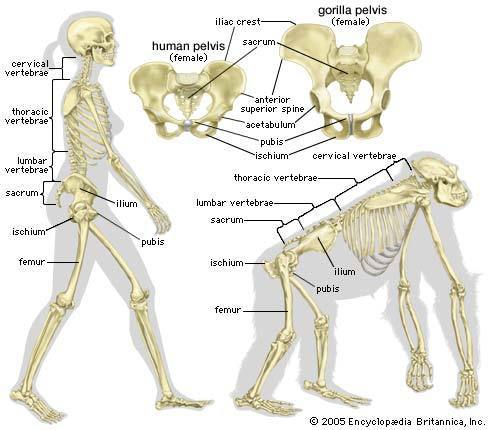
- Alarge brain with a more complex structur
- Bproportionally longer legs
- Cproportionally longer arms
- Dprecision grip
- Earched feet
- Frotated iliac blades
- Gcone-shaped ribcage
- Hrigid, straight spine
- Iknuckle-walker
- Jbig toe is oriented sideways, smaller
35What human-specific gene codes for the stimulated growth of folds and fissures on the brain?
- AARHGAP11B
- BFOXP2
- CHCNS1
36Which human-specific gene codes for cognitive abilities linked to language?
- AARHGAP11B
- BFOXP2
- CHCNS1
37Which human-specific gene possibly contributes to bipedalism and tool making?
- AARHGAP11B
- BFOXP2
- CHCNS1
38Which statements are true?
- AHumans have a fast life history compared to other primates
- BHumans reproduce earlier than other apes
- CHuman offspring are dependent upon their parents for longer than ape offspring
- DHumans have a long gestation period, like other apes
- EHumans have the largest newborn to mother weight ratio than all other primates
39How much of the brain develops prior to birth?
- A30%
- B50%
- C15%
- D80%
- E45%
40In general, humans wean their babies [blank_start]earlier[blank_end] than other [blank_start]mammals[blank_end].
- Aearlier
- Bmammals
41Which of these are characteristics of a fast life history, that feature in the human life history but not in other apes?
- AHigh fertility
- BLonger lactation period
- CEarlier weaning
- DShorter interbirth intervals
- EFatness in babies
Informações
- Descrição
- Quiz sobre EVOLUTION REVISION, criado por Jessica Edney em 21-04-2016.
- Autor
- Jessica Edney
- Idioma
- English
- Visualizações
- 3
- Avaliação
- Ainda sem avaliações Avalie este quiz