
Quiz
CCNA Part 1
Perguntas do quiz (117)
1Which layer of the OSI reference Model is responsible for determining the availability of the receiving program and checking to see if enough resources exist for that communication?
- ATransport
- BNetwork
- CPresentation
- DSession
- EApplication
2Which of the following describes the roles of devices in a WAN? (Choose 3)
- AA CSU/DSU terminates a digital local loop.
- BA modem terminates a digital loop.
- CA CSU/DSU terminates an analog local loop
- DA modem terminates an analog local loop
- EA router is commonly considered a DTE device.
- FA router is commonly considered a DCE device.
3A network administrator is verifying the configuration of a newly installed host by establishing an FTP connection to a remote server. What is the highest layer of the protocol stack that the network administrator is using for this operation?
- AApplication
- BPresentation
- CSession
- DTransport
- EInternet
- FData-Link
4A network interface port has collision detection and carrier sensing enabled on a shared twisted pair network. From this statement, what is known about the network interface port?
- AThis is a 10 Mb/s switch port.
- BThis is a 100 Mb/s switch port.
- CThis is an Ethernet port operating at half duplex.
- DThis is an Ethernet port operating at full duplex.
- EThis is a port on a network interface card in a PC.
5A receiving host computes the checksum on a frame and determines that the frame is damaged. The frame is then discarded. At which OSI layer did this happen?
- ASession
- BTransport
- CNetwork
- DData-Link
- EPhysical
6Which of the following correctly describe steps in the OSI data encapsulation process? (Choose two.)
- AThe transport layer divides a data stream into segments and may add reliability and flow control information.
- BThe data link layer adds physical source and destination addresses and an FCS to the segment.
- CPackets are created when the network layer encapsulates a frame with source and destination host addresses and protocol-related control information.
- DPackets are created when the network layer adds Layer 3 addresses and control information to a segment.
- EThe presentation layer translates bits into voltages for transmission across the physical link.
7Which three statements accurately describe Layer 2 Ethernet switches? (Choose three.)
- ASpanning Tree Protocol allows switches to automatically share VLAN information.
- BEstablishing VLANs increases the number of broadcast domains.
- CSwitches that are configured with VLANs make forwarding decisions based on both Layer 2 and Layer 3 address information.
- DMicrosegmentation decreases the number of collisions on the network.
- EIn a properly functioning network with redundant switched paths, each switched segment will contain one root bridge with all its ports in the forwarding state. All other switches in that broadcast domain will have only one root port.
- FIf a switch receives a frame for an unknown destination, it uses ARP to resolve the address.
8Where does routing occur within the DoD TCP/IP reference model?
- AApplication
- BInternet
- CNetwork
- DTransport
9For what two purposes does the Ethernet protocol use physical addresses? (Choose two.)
- ATo uniquely identify devices at Layer 2
- BTo allow communication with devices on a different network
- CTo differentiate a Layer 2 frame from a Layer 3 packet
- DTo establish a priority system to determine which device gets to transmit first
- ETo allow communication between different devices on the same network
- FTo allow detection of a remote device when its physical address is unknown
10In an Ethernet network, under what two scenarios can devices transmit? (Choose two.)
- AWhen they receive a special token
- BWhen there is a carrier
- CWhen they detect no other devices are sending
- DWhen the medium is idle
- EWhen the server grants access
11Which layer of the OSI reference Model is responsible for determining the availability of the receiving program and checking to see if enough resources exist for that communication?
- ATransport
- BNetwork
- CPresentation
- DSession
- EApplication
12A router has two Fast Ethernet interfaces and needs to connect to four VLANs in the local network. How can you accomplish this task, using the fewest physical interfaces and without decreasing network performance?
- AUse a hub to connect the four VLANS with a Fast Ethernet interface on the router.
- BAdd a second router to handle the VLAN traffic.
- CAdd two more Fast Ethernet interfaces.
- DImplement a router-on-a-stick configuration.
13What is the difference between a CSU/DSU and a modem?
- AA CSU/DSU converts analog signals from a router to a leased line; a modem converts analog signals from a router to a leased line.
- BA CSU/DSU converts analog signals from a router to a phone line; a modem converts digital signals from a router to a leased line.
- CA CSU/DSU converts digital signals from a router to a phone line; a modem converts analog signals from a router to a phone line.
- DA CSU/DSU converts digital signals from a router to a leased line; a modem converts digital signals from a router to a phone line.
14Which port state is introduced by Rapid-PVST?
- ALearning
- BListening
- CDiscarding
- DForwarding
15VLAN 3 is not yet configured on your switch. What happens if you set the switchport access VLAN 3 command in interface configuration mode?
- AThe command is rejected
- BThe port turns amber
- CThe command is accepted and the respective VLAN is added to vlan.dat.
- DThe command is accepted and you must configure the VLAN manually.
16What value is primarily used to determine which port becomes the root port on each nonroot switch in a spanning-tree topology?
- APath Cost
- BLowest port MAC address
- CVTP revision number
- DHighest port priority number
- EPort priority number and MAC address
17In a switched environment, what does the IEEE 802.1Q standard describe?
- AThe operation of VTP
- BA method of VLAN trunking
- CAn approach to wireless LAN communication
- DThe process of root bridge selection
- EVLAN pruning
18What is the function of the command switchport trunk native vlan 999 on a Cisco Catalyst switch?
- AIt creates a VLAN 999 interface.
- BIt designates VLAN 999 for untagged traffic.
- CIt blocks VLAN 999 traffic from passing on the trunk.
- DIt designates VLAN 999 as the default for all unknown tagged traffic.
19Which two protocols are used by bridges and/or switches to prevent loops in a layer 2 network? (Choose two.)
- A802.1d
- BVTP
- C802.1q
- DSTP
- ESAP
20Which switch would STP choose to become the root bridge in the selection process?
- A32768: 11-22-33-44-55-66
- B32768: 22-33-44-55-66-77
- C32769: 11-22-33-44-55-65
- D32769: 22-33-44-55-66-78
21A switch is configured with all ports assigned to VLAN 2 with full duplex FastEthernet to segment existing departmental traffic. What is the effect of adding switch ports to a new VLAN on the switch?
- AMore collision domains will be created.
- BIP address utilization will be more efficient.
- CMore bandwidth will be required than was needed previously.
- DAn additional broadcast domain will be created.
22What are three benefits of implementing VLANs? (Choose three.)
- AA higher level of network security can be reached by separating sensitive data traffic from other network traffic.
- BA more efficient use of bandwidth can be achieved allowing many physical groups to use the same network infrastructure.
- CA more efficient use of bandwidth can be achieved allowing many logical networks to use the same network infrastructure.
- DBroadcast storms can be mitigated by increasing the number of broadcast domains, thus reducing their size.
- EBroadcast storms can be mitigated by decreasing the number of broadcast domains, thus increasing their size.
- FVLANs make it easier for IT staff to configure new logical groups, because the VLANs all belong to the same broadcast domain.
- GPort-based VLANs increase switch-port use efficiency, thanks to 802.1Q trunks.
23Which IEEE standard protocol is initiated as a result of successful DTP completion in a switch over Fast Ethernet?
- A802.3ad
- B802.1w
- C802.1D
- D802.1Q
24Which of the following are benefits of VLANs? (Choose three.)
- AThey increase the size of collision domains.
- BThey allow logical grouping of users by function.
- CThey can enhance network security.
- DThey increase the size of broadcast domains while decreasing the number of collision domains.
- EThey increase the number of broadcast domains while decreasing the size of the broadcast domains.
- FThey simplify switch administration.
25Which two states are the port states when RSTP has converged? (Choose two.)
- ADiscarding
- BListening
- CLearning
- DForwarding
- EDisabled
26Which two commands can be used to verify a trunk link configuration status on a given Cisco switch interface? (Choose two.)
- AShow interface trunk
- BShow interface interface
- CShow ip interface brief
- DShow interface vlan
- Eshow interface switchport
27Which command enables RSTP on a switch?
- Aspanning-tree uplinkfast
- Bspanning-tree mode rapid-pvst
- Cspanning-tree backbonefast
- Dspanning-tree mode mst
28Why will a switch never learn a broadcast address?
- ABroadcasts only use network layer addressing.
- BA broadcast frame is never forwarded by a switch.
- CA broadcast address will never be the source address of a frame.
- DBroadcast addresses use an incorrect format for the switching table.
- EBroadcast frames are never sent to switches.
29Which two link protocols are used to carry multiple VLANs over a single link? (Choose two.)
- AVTP
- B802.1q
- CIGP
- DISL
- E802.3u
30Assuming the default switch configuration, which VLAN range can be added, modified, and removed on a Cisco switch?
- A1 through 1001
- B2 through 1001
- C1 through 1002
- D2 through 1005
31Which statement about VLAN operation on Cisco Catalyst switches is true?
- AWhen a packet is received from an 802.1Q trunk, the VLAN ID can be determined from the source MAC address and the MAC address table.
- BUnknown unicast frames are retransmitted only to the ports that belong to the same VLAN.
- CBroadcast and multicast frames are retransmitted to ports that are configured on different VLAN.
- DPorts between switches should be configured in access mode so that VLANs can span across the ports.
32Which three statements about RSTP are true? (Choose three.)
- ARSTP significantly reduces topology reconverging time after a link failure.
- BRSTP expands the STP port roles by adding the alternate and backup roles.
- CRSTP port states are blocking, discarding, learning, or forwarding.
- DRSTP provides a faster transition to the forwarding state on point-to-point links than STP does.
- ERSTP also uses the STP proposal-agreement sequence.
- FRSTP uses the same timer-based process as STP on point-to-point links.
33At which layer of the OSI model is RSTP used to prevent loops?
- APhysical
- BData Link
- CNetwork
- DTransport
34What does a Layer 2 switch use to decide where to forward a received frame?
- Asource MAC address
- Bsource IP address
- Csource switch port
- Ddestination IP address
- Edestination port address
- Fdestination MAC address
35Which two benefits are provided by creating VLANs? (Choose two.)
- Aadded security
- Bdedicated bandwidth
- Cprovides segmentation
- Dallows switches to route traffic between subinterfaces
- Econtains collisions
36Which command can be used from a PC to verify the connectivity between hosts that connect through a switch in the same LAN?
- APing address
- BTracert address
- CTraceroute address
- DARP address
37Which two of these are characteristics of the 802.1Q protocol? (Choose two.)
- AIt is used exclusively for tagging VLAN frames and does not address network reconvergence following switched network topology changes.
- BIt modifies the 802.3 frame header, and thus requires that the FCS be recomputed.
- CIt is a Layer 2 messaging protocol which maintains VLAN configurations across networks.
- DIt includes an 8-bit field which specifies the priority of a frame.
- EIt is a trunking protocol capable of carrying untagged frames.
38What is one benefit of PVST+?
- APVST+ supports Layer 3 load balancing without loops.
- BPVST+ reduces the CPU cycles for all the switches in the network.
- CPVST+ allows the root switch location to be optimized per VLAN.
- DPVST+ automatically selects the root bridge location, to provide optimized bandwidth usage.
39Which are valid modes for a switch port used as a VLAN trunk? (Choose three.)
- ATransparent
- BAuto
- COn
- DDesirable
- EBlocking
- FForwarding
40Which three of these statements regarding 802.1Q trunking are correct? (Choose three.)
- A802.1Q native VLAN frames are untagged by default.
- B802.1Q trunking ports can also be secure ports.
- C802.1Q trunks can use 10 Mb/s Ethernet interfaces.
- D802.1Q trunks require full-duplex, point-to-point connectivity.
- E802.1Q trunks should have native VLANs that are the same at both ends.
41Which term describes a spanning-tree network that has all switch ports in either the blocking or fowarding state?
- AConverged
- BRedundant
- CProvisioned
- DSpanned
42What are the possible trunking modes for a switch port? (Choose three.)
- ATransparent
- BAuto
- COn
- DDesireable
- EClient
- FForwarding
43Which two of these statements regarding RSTP are correct? (Choose two.)
- ARSTP cannot operate with PVST+.
- BRSTP defines new port roles.
- CRSTP defines no new port states.
- DRSTP is a proprietary implementation of IEEE 802.1D STP.
- ERSTP is compatible with the original IEEE 802.1D STP.
44Three switches are connected to one another via trunk ports. Assuming the default switch configuration, which switch is elected as the root bridge for the spanning-tree instance of VLAN 1?
- AThe switch with the highest MAC address
- BThe switch with the lowest MAC address
- CThe switch with the highest IP address
- DThe switch with the lowest IP address
45What are three advantages of VLANs (Choose Three)
- AVLANs establish broadcast domains in switched networks.
- BVLANs utilize packet filtering to enhance network security.
- CVLANs provide a method of conserving IP addresses in large networks.
- DVLANs provide a low-latency internetworking alternative to routed networks.
- EVLANs allow access to network services based on department, not physical location.
- FVLANs can greatly simplify adding, moving, or changing hosts on the network.
46Cisco Catalyst switches CAT1 and CAT2 have a connection between them using ports FA0/13. An 802.1Q trunk is configured between the two switches. On CAT1, VLAN 10 is chosen as native, but on CAT2 the native VLAN is not specified.
What will happen in this scenario?- A802.1Q giants frames could saturate the link.
- BVLAN 10 on CAT1 and VLAN 1 on CAT2 will send untagged frames.
- CA native VLAN mismatch error message will appear.
- DVLAN 10 on CAT1 and VLAN 1 on CAT2 will send tagged frames.
47You have been asked to come up with a subnet mask that will allow all three web servers to be on the same network while providing the maximum number of subnets. Which network address and subnet mask meet this requirement?
- A192.168.252.0 255.255.255.252
- B192.168.252.8 255.255.255.248
- C192.168.252.8 255.255.255.252
- D192.168.252.16 255.255.255.240
- E192.168.252.16 255.255.255.252
48Given an IP address 172.16.28.252 with a subnet mask of 255.255.240.0, what is the correct network address?
- A172.16.16.0
- B172.16.0.0
- C172.16.24.0
- D172.16.28.0
49Which IPv6 address is the equivalent of the IPv4 interface loopback address 127.0.0.1?
- A::1
- B::
- C2000::/3
- D0::/10
50You are working in a data center environment and are assigned the address range 10.188.31.0/23. You are asked to develop an IP addressing plan to allow the maximum number of subnets with as many as 30 hosts each. Which IP address range meets these requirements?
- A10.188.31.0/26
- B10.188.31.0/25
- C10.188.31.0/28
- D10.188.31.0/27
- E10.188.31.0/29
51What are three features of the IPv6 protocol? (Choose three.)
- AOptional IPsec
- BAutoconfiguration
- CNo broadcasts
- DComplicated header
- EPlug-and-play
- FChecksum
52Which command enables IPv6 forwarding on a Cisco router?
- AIPv6 local
- BIPv6 host
- CIPv6 unicast-routing
- DIPv6 neighbor
53What is known as "one-to-nearest" addressing in IPv6?
- AGlobal Unicast
- BAnycast
- CMulticast
- DUnspecified address
54What is the first 24 bits in a MAC address called?
- ANIC
- BBIA
- COUI
- DVAI
55Which subnet mask will place all hosts on Network B in the same subnet with the least amount of wasted addresses?
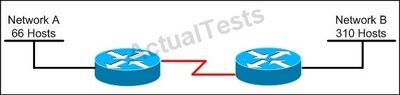
- A255.255.255.0
- B255.255.254.0
- C255.255.252.0
- D255.255.248.0
56What is the most appropriate summarization for these routes?
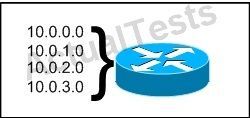
- A10.0.0.0/21
- B10.0.0.0/22
- C10.0.0.0/23
- D10.0.0.0/24
57Which two are features of IPv6? (Choose two.)
- AAnycast
- BBroadcast
- CMulticast
- DPodcast
- EAllcast
58Which two of these statements are true of IPv6 address representation? (Choose two.)
- AThere are four types of IPv6 addresses: unicast, multicast, anycast, and broadcast.
- BA single interface may be assigned multiple IPv6 addresses of any type.
- CEvery IPv6 interface contains at least one loopback address.
- DThe first 64 bits represent the dynamically created interface ID.
- ELeading zeros in an IPv6 16 bit hexadecimal field are mandatory.
59A new subnet with 60 hosts has been added to the network. Which subnet address should this network use to provide enough usable addresses while wasting the fewest addresses?
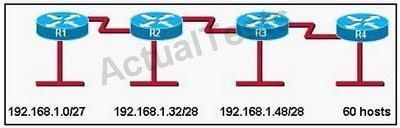
- A192.168.1.56/26
- B192.168.1.56/27
- C192.168.1.64/26
- D192.168.1.64/27
60The network administrator needs to address seven LANs. RIP version 1 is the only routing protocol in use on the network and subnet 0 is not being used. What is the maximum number of usable IP addresses that can be supported on each LAN if the organization is using one class C address block?
- A8
- B6
- C30
- D32
- E14
- F16
61What will happen if a private IP address is assigned to a public interface connected to an ISP?
- AAddresses in a private range will be not be routed on the Internet backbone.
- BOnly the ISP router will have the capability to access the public network.
- CThe NAT process will be used to translate this address to a valid IP address.
- DA conflict of IP addresses happens, because other public routers can use the same range.
62Which two benefits are provided by using a hierarchical addressing network addressing scheme?
(Choose two.)- AReduces routing table entries
- BAuto-negotiation of media rates
- CEfficient utilization of MAC addresses
- DDedicated communications between devices
- EEase of management and troubleshooting
63What is the alternative notation for the IPv6 address
B514:82C3:0000:0000:0029:EC7A:0000:EC72?- AB514 : 82C3 : 0029 : EC7A : EC72
- BB514 : 82C3 :: 0029 : EC7A : EC72
- CB514 : 82C3 : 0029 :: EC7A : 0000 : EC72
- DB514 : 82C3 :: 0029 : EC7A : 0 : EC72
64All hosts have connectivity with one another. Which statements describe the addressing scheme that is in use in the network? (Choose three.)
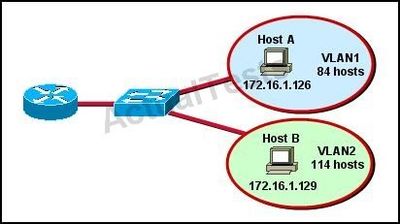
- AThe subnet mask in use is 255.255.255.192.
- BThe subnet mask in use is 255.255.255.128.
- CThe IP address 172.16.1.25 can be assigned to hosts in VLAN1
- DThe IP address 172.16.1.205 can be assigned to hosts in VLAN1
- EThe LAN interface of the router is configured with one IP address.
- FThe LAN interface of the router is configured with multiple IP addresses.
65Which two statements describe characteristics of IPv6 unicast addressing? (Choose two.)
- AGlobal addresses start with 2000::/3.
- BLink-local addresses start with FE00:/12.
- CLink-local addresses start with FF00::/10.
- DThere is only one loopback address and it is ::1.
- EIf a global address is assigned to an interface, then that is the only allowable address for the
interface.
66The network administrator has been asked to give reasons for moving from IPv4 to IPv6. What are
two valid reasons for adopting IPv6 over IPv4? (Choose two.)- ANo broadcast
- BChange of source address in the IPv6 header
- CChange of destination address in the IPv6 header
- DTelnet access does not require a password
- EAutoconfiguration
- FNAT
67An administrator must assign static IP addresses to the servers in a network. For network
192.168.20.24/29, the router is assigned the first usable host address while the sales server is
given the last usable host address. Which of the following should be entered into the IP properties
box for the sales server?- AIP address: 192.168.20.14
Subnet Mask: 255.255.255.248
Default Gateway: 192.168.20.9 - BIP address: 192.168.20.254
Subnet Mask: 255.255.255.0
Default Gateway: 192.168.20.1 - CIP address: 192.168.20.30
Subnet Mask: 255.255.255.248
Default Gateway: 192.168.20.25 - DIP address: 192.168.20.30
Subnet Mask: 255.255.255.240
Default Gateway: 192.168.20.17 - EIP address: 192.168.20.30
Subnet Mask: 255.255.255.240
Default Gateway: 192.168.20.25
- AIP address: 192.168.20.14
68Which subnet mask would be appropriate for a network address range to be subnetted for up to eight LANs, with each LAN containing 5 to 26 hosts?
- A0.0.0.240
- B255.255.255.252
- C255.255.255.0
- D255.255.255.224
- E255.255.255.240
69How many bits are contained in each field of an IPv6 address?
- A24
- B4
- C8
- D16
70What are three approaches that are used when migrating from an IPv4 addressing scheme to an
IPv6 scheme. (Choose three.)- AEnable dual-stack routing
- BConfigure IPv6 directly
- CConfigure IPv4 tunnels between IPv6 islands
- DUse proxying and translation to translate IPv6 packets into IPv4 packets
- EStatically map IPv4 addresses to IPv6 addresses
- FUse DHCPv6 to map IPv4 addresses to IPv6 addresses
71How is an EUI-64 format interface ID created from a 48-bit MAC address?
- ABy appending 0xFF to the MAC address
- BBy prefixing the MAC address with 0xFFEE
- CBy prefixing the MAC address with 0xFF and appending 0xFF to it
- DBy inserting 0xFFFE between the upper three bytes and the lower three bytes of the MAC address
- EBy prefixing the MAC address with 0xF and inserting 0xF after each of its first three bytes
72Which three are characteristics of an IPv6 anycast address? (Choose three.)
- AOne-to-many communication model
- BOne-to-nearest communication model
- CAny-to-many communication model
- DA unique IPv6 address for each device in the group
- EThe same address for multiple devices in the group
- FDelivery of packets to the group interface that is closest to the sending device
73Which option is a valid IPv6 address?
- A2001:0000:130F::099a::12a
- B2002:7654:A1AD:61:81AF:CCC1
- CFEC0:ABCD:WXYZ:0067::2A4
- D2004:1:25A4:886F::1
74A national retail chain needs to design an IP addressing scheme to support a nationwide network. The company needs a minimum of 300 sub-networks and a maximum of 50 host addresses per subnet. Working with only one Class B address, which of the following subnet masks will support an appropriate addressing scheme? (Choose two.)
- A255.255.255.0
- B255.255.255.128
- C255.255.252.0
- D255.255.255.224
- E255.255.255.192
- F255.255.248.0
75Which IPv6 address is the all-router multicast group?
- AFF02::1
- BFF02::2
- CFF02::3
- DFF02::4
76Which IPv6 address is valid?
- A2001:0db8:0000:130F:0000:0000:08GC:140B
- B2001:0db8:0:130H::87C:140B
- C2031::130F::9C0:876A:130B
- D2031:0:130F::9C0:876A:130B
77Which command can you use to manually assign a static IPv6 address to a router interface?
- Aipv6 autoconfig 2001:db8:2222:7272::72/64
- Bipv6 address 2001:db8:2222:7272::72/64
- Cipv6 address PREFIX_1 ::1/64
- Dipv6 autoconfig
78Which of these represents an IPv6 link-local address?
- AFE80::380e:611a:e14f:3d69
- BFE81::280f:512b:e14f:3d69
- CFEFE:0345:5f1b::e14d:3d69
- DFE08::280e:611:a:f14f:3d69
79The network administrator is asked to configure 113 point-to-point links. Which IP addressing scheme defines the address range and subnet mask that meet the requirement and waste the fewest subnet and host addresses?
- A10.10.0.0/16 subnetted with mask 255.255.255.252
- B10.10.0.0/18 subnetted with mask 255.255.255.252
- C10.10.1.0/24 subnetted with mask 255.255.255.252
- D10.10.0.0/23 subnetted with mask 255.255.255.252
- E10.10.1.0/25 subnetted with mask 255.255.255.252
80What will Router1 do when it receives the data frame shown? (Choose three.)
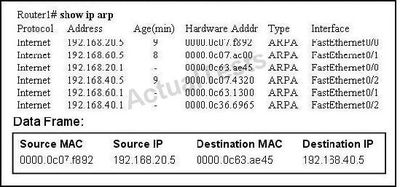
- ARouter1 will strip off the source MAC address and replace it with the MAC address 0000.0c36.6965.
- BRouter1 will strip off the source IP address and replace it with the IP address 192.168.40.1.
- CRouter1 will strip off the destination MAC address and replace it with the MAC address 0000.0c07.4320.
- DRouter1 will strip off the destination IP address and replace it with the IP address of 192.168.40.1.
- ERouter1 will forward the data packet out interface FastEthernet0/1.
- FRouter1 will forward the data packet out interface FastEthernet0/2.
81Which three statements correctly describe Network Device A? (Choose three.)
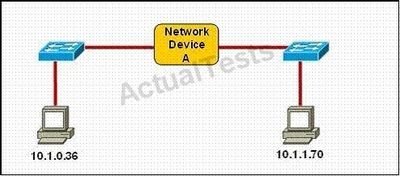
- AWith a network wide mask of 255.255.255.128, each interface does not require an IP address.
- BWith a network wide mask of 255.255.255.128, each interface does require an IP address on a unique IP subnet.
- CWith a network wide mask of 255.255.255.0, must be a Layer 2 device for the PCs to communicate with each other.
- DWith a network wide mask of 255.255.255.0, must be a Layer 3 device for the PCs to communicate with each other.
- EWith a network wide mask of 255.255.254.0, each interface does not require an IP address.
82Host A pings interface S0/0 on router 3. What is the TTL value for that ping?
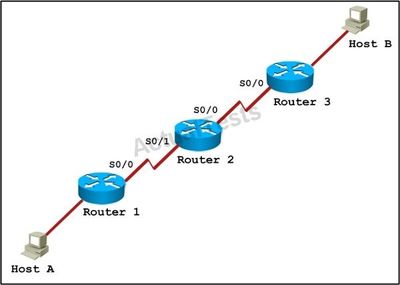
- A252
- B253
- C254
- D255
83After HostA pings HostB, which entry will be in the ARP cache of HostA to support this transmission?
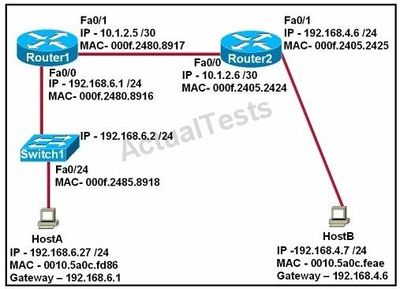
- A

- B

- C

- D

- E

- F

- A
84Host A is communicating with the server. What will be the source MAC address of the frames received by Host A from the server?
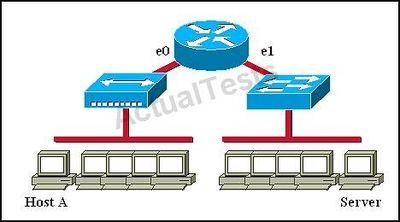
- AThe MAC address of router interface e0
- BThe MAC address of router interface e1
- CThe MAC address of the server network interface
- DThe MAC address of host A
85What two results would occur if the hub were to be replaced with a switch that is configured with one Ethernet VLAN? (Choose two.)
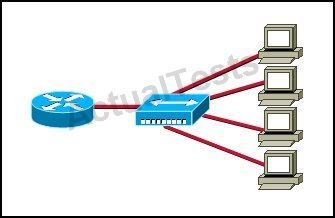
- AThe number of collision domains would remain the same.
- BThe number of collision domains would decrease.
- CThe number of collision domains would increase.
- DThe number of broadcast domains would remain the same.
- EThe number of broadcast domains would decrease.
- FThe number of broadcast domains would increase.
86Which destination addresses will be used by Host A to send data to Host C? (Choose two.)
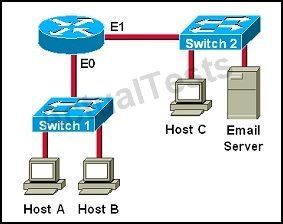
- AThe IP address of Switch 1
- BThe MAC address of Switch 1
- CThe IP address of Host C
- DThe MAC address of Host C
- EThe IP address of the router's E0 interface
- FThe MAC address of the router's E0 interface
87Based on the information given, which switch will be elected root bridge and why?
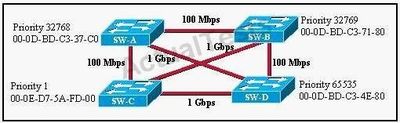
- ASwitch A, because it has the lowest MAC address
- BSwitch A, because it is the most centrally located switch
- CSwitch B, because it has the highest MAC address
- DSwitch C, because it is the most centrally located switch
- ESwitch C, because it has the lowest priority
- FSwitch D, because it has the highest priority
88Which of the following statements describe the network shown in the graphic? (Choose two.)
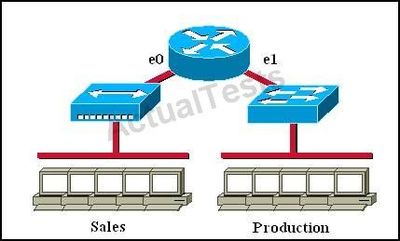
- AThere are two broadcast domains in the network.
- BThere are four broadcast domains in the network.
- CThere are six broadcast domains in the network.
- DThere are four collision domains in the network.
- EThere are five collision domains in the network.
- FThere are seven collision domains in the network.
89Host 1 is trying to communicate with Host 2. The e0 interface on Router C is down.
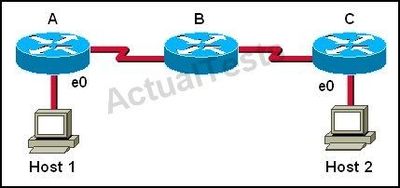
- ARouter C will use ICMP to inform Host 1 that Host 2 cannot be reached.
- BRouter C will use ICMP to inform Router B that Host 2 cannot be reached.
- CRouter C will use ICMP to inform Host 1, Router A, and Router B that Host 2 cannot be reached.
- DRouter C will send a Destination Unreachable message type.
- ERouter C will send a Router Selection message type.
- FRouter C will send a Source Quench message type.
90Refer to the exhibit
Switch port FastEthernet 0/24 on ALSwitch1 will be used to create an IEEE 802.1Q-compliant trunk to another switch. Based on the output shown, what is the reason the trunk does not form, even though the proper cabling has been attached?.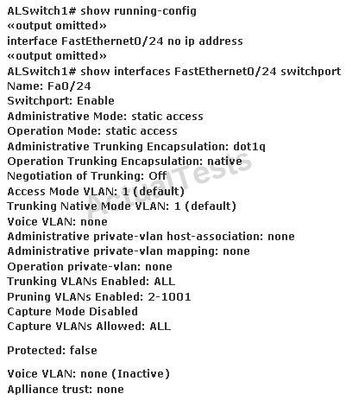
- AVLANs have not been created yet.
- BAn IP address must be configured for the port.
- CThe port is currently configured for access mode.
- DThe correct encapsulation type has not been configured.
- EThe “no shutdown” command has not been entered for the port.
91Switch-1 needs to send data to a host with a MAC address of 00b0.d056.efa4. What will Switch-1 do with this data?
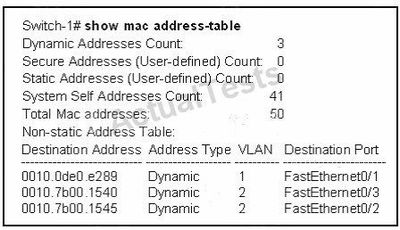
- ASwitch-1 will drop the data because it does not have an entry for that MAC address.
- BSwitch-1 will flood the data out all of its ports except the port from which the data originated.
- CSwitch-1 will send an ARP request out all its ports except the port from which the data originated.
- DSwitch-1 will forward the data to its default gateway.
92A technician has installed SwitchB and needs to configure it for remote access from the management workstation connected to SwitchA. Which set of commands is required to
accomplish this task?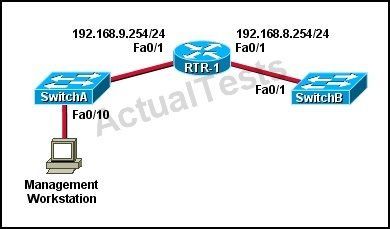
- ASwitchB(config)# interface FastEthernet 0/1
SwitchB(config-if)# ip address 192.168.8.252 255.255.255.0
SwitchB(config-if)# no shutdown - BSwitchB(config)# interface vlan 1
SwitchB(config-if)# ip address 192.168.8.252 255.255.255.0
SwitchB(config-if)# ip default-gateway 192.168.8.254 255.255.255.0
SwitchB(config-if)# no shutdown - CSwitchB(config)# ip default-gateway 192.168.8.254
SwitchB(config)# interface vlan 1
SwitchB(config-if)# ip address 192.168.8.252 255.255.255.0
SwitchB(config-if)# no shutdown - DSwitchB(config)# ip default-network 192.168.8.254
SwitchB(config)# interface vlan 1
SwitchB(config-if)# ip address 192.168.8.252 255.255.255.0
SwitchB(config-if)# no shutdown - ESwitchB(config)# ip route 192.168.8.254 255.255.255.0
SwitchB(config)# interface FastEthernet 0/1
SwitchB(config-if)# ip address 192.168.8.252 255.255.255.0
SwitchB(config-if)# no shutdown
- ASwitchB(config)# interface FastEthernet 0/1
93All switch ports are assigned to the correct VLANs, but none of the hosts connected to SwitchA can communicate with hosts in the same VLAN connected to SwitchB. Based on the output shown, what is the most likely problem?
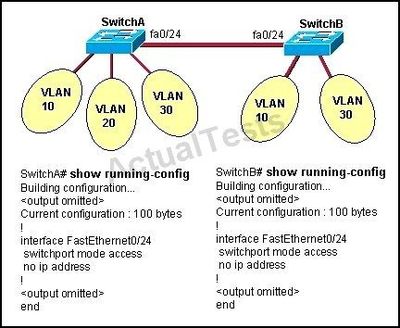
- AThe access link needs to be configured in multiple VLANs.
- BThe link between the switches is configured in the wrong VLAN.
- CThe link between the switches needs to be configured as a trunk.
- DVTP is not configured to carry VLAN information between the switches.
- ESwitch IP addresses must be configured in order for traffic to be forwarded between the switches.
94Which WAN protocol is being used?
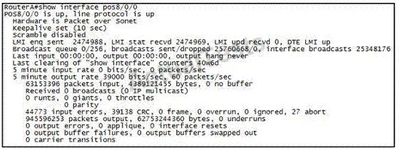
- AATM
- BHDLC
- CFrame Relay
- DPPP
95Given the output shown from this Cisco Catalyst 2950, what is the reason that interface FastEthernet 0/10 is not the root port for VLAN 2?
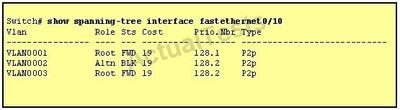
- AThis switch has more than one interface connected to the root network segment in VLAN 2.
- BThis switch is running RSTP while the elected designated switch is running 802.1d Spanning Tree.
- CThis switch interface has a higher path cost to the root bridge than another in the topology.
- DThis switch has a lower bridge ID for VLAN 2 than the elected designated switch.
96Why has this switch not been elected the root bridge for VLAN1?
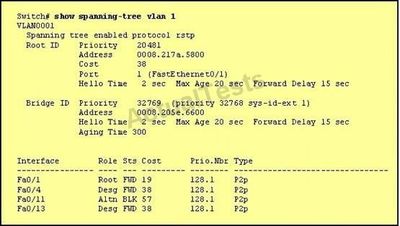
- AIt has more than one interface that is connected to the root network segment.
- BIt is running RSTP while the elected root bridge is running 802.1d spanning tree.
- CIt has a higher MAC address than the elected root bridge.
- DIt has a higher bridge ID than the elected root bridge.
97Which ports will be STP designated ports if all the links are operating at the same bandwidth? (Choose three)
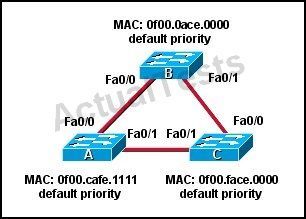
- ASwitch A - Fa0/0
- BSwitch A - Fa0/1
- CSwitch B - Fa0/0
- DSwitch B - Fa0/1
- ESwitch C - Fa0/0
- FSwitch C - Fa0/1
98How should the FastEthernet0/1 ports on the 2950 model switches that are shown in the exhibit be configured to allow connectivity between all devices?
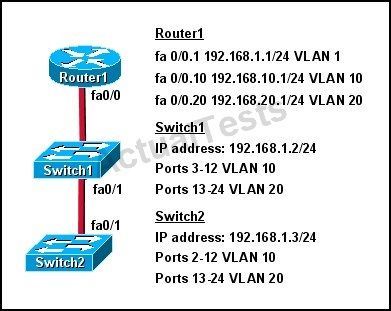
- AThe ports only need to be connected by a crossover cable.
- BSwitchX(config)# interface fastethernet 0/1
SwitchX(config-if)# switchport mode trunk - CSwitchX(config)# interface fastethernet 0/1
SwitchX(config-if)# switchport mode access
SwitchX(config-if)# switchport access vlan 1 - DSwitchX(config)# interface fastethernet 0/1
SwitchX(config-if)# switchport mode trunk
SwitchX(config-if)# switchport trunk vlan 1
SwitchX(config-if)# switchport trunk vlan 10
SwitchX(config-if)# switchport trunk vlan 20
99A frame on VLAN 1 on switch S1 is sent to switch S2 where the frame is received on VLAN 2.
What causes this behavior?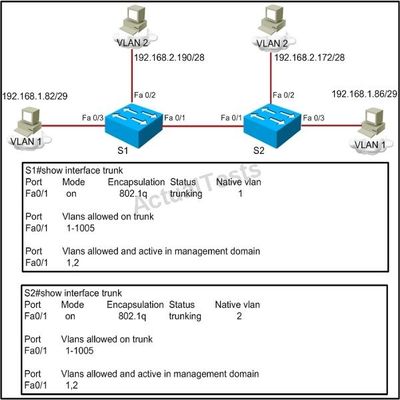
- ATrunk mode mismatches
- BAllowing only VLAN 2 on the destination
- CNative VLAN mismatches
- DVLANs that do not correspond to a unique IP subnet
100Which statement is true?
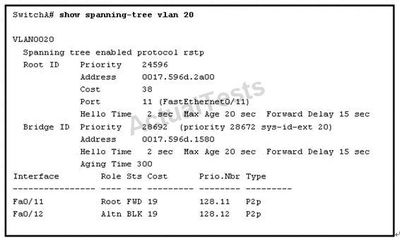
- AThe Fa0/11 role confirms that SwitchA is the root bridge for VLAN 20.
- BVLAN 20 is running the Per VLAN Spanning Tree Protocol.
- CThe MAC address of the root bridge is 0017.596d.1580.
- DSwitchA is not the root bridge, because not all of the interface roles are designated.
101Which option contains both the potential networking problem and the protocol or setting that should be used to prevent the problem?
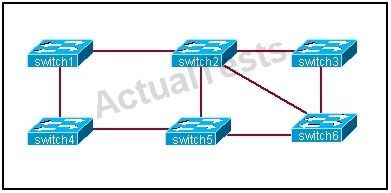
- Arouting loops, hold down timers
- Bswitching loops, split horizon
- Crouting loops, split horizon
- Dswitching loops, VTP
- Erouting loops, STP
- Fswitching loops, STP
102Which two statements are true about interVLAN routing in the topology that is shown in the exhibit? (Choose two.)
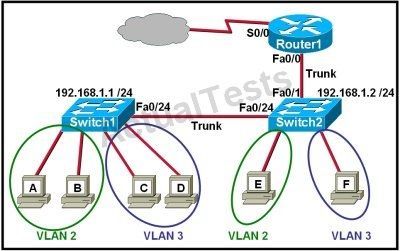
- AHost E and host F use the same IP gateway address.
- BRouter1 and Switch2 should be connected via a crossover cable.
- CRouter1 will not play a role in communications between host A and host D.
- DThe FastEthernet 0/0 interface on Router1 must be configured with subinterfaces.
- ERouter1 needs more LAN interfaces to accommodate the VLANs that are shown in the exhibit.
- FThe FastEthernet 0/0 interface on Router1 and the FastEthernet 0/1 interface on Switch2 trunk ports must be configured using the same encapsulation type.
103Each of these four switches has been configured with a hostname, as well as being configured to run RSTP. No other configuration changes have been made. Which three of these show the correct RSTP port roles for the indicated switches and interfaces? (Choose three.)
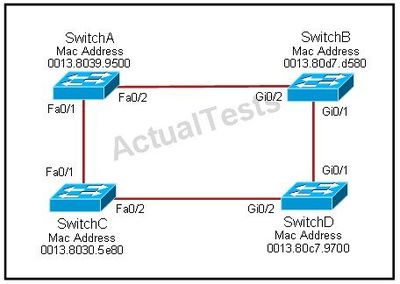
- ASwitchA, Fa0/2, designated
- BSwitchA, Fa0/1, root
- CSwitchB, Gi0/2, root
- DSwitchB, Gi0/1, designated
- ESwitchC, Fa0/2, root
- FSwitchD, Gi0/2, root
104The network administrator normally establishes a Telnet session with the switch from host A. However, host A is unavailable. The administrator's attempt to telnet to the switch from host B fails, but pings to the other two hosts are successful. What is the issue?
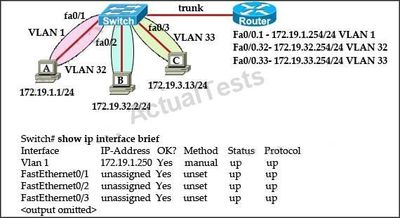
- AHost B and the switch need to be in the same subnet.
- BThe switch interface connected to the router is down.
- CHost B needs to be assigned an IP address in VLAN 1.
- DThe switch needs an appropriate default gateway assigned.
- EThe switch interfaces need the appropriate IP addresses assigned.
105Which switch provides the spanning-tree designated port role for the network segment that services the printers?
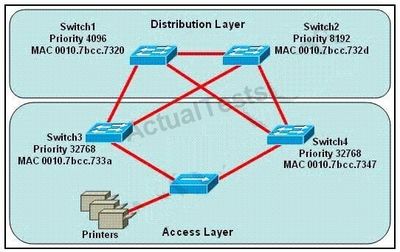
- ASwitch1
- BSwitch2
- CSwitch3
- DSwitch4
106How many broadcast domains are shown in the graphic assuming only the default VLAN is configured on the switches?
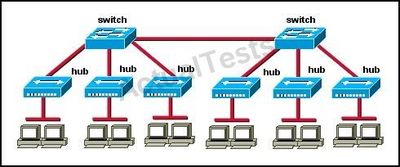
- AOne
- BTwo
- CSix
- DTwelve
107The output that is shown is generated at a switch. Which three statements are true? (Choose three.)
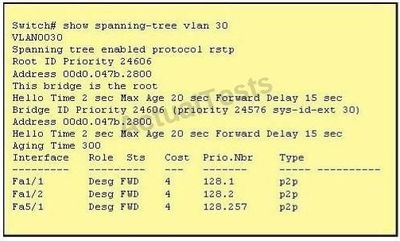
- AAll ports will be in a state of discarding, learning, or forwarding.
- BThirty VLANs have been configured on this switch.
- CThe bridge priority is lower than the default value for spanning tree.
- DAll interfaces that are shown are on shared media.
- EAll designated ports are in a forwarding state.
- FThis switch must be the root bridge for all VLANs on this switch.
108At the end of an RSTP election process, which access layer switch port will assume the discarding role?
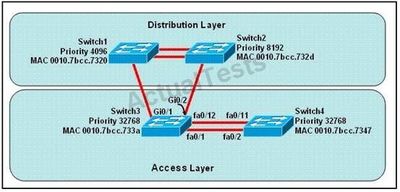
- ASwitch3, port fa0/1
- BSwitch3, port fa0/12
- CSwitch4, port fa0/11
- DSwitch4, port fa0/2
- ESwitch3, port Gi0/1
- FSwitch3, port Gi0/2
109Which two statements are true of the interfaces on Switch1? (Choose two.)
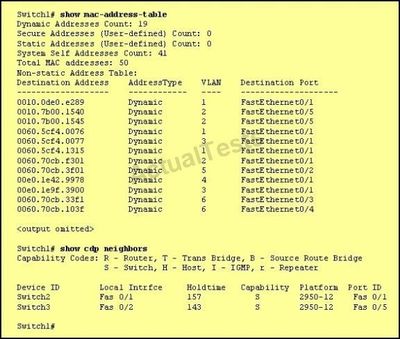
- AMultiple devices are connected directly to FastEthernet0/1.
- BA hub is connected directly to FastEthernet0/5.
- CFastEthernet0/1 is connected to a host with multiple network interface cards.
- DFastEthernet0/5 has statically assigned MAC addresses.
- EFastEthernet0/1 is configured as a trunk link.
- FInterface FastEthernet0/2 has been disabled.
110A network technician is asked to design a small network with redundancy. The exhibit represents this design, with all hosts configured in the same VLAN. What conclusions can be made about this design?
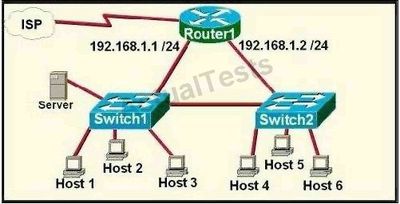
- AThis design will function as intended.
- BSpanning-tree will need to be used.
- CThe router will not accept the addressing scheme.
- DThe connection between switches should be a trunk.
- EThe router interfaces must be encapsulated with the 802.1Q protocol.
111A technician is troubleshooting host connectivity issues on the switches. The hosts in VLANs 10 and 15 on Sw11 are unable to communicate with hosts in the same VLANs on Sw12. Hosts in the Admin VLAN are able to communicate. The port-to-VLAN assignments are identical on the two switches. What could be the problem?
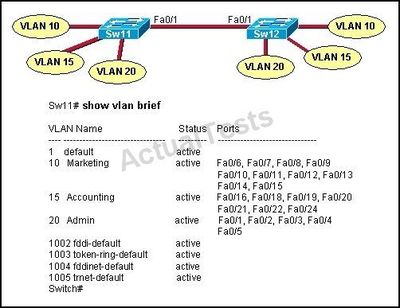
- AThe Fa0/1 port is not operational on one of the switches.
- BThe link connecting the switches has not been configured as a trunk.
- CAt least one port needs to be configured in VLAN 1 for VLANs 10 and 15 to be able to communicate.
- DPort FastEthernet 0/1 needs to be configured as an access link on both switches.
- EA router is required for hosts on SW11 in VLANs 10 and 15 to communicate with hosts in the same VLAN on Sw12.
112Given this output for SwitchC, what should the network administrator's next action be?
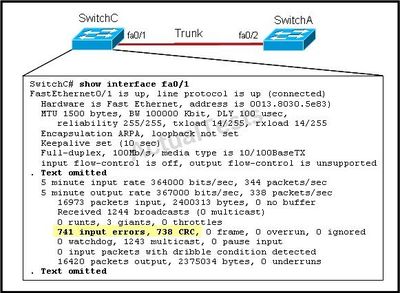
- ACheck the trunk encapsulation mode for SwitchC's fa0/1 port.
- BCheck the duplex mode for SwitchC's fa0/1 port.
- CCheck the duplex mode for SwitchA's fa0/2 port.
- DCheck the trunk encapsulation mode for SwitchA's fa0/2 port.
113All of the routers in the network are configured with the ip subnet-zero command. Which network addresses should be used for Link A and Network A? (Choose two.)
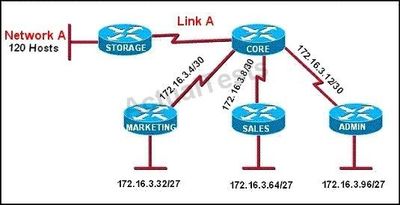
- ANetwork A - 172.16.3.48/26
- BNetwork A - 172.16.3.128/25
- CNetwork A - 172.16.3.192/26
- DLink A - 172.16.3.0/30
- ELink A - 172.16.3.40/30
- FLink A - 172.16.3.112/30
114In this VLSM addressing scheme, what summary address would be sent from router A?
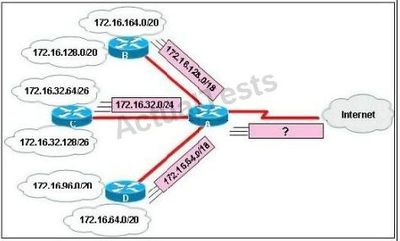
- A172.16.0.0 /16
- B172.16.0.0 /20
- C172.16.0.0 /24
- D172.32.0.0 /16
- E172.32.0.0 /17
- F172.64.0.0 /16
115What is the most efficient summarization that R1 can use to advertise its networks to R2?
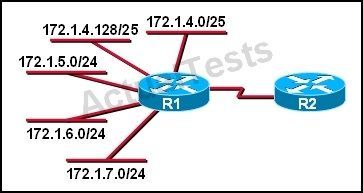
- A172.1.0.0/22
- B172.1.0.0/21
- C172.1.4.0/22
- D172.1.4.0/24
172.1.5.0/24
172.1.6.0/24
172.1.7.0/24 - E172.1.4.0/25
172.1.4.128/25
172.1.5.0/24
172.1.6.0/24
172.1.7.0/24
116A network administrator is adding two new hosts to SwitchA. Which three values could be used for the configuration of these hosts? (Choose three.)
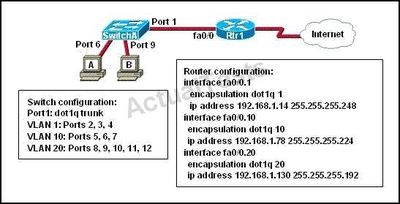
- Ahost A IP address: 192.168.1.79
- Bhost A IP address: 192.168.1.64
- Chost A default gateway: 192.168.1.78
- Dhost B IP address: 192.168.1.128
- Ehost B default gateway: 192.168.1.129
- Fhost B IP address: 192.168.1.190
117Which address range efficiently summarizes the routing table of the addresses for router Main?
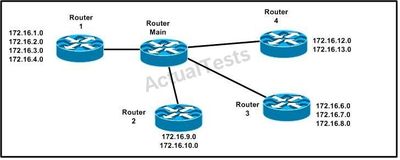
- A172.16.0.0./21
- B172.16.0.0./20
- C172.16.0.0./16
- D172.16.0.0/18
Informações
- Descrição
- Practice exam for 200-120 exam Questions for the following Topics Topic 1: Operation of IP Data Networks Topic 2: LAN Switching Technologies Topic 3: IP Addressing (IPv4/IPv6)
- Autor
- Axiom42
- Idioma
- English
- Visualizações
- 1.161
- Etiquetas
- Avaliação
- 5,0 de 5 · 6 avaliações Avalie este quiz