
Quiz
AP Bio Chapter 2
Crie uma conta grátis para terminar este quiz
Salve seu progresso e veja sua nota final.
Já tem uma conta? Inicie sessão
Perguntas do quiz (27)
1About 25 of the 92 natural elements are known to be essential to life. Which 4 of these 25 elements make up approximately 96% of living matter?
- Acarbon, sodium, hydrogen, nitrogen
- Bcarbon, oxygen, phosphorus, hydrogen
- Coxygen, hydrogen, calcium, nitrogen
- Dcarbon, hydrogen, nitrogen, oxygen
- Ecarbon, oxygen, nitrogen, calcium
2Which of the following statements is false?
- ACarbon, hydrogen, oxygen, and nitrogen are the most abundant elements of living matter.
- BSome naturally occurring elements are toxic to organisms.
- CAll organisms require the same elements in the same quantities.
- DIron is an example of an element needed by all organisms.
- EApproximately one-quarter of the natural elements are essential elements.
3Why is each element unique and different from other elements with respect to its chemical properties?
- AEach element has a unique atomic mass.
- BEach element has a unique mass number.
- CEach element has a unique number of protons.
- DEach element has a unique number of neutrons.
- EEach element has different radioactive properties.
4The nucleus of a nitrogen atom contains 7 neutrons and 7 protons. Which of the following is a correct statement concerning nitrogen?
- AThe nitrogen atom has a mass number of approximately 7 and an atomic number of 14.
- BThe nitrogen atom has a mass number of approximately 14 and an atomic number of 7.
- CThe nitrogen atom has a mass number of approximately 14 and an atomic number of 14.
- DThe nitrogen atom has a mass number of approximately 7 and an atomic number of 21.
- EThe nitrogen atom has a mass number of approximately 14 and an atomic number of 21
5Carbon-12 is the most common isotope of carbon and has a mass number of 12. However, the atomic mass of carbon is slightly more than 12 daltons. Why?
- AThe atomic mass does not include the mass of electrons.
- BSome carbon atoms in nature have an extra proton.
- CSome carbon atoms in nature have more neutrons.
- DSome carbon atoms in nature have a different valence electron distribution.
- ESome carbon atoms in nature have undergone radioactive decay.
6An atom has 6 electrons in its outer shell. How many unpaired electrons does it have?
- A0
- B2
- C4
- D6
- E2 or 4
7The atomic number of each atom is given to the left of each of the following elements. Which of the atoms has the same valence as carbon (12/6 C)
- A7N nitrogen
- B9F fluorine
- C10Ne neon
- D12Mg magnesium
- E14Si silicon
8Which of the following molecules contains the most polar covalent bond?
- AH2
- BO2
- CCO2
- DH2O
- ECH4
9Which of the following correctly describes any reaction that has reached chemical equilibrium?
- AThe concentration of the reactants equals the concentration of the products.
- BThe rate of the forward reaction is equal to the rate of the reverse reaction.
- CAll of the reactants have been converted to the products of the reaction.
- DAll of the products have been converted to the reactants of the reaction.
- EBoth the forward and the reverse reactions have stopped with no net effect on the concentration of the reactants and the products.
10Which of the following explains most specifically the attraction of water molecules to one another?
- Anonpolar covalent bond
- Bpolar covalent bond
- Cionic bond
- Dhydrogen bond
- Ehydrophobic interaction
11Which of the following takes place as an ice cube cools a drink?
- AMolecular collisions in the drink increase.
- BKinetic energy in the drink decreases.
- CA calorie of heat energy is transferred from the ice to the water of the drink.
- DThe specific heat of the water in the drink decreases.
- EEvaporation of the water in the drink increases.
12Liquid water's high specific heat is mainly a consequence of the
- Asmall size of the water molecules.
- Bhigh specific heat of oxygen and hydrogen atoms.
- Cabsorption and release of heat when hydrogen bonds break and form.
- Dfact that water is a poor heat conductor.
- Ehigher density of liquid water than solid water (ice).
13Which type of bond must be broken for water to vaporize?
- Aionic bonds
- Bboth hydrogen bonds and ionic bonds
- Cpolar covalent bonds
- Dhydrogen bonds
- Eboth polar covalent bonds and hydrogen bonds
14Temperature usually increases when water condenses. Which behavior of water is most directly responsible for this phenomenon?
- Athe change in density when it condenses to form a liquid or solid
- Breactions with other atmospheric compounds
- Cthe release of heat by the formation of hydrogen bonds
- Dthe release of heat by the breaking of hydrogen bonds
- Ethe high surface tension of water
15Based on your knowledge of the polarity of water molecules, the solute molecule depicted in Figure 2.9 is most likely
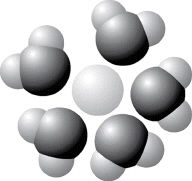
- Apositively charged.
- Bnegatively charged.
- Cwithout charge.
- Dhydrophobic.
- Enonpolar.
16Which of the following statements is true about buffer solutions?
- AThey maintain a constant pH when bases are added to them but not when acids are added to them.
- BThey maintain a constant pH when acids are added to them but not when bases are added to them.
- CThey maintain a relatively constant pH of approximately 7 when either acids or bases are added to them.
- DThey maintain a relatively constant pH when either acids or bases are added to them.
- EThey are found only in living systems and biological fluids.
17Buffers are substances that help resist shifts in pH by
- Areleasing H+ to a solution when acids are added.
- Bdonating H+ to a solution when bases are added.
- Creleasing OH- to a solution when bases are added.
- Daccepting H+ from a solution when acids are added.
- Eboth donating H+ to a solution when bases are added and accepting H+ when acids are added.
18One of the buffers that contributes to pH stability in human blood is carbonic acid (H2CO3). Carbonic acid is a weak acid that dissociates into a bicarbonate ion (HCO3-) and a hydrogen ion (H+). Thus,
H2CO3 ↔ HCO3- + H+
If the pH of the blood drops, one would expect- Aa decrease in the concentration of H2CO3 and an increase in the concentration of HCO3-.
- Bthe concentration of hydroxide ion (OH-) to increase.
- Cthe concentration of bicarbonate ion (HCO3-) to increase.
- Dthe HCO3- to act as a base and remove excess H+ with the formation of H2CO3.
- Ethe HCO3- to act as an acid and remove excess H+ with the formation of H2CO3.
19Research indicates that acid precipitation can damage certain marine organisms by
- Abuffering ocean waters.
- Bdecreasing the H+ concentration in oceans.
- Cincreasing the OH- concentration in oceans.
- Ddecreasing the concentration of carbonate ions in oceans.
- Eboth decreasing the H+ concentration and increasing the OH- concentration in oceans.
20Consider two solutions: solution X has a pH of 4; solution Y has a pH of 7. From this information, we can reasonably conclude that
- Asolution Y has no free hydrogen ions (H+).
- Bthe concentration of hydrogen ions in solution X is 30 times as great as the concentration of hydrogen ions in solution Y.
- Cthe concentration of hydrogen ions in solution Y is 1,000 times as great as the concentration of hydrogen ions in solution X.
- Dthe concentration of hydrogen ions in solution X is 3 times as great as the concentration of hydrogen ions in solution Y.
- Ethe concentration of hydrogen ions in solution X is 1,000 times as great as the concentration of hydrogen ions in solution Y.
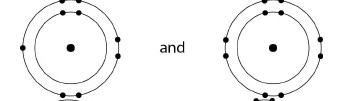
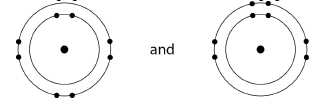
21Which of the following pairs of atoms would be most likely to form a polar covalent bond?
- A
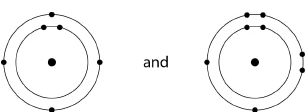
- B
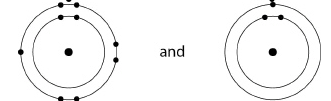
- C
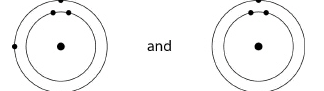
- D
- E
- A
22Which one of the following pairs of atoms would be most likely to form ions and thus an ionic bond?
- A
- B
- C
- D
- E
- A
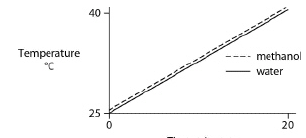
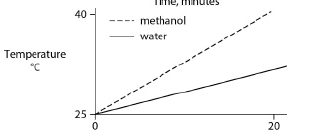
23Identical heat lamps are arranged to shine on identical containers of water and methanol (wood alcohol), so that each liquid absorbs the same amount of energy minute by minute. The covalent bonds of methanol molecules are nonpolar, so there are no hydrogen bonds among methanol molecules. Which of the following graphs correctly describes what will happen to the temperature of the water and the methanol?
- A
- B
- C
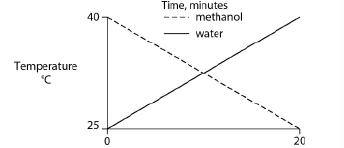
- D
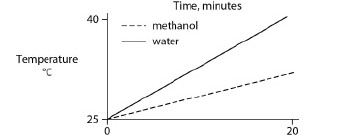
- E
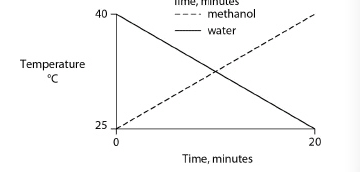
- A
24A group of molecular biologists is trying to synthesize a new artificial compound to mimic the effects of a known hormone that influences sexual behavior. They have turned to you for advice. Which of the following compounds is most likely to mimic the effects of the hormone?
- Aa compound with the same number of carbon atoms as the hormone
- Ba compound with the same molecular mass (measured in daltons) as the hormone
- Ca compound with the same three-dimensional shape as part of the hormone
- Da compound with the same number of orbital electrons as the hormone
- Ea compound with the same number of hydrogen and nitrogen atoms as the hormone
25The reactivity of an atom arises from
- Athe average distance of the outermost electron shell from the nucleus.
- Bthe existence of unpaired electrons in the valence shell.
- Cthe sum of the potential energies of all the electron shells.
- Dthe potential energy of the valence shell.
- Ethe energy difference between the s and p orbitals.
26Which of the following is not considered to be a weak molecular interaction?
- Aa covalent bond
- Ba van der Waals interaction
- Can ionic bond in the presence of water
- Da hydrogen bond
- EA and B only
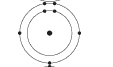
27Which one of the atoms shown would be most likely to form an anion with a charge of -1?
- A
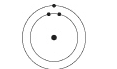
- B
- C

- D

- E

- A
Informações
- Descrição
- Quiz sobre AP Bio Chapter 2, criado por Brooke Nyenhuis em 01-11-2017.
- Autor
- Brooke Nyenhuis
- Idioma
- English
- Visualizações
- 97
- Etiquetas
- Avaliação
- Ainda sem avaliações Avalie este quiz