
Quiz
AP Bio Chapter 3
Crie uma conta grátis para terminar este quiz
Salve seu progresso e veja sua nota final.
Já tem uma conta? Inicie sessão
Perguntas do quiz (35)
1How many molecules of water are needed to completely hydrolyze a polymer that is 9 monomers long?
- A12
- B11
- C10
- D9
- E8
2The bonding of two amino acid molecules to form a larger molecule requires
- Athe release of a water molecule.
- Bthe release of a carbon dioxide molecule.
- Cthe addition of a nitrogen atom.
- Dthe addition of a water molecule.
- Ethe release of a nitrous oxide molecule.
3All of the following are polysaccharides except
- Alactose
- Bglycogen
- Cchitin
- Dcellulose
- Eamylopectin
4The label on a container of margarine lists "hydrogenated vegetable oil" as the major ingredient. What is the result of adding hydrogens to vegetable oil?
- AThe hydrogenated vegetable oil has a lower melting point.
- BThe hydrogenated vegetable oil stays solid at room temperature.
- CThe hydrogenated vegetable oil has more "kinks" in the fatty acid chains.
- DThe hydrogenated vegetable oil has fewer trans fatty acids.
- EThe hydrogenated vegetable oil is less likely to clog arteries.
5All of the following contain amino acids except
- Ahemoglobin
- Bcholesterol
- Cantibodies
- Denzymes
- Einsulin
6At which level(s) of protein structure are interactions between the side chains (R groups) most important?
- Aprimary
- Bsecondary
- Ctertiary
- Dquaternary
- Eprimary, secondary, tertiary, and quaternary
7Which of the following statements best summarizes the differences between DNA and RNA?
- ADNA encodes hereditary information, whereas RNA does not.
- BThe bases in DNA form base-paired duplexes, whereas the bases in RNA do not.
- CDNA nucleotides contain a different sugar than RNA nucleotides.
- DDNA contains the base uracil, whereas RNA contains the base thymine.
- EDNA encodes hereditary information, whereas RNA does not; the bases in DNA form base-paired duplexes, whereas the bases in RNA do not; and DNA nucleotides contain a different sugar than RNA nucleotides.
8The element present in all organic molecules is
- Ahydrogen
- Boxygen
- Ccarbon
- Dnitrogen
- Ephosphorus
9The experimental approach taken in current biological investigations presumes that
- Asimple organic compounds can be synthesized in the laboratory from inorganic precursors, but complex organic compounds such as carbohydrates and proteins can only be synthesized by living organisms.
- Ba life force ultimately controls the activities of living organisms, and this life force cannot be studied by physical or chemical methods.
- Calthough a life force, or vitalism, exists in living organisms, this life force cannot be studied by physical or chemical methods.
- Dliving organisms are composed of the same elements present in nonliving things, plus a few special trace elements found only in living organisms or their products.
- Eliving organisms can be understood in terms of the same physical and chemical laws that can be used to explain all natural phenomena.
10How many electron pairs does carbon share in order to complete its valence shell?
- A1
- B2
- C3
- D4
- E8
11A carbon atom is most likely to form which of the following bonds with other atoms?
- Aionic bond
- Bhydrogen bond
- Ccovalent bond
- Dcovalent bonds and hydrogen bonds
- Eionic bonds, covalent bonds, and hydrogen bonds
12Which of the following is not a monomer/polymer pairing?
- Amonosaccharide/polysaccharide
- Bamino acid/protein
- Ctriglyceride/phospholipid bilayer
- Ddeoxyribonucleotide/DNA
- Eribonucleotide/RNA
13Which of these molecules is not formed by dehydration reactions?
- Afatty acids
- Bdisaccharides
- CDNA
- Dprotein
- Eamylose
14Which of the following is not a polymer?
- Aglucose
- Bstarch
- Ccellulose
- Dchitin
- EDNA
15What is the chemical reaction mechanism by which cells make polymers from monomers?
- Aphosphodiester linkages
- Bhydrolysis
- Cdehydration reactions
- Dionic bonding of monomers
- Ethe formation of disulfide bridges between monomers
16Which of the following is true of cellulose?
- AIt is a polymer composed of enantiomers of glucose.
- BIt is a storage polysaccharide for energy in plant cells.
- CIt is digestible by bacteria in the human gut.
- DIt is a major structural component of plant cell walls.
- EIt is a polymer composed of enantiomers of glucose, it is a storage polysaccharide for energy in plant cells, it is digestible by bacteria in the human gut, and it is a major structural component of plant cell walls.
17Which of the following statements is true regarding the molecule illustrated in Figure 3.8?

- AIt is a saturated fatty acid.
- BA diet rich in this molecule may contribute to atherosclerosis.
- CMolecules of this type are usually liquid at room temperature.
- DIt is a saturated fatty acid, and a diet rich in this molecule may contribute to atherosclerosis.
- EIt is a saturated fatty acid, a diet rich in this molecule may contribute to atherosclerosis, and molecules of this type are usually liquid at room temperature.
18Which bond is a peptide bond?
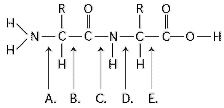
- AA
- BB
- CC
- DD
- EE
19Which bonds are created during the formation of the primary structure of a protein?
- Apeptide bonds
- Bhydrogen bonds
- Cdisulfide bonds
- Dphosphodiester bonds
- Epeptide bonds, hydrogen bonds, and disulfide bonds
20Which type of interaction stabilizes the α helix and the β pleated sheet structures of proteins?
- Ahydrophobic interactions
- Bdisulfide bonds
- Cionic bonds
- Dhydrogen bonds
- Epeptide bonds
21The tertiary structure of a protein is the
- Abonding together of several polypeptide chains by weak bonds.
- Border in which amino acids are joined in a polypeptide chain.
- Cunique three-dimensional shape of the fully folded polypeptide.
- Dorganization of a polypeptide chain into an a helix or b pleated sheet.
- Eoverall protein structure resulting from the aggregation of two or more polypeptide subunits.
22The difference between the sugar in DNA and the sugar in RNA is that the sugar in DNA
- Ais a six-carbon sugar and the sugar in RNA is a five-carbon sugar.
- Bcan form a double-stranded molecule.
- Cis an aldehyde sugar and the sugar in the RNA is a keto sugar.
- Dis in the a configuration and the sugar in RNA is in the b configuration.
- Econtains one less oxygen atom.
23If one strand of a DNA molecule has the sequence of bases 5'ATTGCA3', the other complementary strand would have the sequence
- A5'TAACGT3'.
- B5'TGCAAT3'.
- C5'UAACGU3'.
- D3'UAACGU5'.
- E5'UGCAAU3'.
24Which molecule has hydrophilic and hydrophobic properties and would be found in plasma membranes?
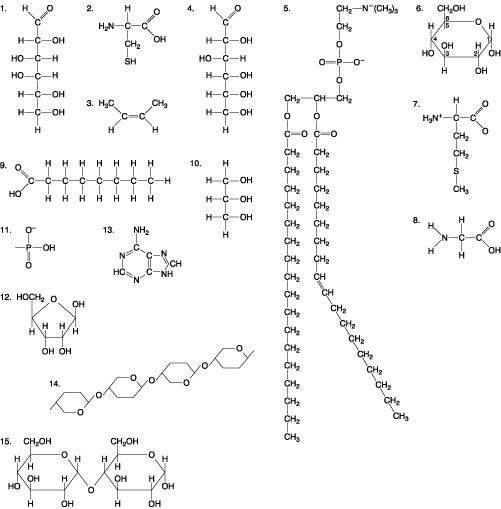
- A1
- B5
- C6
- D12
- E14
25Which of the following combinations could be linked together to form a nucleotide?
- A1, 2, and 11
- B3, 7, and 8
- C5, 9, and 10
- D11, 12, and 13
- E12, 14, and 15
26Which molecule is glycerol?
- A1
- B6
- C10
- D14
- E15
27Which molecule is a saturated fatty acid?
- A1
- B5
- C6
- D8
- E9
28Which of the following molecules is a purine type of nitrogenous base?
- A2
- B3
- C5
- D12
- E13
29Which of the following molecules act as building blocks (monomers) of polypeptides?
- A1, 4, and 6
- B2, 7, and 8
- C7, 8, and 13
- D11, 12, and 13
- E12, 13, and 15
30Which of the following molecules could be joined together by a peptide bond as a result of a dehydration reaction?
- A2 and 3
- B3 and 7
- C7 and 8
- D8 and 9
- E12 and 13
31A fat (or triacylglycerol) would be formed as a result of a dehydration reaction between
- Aone molecule of 9 and three molecules of 10.
- Bthree molecules of 9 and one molecule of 10.
- Cone molecule of 5 and three molecules of 9.
- Dthree molecules of 5 and one molecule of 9.
- Eone molecule of 5 and three molecules of 10.
32Which of the following molecules could be joined together by a phosphodiester type of covalent bond?
- A3 and 4
- B3 and 8
- C6 and 15
- D11 and 12
- E11 and 13
33Which of the following molecules contains a glycosidic linkage type of covalent bond?
- A4
- B6
- C12
- D13
- E15
34Which of the following molecules consists of a hydrophilic "head" region and a hydrophobic "tail" region?
- A2
- B5
- C7
- D9
- E11
35Which of the following statements is false?
- A1 and 4 could be joined together by a glycosidic linkage to form a disaccharide.
- B9 and 10 could be joined together by ester bonds to form a triacylglycerol.
- C2 and 7 could be joined together to form a short peptide.
- D2, 7, and 8 could be joined together to form a short peptide.
- E14 and 15 could be joined together to form a polypeptide.
Informações
- Descrição
- Quiz sobre AP Bio Chapter 3, criado por Brooke Nyenhuis em 01-11-2017.
- Autor
- Brooke Nyenhuis
- Idioma
- English
- Visualizações
- 294
- Etiquetas
- Avaliação
- Ainda sem avaliações Avalie este quiz