
Quiz
Palate quiz
Este quiz tem tipos de pergunta que abrem no player de sempre.
Perguntas do quiz (34)
1What structures are being pointed to in this image?
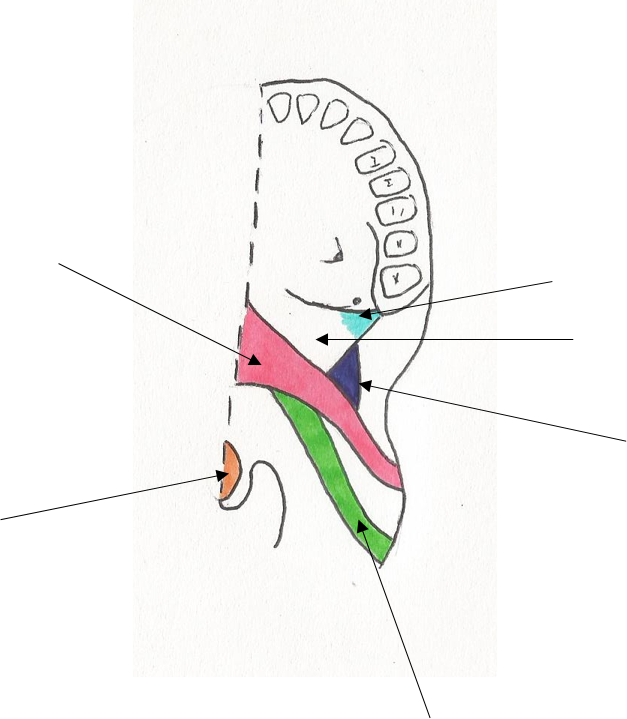
- ALevator veli palatini
- BPalatoglossus
- CPalatopharyngeus
- DTensor veli palatini
- EMusculus uvulae
- FLevator veli palatini
- GTensor veli palatini
- HMusculus uvulae
- IPalatoglossus
- JPalatopharyngeus
- KTenors veli palatini
- LLevator veli palatini
- MPalatoglossus
- NPalatopharyngeus
- OMusculus uvulae
- PTensor veli palatini
- QLevator veli palatini
- RMusculus uvulae
- SPalatoglossus
- TPalatopharyngeus
- UPalatoglossus
- VPalatopharyngeus
- WPalatine aponeurosis
- XTensor veli palatini
- YLevator veli palatini
- ZTenors veli palatini
- AALevator veli palatini
- ABPalatine aponeurosis
- ACPalatoglossus
- ADMusculus uvulae
2Where does fertilisation occur?
- AUterus
- BAmpulla of the uterine tube
- COvary
- DIsthmus of the uterine tube
3The zona pellucida breaks down during fertilisation.
- AVerdadeiro
- BFalso
4The trophoblast differentiates into the cytotrophoblast.
- AVerdadeiro
- BFalso
5After gastrulation the three germ layers that form are the hypoblast, mesoderm and endoderm.
- AVerdadeiro
- BFalso
6The first pharynegeal arch is associated with the [blank_start]Trigeminal[blank_end] nerve. Pharyngeal arch two is associated with the [blank_start]facial[blank_end] nerve. [blank_start]Glossopharyngeal[blank_end] nerve is associated with the third pharyngeal arch and the [blank_start]vagus[blank_end] nerve is associated with the fourth and sixth pharyngeal arches.
- Atrigeminal
- Bfacial
- CGlossopharyngeal
- Dvagus
7Which pharyngeal arch does the maxillary and mandibular prominence's arise from?
- AFirst
- BSecond
- CThird
- DFourth-sixth
- EFifth
8The lateral nasal swellings form the intermaxillary segment.
- AVerdadeiro
- BFalso
9The incisive foramen is the landmark between the primary and secondary palates.
- AVerdadeiro
- BFalso
10Which of these foramen are found on the hard palate?
- Agreater palatine foramen
- Blesser palatine foramen
- Cinfraorbital foramen
- DIncisive fossa
- Emental spines
11The greater palatine foramen can be located near the first molar tooth on either side of the hard palate.
- AVerdadeiro
- BFalso
12The palatine aponeurosis, which is an expansion of the [blank_start]tensor veli palatini tendons[blank_end], strengthens the soft palate. The palatine aponeurosis is thin posteriorly where it ends in a free margin and thick anteriorly where it attaches to the [blank_start]hard palate[blank_end]. The [blank_start]palatine aponeurosis[blank_end] mainly forms the the anterior part of the soft palate, whereas the posterior part of the soft palate is mainly formed form [blank_start]muscle[blank_end]. The aponeurosis also serves as a site for muscle attachment for the other palatine muscle
- Atensor veli palatini tendons
- Blevator veli palatini tendons
- Cmusculus uvulae
- Dpalatopharyngeus tendons
- Epharynx
- Fhard palate
- Gtongue
- Hpalatoglossus muscle
- Ibone
- Jpalatine muscles
- Kconnective tissue
- Lpalatine aponeurosis
- Mmuscle
- Npalatine aponeurosis
- Obone
- Pconnective tissue
13Which muscles are involved in elevating the soft palate?
- Alevator veli palatini
- Bmusculus uvulae
- Cpalatoglossus
- Dpalatopharyngeal
14Which muscles are involved in depressing the soft palate?
- Alevator veli palatini
- Bmusculus uvulae
- Cpalatoglossus
- Dpalatopharyngeal
15Which of these muscles are supplied by the vagus nerve?
- Atensor veli palatini
- Blevator veli palatini
- Cmusculus uvulae
- Dpalatoglossus
- Epalatopharyngeus
16Which other nerve supplies the soft palate, along with the lesser palatine nerve?
- Avagus
- Bfacial
- Cglossopharyngeal
- Dhypoglossal
17The greater palatine nerve terminates in the oral cavity?
- AVerdadeiro
- BFalso
18The [blank_start]soft[blank_end] palate contains taste papillae that are referred to as palate papillae. The palate papillae are morphologically similar to [blank_start]fungiform papillae[blank_end] that are located on the anterior aspect of the tongue. The gustatory function of the soft palate is predominately innervated by the [blank_start]greater petrosal nerve[blank_end]. However, some are innervated by the deep petrosal nerve. The soft palate is most sensitive to [blank_start]sweet[blank_end] sensation.
- Asoft
- Bhard
- Cfiliform papillae
- Dfungiform papillae
- Efoliate papillae
- Fcircumvallate papillae
- Glesser palatine nerve
- Hgreater petrosal nerve
- Igreater palatine nerve
- Jnasopalatine nerve
- Kbitter
- Lunami
- Msour
- Nsweet
- Osalty
19The transport of food is done by the "squeeze-back" method
- AVerdadeiro
- BFalso
20The soft palate helps direct air flow?
- AVerdadeiro
- BFalso
21The soft palate is depressed during oral breathing.
- AVerdadeiro
- BFalso
22The levator veli palatini muscles are most active during oral breathing.
- AVerdadeiro
- BFalso
23Individuals with flat palates tend to have an increased vowel production .
- AVerdadeiro
- BFalso
24Clefts of the primary palate occur posterior to the incisive foramen.
- AVerdadeiro
- BFalso
25Name the type of cleft palate pointed to by the arrows.
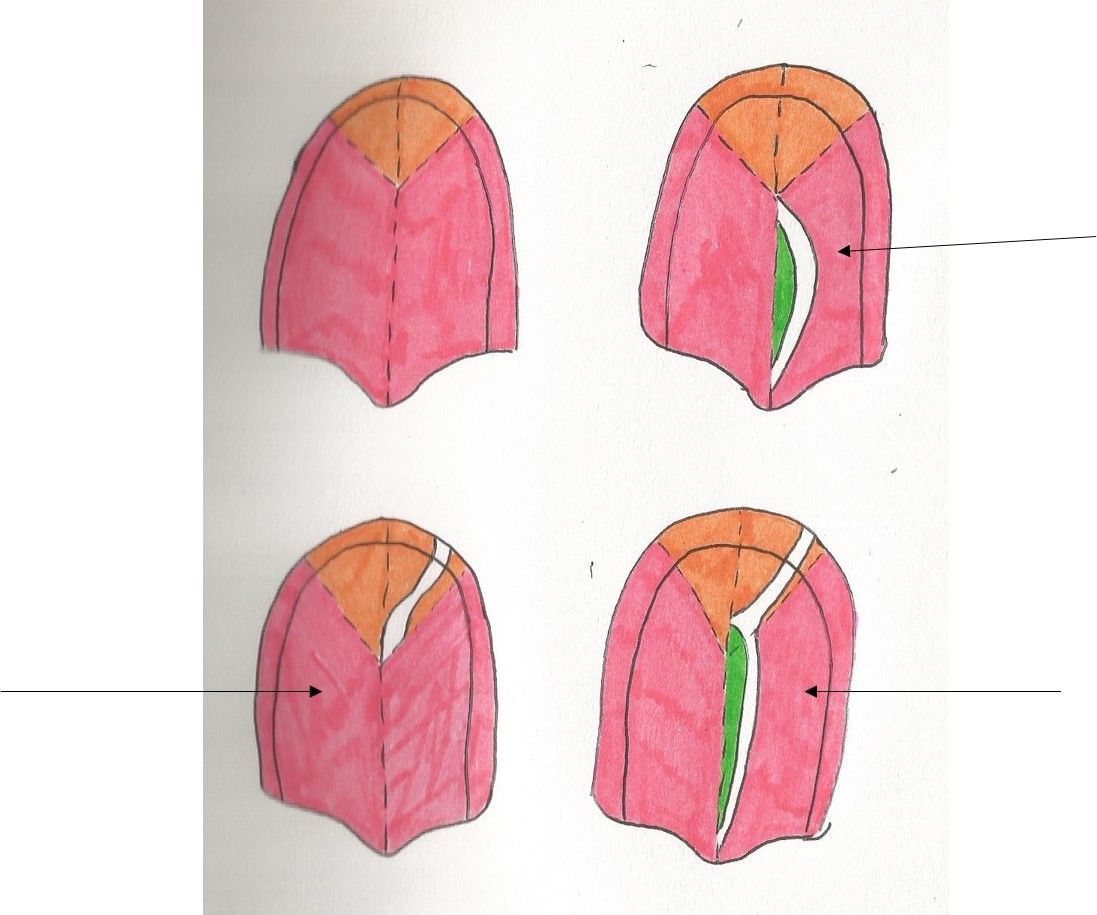
- Aprimary cleft palate
- Bsecondary cleft palate
- Cprimary + secondary cleft palate
- Dprimary cleft palate
- Esecondary cleft palate
- Fprimary + secondary cleft palate
- Gprimary cleft palate
- Hsecondary cleft palate
- Iprimary + secondary cleft palate
26Cleft palates can reduce the nasal airways?
- AVerdadeiro
- BFalso
27At week six the [blank_start]palatine shelves[blank_end] grow inferiorly on either side of the tongue. In week [blank_start]seven[blank_end] the palatine shelves rotate and move to a [blank_start]horizontal[blank_end] position above the tongue. The palatine shelves will fuse in the midline and continue to fuse anteriorly and posteriorly. The nasal septum will grow [blank_start]inferiorly[blank_end] to fuse with the superior surface of the palate. The fusion of the nasal septum and palate separates the oral cavity and the nasal cavity. Rotation of the shelves is believed to be due to synthesis and hydration of [blank_start]hyaluronic acid[blank_end] within the extracellular matrix of the shelves.
- Apalatine shelves
- Bmedial nasal prominences
- Clateral nasal prominences
- Dnine
- Esix
- Fseven
- Geight
- Hhorizontal
- Ivertical
- Joblique
- Ksuperiorly
- Linferiorly
- Mposteriorly
- Nanteriorly
- Ohyaluronic acid
- Plactic acid
- Qformic acid
- Rmalic acid
28The palatine processes of the [blank_start]maxillae[blank_end] and the [blank_start]palatine[blank_end] bone are the main components of the hard palate. The palatine processes of the maxillae makes up the anterior [blank_start]three-quarters[blank_end]. The palatine bones form the posterior [blank_start]one-quarter[blank_end].
- Amaxillae
- Btemporal bone
- Csphenoid bone
- Dmandibular
- Epalatine
- Fthree-quarters
- Gtwo-thirds
- Hone-third
- Ione-quarter
29To reach the palate the greater and lesser palatine nerves descends through the pterygopalatine fossa and [blank_start]palatine canal[blank_end]. The greater palatine nerve supplies the [blank_start]hard palate[blank_end] and gingiva. The lesser palatine nerve, which supplies the [blank_start]soft palate[blank_end], travels through the lesser palatine foramen and passes [blank_start]posteromedially[blank_end].
- Apalatine canal
- Blesser palatine foramen
- Cincisive foramen
- Dhard palate
- Epalatoglossus muscle
- Fsoft palate
- Gpalatopharyngeus
- Hposteromedially
- Ianteromedially
- Janterolaterally
- Kposterolaterally
30During swallowing the soft palate is [blank_start]elevated[blank_end], separating the oral cavity and the nasal cavity, closing the [blank_start]pharyngeal[blank_end] isthmus. The actions allows the transport of food to the pharynx and prevents food entering the nasal cavity. The main muscle involved in elevation of the soft palate is the [blank_start]levator veli palatini[blank_end] muscles. The musculus uvulae will assist in this action.
- Aelevated
- Bpharyngeal
- Clevator veli palatini
31The [blank_start]soft[blank_end] palate is lowered and contacts the [blank_start]posterior[blank_end] part of the tongue, closing the [blank_start]oropharyngeal[blank_end] isthmus, during [blank_start]nasal[blank_end] breathing. The [blank_start]palatoglossus[blank_end] is the muscle most active during nasal breathing.
- Asoft
- Bhard
- Canterior
- Dposterior
- Emedial
- Flateral
- Goropharyngeal
- Hpharyngeal
- Inasal
- Jnon-nasal
- Kpalatopharyngeus
- Lpalatoglossus
- Mlevator veli palatini
- Ntensor veli palatini
32The soft palate is elevated during [blank_start]non-nasal[blank_end] sounds so air is expelled only through the [blank_start]mouth[blank_end]. When the soft palate is depressed then this produces [blank_start]nasal[blank_end] sounds. Hypernasal resonance and nasal emissions occur when there is an inadequate closure of the [blank_start]pharyngeal isthmus[blank_end] during speech production. The soft palate is generally elevated by the [blank_start]levator veli palatini[blank_end] muscles during speech. Elevation of the soft palate is [blank_start]lower[blank_end] during speech than it is during swallowing.
- Anon-nasal
- Bnasal
- Cmouth
- Dnose
- Enon-nasal
- Fnasal
- Gpharyngeal isthmus
- Horopharyngeal isthmus
- Itensor veli palatini
- Jlevator veli palatini
- Kpalatoglossus
- Lpalatopharyngeus
- Mlower
- Nhigh
33Problems that can occur in an individual with a cleft palate include weak articulation of consonants. The consonant '[blank_start]s[blank_end]' appears to be the most common articulation difficulty. Cleft palate patients avoid using [blank_start]nasal[blank_end] consonants and instead use [blank_start]non-nasal[blank_end] consonants. For example, using 'm' instead of 'b'. Omission is another speech problem with cleft palates. Omission of speech is where the [blank_start]last[blank_end] consonant is missed to avoid any nasal emission.
- As
- Bm
- CL
- Dnasal
- Enon-nasal
- Flast
- Gmiddle
- Hfirst
34If the cleft palate is accompanied by a cleft lip a lip repair is done first and normally occurs around [blank_start]three months[blank_end]. At about [blank_start]six months to one year[blank_end] a cleft palate repair is done. Surgery normally occurs early on to help in feeding and to avoid any speech habits. When the individual is around [blank_start]five[blank_end] years of age they will undergo rhinoplasty.
- Athree months
- Bone month
- Cten months
- Dsix months
- Eone month to three months
- Fsix months to one year
- Gone year to two years
- Hthree months to six months
- Ifive
- Jten
- Kone
- Ltwo
Informações
- Descrição
- Quiz sobre Palate quiz, criado por Tara McLaughlin em 11-03-2018.
- Autor
- Tara McLaughlin
- Idioma
- English
- Visualizações
- 311
- Avaliação
- Ainda sem avaliações Avalie este quiz