
Quiz
Mental State Exam
Este quiz tem tipos de pergunta que abrem no player de sempre.
Perguntas do quiz (12)
1In terms of a clinical consultation:
[blank_start]History[blank_end] = A patient's account of events
[blank_start]Mental State Exam[blank_end] = An objective assessment based on observation- AMental State Exam
- BHistory
2Although most of it is done as part of the history, the Mental State Exam does have a recommended structure.
What is the normal order in which a Mental State Exam is conducted?
[blank_start]Appearance & Behaviour[blank_end]
[blank_start]Speech[blank_end]
[blank_start]Mood & Affect[blank_end]
[blank_start]Thoughts (control & content)[blank_end]
[blank_start]Perception[blank_end]
[blank_start]Cognition[blank_end]
[blank_start]Insight[blank_end]- AAppearance & Behaviour
- BSpeech
- CMood & Affect
- DThoughts (control & content)
- EPerception
- FCognition
- GInsight
3Of the following options, which 4 could be assessed as part of the 'Behaviour' section of the MSE?
- AEye Contact
- BRapport with doctor
- CAgitation
- DDisinhibition
- ERate of speech
- FWhether mood is low or high
- GWhether they are able to list months of the year backwards
4What is the definition of disinhibition?
- AA lack of restraint manifested in disregard for social conventions
- BA lack of mood fluctuation in response to questioning/stimulus - can be consistently low mood or vice versa
- CInability to refrain from moving, e.g. patient may refuse to sit down and constantly walk/twitch/etc
5Difference between mood & affect:
[blank_start]Mood[blank_end] = How the patient feels in themselves today - doctors usually quote what they say
[blank_start]Affect[blank_end] = Doctor's observation of how patient appears throughout a conversation- AMood
- BAffect
6Which of the following describes a stable mood, whereby a patient has a normal, tranquil mental state.
- AEuthymic
- BEurhythmic
- CEuthalamic
7From the graph, which colour shows a reactive affect and which shows an unreactive affect?
Reactive affect = [blank_start]Black[blank_end]
Unreactive affect = [blank_start]Red[blank_end]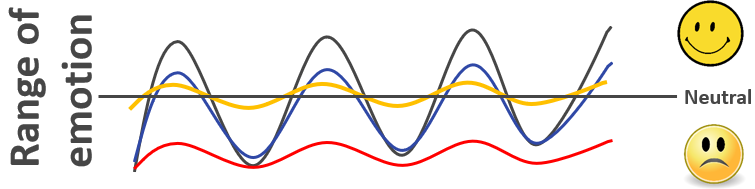
- ABlack
- BYellow
- CBlue
- DRed
8Name the different types of affect given below:
[blank_start]Blunted[blank_end] affect = A moderate reduction in an individual's emotional response to a stimulus
[blank_start]Flattened[blank_end] affect = A severe reduction in an individual's emotional response to a stimulus
[blank_start]Labile[blank_end] affect = Extreme fluctuations in an individual's emotional response to a stimulus - highs are very high, lows are very low- ABlunted
- BFlattened
- CLabile
9Patients with schizophrenia tend to have which type of affect?
- ABlunted/Flattened Affect
- BLabile Affect
- CElation Affect
10What are the three aspects of cognitive function and how are they assessed?
[blank_start]Orientation to Time, Place and Person[blank_end] = “What is today’s date?”, “What is the current month?”, “Where are we right now?” among other questions
[blank_start]Concentration[blank_end] = “Can you go through the months of the year backwards for me?”
[blank_start]Memory[blank_end] = “In which year was the last Olympic games held?”, “What were the dates of the second world war?”- AOrientation to Time, Place and Person
- BCoherence
- CAwareness
- DConcentration
- EMemory
11Which part of the mental state exam considers whether the patient recognises that they are unwell?
[blank_start]Insight[blank_end]- AInsight
12Which part of the mental state exam concerns hallucinations and illusions (visual, auditory, etc)?
[blank_start]Perception[blank_end]- APerception
Informações
- Descrição
- Dr Dow's lecture regarding the mental state examination on 01/10/2018
- Autor
- Matthew Coulson
- Idioma
- English
- Visualizações
- 1.310
- Etiquetas
- Avaliação
- Ainda sem avaliações Avalie este quiz