
Quiz
Motor System
Este quiz tem tipos de pergunta que abrem no player de sempre.
Perguntas do quiz (55)
1Three types of movements (antialphabetic):
- [blank_start]Voluntary[blank_end] movements
- [blank_start]Rhythmic[blank_end] movements
- [blank_start]Reflexes[blank_end]- AVoluntary
- BRhythmic
- CReflexes
2The visuomotor delay is approximately [blank_start]200[blank_end] ms.
The proprioceptive delay is approximately [blank_start]50[blank_end] ms.- A200
- B250
- C300
- D150
- E50
- F30
- G80
- H150
3Three things that make motor control difficult (alphabetic):
- [blank_start]environmental[blank_end] uncertainty
- [blank_start]motor[blank_end] noise
- [blank_start]sensory[blank_end] noise- Aenvironmental
- Bmotor
- Csensory
4The human body has "only" 600 muscles. Nonetheless motor control is very difficult, since the number of possible movement patterns increases [blank_start]exponentially[blank_end] with the [blank_start]degrees of freedom[blank_end].
- Aexponentially
- Bdegrees of freedom
5The principle of [blank_start]redundancy[blank_end] means that there is a [blank_start]gap[blank_end] between high- and low-level specification. Any high level task can be achieved in [blank_start]infinitely[blank_end] many low level ways.
- Aredundancy
- Bgap
- Cinfinitely
6[blank_start]Fitt's[blank_end] law describes the [blank_start]speed-accuracy[blank_end] trade-off.
- AFitt's
- Bspeed-accuracy
7In simple grasping tasks the paths of hand movements are usually [blank_start]straight[blank_end] and the speed profiles are [blank_start]bell-shaped[blank_end].
- Astraight
- Bbell-shaped
8The two-thirds power law:
[blank_start]angular[blank_end] velocity ~ [blank_start]curvature[blank_end]^(2/3)- Aangular
- Bcurvature
9Three levels of analysis:
(1) [blank_start]Computational[blank_end]: What is the [blank_start]problem[blank_end] the brain is trying to solve?
(2) [blank_start]Algorithmic[blank_end]: What is the [blank_start]strategy[blank_end] to solve this problem?
(3) [blank_start]Neuronal[blank_end]: How is it done by the nervous system?- AComputational
- BAlgorithmic
- CNeuronal
- Dproblem
- Estrategy
10The forward model [blank_start]predicts behaviour[blank_end] based on [blank_start]motor commands[blank_end].
The inverse model [blank_start]calculates motor commands[blank_end] from [blank_start]desired behaviour[blank_end].- Apredicts behaviour
- Bmotor commands
- Ccalculates motor commands
- Ddesired behaviour
- Epredicts motor commands
11Feedforward ([blank_start]open[blank_end]-loop) control:
Because of the delays in the sensorimotor system, open-loop control is used for [blank_start]short[blank_end] movements.
Disadvantages:
- [blank_start]Inaccuracies[blank_end] cannot be corrected
- [blank_start]Unexpected changes[blank_end] will not be taken into account- Ashort
- Blong
- Copen
- Dclosed
- EInaccuracies
- FDelays
- GNoise
- HUnexpected changes
- IInaccuracies
- JNoise
12In order for feedforward control to be sufficient, the [blank_start]inverse[blank_end] model would have to be perfect.
- Ainverse
13Feedback (closed-loop) control can compensate for errors due to
- Aneural noise
- Bunexpected changes in the outside world
- Cinaccurate motor commands
- Dthe sensorimotor delay
- Eproprioception
14In an experiment, subjects are given 400g blocks and practice to lift them.
After training the weight is surprisingly increased to 800g.
The experiment shows the subjects use- Afeedforward control.
- Bfeedback control.
- Cboth feedforward and feedback control.
15The [blank_start]gain[blank_end] factor is the amount by which the [blank_start]corrective[blank_end] motor command is increased or decreased per unit of error.
- Again
- Bcorrective
16[blank_start]High[blank_end] gain and [blank_start]high[blank_end] sensorimotor delay can lead to [blank_start]overcompensation[blank_end] and [blank_start]instabilities[blank_end].
- AHigh
- BLow
- Chigh
- Dlow
- Eovercompensation
- Ftoo little compensation
- Ginstabilities
- Ha stable motor command
17An [blank_start]efference[blank_end] copy is an internal copy of an outflowing ([blank_start]efferent[blank_end]), movement-producing signal generated by the motor system.
- Aefference
- Bafference
- Cefferent
- Dafferent
18Two strategies to compensate for sensory delays:
(1) [blank_start]Intermittency[blank_end] of movements
(2) [blank_start]Prediction[blank_end]- AIntermittency
- BPrediction
19The experiment where you move your eyeball with your hand and the world moves shows that the brain uses [blank_start]motor commands to the eye[blank_end] in order to predict the eye's position.
- Amotor commands to the eye
- Bsensors in the eye muscles
20What's the problem with using a forward model in feedback control to predict the position of a limb.
- AErrors accumulate over time.
- BDelay leads to instabilites.
- CActually an inverse model would have to be used.
21Which are the main structures of the CNS involved in motor control?
- Apons
- Bspinal cord: reflexes
- Cbrainstem: facial muscles
- Dcerebral cortex as the generator
- Ecerebellum
- Fbasal ganglia
- Gmedulla oblongata
- Hhippocampus
- Identate gyrus
22A motor unit consists of [blank_start]a spinal motor neuron[blank_end] and [blank_start]the muscle fibres that it innervates.[blank_end]
- Aa spinal motor neuron
- Ba sensory interneuron
- Ca pyramidal motor neuron
- Dthe muscle fibres that it innervates.
- Ethe motor neurons it projects to.
- Fthe disc in the spinal cord it projects
23A muscle is typically innervated by [blank_start]a few hundred[blank_end] spinal motor neurons.
- Aa few hundred
- Ba few thousand
- Cabout 50
- Dabout 50.000
24The [blank_start]innervation number[blank_end] tells how many muscle fibres a motor neuron innervates.
- Ainnervation number
25The innervation number
- Aindicates the increment in force when the motor unit is activated.
- Bcan be very different for the same muscle.
- Cis the same for all neurons that project to one muscle
- Dindicates the speed by which the muscle is activated
26The muscle force is controlled by
- Arecruitment (how many motor neurons of the unit fire)
- Bthe discharge rate of motor units
- Cthe innervation number of the motor unit
- Dthe axon diameter of the motor neuron
27Motor units differ in [blank_start]speed[blank_end] and maximum [blank_start]force[blank_end].
- Aspeed
- Bforce
28Recruitment:
[blank_start]Small[blank_end] motor neurons are recruited first because of the [blank_start]high[blank_end] resistance within their axon.
They have a [blank_start]lower[blank_end] innervation number and therefore produce [blank_start]less[blank_end] force.- ASmall
- BLarge
- Chigh
- Dlow
- Elower
- Fhigher
- Gless
- Hmore
29Spinal reflexes are [blank_start]involuntary[blank_end] and triggered by [blank_start]external stimuli[blank_end].
Despite classical theory they can be quite flexible.- Ainvoluntary
- Bexternal stimuli
30The withdrawal from a painful stimulus is called [blank_start]flexion-withdrawal[blank_end] reflex.
The [blank_start]flexor[blank_end] muscle is activated and the [blank_start]extensor[blank_end] muscle is inhibited.
This is called [blank_start]reciprocal innervation[blank_end].
The opposite effect happens on the [blank_start]contralateral[blank_end] limb.
The force [blank_start]does[blank_end] (does or does not) depend on the stimulus intensity.- Aflexion-withdrawal
- Bflexor
- Cextensor
- Dreciprocal innervation
- Econtralateral
- Fdoes
31The stretch reflex is a [blank_start]muscle contraction[blank_end] in response to stretching within the muscle.
The antagonist muscle is inhibited, this is called [blank_start]reciprocal innervation[blank_end].
The stretch reflex increases the [blank_start]stiffness[blank_end] of the muscle.- Astiffness
- Bmuscle contraction
- Creciprocal innervation
32The areas of the cerebral cortex that are used in motor control:
- [blank_start]Primary motor cortex[blank_end] (M1)
- [blank_start]Premotor cortex[blank_end] (PM)
- [blank_start]Supplementary motor area[blank_end] (SMA)- APrimary motor cortex
- BPremotor cortex
- CSupplementary motor area
33The motor cortices receive input from
- Athe somatosensory cortex
- Bthe posterior parietal cortex
- Cthe temporal lobe
- Dthe cerebellum
34The motor homunculus is most detailed for the [blank_start]primary motor cortex[blank_end].
It disappears if you [blank_start]zoom on[blank_end].- Aprimary motor cortex
- Bpremotor cortex
- Csupplementary motor area
- Dzoom in
- Ezoom out
35The motor pathway to lateral motorneurons runs [blank_start]contralateral[blank_end] and controls mainly [blank_start]distal muscles[blank_end].
It includes the [blank_start]corticospinal tract[blank_end].
The patway to medial motorneurons runs [blank_start]ipsilateral[blank_end] and controls mainly [blank_start]stance and posture[blank_end].- Acontralateral
- Bipsilateral
- Cdistal muscles
- Dnearby muscles
- Ecorticospinal tract
- Fmedial tract
- Gipsilateral
- Hcontralateral
- Istance and posture
- Jfine movements
- Kunconscious movements
36The corticospinal tract
The connections come from the cortical layer [blank_start]V[blank_end].
Many of these connections terminate on spinal [blank_start]interneurons[blank_end].
Only [blank_start]M1[blank_end] contains neurons projecting directly to spinal motor neurons. These cortical neurons are called [blank_start]corticomotorneurons[blank_end]. Those neurons have only one synapse.- AV
- BIV
- CIII
- DII
- EI
- Finterneurons
- Gmedial neurons
- Hprojection neurons
- IM1
- JPM
- KSMA
- Lcorticomotorneurons
- Mcomplex neurons
37The axons of corticomotorneurons terminate on [blank_start]spinal motor neurons[blank_end].
The can also influence other muscles via spinal [blank_start]interneurons[blank_end].
Most of the time the excite agonist muscles and inhibit antagonist ones.- Aspinal motor neurons
- Bthe muscle fiber
- Cinterneurons
- Dprojection neurons
- Ereceptors
38Reading information about the direction of a movement from several motor neurons is done via [blank_start]population codes[blank_end].
- Apopulation codes
39Neuronal tuning with respect to movement means
- Athat firing rates of cortical motor neurons correlate with parameters of movement, e.g. direction, velocity, acceleration, ...
- Bthat reinforcement learning can be applied to fine-tune execution of motor tasks.
- Cthat firing rates of cortical motor neurons are highly intercorrelated ("tuning each other")
40Different digits of the hand are controlled by sharply separated areas in M1.
- AVerdadeiro
- BFalso
41Four symptoms of cerebellar disorders:
[blank_start]Hypotonia[blank_end]: A diminished resistance to passive limb displacements.
[blank_start]Astasia-abasia[blank_end]: An inability to stand or walk.
[blank_start]Ataxia[blank_end]: The abnormal execution of multijointed voluntary movements, characterized by lack of coordination.
[blank_start]Action tremor[blank_end]: A form of tremor at the end of a movement, when the patient attempts to stop the movement by using antagonist muscles.- AHypotonia
- BAstasia-abasia
- CAtaxia
- DAction tremor
42The basal ganglia are involved in
- Areinforcement motor learning
- Baction selection
- Cmovement initiation
- Donline motor control
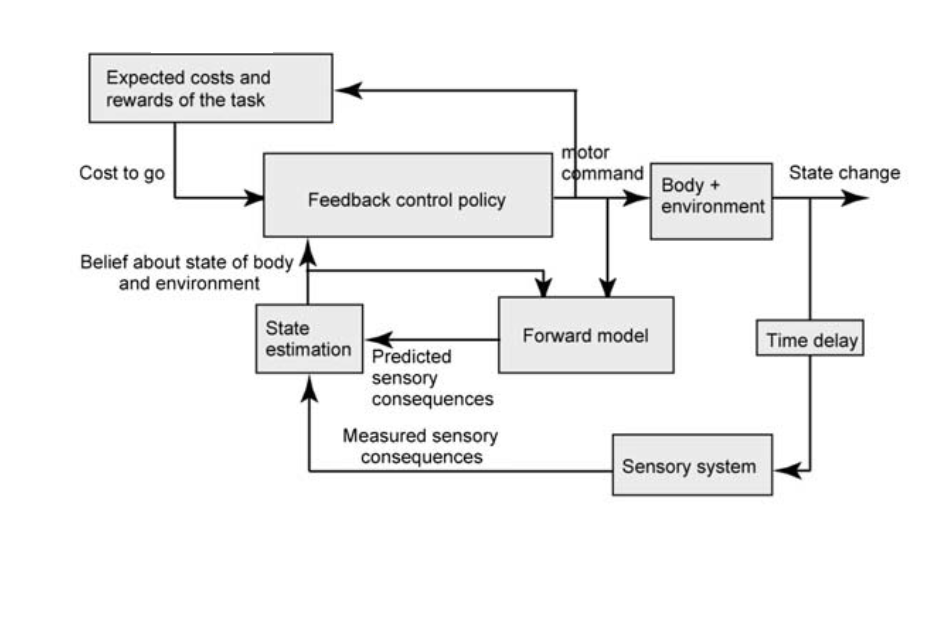
43Relation between function and areas of the brain (hypothesis)
- Abasal ganglia
- Bmotor cortex
- Cparietal cortex
- Dcerebellum
- Ethalamus
- Fprefrontal cortex
- Gmedulla oblongata
44The motor control loop
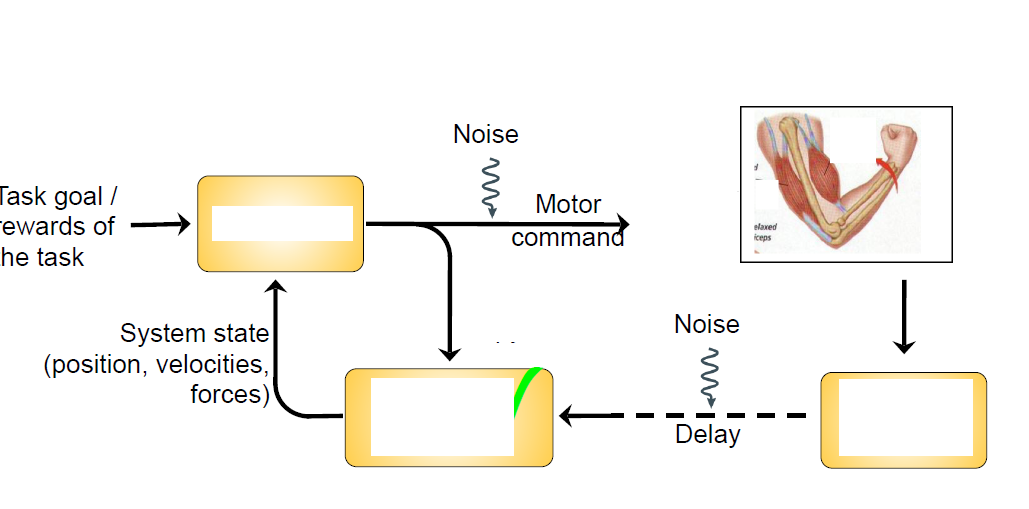
- Acontroller
- Bstate estimation
- Cefference copy
- Dsensory feedback
- Eforward model
- Finverse model
- Ggain
45?
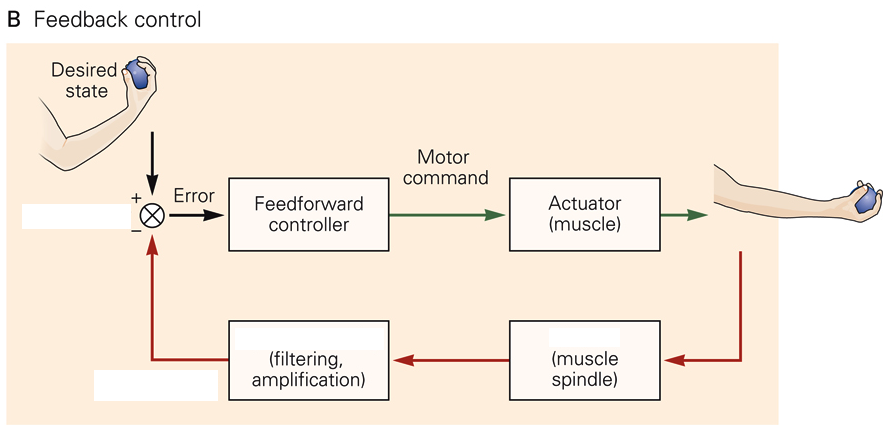
- AComparator
- BSensed state
- CInput processing
- DSensor
- EForward model
- FInverse model
- GEstimated state
46?
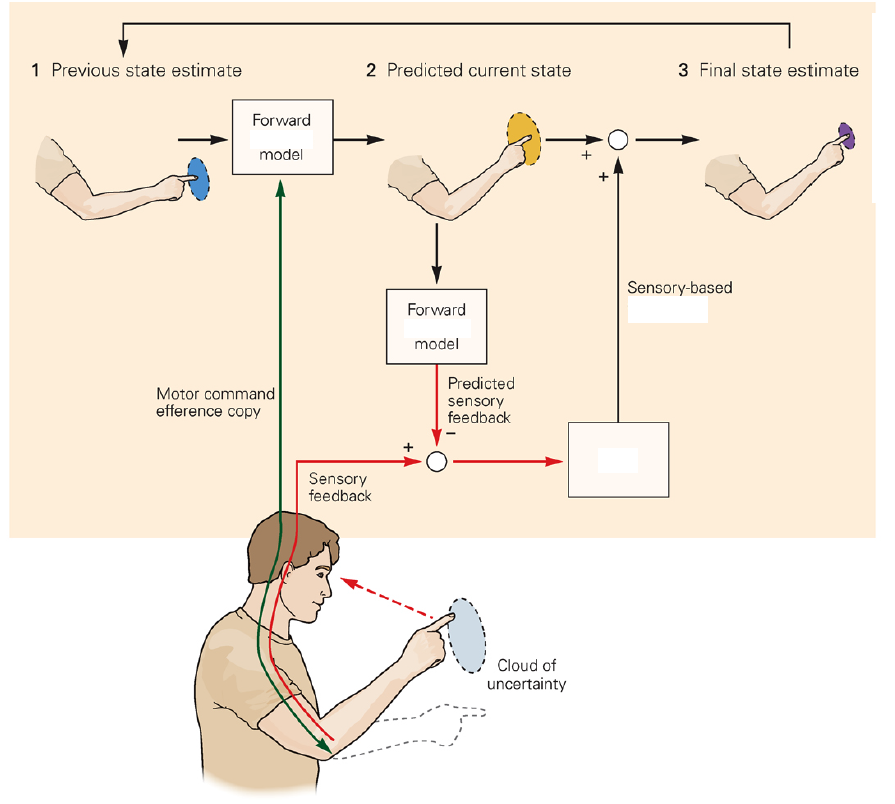
- Adynamic
- Bpredictive
- Csensory
- Dcorrection
- Eestimation
- Fgain
47?
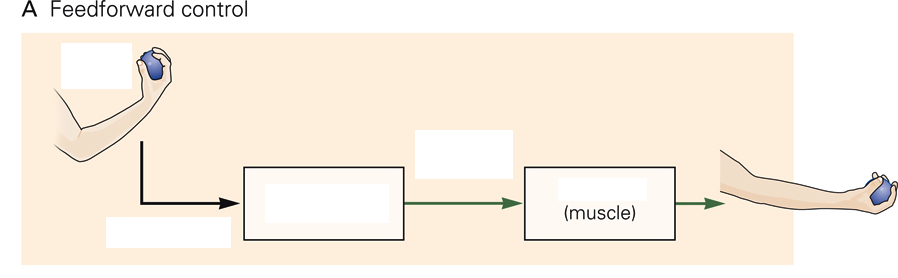
- ADesired state
- BEstimated state
- CFeedforward controller
- DInverse controller
- EMotor command
- FState estimation
- GActuator
48Optimal feedback control

- Aposition
- Bweight
- Cmotor command
49?
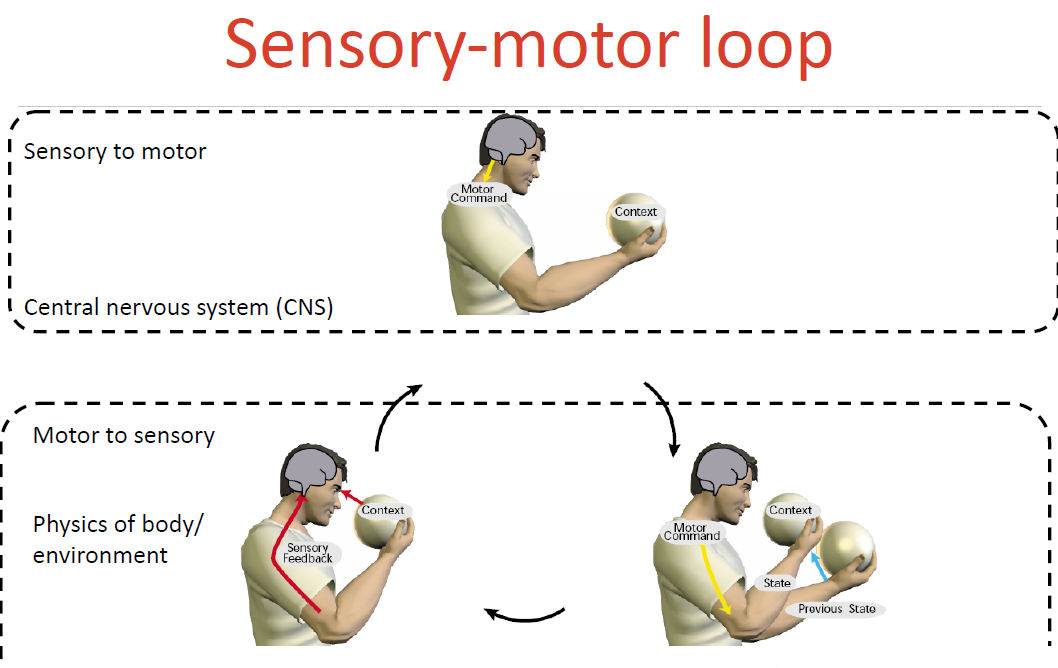
- AMotor command
- BSensory feedback and proprioception
- CState transition
- DState estimation
- EForward model
- FInverse model
- GGain factor
50The forward-model is used at the [blank_start]beginning[blank_end] of movements.
- Abeginning
- Bend
51There are slow- and fast-[blank_start]twitch[blank_end] muscle fibers.
- Atwitch
52[blank_start]Supraspinal[blank_end] centers play an important role in modulating and adapting spinal reflexes, even to the extent of reversing movements when appropriate.
- ASupraspinal
53Stretch reflex:
In addition to the muscle that is stretched [blank_start]synergistic[blank_end] muscles are contracted.- Asynergistic
54M1: Brodman [blank_start]4[blank_end]
PM & SMA: Brodman [blank_start]6[blank_end]- A4
- B6
55Motor areas
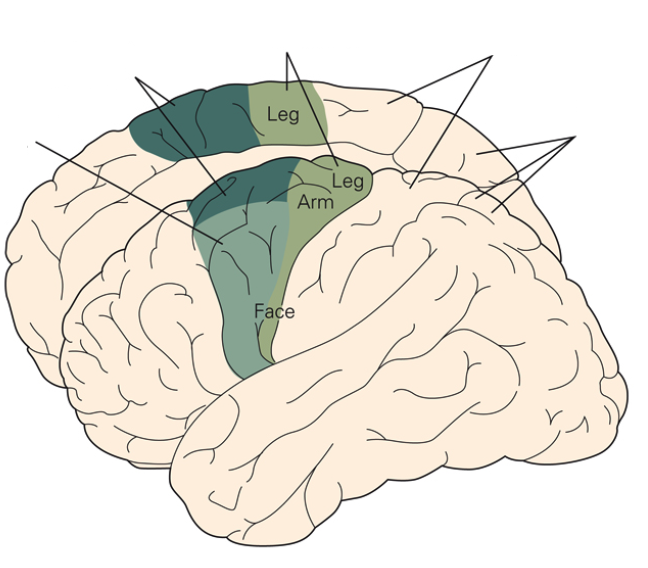
- APosterior parietal cortex
- BPrimary somatosensory cortex
- CPrimary motor cortex
- DPremotor cortex
- ESupplementary motor area
Informações
- Descrição
- Master Neuroscience (From Membrane to Brain [Lecture]) Quiz sobre Motor System, criado por Lukas Paulun em 08-11-2018.
- Autor
- Lukas Paulun
- Idioma
- Deutsch
- Visualizações
- 357
- Etiquetas
- Avaliação
- Ainda sem avaliações Avalie este quiz