
Quiz
How much do you know about Language teaching Materials?
Este quiz tem tipos de pergunta que abrem no player de sempre.
Perguntas do quiz (16)
1Choose the right answer(s):
"Materials are ____________no less rooted in a particular time and culture than any other in-
stance of human activity, and, as such, are shaped by the context in which they occur"- ACultural Artifacts

- BCultural Developments

- CBoth

- ACultural Artifacts
2The notion that human action is socially and temporally located can be attributed to Phillipson, Edge and Cameron (2002)

- AVerdadeiro
- BFalso
3Choose the right answer(s) (You can select one or more options)
In relation to materials design and English Teaching lesson oplan, during the 1950/60's anf the Cold War Period, some stregies were:
- AMim-mem exercises

- BLanguage laboratories

- CPattern-practice drills Atomised samples

- DCommunicative Language Tasks

- EAll of them
- AMim-mem exercises
4At a time when [blank_start]behaviourism[blank_end] was very much the dominant force in psychology and [blank_start]learning theory[blank_end], it is perhaps not surprising that most of the extra funds from the 1958 Act went directly into these behaviourist inspired [blank_start]methodologies[blank_end], but the nett effect is that behaviourism in one form of another has been firmly cemented into [blank_start]language teaching materials[blank_end], with its persistence right up to the present day, as the continuing use of drills, substitution tables and such like, demonstrates.

- Abehaviourism
- Blearning theory
- Cmethodologies
- Dlanguage teaching materials
5During the late 1960s to the late [blank_start]1970[blank_end]s the era was marked by a shift towards [blank_start]alternative ways[blank_end] of doing things – a word frequently found in the titles of many publications of the time. ‘Flower power,’ ‘[blank_start]the love generation[blank_end],’ ‘dropping
out,’ ‘do your own thing’ and DIY (Do It Yourself) were all key concepts of the time.
- A1970
- B1990
- C1950
- Dstrict ways
- Ealternative ways
- Fbehaviorist ways
- Gthe weird generation
- Hthe best cognitive generation
- Ithe love generation
6During the 1960/70's, it was not only in respect of [blank_start]humanistic approaches[blank_end] that the urge towards an alternative was found. The notion of ‘doing your own thing’ and DIY quickly found echoes in another major development in language [blank_start]pedagogy[blank_end] in this time – [blank_start]self-access work[blank_end], featuring self-study materials and teacherless language learning, often carried out in ex-language laboratories now stripped of their hutch-like partitions, so that pairs of learners could work on the same [blank_start]material[blank_end].

- AHumanistic approaches
- BCognitive approaches
- CCommunicative approaches
- DSelf-access independence
- ESelf-access language structures
- FSelf-access work
- Gpedagogy
- Htheory
- Imetacognition
- Jmaterial
- Kproject
- Lspace
- Mbooks
7The following picture is an example of:

- AELT functionally-based materials
8Interestingly, during the 1960/70's we also saw the origins of another example of the rejection of mainstream, establishment methodologies in a new perspective on language acquisition theory: Krashen’s Input Hypothesis. Krashen aimed to take language teaching back to a more natural, simpler life, where learners would produce language when they were “ready,” free of the “extensive use of conscious grammatical rules” and “tedious drill”

- AVerdadeiro
- BFalso
9The following image corresponds to:
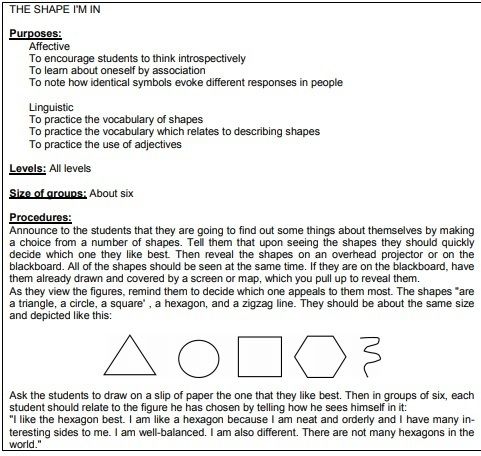
- AA humanistic language practice exercise
- BA behavioristic language practice
- CA grammar practice exercise
10Choose the right answer, more than one option is possible:
The Communicative Language Teaching movement, as a clear break from the top-down regime of grammar rules and
specifications of rights and wrongs in language form, championed:- AThe way language should be, grammar areas and notions to replace functions and notions.
- BHow ordinary people use the language, functions and notions to replace grammar areas.
- CBoth.
11 The process of [blank_start]embourgeoisement[blank_end] (Goldthorpe, 1963, 1987), in which the increasingly affluent working class populations of the developed economies were said to be taking on the [blank_start]individualist[blank_end] mindset of the middle classes, had firmly taken root. This shift away from collectivist goals and the prevalence of a concern for individualism, prompted the journalist and social critic, Tom Wolfe (1976) to term the 1970s the ‘[blank_start]Me[blank_end] Decade.’

- Aembourgeoisement
- Bcapitalization
- Cneo-liberalism
- Dcooperativism
- Eindividualist
- Fcommunicative
- GMoney
- HMe
- IYou
- JPoor
12Select the right answers:
A particular note during the ‘Me decade’ was the recognition that learners have their own unique ways of approaching language study, that is, their own styles and strategies. important publications during this period were:
Ellis and Sinclair’s “Learning to Learn English,”- ANaiman et al.’s landmark “The Good Language Learner” study (1978)

- BEllis and Sinclair’s “Learning to Learn English,” (1989) and Littlejohn ‘The democratisation of language’ (1987)

- CNaiman et al.’s landmark “The Good Language Learner” study (1978) and Ellis and Sinclair’s “Learning to Learn English,” (1989)

- ANaiman et al.’s landmark “The Good Language Learner” study (1978)
13This is an example of McDonalization in English Teaching Textbooks, choose its parts.
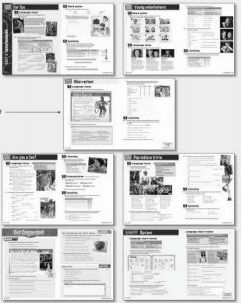
- ATwo Language Lessons per page
- BA Get Connected review
- CMini Review
- DLanguage Lessons Itself
- EMini review
- FA Get Connected and Unit Review
14Within the McDonalization process what is notable is the manner in which the materials aim to provide not only a [blank_start]guide[blank_end] to
[blank_start]how[blank_end] the teachers and learners are to interact, but, further, precisely [blank_start]what[blank_end] they are to say to each other.
- Aguide
- Bspace
- Cidea
- Dwhom
- Ewhere
- Fhow
- Ghow
- Hwhat
- Iwhich
15McDonaldization, in a nutshell, is NOT characterised by an absolute emphasis on efficiency and total predictability.

- AVerdadeiro
- BFalso
16Neo-liberalism requires the commodification of [blank_start]interactions[blank_end], whether they involve a physical product or an intangible service. The key to the ‘successful’ function of the [blank_start]market[blank_end] is atomisation - the subdivision and [blank_start]specification[blank_end] of goods
and services, such that ‘added value’ can be determined through monetisation – that is, that a detailed breakdown of interactions and [blank_start]products[blank_end] is given a monetary value, which can be accounted for, traded, accumulated or invested.
- Ainteractions
- Bcommunication
- Cexperiences
- Dpublic
- Emarket
- Fmoney
- Gcollaboration
- Haccumulation
- Ispecification
- Jproducts
- Kpeople
- Lpsychology
Informações
- Descrição
- Language Teaching Materials and the (Very) Big Picture Andrew Littlejohn Sultan Qaboos University, Oman
- Autor
- Lizeth Castillo Mise
- Idioma
- Español
- Visualizações
- 25
- Histórico
- Criado em 30 abr 2019 · atualizado em 30 abr 2019
- Avaliação
- Ainda sem avaliações Avalie este quiz