
Quiz
NSF Week 5
Crie uma conta grátis para terminar este quiz
Salve seu progresso e veja sua nota final.
Já tem uma conta? Inicie sessão
Perguntas do quiz (30)
1A 67-year-old male with history of hypertension presents to the ER with acute left sided weakness and dysarthria. He was last seen with a normal examination about 90 minutes ago. Which of the following would exclude him from being an IV tPA candidate?
- AA blood pressure of 150/95
- BAn EKG demonstrating Afib?
- CA 1 cm hyperdense subcortical lesion on CT head
- DA history of stroke 2 years ago
2What do the ASPECTS score and CT perfusion studies have in common?
- AThey can differentiate if a patient would be more likely to benefit from tPA or mechanical thrombectomy
- BThey can help estimate if there is a penumbra warranting acute intervention
- CThey provide prognostic information about the likelihood of functional independence at 90 days
- DThey determine the degree of risk for hemorrhagic conversion of the infarct if tPA is given
3A 42 year-old man who has a history of using cocaine presents to the ER because he reportedly became suddenly unresponsive after taking some drugs. On your assessment, you find that his blood pressure is 162/98 with a heart rate of 96. You note that his eyes do open with some minimal stimulation. He isn't following verbal commands. CT angiogram of the head shows a mid-basilar artery occlusion. Which of the following WRITTEN commands do you expect this patient to follow if he is in a locked-in state?
- A"look up"
- B"Hold up 2 fingers"
- C"smile"
- D"look left"
4Please refer to the attached image to answer the following question: A 76-year-old right-handed female with history of diabetes presents with drooling on the right side of her face with completely paralyzed right arm and right leg. The patient is fully conversant (no aphasia) but has slurred speech (dysarthric). Which of the following most likely represents her MRI Scan?
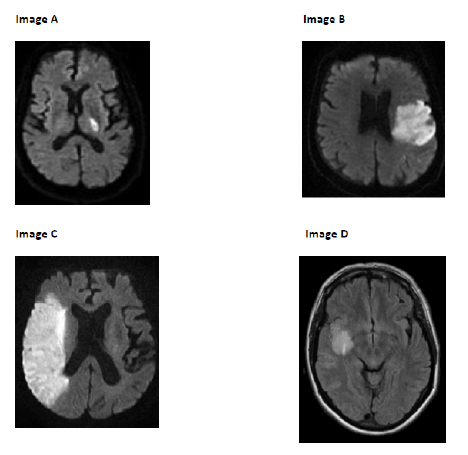
- AA
- BB
- CC
- DD
5A 59-year-old smoker with hypertension presents to the emergency room with signs of a stroke. Since you were a rock star in NSF, you told your attending that you think he has a brainstem stroke because he has opposite findings in his face and his body. You obtain an MRI brain and a CT angiogram quickly, and confirm that there has been a right PICA occlusion. What symptom is he most likely to have?
- ALeft arm ataxia
- BRight arm decrease in temp/sensation
- CLeft miosis
- DRight ptosis
6A 63-year-old woman presented to the hospital with new right arm weakness starting three days ago, but is otherwise well and on no medications. She has normal vital signs and mental status. An MRI of the brain shows evidence of 3 recent strokes (within the last 10 days). The first is a 1 cm lesion in the left frontal lobe, and accounts for current symptoms. A second stroke is a 2 cm infarct at the junction of the right medial posterior temporal and occipital lobes. A third stroke is a 0.5 cm infarct in the left parietal lobe. Which test would be the most likely to find the cause of her strokes?
- Acarotid US
- BEKG/telemetry
- Ccerebral angiography
- Drepeat MRI brain w/ contrast
7Identify the correct risk that has been most strongly associated with natalizumab therapy for multiple sclerosis?
- ASystemic flushing reaction
- BFlu-like symptoms
- Cprogressive multifocal leukoencephalopathy
- Dherpes encephalitis
8A previously healthy 17 year-old girl has a right reactive afferent pupillary defect that is noted in clinic visit, following a 2 day course of progressive eye pain and decreasing visual acuity in that eye. Which of the following treatments is most appropriate?
- AInterferon beta 1a
- Bnatalizumab
- Cglatiramer acetate
- DIV methylprednisolone
9A 45 year-old (y/o) woman was diagnosed with bilateral optic neuritis at 19 y/o. She next had clinical symptoms with sensory loss in her left leg at 25 y/o. At that time she had multiple periventricular demyelinating plaques on a brain MRI, some of which were enhanced with contrast. She developed a transverse myelitis at 31 y/o. In the last three years, she has had increasing difficulty with lower extremity spasticity leading to loss of independent ambulation, and she has had steadily worsening cognitive difficulties and depression. All MRIs in the past 3 years demonstrate Gadolinium enhancement. Which clinical entity best describes the disease course?
- ARelapsing-remitting MS
- BPrimary progressive MS
- CSecondary progressive MS
- DClinically isolated symptoms
10A 37 year old woman has had 3 strokes over the last 18 months. Each infarct is in a different vascular distribution and small-medium in size. She has had negative telemetry, echocardiogram, carotid ultrasounds, and hypercoagulability workup. For CNS
vasculitis, which of the following provides a definitive diagnosis?- Aserum inflammatory markers (ESR/CRP)
- Bcerebral angiogram
- Clumbar puncture to evaluate for pleocytosis and positive oligoclonal bands
- Dbrain biopsy
11A 23 year old graduate student seems strangely giddy to her friends over the past 5 days and she has begun saying bizarre things out of context to the situation. She is brought to the emergency room by her roommate after a seizure. Over the next few days, she
has a worsening encephalopathy and new involuntary movements of the mouth and cheek. Which antibody test helped to confirm
her diagnosis?- ANMDAR Ab
- BNMO-IgG
- Canti-Hu Ab
- Danti-Yo Ab
12A 17-year-old woman has developed a worsening daily headache over the past year. She complains that her vision darkens for a few seconds when she coughs, and when she lies down there's a pulsatile ringing in her ears. She takes albuterol and fluticasone for asthma and she recently started taking tretinoin (Retin-A) for acne. What is the most concerning outcome if her headaches remain untreated?
- AHerniation
- BSeizures
- CVisual field loss
- Dsubarachnoid hemorrhage
13A 25-year-old-first year medical student has started having intense headaches during the first 3 months of medical school. Her roommate is a second-year in NSF, and she becomes increasingly worried after seeing pictures of brain tumor pathology on her
roommate's computer screen. Which of the following features of her headache would be most consistent with a primary headache disorder?- AHeadaches are new w/in the past 6 months
- BThey are intermittent and accompanied by nausea and photophobia
- CShe does not have a family hx of headache disorders
- DHer pain intensifies when she lies down
14A 16-year-old boy has been having headaches with photophobia and phonophobia. They frequently last 3-4 hours, and the worst headaches cause him to vomit and miss school. He usually develops a blind spot in his periphery prior to his headache with shimmering lights around the edge. He used to treat his headaches successfully with ibuprofen, but this has become less effective. What would you recommend next for abortive treatment of these headaches?
- Aoral oxycodone (opiate)
- BIntravenous dihydroergotamine (serotonin agonist)
- Coral amitriptyline (tricyclic antidepressant)
- Dintranasal sumatriptan (serotonin agonist)
15A 62-year-old woman describes intense stabbing pain in her jaw ~5 times/day, and this is often precipitated when brushing her teeth on the right side of her mouth or drinking hot liquids. She has no autonomic symptoms. The most appropriate first-line treatment is
which of the following?- Aaspirin
- Bindomethacin
- Ccarbamezapine
- Doxygen
16A 26 year-old man with a history of anxiety presents with 2 weeks of severe headaches starting every day at 8 pm. His headaches are supraorbital, located solely on the left side and last up to 2 hours. What clinical features would you expect in this patient?
- Alacrimation
- Bnausea
- Cvisual aura
- Dpulsatile tinnitus
17Please refer to the attached image to answer the following question: A 74-year old left-handed woman is brought to the clinic because of reduced awareness of stimuli on the left side of her body. When presented with food, she shows only interest in items on her right. You ask her to draw a clock (see image attached). Damage to what part of her brain is most likely to explain her symptoms?
- ARight parietal lobe
- BLeft parietal lobe
- CRight frontal lobe
- DLeft frontal lobe
18While undergoing abdominal surgery, a 78-year-old man has a prolonged episode of hypotension. As a result of selective vulnerability, which of the following brain regions is most likely to have suffered injury?
- Ahippocampus
- Bbilateral inferior occipital lobes
- Ccentral pons
- Dlateral frontal-parietal cortex
19Intracranial hemorrhage due to long-standing hypertension is most commonly located where?
- Afrontal and parietal lobes
- Bsubarachnoid space
- Coccipital and temporal lobes
- Dbasal ganglia
20Please refer to the attached image to answer the following question. a 68 y.o. woman is transferred from an outside hospital. The transfer note simply says "history of stroke". If her stroke is similar to the lesion in the photograph attached, the most likely time interval since the onset of her stroke is which of the following?
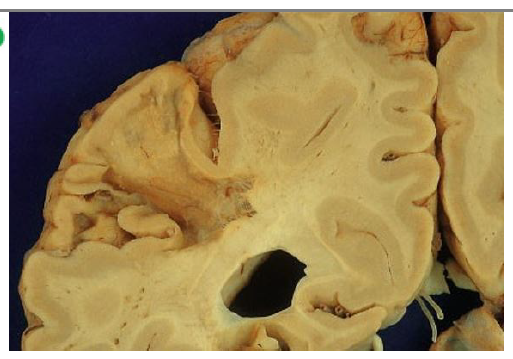
- Aless than 12 hours
- B24-48 hours
- Cone week
- Dsix months
21A 55 y.o. male w/ a hix of HTN, diabetes, coronary artery disease, alcohol use, and cigarette smoking presents with a sudden onset "worse headache" of his life, nausea, vomiting, and loss of consciousness. Non-contrast CT head is shown. What is the most likely etiology of hemorrhage?
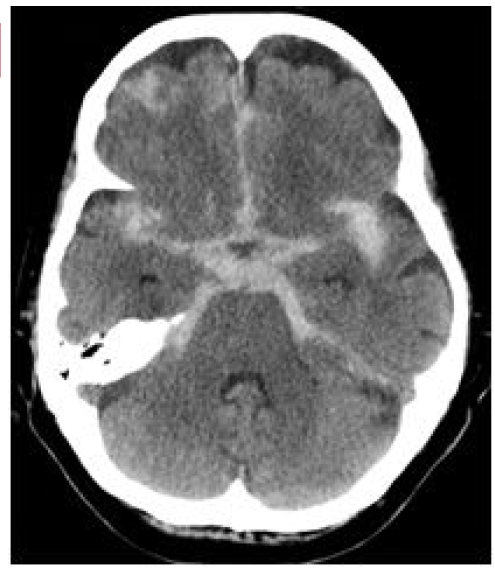
- AHypertension
- Bcerebral amyloid angiopathy
- Cvenous infarction
- Dcerebral aneurysmal rupture
22A 68 y.o. male is brought to ED by his family for altered mental status. Medical hx is significant for coronary artery disease, transient ischemic attacks, COPD, and HTN. Over the past 2-3 weeks, he has been sleeping more than usual and he is confused. Physical examination is significant for orientation to self only and mild left upper and lower extremity weakness. CT scan demonstrates a crescent shaped hematoma. What is the most likely etiology?
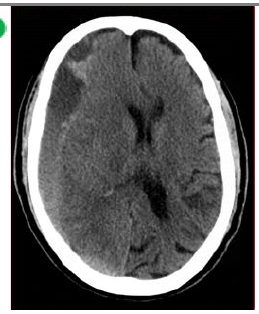
- Arupture of middle meningeal artery
- Brupture of middle cerebral artery aneurysm
- Ctearing of bridging veins
- Docclusion of the superior sagittal sinus
23In considering the blood brain barrier, which of the following is a characteristic of cerebral capillaries?
- Afenestrated endothelium
- Bpassive diffusivity of large molecules (e.g. insulin, immunoglobulins)
- Cbarrier to passage of amino acids and glucose
- Dtight junctions comprised of occludins and claudins
24A 34-year-old woman presented with weakness of her right leg and tingling in her right arm. MRI demonstrated several welldemarcated
lesions involving periventricular white matter and internal capsule extending into the thalamus. Which cell population
is most likely undergoing cell death at this time?- Aoligodendrocytes
- Bmacrophages
- Castrocytes
- Dendothelial cells
25Multiple sclerosis plaques can be active, inactive or shadow. Which of the following is a feature of an inactive multiple sclerosis
plaque?- Areactive astrocytes
- Bincreased number of oligodendrocytes
- Cremyelination
- Dperivascular lymphocytes
26A 29-year-old woman presents with a neurologic disease that includes both spinal cord and visual symptoms, suggestive of
neuromyelitis optica (NMO). Which of the following is a pathologic feature of NMO, but not multiple sclerosis?- Aremyelination
- Bdecreased aquaporin 4
- Cspinal cord involvement
- Dperivascular inflammation
27A 75-year-old woman with atrial fibrillation presents to the emergency room and is found to have bilateral occipital strokes. Her
pupils are reactive and she denies vision problems, but she bumps into things when walking and is unable to visually identify
objects in the room. What is her diagnosis?- Aapraxia
- Bprosopagnosia
- Ccortical blindness
- Daphasia
28A 25-year-old man displays inappropriate social behavior and impulsiveness after recovering from coma due to severe head
trauma. On neuropsychological testing, he performs poorly on tests requiring suppression of automatic responses, such as "go-nogo" and alternating sequences. Language function and visuospatial function are intact. He most likely has damage to which of the
following?- ABroca's area
- Bfusiform gyrus
- Cdorsolateral frontal cortex
- Dorbitofrontal cortex
29Use the attached image to answer the following question. A 72-year-old man had sudden onset of confusion and was brought to the hospital. He was found to have a lesion similar to that shown in the attached photograph. Which of the following is the most likely diagnosis for this lesion?
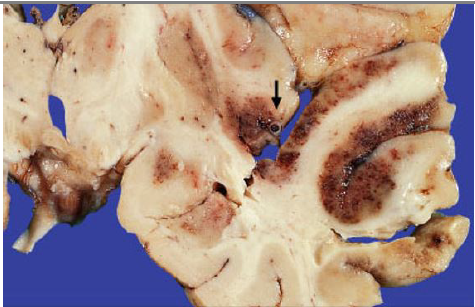
- Aamyloid angiopathy
- Bhypertensive hemorrhage
- Cre-perfused ischemic infarct
- Dvenous infarct
30Which of the following can account for low CSF concentration of a lipophilic molecule (2 correct answers)?
- Ahigh polarity
- Befflux transporters
- Clow molecular weight
- Dlow serum protein binding
Informações
- Descrição
- Quiz sobre NSF Week 5, criado por Erin Urbanowicz em 20-09-2019.
- Autor
- Erin Urbanowicz
- Idioma
- English
- Visualizações
- 102
- Histórico
- Criado em 20 set 2019 · atualizado em 30 set 2019
- Avaliação
- Ainda sem avaliações Avalie este quiz