
Quiz
Study Guide 13 - Winter 2015
Crie uma conta grátis para terminar este quiz
Salve seu progresso e veja sua nota final.
Já tem uma conta? Inicie sessão
Perguntas do quiz (39)
1Xeroderma pigmentosum, can be considered a disease linked to a deficiency in a protein required within the transcription apparatus. Why?
- AThe disease xeroderma pigmentosum is caused by a defect in a cell's ability to repair DNA damage caused by irradiation, amongst other causes. A DNA damage repair complex is required, which consists of several DNA repair proteins, including XPC, XPF, XPG, and ERCC1, associated with the
core of TFIIH during transcription elongation. XPC recognizes damaged DNA and provides a link between the processes of transcription and preferential repair of the transcribed DNA strand. XPF, XPG, and ERCC1 are endonucleases involved with the repair process. In addition to these proteins, the TFIIH complex also includes the protein XPD, a helicase involved in both the initial creation of the transcription bubble and the melting of DNA at the site of damage. Mutations in any of the XP genes cause the disease. - Bnone of these
- AThe disease xeroderma pigmentosum is caused by a defect in a cell's ability to repair DNA damage caused by irradiation, amongst other causes. A DNA damage repair complex is required, which consists of several DNA repair proteins, including XPC, XPF, XPG, and ERCC1, associated with the
2A cis-acting DNA sequence restricted to a fixed position physically distant from a promoter recognized by RNA polymerase II does not effectively influence the initiation of transcription, ; however, the same sequence brought into a close physical proximity with the promoter facilitates efficient transcription. Describe why the sequence must be in close proximity to the core promoter region for function.
- ADNA sequences to which proteins bind effectively influence the initiation of transcription by increasing the concentration of activator proteins in close physical proximity of the core promoter; therefore, the physical placement of the sequence is crucial to its function. Restriction of the placement of a sequence would limit its ability to physically contact the core promoter, effectively eliminating its effect on transcription initiation. Enhancer sequences can increase transcription efficiency even when maintaining positions several kb upstream or downstream of the start-point, regardless of their orientation, ; however, the intervening DNA must be flexible so that it can be looped out of the way such that the enhancer and promoter are brought into close proximity.
- Bnone of these
3 The nucleotide sequence elements within the promoters of genes recognized by RNA polymerase II are assembled in a "mix and match" fashion. A). Explain the regulatory significance of this organizational pattern. B). Considering the fact that sequence elements can function in either orientation, what does this suggest regarding the function of nucleotide sequence elements within the process of transcription initiation?
- ADNA sequences to which proteins bind effectively influence the initiation of transcription by increasing the concentration of activator proteins in close physical proximity of the core promoter, ; therefore, the physical placement of the sequence is crucial to its function. Restriction of the placement of a sequence would limit its ability to physically contact the core promoter, effectively eliminating its effect on transcription initiation. Enhancer sequences can increase transcription efficiency even when maintaining positions several kb upstream or downstream of the start-point, regardless of their orientation, ; however, the intervening DNA must be flexible so that it can be looped out of the way such that the enhancer and promoter are brought into close proximity.
- BA variety of elements including the GC box and CAAT box can contribute to the function of the promoter; however, none of the nucleotide sequence elements are essential for all promoters. Therefore, promoters may contain the same sequence elements or maintain a completely different organization. This organizational pattern confers a level of regulation due to the unique combination of nucleotide sequence elements contained within each promoter. The diverse combination of sequence elements ensures activation of the gene will only occur in the presence of a specific
combination of DNA binding proteins. - CThe function of sequence elements is to bring proteins within the vicinity of the basal apparatus to facilitate initiation. The fact that the sequence elements can function in either orientation demonstrates that the promoter sequence must be flexible enough to facilitate the protein-–protein
interactions between individual transcription factors and between transcription factors and the basal apparatus.
4Eukaryotic RNA polymerases can be distinguished by their sensitivities to ____________.
- Aactinomycin D
- Balpha-amanitin
- Cchloramphenicol
- Drifampicin
5Pre-initiation begins with either _________ or TATA binding protein binding to the core promoter
- ATFIID
- BTFIIH
- CTFIIE
- DTFIIF
6The C-terminal domain of the largest RNA polymerase subunit must be ____________ for chain elongation to occur.
- Amethylated
- Bphosphorylated
- Cglycosylated
- Dprotonated
7Which of the following is NOT a function of some type of RNA?
- ACarrying nucleotide sequence information
- BMetabolic energy transformation
- CControl of protein production
- DTranslation of nucleotide sequence into amino acid sequence
- ECatalysis of chemical reactions
8A consensus sequence is one that is
- Adeduced from investigation of crystal structures of DNA binding proteins interacting with DNA.
- Bdeduced from studying the effects of mutation on a single nucleotide, such as the promoter of one gene.
- Cdeduced by comparing sequences, looking for perfect matches in all sequences.
- Ddeduced by comparing sequences, looking for a high level of agreement, though not necessarily a perfect match, between all sequences.
- Ededuced from whole genome sequence analysis, looking for protein coding regions that are identical.
9The nucleotide sequences upstream from a transcriptional start site and where RNA polymerase binds to convert DNA from a closed to an open complex are called a(n)
- A-35 sequence.
- Benhancer.
- CShine-Dalgarno sequence
- DKozak sequence
- Epromoter.
10Figure 1 shows the results of a site directed mutagenesis experiment analyzing the upstream region of the mouse Beta-globin gene. Specific point mutations were introduced into upstream region and then the ability of the mutated upstream region to promote transcription was measured, with the transcriptional activity of the wild-type sequence designated as 1.0.
What conclusion about the ATATAA sequence marked by the open box is warranted by the data?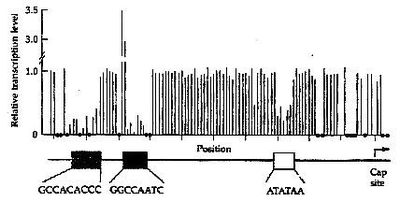
- AIt is a location where proteins can bind to reduce transcription.
- BIt is a sequence needed for positive regulation of transcription.
- CIt signals the ribosome to begin translation at the next ATG
- DIt base pairs with a short sequence in the 16S rRNA
- EThe reduction in relative transcription at this site indicates that the sequence is used to signal transcription termination.
11Figure 1 shows the results of a site directed mutagenesis experiment analyzing the upstream region of the mouse Beta-globin gene. Specific point mutations were introduced into upstream region and then the ability of the mutated upstream region to promote transcription was measured, with the transcriptional activity of the wild-type sequence designated as 1.0.
The molecule being mutated in this experiment is: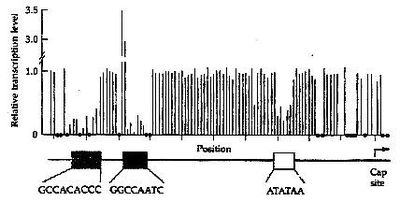
- AmRNA
- BDNA
- Cprotein
- DrRNA
- EcRNA
12Figure 1 shows the results of a site directed mutagenesis experiment analyzing the upstream region of the mouse Beta-globin gene. Specific point mutations were introduced into upstream region and then the ability of the mutated upstream region to promote transcription was measured, with the transcriptional activity of the wild-type sequence designated as 1.0.
The right angle arrow above the location labeled as the “Cap site” indicates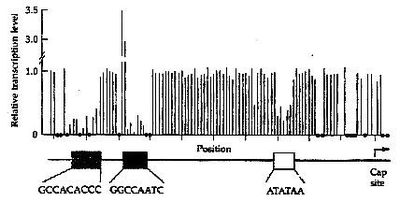
- Athe deoxyribonucleotide to which the 5' cap is added.
- Bthe location of the start codon.
- Cthe first nucleotide to be used in transcription (+1).
- Dan decreased level of transcription due to a mutation.
- Ethe promoter sequence.
13Figure 1 shows the results of a site directed mutagenesis experiment analyzing the upstream region of the mouse Beta-globin gene. Specific point mutations were introduced into upstream region and then the ability of the mutated upstream region to promote transcription was measured, with the transcriptional activity of the wild-type sequence designated as 1.0.
Transcription begins ______________ the GGCCAATC sequence.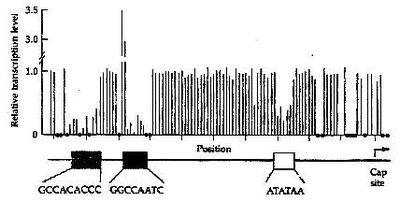
- Ato the 5' side of
- Bby snRNP U2 binding to
- Cwhen cis-acting proteins bind to
- Dby disrupting the Shine-Dalgarno sequence of.
- Edownstream of
14Which of the following is not true about RNA polymerase in bacteria?
- ARNA polymerase core enzyme will bind to any DNA.
- BRNA polymerase will only bind to the promoter.
- CSigma factors determine specificity of RNA polymerase.
- DIt is made of five subunits.
- ESynthesis of RNA occurs in a 5' to 3' direction
15If Rho factors are mutated and rendered non-functional,
- ANothing would happen.
- BAll the transcripts would be longer.
- CAll the transcripts would be shorter.
- DSome transcripts would be longer and others would be normal length.
- ESome transcripts would be shorter and others would be longer.
16RNA samples were isolated from liver cells before and after treatment with insulin, and the RNA samples were sequenced using the RNA-Seq method. For gene A the number of times the sequence appeared before insulin treatment was quite high, but after insulin treatment the frequency of sequences matching gene A were quite low. What does this reveal about expression of gene A?
- AInsulin treatment increased the number of copies of gene A in the genme.
- BExpression of gene A is unaffected by insulin.
- CGene A transcription is greater before insulin treatment.
- DTranscription of gene A is elevated after cells are exposed to insulin.
- EThe protein encoded by gene A is more active after insulin treatment.
17In Rho-dependent termination…
- ARho binds to the operator and represses transcription.
- BRho binds to the rut site on the coding strand.
- CRho binds to the rut site on the template strand.
- DRho binds to the rut site on the mRNA.
- ERho binds to galactosides and regulates the lac operon.
- ARho binds to the operator and represses transcription.
18 The start site of transcription would best be indicated by which of the following?
- A-35
- B-10
- C+1
- DTATA
- EGU/AG
- A-35
19An electrophoretic mobility shift assay is used to
- AA. determine the start of transcription
- BB. determine the abundance of a single mRNA even if a great many other RNAs are present.
- CC. identify the mRNA termination proteins in rho-independent termination of transcription.
- DD. determine if a protein binds to a DNA sequence.
- EE. distinguish between tRNA binding to the A or P site.
- AA. determine the start of transcription
20Which one of the following is a DNA sequence?
- Alox
- Bsigma factor
- CRNA polymerase
- DGyrase
- Erho
- FRecA
- GRuvB
- Alox
21Transcription termination takes place closest to which one of the following?
- AA. 5'-m7 G caps
- BB. poly(A) site
- CC. promoter region
- DD. enhancer sequences
- EE. intron splicing site
- AA. 5'-m7 G caps
22Ras mRNA (mRNA transcribed from the Ras gene) is found at a concentration of 100 molecules per nerve cell at time zero. Then at time zero you irradiate the cells with UV light such that transcription is turned off. After 40 minutes you determine that the concentration of Ras mRNA is now 25 molecules per cell. What is the half life of mRNA-X in these cells?
- AA. 20 minutes
- BB. 35 minutes
- CC. 40 minutes
- DD. 100 minutes
- EE. 200 minutes
- AA. 20 minutes
23Promoters are cis-acting. The promoter is considered a cis-acting site because:
- AA. it influences the expression of a family of genes within a domain.
- BB. it exclusively influences the expression of a gene to which the promoter is proximal.
- CC. it activates the gene it is proximal to while inhibiting the expression of all others.
- DD. it regulates the transcription of both alleles of an allele pair.
- AA. it influences the expression of a family of genes within a domain.
24Which of the following accurately describes the relationship between each eukaryotic RNA polymerase and its product?
- AA. pol I - mRNA, pol II- tRNA, pol III-rRNA
- BB. pol III- rRNA, pol I-tRNA, pol II- mRNA
- CC. pol III-rRNA, pol II-mRNA, pol I-tRNA
- DD. pol III-tRNA, pol I-rRNA, pol II-mRNA
- EE. pol II-mRNA, pol I-tRNA, pol III-rRNA
- AA. pol I - mRNA, pol II- tRNA, pol III-rRNA
25cDNA for twelve different liver specific genes was spotted onto a membrane as shown in the bottom left corner. cDNA for the actin, the alpha subunit of tubulin (used to make microtubules), and the beta subunit of tubulin genes were spotted as shown in Figure 2. The DNA from the plasmid pB (used as a vector to carry the cDNA) was spotted on the membrane as shown. DNA for the methionine tRNA gene was spotted on the membrane as shown. The DNA was denatured (single stranded) and remained tightly bound to the membrane. Three replicate spotted membranes were produced. A rat was fed 32P-labeled UTP for several days. The rat was sacrificed and the total RNA from the rat liver tissue, the rat kidney tissue, and the rat brain tissue were separately isolated. The radioactive RNA from each
tissue type was used as a probe to hybridize to the DNA targets on the membrane. The autoradiograms shown in Figure 2 are for the liver, kidney, and brain probe conditions.
This experiment is most like which of the following?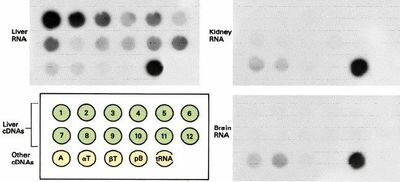
- AA. Sedimentation Gradient
- BB. Southern blot
- CC. DNA footprinting
- DD. Western blot
- EE. Electrophoretic Mobility Shift Assay
26cDNA for twelve different liver specific genes was spotted onto a membrane as shown in the bottom left corner. cDNA for the actin, the alpha subunit of tubulin (used to make microtubules), and the beta subunit of tubulin genes were spotted as shown in Figure 2. The DNA from the plasmid pB (used as a vector to carry the cDNA) was spotted on the membrane as shown. DNA for the methionine tRNA gene was spotted on the membrane as shown. The DNA was denatured (single stranded) and remained tightly bound to the membrane. Three replicate spotted membranes were produced.
A rat was fed 32P-labeled UTP for several days. The rat was sacrificed and the total RNA from the rat liver tissue, the rat kidney tissue, and the rat brain tissue were separately isolated. The radioactive RNA from each tissue type was used as a probe to hybridize to the DNA targets on the membrane. The autoradiograms shown in Figure 2 are for the liver, kidney, and brain probe conditions.
Why was there no hybridization to pB?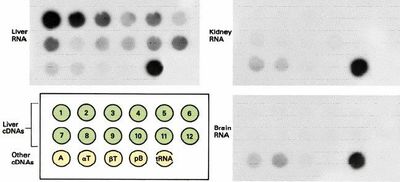
- AA. It is likely that the pB is needed most in the liver where there is more binding to the target genes
- BB. The pB is a positive control - it should be expressed in every cell type.
- CC. The pB is a negative control - it should not be expressed in any of the cell types.
- DD. So the translational control exerted by the first codon in pB can be studied.
- EE. The pB was not radioactive in this experiment.
27cDNA for twelve different liver specific genes was spotted onto a membrane as shown in the bottom left corner. cDNA for the actin, the alpha subunit of tubulin (used to make microtubules), and the beta subunit of tubulin genes were spotted as shown in Figure 2. The DNA from the plasmid pB (used as a vector to carry the cDNA) was spotted on the membrane as shown. DNA for the methionine tRNA gene was spotted on the membrane as shown. The DNA was denatured (single stranded) and remained tightly bound to the membrane. Three replicate spotted membranes were produced.
A rat was fed 32P-labeled UTP for several days. The rat was sacrificed and the total RNA from the rat liver tissue, the rat kidney tissue, and the rat brain tissue were separately isolated. The radioactive RNA from each tissue type was used as a probe to hybridize to the DNA targets on the membrane. The autoradiograms shown in Figure 2 are for the liver, kidney, and brain probe conditions.
Why was the methionine tRNA gene included in the experiment?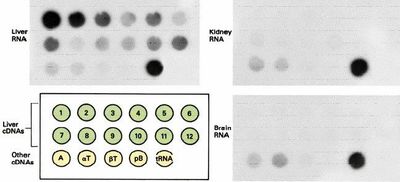
- AThe methionine tRNA gene is a positive control - it should be expressed in every cell type.
- BIt is likely that the methionine tRNA is needed most in the liver where there is more binding to the target genes.
- CThe methionine tRNA gene is a negative control - it should not be expressed in any of the cell types.
- DThe translational control exerted by the first codon, AUG, which encodes for methionine can be studied.
- ETo compete with tryptophan tRNA and increase attenuation
- AThe methionine tRNA gene is a positive control - it should be expressed in every cell type.
28cDNA for twelve different liver specific genes was spotted onto a membrane as shown in the bottom left corner. cDNA for the actin, the alpha subunit of tubulin (used to make microtubules), and the beta subunit of tubulin genes were spotted as shown in Figure 2. The DNA from the plasmid pB (used as a vector to carry the cDNA) was spotted on the membrane as shown. DNA for the methionine tRNA gene was spotted on the membrane as shown. The DNA was denatured (single stranded) and remained tightly bound to the membrane. Three replicate spotted membranes were produced.
A rat was fed 32P-labeled UTP for several days. The rat was sacrificed and the total RNA from the rat liver tissue, the rat kidney tissue, and the rat brain tissue were separately isolated. The radioactive RNA from each tissue type was used as a probe to hybridize to the DNA targets on the membrane. The autoradiograms shown in Figure 2 are for the liver, kidney, and brain probe conditions.
Which one of the following conclusions is best supported by this data?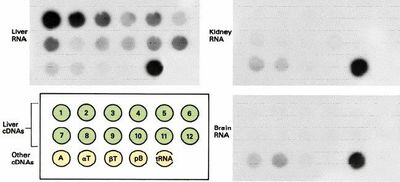
- AThe genes are first expressed in the liver, before the brain and kidney. This explains the intensity of the dots spotted on the membrane because the genes had a longer time to make the RNA.
- BCompared to liver, in which genes 1-12 all gave positive signals, kidney only generated weak signals for genes 7, 8, and 10, and there were no positive spots for brain (hard to tell if the smudges at 10 and 11 are real).
- CThe plasmid DNA gene is expressed at high levels in the rat.
- DControl of gene expression is achieved by tissue-specific control of the initiation of transcription.
- EThe operator sequences are missing in kidney and brain cells.
29Eukaryotic messenger RNA has ___________ at their 3'-ends.
- AA. m7 G caps
- BB. poly(A) tails
- CC. hairpin structures
- DD. covalently bound proteins
- E5'-UTR
- AA. m7 G caps
30In 1969, Bob Roeder published the results of experiments that were designed to resolve yeast RNA polymerase enzymes using chromatography. The results of this work are shown in Figure 4. Fractions 1-36 are presented from left to right on the X-axis. An aliquot of each fractions was assayed for RNA polymerase activity using radioactive UMP (*UMP).
Which of the following fractions contained the most total protein?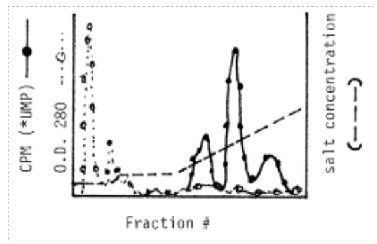
- AA. Fraction 5
- BB. Fraction 15
- CC. Fraction 25
- DD. Fraction 35
- AA. Fraction 5
31In 1969, Bob Roeder published the results of experiments that were designed to resolve yeast RNA polymerase enzymes using chromatography. The results of this work are shown in Figure 4. Fractions 1-36 are presented from left to right on the X-axis. An aliquot of each fractions was assayed for RNA polymerase activity using radioactive UMP (*UMP).
If this had been performed using a negatively charged ion exchange chromatography column, these results would suggest that the RNA polymerases are…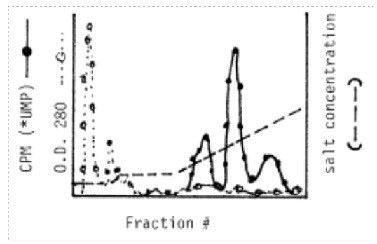
- AA. More negatively charged than the majority of proteins eluted from the column
- BB. More positively charged than the majority of proteins eluted from the column
- CC. Larger than the majority of proteins eluted from the column
- DD. Smaller than the majority of proteins eluted from the column.
- AA. More negatively charged than the majority of proteins eluted from the column
32In 1969, Bob Roeder published the results of experiments that were designed to resolve yeast RNA polymerase enzymes using chromatography. The results of this work are shown in Figure 4. Fractions 1-36 are presented from left to right on the X-axis. An aliquot of each fractions was assayed for RNA polymerase activity using radioactive UMP (*UMP).
The solid line labeled CPM (*UMP) reflects…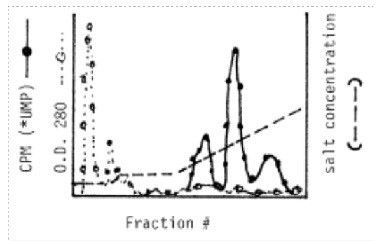
- AA. Three kinds of RNA purified
- BB. The total amount of protein purified
- CC. RNA polymerase enzyme activity
- DD. The synthesis of radiolabeled proteins
33In 1969, Bob Roeder published the results of experiments that were designed to resolve yeast RNA polymerase enzymes using chromatography. The results of this work are shown in Figure 4. Fractions 1-36 are presented from left to right on the X-axis. An aliquot of each fractions was assayed for RNA polymerase activity using radioactive UMP (*UMP).
The results represented above demonstrated that…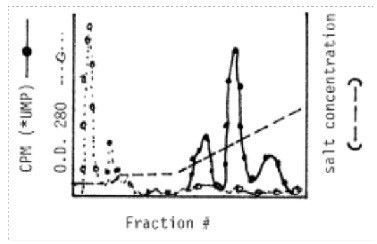
- AA. RNA polymerase synthesizes three predominant species of RNA
- BB. The 28S peak is larger than the 18S and 5S peaks
- CC. Yeast makes three distinct mRNA species.
- DD. There are three distinct RNA polymerase enzymes in yeast.
- EE. mRNA makes up a small portion of the total RNA in a cell
34If the sequence of part of a gene is AGCCTAGCT, what is the sequence of the RNA transcribed from this section of the gene?
- AAGCCTAGCT
- BAGCTAGGCT
- CAGCCUAGCU
- DAGCUAGGCU
- EUCGAUCCGA
- AAGCCTAGCT
35In order to examine the role that certain gene sequences in the H2A gene play in transcription, you make mutant versions of the H2A gene containing deletions in those regions. You then inject the DNA containing those deletion mutations into frog eggs and examine the RNA produced using electrophoresis. The location of deletions is shown in Figure 5. The agarose gel electrophoresis results are shown in Figure 6. H2B mRNA and three other large mRNA’s were added as a control in each lane.
Which conclusion is validated by the delta-A sample in lane 2?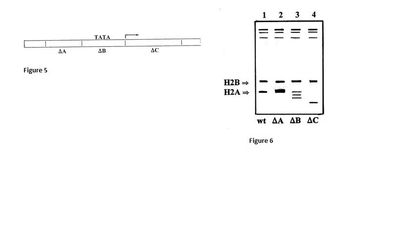
- AThe delta-A deletion caused transcription to start further upstream, thereby generating a longer transcript.
- BThe delta-A deletion eliminated a positive regulatory element
- CThe delta-A deletion eliminated a negative regulatory element
- DThe delta-A region is required for initiation of transcription at the correct start site
36In order to examine the role that certain gene sequences in the H2A gene play in transcription, you make mutant versions of the H2A gene containing deletions in those regions. You then inject the DNA containing those deletion mutations into frog eggs and examine the RNA produced using electrophoresis. The location of deletions is shown in Figure 5. The agarose gel electrophoresis results are shown in Figure 6. H2B mRNA and three other large mRNA’s were added as a control in each lane.
Which conclusion is best validated by the B sample in lane 3?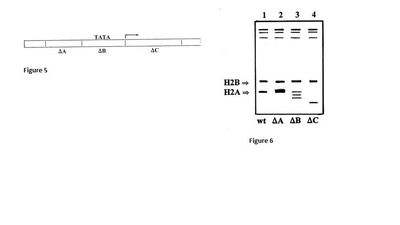
- AA. A sequence in the deleted delta-B region binds three regulatory proteins
- BB. A sequence in the deleted delta-B region drives transcription from three nearby promoters
- CC. A sequence in the deleted delta-B region helps signal the correct transcriptional start site
- DD. A sequence in the deleted delta-B region signals the correct site to start translation
- AA. A sequence in the deleted delta-B region binds three regulatory proteins
37A mRNA that is polycistronic
- AA. Codes for multiple proteins through alternative splicing.
- BB. Contains multiple start and stop sites for transcription.
- CC. Codes for multiple copies of the same protein.
- DD. Codes for multiple different proteins.
- EE. Must be cut into separate segments before it can be translated.
- AA. Codes for multiple proteins through alternative splicing.
38The concept that eukaryotic regulatory proteins have multiple functional domains was arrived at in stages. However, a few experiments stand out, such as the study by Roger Brent and Mark Ptashne published in 1985. When the study began, one known mechanism for activation of transcription by an activator protein was simply direct interaction with RNA polymerase. The investigators also considered an alternative mechanism: that the transcription activator functioned by altering the structure of the DNA to which it bound, facilitating the binding of RNA polymerase.
This study focused on two different regulatory proteins. The first was a well-characterized bacterial repressor called LexA. The LexA repressor controls a regulon in E. coli, the SOS response, that is activated when cellular DNA is subjected to extensive damage. The sequence of its binding site on DNA was known, and the protein had been studied by the Ptashne group and others. The second regulatory protein was a eukaryotic gene activator protein from yeast, Gal4p, which activates transcription of the GAL1 gene when yeast cells are grown on galactose. Ptashne and his coworkers knew that the DNA-binding element of Gal4p was located in the N-terminal 74 amino acids of the protein. They deleted these amino acids and replaced them with the first 87 amino acids of the LexA protein, which they knew contained the DNA-binding elements of that protein. They then expressed this fusion protein, LexA-Gal4, in both yeast and E. coli. They separately expressed the native LexA protein by itself. To monitor the effects of the fusion protein in yeast, the researchers needed to construct several variants of a second plasmid containing the ß-galactosidase gene (the lacZ gene, encoding an enzyme activity that is easy to measure) fused to an unrelated yeast gene, CYC1. The different constructs contained a variety of regulatory sequences upstream from the fusion genes.
Next, they carried out a series of measurements of ß-galactosidase activity with the two-plasmid system in yeast cells, with the results shown in Table 1 (adapted from their published table). In the table, ß-galactosidase activity is given in units of blue color produced in conversion of substrate to product. UAS is upstream activator sequence; UASC1 and UASC2 are binding sites for activator proteins that function at the CYC1 gene; and UASG is the normal binding site for Gal4p. UASG consists of four separate binding sites for Gal4p, each 17 bp long. The 17mer is a site with just one of these sequences. The abbreviation “op” means operator, which is the LexA-binding site; -178 and -577 indicate the distance in base pairs between the operator and the transcription start site. In the yeast cells used for the study, the genes encoding the endogenous Gal4p and the CYC1 gene activators were all present and functional.
The transcription activated by the LexA-Gal4 fusion protein acting at the LexA operator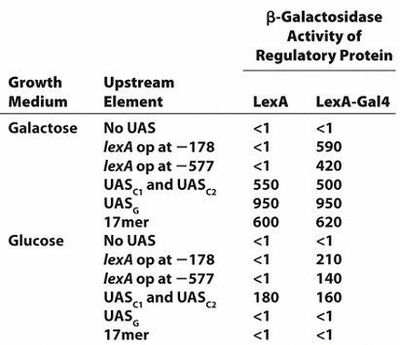
- AA. required the presence of SOS.
- BB. stopped at the -178 site.
- CC. did not require an operator sequence.
- DD. was expressed at higher levels of LexA alone when introduced into the bacterial cell on a plasmid.
- EE. occurred at a level similar to that stimulated by Gal4p at UASG.
- AA. required the presence of SOS.
39The concept that eukaryotic regulatory proteins have multiple functional domains was arrived at in stages. However, a few experiments stand out, such as the study by Roger Brent and Mark Ptashne published in 1985. When the study began, one known mechanism for activation of transcription by an activator protein was simply direct interaction with RNA polymerase. The investigators also considered an alternative mechanism: that the transcription activator functioned by altering the structure of the DNA to which it bound, facilitating the binding of RNA polymerase.
This study focused on two different regulatory proteins. The first was a well-characterized bacterial repressor called LexA. The LexA repressor controls a regulon in E. coli, the SOS response, that is activated when cellular DNA is subjected to extensive damage. The sequence of its binding site on DNA was known, and the protein had been studied by the Ptashne group and others. The second regulatory protein was a eukaryotic gene activator protein from yeast, Gal4p, which activates transcription of the GAL1 gene when yeast cells are grown on galactose. Ptashne and his coworkers knew that the DNA-binding element of Gal4p was located in the N-terminal 74 amino acids of the protein. They deleted these amino acids and replaced them with the first 87 amino acids of the LexA protein, which they knew contained the DNA-binding elements of that protein. They then expressed this fusion protein, LexA-Gal4, in both yeast and E. coli. They separately expressed the native LexA protein by itself. To monitor the effects of the fusion protein in yeast, the researchers needed to construct several variants of a second plasmid containing the ß-galactosidase gene (the lacZ gene, encoding an enzyme activity that is easy to measure) fused to an unrelated yeast gene, CYC1. The different constructs contained a variety of regulatory sequences upstream from the fusion genes.
Next, they carried out a series of measurements of ß-galactosidase activity with the two-plasmid system in yeast cells, with the results shown in Table 1 (adapted from their published table). In the table, ß-galactosidase activity is given in units of blue color produced in conversion of substrate to product. UAS is upstream activator sequence; UASC1 and UASC2 are binding sites for activator proteins that function at the CYC1 gene; and UASG is the normal binding site for Gal4p. UASG consists of four separate binding sites for Gal4p, each 17 bp long. The 17mer is a site with just one of these sequences. The abbreviation “op” means operator, which is the LexA-binding site; -178 and -577 indicate the distance in base pairs between the operator and the transcription start site. In the yeast cells used for the study, the genes encoding the endogenous Gal4p and the CYC1 gene activators were all present and functional.
Positioning of the LexA operator 577 bp rather than 178 bp away from the transcription start site lowers transcription activation by about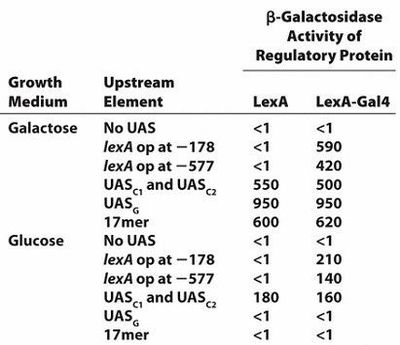
- A5%.
- B15%.
- C25%.
- D40%
- E75%
- A5%.
Informações
- Descrição
- questions 39-142
- Autor
- John Bench
- Idioma
- English
- Visualizações
- 57
- Etiquetas
- Avaliação
- Ainda sem avaliações Avalie este quiz