
Quiz
Econ 3251 Exam 1
Crie uma conta grátis para terminar este quiz
Salve seu progresso e veja sua nota final.
Já tem uma conta? Inicie sessão
Perguntas do quiz (20)
1Plastic and steel are substitutes in the production of body panels for certain automobiles. If the price of plastic increases, with other things remaining the same, we would expect
- AThe price of steel to fall.
- BThe demand curve for steel to shift to the right.
- CThe demand curve for plastic to shift to the left.
- DNothing to happen to steel because it is only a substitute for plastic.
- EThe demand curve for steel to shift to the left.
2Which of the following will not cause a shift in the supply of gasoline?
- AAn increase in the wage in the rate of refinery workers.
- BA decrease in the price of gasoline
- CAn improvement in oil refining technology.
- DA decrease in the price of crude oil.
3A consumer prefers market basket A to market basket B, and prefers market basket B to market basket C. Therefore, A is preferred to C. the assumption that leads to this conclusion is
- ATransitivity
- BCompleteness
- CAll goods are good
- DDiminishing MRS
- EAssumption of rationality
4The slope of an indifference curve reveals:
- AThat preferences are complete
- BThe marginal rate of substitution of one good for another good
- CThe ratio of market prices
- DThat preferences are transitive
- ENone of the above
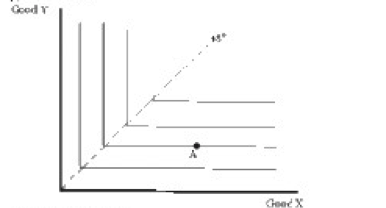
5Refer to the figure below. At any consumption bundle with the quantity of good X exceeding the quantity of good Y (that is, a bundle located below the 45 degree line, like point A) Alvin’s marginal rate of substitution of good X for good Y is
- ADiminishing
- BPositive
- CConstant and positive
- DZero
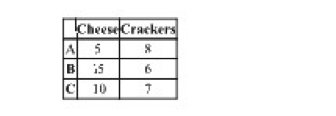
6Consider the following three market baskets. If baskets A and B are on the same indifference curve and if indifference curves exhibit diminishing MRS:
- AC is preferred to both A and B
- BA and B are both preferred to C
- CC is on the same indifference curve as A and B
- DThere is not enough information to determine preferences for
- EC relative to the other goods
7If Jill’s MRS of popcorn for candy is 2, Jill would willingly give up:
- A2, but no more than 2 units of popcorn for an additional unit of candy.
- B2, but no more than 2, units of candy for an additional unit of popcorn.
- C1, but no more than 1 unit of candy for an additional 2 units of popcorn.
- D2, but no more than, units of popcorn for an additional 2 units of candy.
8According to the law of diminishing returns
- AThe total product of an input will eventually be negative
- BThe total product of an input will eventually decline
- CThe marginal product of an input will eventually be negative
- DThe marginal product of an input will eventually decline
- ENone of the above
9What describes the graphical relationship between average product and marginal product?
- AAverage product cuts marginal product from above, at the maximum point of marginal product.
- BAverage product cuts marginal product from below, at the maximum point of marginal product.
- CMarginal product cuts average product from above, at the maximum point of average product.
- DMarginal product cuts average product from below, at the maximum point of average product.
- EAverage and marginal product do not intersect.
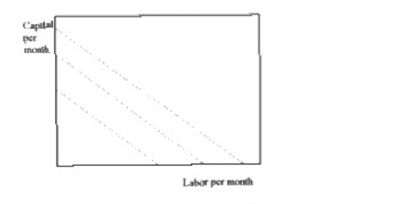
10An examination of the production isoquants in the diagram below reveals that :
- ACapital and labor must be used in fixed proportions
- BCapital and labor are perfectly substitutable
- CThe MRTS is constant along the line
- DThe MRTS is constant along the line 7 Capital and labor are perfectly substitutable are
- ENone of the above
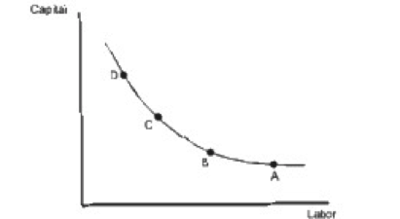
11The isoquant below is illustrating
- ATwo inputs are perfect substitutes
- BDiminishing marginal rate of technical substitution (MRTS)
- CConstant MRTS
- DIncreasing MRTS
- EDiminishing Marginal returns.
12In a production process, all inputs are increased by 10%, but output increases less than 10%. This means that the firm experiences
- ADecreasing return to scale
- BConstant returns to scale
- CIncreasing returns to scale
- DNegative returns to scale
13Refer to the figure. The situation pictured is one of..
- AConstant returns to scale, because the line through the origin is linear
- BDecreasing returns to scale, because the isoquants are convex.
- CDecreasing returns to scale, because doubling inputs results in less than double the amount of output.
- DIncreasing returns to scale, because the isoquants are convex.
- Eoutput.
1414. Constantine purchased 100 shares of IBM stock several years ago for $150 per share. The price of these shares has fallen to $55 per share. Constantine’s investment strategy is “buy low, sell high.” Therefore he will not sell his IBM stock until the price rises above $150 per share. If he sells at a price lower than 150 per share he will have “bought high and sold low.” Constantine’s decision:
- AIs correct and shows solid command of the nature of opportunity cost
- BIs incorrect because the original price paid for he shares is a sunk cost and should have no bearing on whether the shares should be held or sold.
- CIs incorrect because when the price of a stock falls, the law of demanded states that he should buy more shares.
- DIs incorrect because it treats the price of the shares as an explicit cost.
15The difference between the economic and accounting costs of a firm are
- AThe accountant’s fees
- BThe corporate tax on profits.
- CThe opportunity costs of the factors of production that the firm owns.
- DThe sunk costs incurred by the firm.
- EThe explicit costs of the firm.
16When marginal product is increasing, which of the following is true?
- AMarginal cost is decreasing
- BAverage cost is decreasing
- CAverage product is decreasing
- DMarginal Cost is increasing
- EAverage product is increasing
17Consider the following statements when answering this question.
I---Whenever a firim’s average variable costs are falling as output rises, marginal costs must be falling oo.
II----Whenever a firms average total costs are rising as output rises, average variable costs must be rising too.- AI is true, II is false
- BI is false, and II is true
- CI and II are both true
- DI and II are both false
18In the long run,
- AATC>AVC
- BAll inputs and costs are variable
- CFixed cost is a positive constant
- DAVC>ATC
- EAFC>AVC
19Which of the following is always true along the isoquant curve?
- AMRTS-slope of the isoquant
- BMRTS=MPl/MPk
- CMRTS=w/r
- DAll of the above
- EOnly MRTS-slope of the isoquant & MRTS=MPl/MPk are correct
20If a firms average cost decreases as the produce more outputs, the firm is experiencing
- AEconomies of scale
- BDiseconomies of scale
- CConstant return to scale
- DDiminishing marginal returns
- ENone of the above
Informações
- Descrição
- Econ 3251 Exam 1
- Autor
- Ted McGraw
- Idioma
- English
- Visualizações
- 188
- Etiquetas
- Avaliação
- Ainda sem avaliações Avalie este quiz