
Quiz
Macroeconomics Final
Perguntas do quiz (75)
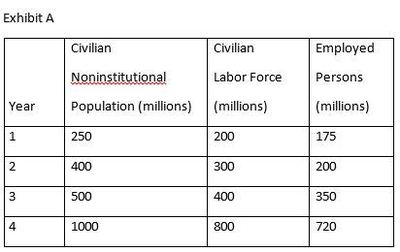
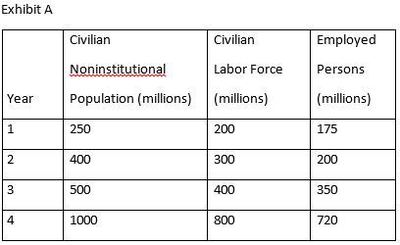
1Refer to Exhibit A. The employment rate in year 4 is:
- A12.5 %
- B7.2 %
- C72%
- D10%
- E90%
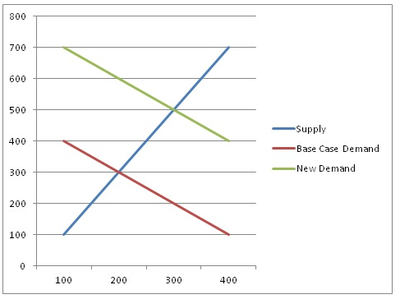
2 The graph below shows the market for llamas and how that market would change with a new law requiring every pizza delivery company that has had a delivery driver cause a traffic collision to switch to a llama only delivery system. The Y-Axis from 0 to 800 indicates price. The X-Axis from 0 to 400 indicates quantity.
What is the price per llama at the new equilibrium?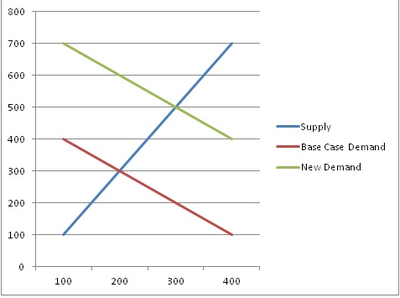
- A$365,000
- B$0
- C$500
- D$300
3The graph below shows the market for llamas and how that market would change with a new law requiring every pizza delivery company that has had a delivery driver cause a traffic collision to switch to a llama only delivery system. The Y-Axis from 0 to 800 indicates price. The X-Axis from 0 to 400 indicates quantity.
What is the price per llama at the initial equilibrium?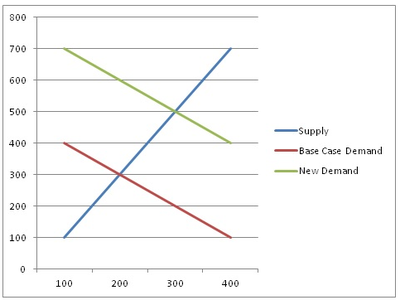
- A$200,000
- B$16.50
- C$500
- D$300
4The graph below shows the market for llamas and how that market would change with a new law requiring every pizza delivery company that has had a delivery driver cause a traffic collision to switch to a llama only delivery system. The Y-Axis from 0 to 800 indicates price. The X-Axis from 0 to 400 indicates quantity
How would the price of llamas react under this policy if the supply of llamas was, unlike the graph, actually a constant due to breeding and health limitations?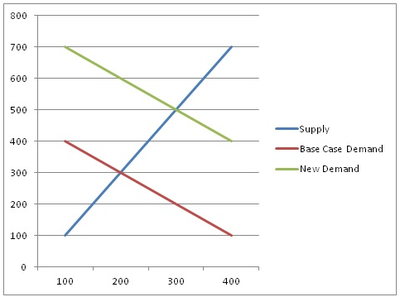
- ALlamas would escape and attack the citizens of Terrell.
- BThe price of llamas would go up some but it would not reach the amount shown on the graph as the new equilibrium price.
- CThe price of llamas would go down.
- DThe price of llamas would go up and be higher than the amount shown on the graph as the new equilibrium price.
5The graph below depicts the balance between the marginal benefits of exercise in terms of the number of times of exercise per week and the marginal costs of exercise in terms of the expenditure of time.
Opportunity Cost is related to this graph because: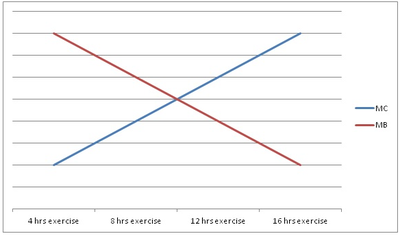
- AEconomic actors have to give up something to enter the market and hire accountant to calculate these amounts
- BThe transaction costs of owning a workout facility and being available to customers on a regular schedule are difficult for an entrepreneur to deliver on a consistent basis
- CThe more you exercise, the more you are not doing something else. The something else you choose not to do can likely be of low value for the first 4 hours of weekly exercise but is likely of a higher value in the 13th to 16th hours of exercise. Thus, the MC curve is upward sloping reflecting opportunity costs.
- DThe marginal benefit of all activities increase with increased consumption.
6The graph below shows the market for llamas and how that market would change with a new law requiring every pizza delivery company that has had a delivery driver cause a traffic collision to switch to a llama only delivery system. The Y-Axis from 0 to 800 indicates price. The X-Axis from 0 to 400 indicates quantity. Is the movement from the Base Case Demand to the New Demand:
- AA Change in the Quantity Demanded
- BA Change in Demand
- CUnfair Price Gouging by Suppliers
- DAn opportunity to invest in an auto repair business
7The following is a series of excerpts from an economics parable entitled “I, Pencil” by Leonard Read, recounted in video form on the nanocivics website by Milton Friedman.
I am a lead pencil—the ordinary wooden pencil familiar to all boys and girls and adults who can read and write. Writing is both my vocation and my avocation; that's all I do….
I am seemingly so simple. …. Yet, not a single person on the face of this earth knows how to make me. This sounds fantastic, doesn't it? Especially when it is realized that there are about one and one-half billion of my kind produced in the U.S.A. each year.
Pick me up and look me over. What do you see? Not much meets the eye—there's some wood, lacquer, the printed labeling, graphite lead, a bit of metal, and an eraser….
My family tree begins with what in fact is a tree, a cedar of straight grain that grows in Northern California and Oregon. Now contemplate all the saws and trucks and rope and the countless other gear used in harvesting and carting the cedar logs to the railroad siding. Think of all the persons and the numberless skills that went into their fabrication: the mining of ore, the making of steel and its refinement into saws, axes, motors; the growing of hemp and bringing it through all the stages to heavy and strong rope; the logging camps with their beds and mess halls, the cookery and the raising of all the foods. Why, untold thousands of persons had a hand in every cup of coffee the loggers drink!
The logs are shipped to a mill in San Leandro, California. Can you imagine the individuals who make flat cars and rails and railroad engines and who construct and install the communication systems incidental thereto? These legions are among my antecedents.
Consider the millwork in San Leandro. The cedar logs are cut into small, pencil-length slats less than one-fourth of an inch in thickness. These are kiln dried and then tinted for the same reason women put rouge on their faces. People prefer that I look pretty, not a pallid white. The slats are waxed and kiln dried again. How many skills went into the making of the tint and the kilns, into supplying the heat, the light and power, the belts, motors, and all the other things a mill requires? Sweepers in the mill among my ancestors? Yes, and included are the men who poured the concrete for the dam of a Pacific Gas & Electric Company hydroplant which supplies the mill's power! ….
My "lead" itself—it contains no lead at all—is complex. The graphite is mined in Ceylon. Consider these miners and those who make their many tools and the makers of the paper sacks in which the graphite is shipped and those who make the string that ties the sacks and those who put them aboard ships and those who make the ships. Even the lighthouse keepers along the way assisted in my birth—and the harbor pilots.
The graphite is mixed with clay from Mississippi in which ammonium hydroxide is used in the refining process. Then wetting agents are added such as sulfonated tallow—animal fats chemically reacted with sulfuric acid. After passing through numerous machines, the mixture finally appears as endless extrusions—as from a sausage grinder-cut to size, dried, and baked for several hours at 1,850 degrees Fahrenheit. To increase their strength and smoothness the leads are then treated with a hot mixture which includes candelilla wax from Mexico, paraffin wax, and hydrogenated natural fats.
My cedar receives six coats of lacquer. Do you know all the ingredients of lacquer? Who would think that the growers of castor beans and the refiners of castor oil are a part of it? They are. Why, even the processes by which the lacquer is made a beautiful yellow involve the skills of more persons than one can enumerate! ….
My bit of metal—the ferrule—is brass. Think of all the persons who mine zinc and copper and those who have the skills to make shiny sheet brass from these products of nature. Those black rings on my ferrule are black nickel. What is black nickel and how is it applied? The complete story of why the center of my ferrule has no black nickel on it would take pages to explain.
….no single person on the face of this earth knows how to make me…
The pencil story communicated the following important concepts related to price:- AThe market price is how much the corporate owner of the pencil making operation force people to pay.
- BThe market price is the amount that the government sets because people need pencils and should not have to pay too much.
- CThe market price of the pencil summarizes information about the supply and demand for the individual pieces of the pencil and rations the limited number pencils that are actually produced.
- DThe market price of the pencil conceals the actual danger of using pencils as a substitute for chop sticks.
8Gross Domestic Product (GDP) is the total market value of all
- Afinal goods and services produced annually within a country's borders
- Bfinal and intermediate goods and services produced annually within a country's borders
- Cintermediate goods and services produced annually within a country's borders
- Dfinal goods and services produced every month within a country's borders
9Read the passage from nanocivics.com below and then answer the following question:
The Invisible Hand is perhaps the most well-known economics turn of phrase. During a recession, it may seem not only invisible, but missing altogether. What does it really mean?
Here’s economist Peter Leeson, author of The Invisible Hook: The Hidden Economics of Pirates , on the question:
“In 1776 Scottish moral philosopher Adam Smith published a landmark treatise that launched the study of modern economics. Smith titled his book, An inquiry in the Nature of Cause of the Wealth of Nations. In it he described the most central idea to economics which he called the “invisible hand.” The invisible hand is the hidden force that guides economic cooperation. According to the Smith, people are self-interested; they’re interested in doing what’s best for them. However, often time, to do what’s best for them, people must also do what’s best for others.
The reason for this is straight forward. Most of us can only serve our self-interests by cooperating with others. We can achieve very few of our self-interested goals, from securing our next meal to acquiring our next pair of shoes, in isolation. Just think about how many skills you’d need to master and how much time you’re require if you had to produce your own milk or fashion your own coat, let alone manufacture our own car.
Because of this, Smith observed, in seeking to satisfy our own interests, we’re led, “as if by an invisible hand,” to serve others’ interests too. Serving others’ interests gets them to cooperate with us, serving our own. The milk producer, for example, must offer the best milk at the lowest price possible to serve his self interest, which is making money. Indirectly he serves his customers’ self-interest, which is acquiring cheap, high-quality milk. And on the other side of this, the milk producers’ customers, in their capacity as producers of whatever they sell, must offer the lowest price and highest quality to their customers, and so on. The result is a group of self-interest seekers, each narrowly focused on themselves but also unwittingly focused on assisting others.”
Here’s what Adam Smith, author of The Wealth of Nations , wrote:
“It is not from the benevolence of the butcher, the brewer or the baker, that we expect our dinner, but from their regard to their own interest. We address ourselves, not to their humanity but to their self-love, and never talk to them of our own necessities but of their advantages.”
That is, we pay the butcher and the baker a monetary price for their effort. We don’t tell them we are hungry and hope for the best; we give them the means to satisfy their own needs when we pay them. Thus, we ourselves had better find a way to satisfy someone else’s needs or else we won’t have the resources to pay for diner.
So that’s the invisible hand, the order in society generated by many people freely seeking their own, but only able to do so successfully by serving others.
by Mike Sims
According to Adam Smith’s work, which of the following describes the “invisible hand”?- AMilitary elites secret control of raw materials
- BWealthy elites in corporations controlling prices
- CIntellectual elites in government and the media controlling your beliefs and perceptions about the world
- DThe uncoordinated activity of many who incidentally serve others in order to obtain the rationing device they desire for themselves
- ESauron’s pursuit of the one ring that will rule them all
10If the CPI is 100 in the base year and 140 in the current year, how much did prices rise between these two years?
- A40 percent
- B140 percent
- C1.40 percent
- D0.14 percent
11In 2007, the U.S. GDP was approximately
- A$13.84 trillion
- B$5.15 trillion
- C$12.67 billion
- D$19.83 million
12In the business cycle, what is the difference between the recovery phase and the expansion phase?
- AThe expansion phase occurs in the rising portion of the business cycle, while the recovery phase occurs in the falling portion of the business cycle
- BThe expansion phase occurs in the falling portion of the business cycle, while the recovery phase occurs in the rising portion of the business cycle.
- CThe expansion phase is the period when Real GDP increases beyond the recovery phase
- DThe expansion phase must always precede the recovery phase
13Read the following selection and answer the question which follows:
There was a recent flap because three different members of the Obama administration, on three different Sunday television talk shows, gave three widely differing estimates of how many jobs the president has created.
The big question that seldom-- if ever-- gets asked in the mainstream media is whether these are a net increase in jobs. Since the only resources that the government has are the resources it takes from the private sector, using those resources to create jobs means reducing the resources available to create jobs in the private sector.
So long as most people do not look beyond superficial appearances, politicians can get away with playing Santa Claus on all sorts of issues, while leaving havoc in their wake-- such as growing unemployment, despite all the jobs being "created."
Whatever position people take on health care reform, there seems to be a bipartisan consensus-- usually a sign of mushy thinking-- that it is a good idea for the government to force insurance companies to insure people whom politicians want them to insure, and to insure them for things that politicians think should be insured.
… let's stop and think.
Why aren't insurance companies already insuring the people and the conditions that they are now going to be forced to cover? Because that means additional costs-- and because the insurance companies don't think their customers are willing to pay those particular costs for those particular coverages.
It costs politicians nothing to mandate more insurance coverage for more people. But that doesn't mean that the costs vanish into thin air. It simply means that both buyers and sellers of insurance are forced to pay costs that neither of them wants to pay. But, because soaring political rhetoric leaves out such grubby things as costs, it sounds like a great deal.
It is not just costs that are left out. It is consequences in general. With all the laments in the media about skyrocketing unemployment among young people, and especially minority young people, few media pundits even try to connect the dots to explain why unemployment hits some groups much harder than others.
Yet unusually high unemployment rates among young people is not something new or even something peculiar to the United States. Even before the current worldwide recession, unemployment rates were 20 percent or more among workers under 25 years of age in a number of Western European countries.
The young have less experience to offer and are therefore less in demand. Before politicians stepped in, that just meant that younger workers were paid less. But this is not a permanent situation because youth itself is not permanent, and pay rises with experience.
Enter politicians. By mandating a minimum wage that sounds reasonable for most workers, they put a price on inexperienced and unskilled labor that often exceeds what it is worth. Mandated pay rates, like mandated insurance coverage, impose on buyers and sellers alike things that they would not choose to do otherwise.
Workers of course prefer higher wage rates. But the very fact that the government has to impose those wage rates means that workers were unwilling to risk not having a job by refusing to work for less than the wage rate that has been mandated. Now that choice has been taken out of their hands, with the hidden cost in this case being higher unemployment rates.
By Thomas Sowell
This analysis encourages the reader to consider:- AThe marginal benefits and marginal costs faced by employers and employees.
- BChanges in economic behavior caused by changes in governmental policy.
- CBoth of the above
- DNone of the above
14Economics is the study of:
- AMoney
- BScarcity
- CAbundance
- DEcology
15Suppose that 1982 is the base year for the Consumer Price Index (CPI) and in 2007 the CPI is 320. What does this "320" mean?
- AWhat cost $100 in 1982 will on average cost 320 times as much in 2007
- BWhat cost $100 in 1982 will on average cost $320 in 2007
- CWhat cost $100 in 1982 will on average cost 0.32 times as much in 2007 (that is, it will cost $32 in 2007)
- DWhat cost $100 in 1982 will on average cost $32 more in 2007
16Economics categorizes resources into several categories, these are:
- AMoney, Debt, Scarcity, and Abundance
- BPrice, Quantity and Exchange
- CLand, Labor, Entrepreneurship and Capital
- DInvestment, Labor, Natural Resources, and Finance
17Something must be happening in the two Production Possibility Frontier graphs below that make them change in different ways. Which of the following best describes the difference between these two?
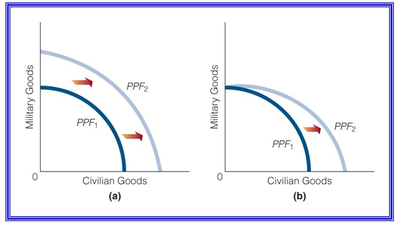
- AIn A, there has been tornado which destroyed both types of manufacturing capacity and caused a shift from PPF1 to PPF2. In B, there has been a tornado which destroyed only the civilian goods manufacturing capacity.
- BIn A, there has been a technological breakthrough which helped all manufacturing equally and caused a shift from PPF2 to PPF1. In B, there has been technological breakthrough which helped only the military goods manufacturing capacity.
- CIn A, there has been a productivity improvement for military goods and civilian goods causing the shift from PPF1 to PPF2. In B, there has been a productivity improvement for only civilian goods.
- DNone of the above.
18Water-proof poncho production increases under which of the following situations:
- AIt stops raining and the forecast is for dry weather.
- BPop-stars wearing water-proof ponchos to major events cause a general increase in the demand for ponchos; causing several existing clothing manufactures to get into the poncho production business.
- CSeveral traffic fatalities are blamed on the lack of visibility from hooded poncho wearing drivers; public acceptance for ponchos drops and surpluses of ponchos are sent to warehouses for storage.
- DNew rules make poncho sales illegal in most international markets.
19Refer to Exhibit A. How many people are not in the labor force in year 1?
- A25 million
- B50 million
- C75 million
- D175 million
- E200 million
20A recession is always part of a
- AContraction
- BRecovery
- CDetraction
- DParty Mix Tape
21When the opportunity cost of an activity is high, then:
- AThe marginal costs go to zero.
- BThe marginal benefits go to zero.
- CIt must have high marginal benefits to be the subject of an economic exchange.
- DThe transaction costs are low.
22The graph below shows the market for llamas and how that market would change with a new law imposing a maximum price for llamas.
The new law will create: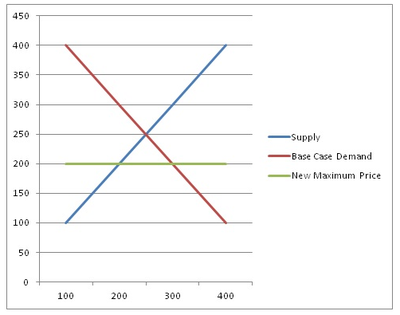
- AA price per llama that exceeds the base case
- BA shortage of llamas
- CA surplus of llamas
- DA new equilibrium that fully satisfies the supply and demand
23
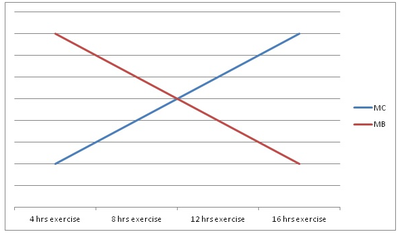
The graph below depicts the balance between the marginal benefits of exercise in terms of the number of times of exercise per week and the marginal costs of exercise in terms of the expenditure of time.
The point of economic efficiency is:
- AThe end point of the Marginal Cost curve (MC).
- BSomething that can be determined only through mathematical equations.
- CThe starting point of the Marginal Benefit curve (MB).
- DThe intersection of the MB curve and the MC curve.
24The graph below shows the market for llamas and how that market would change with a new law imposing a maximum price for llamas.
Prior to the law, what was the market determined price for a llama?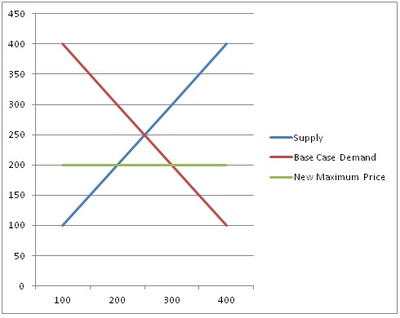
- A$200
- B$400
- C$250
- D$600
25 Consider the following equations:
Qd = 1500 - 32P
Qs = 1200 + 43P
Qd = Qs
Which statement is correct?- AThe equilibrium price is $16 and the equilibrium quantity is 5532.
- BThe equilibrium price is $2 and the equilibrium quantity is 418.
- CThe equilibrium price is $4 and the equilibrium quantity is 1372.
- DIt is not possible to determine an answer from the information given.
26According to the author, Keynes disagreed with previous economists regarding:
- AThe importance of eco-friendly projects in long-term growth.
- BThe importance of inflexible wages in preventing recovery.
- CThe importance of America as a trading partner for Asian countries.
- DThe importance of the exchange rate in the long-term.
27Regarding the classical economics position with respect to (a) wages, (b) prices, and (c) interest rates, all three are considered by classical economics to be___________________, and to be determined by the interaction of supply and demand in their respective markets, leading to a position of equilibrium.
The correct missing phrase is:- Aintangible in long-term
- Bincoherent under detailed scrutiny
- Cflexible both up and down
- Dinflexible either up or down
28According to economists who believe in a self-regulating economy, what happens when the economy is in an inflationary gap?
- AExcess unemployment exists. This will cause wages to fall, and the SRAS curve will shift to the right, moving along the AD curve until the economy returns to its long-run equilibrium.
- BUnemployment is below its natural rate, creating wage inflation. This shifts the SRAS curve to the left, moving along the AD curve until the economy returns to its long-run equilibrium.
- CHayek has to come and turn the knob that says, “reach equilibrium”.
- DNone of the above.
29 What is the state of the labor market in a recessionary gap:
- AThere is a labor market surplus.
- BThere is a labor market shortage.
- CThe labor market is in equilibrium.
- DThe labor market is spastic.
30The graph below illustrates how government can use supply-side fiscal policy to get an economy out of a recessionary gap.
The following provides a correct explanation of the graph: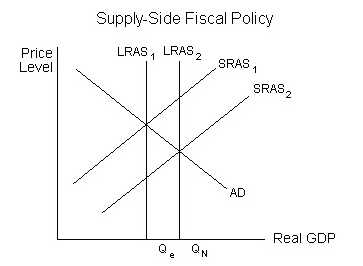
- AThe economy is in an inflationary gap at Qe. We implement a permanent income tax cut that moves SRAS to SRAS2 and LRAS to LRAS2, removing the gap at QN.
- BThe economy is in a recessionary gap at Qe. We implement a permanent income tax increase that moves SRAS to SRAS2 and LRAS to LRAS2, removing the gap at QN.
- CThe economy is in a inflationary gap at Qe. We implement a permanent income tax increase that moves SRAS to SRAS2 and LRAS to LRAS2, removing the gap at QN.
- DThe economy is in a recessionary gap at Qe. We implement a permanent income tax cut that moves SRAS to SRAS2 and LRAS to LRAS2, removing the gap at QN.
31
The graph below shows Aggregate Demand and Short Run Aggregate Supply depicting a decrease in wealth.
What is the correct interpretation of the resulting new equilibrium: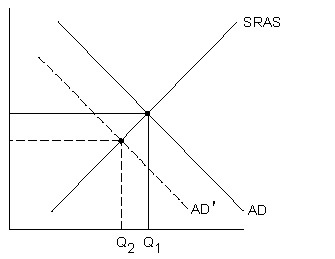
- AThe price level will stay the same and Real GDP will fall .
- BThe price level will fall and Real GDP will stay the same .
- CThe price level will rise and Real GDP will rise .
- DThe price level will drop and Real GDP will fall .
- EThe price level will stabilize and Real GDP will oscillate .
32Happy Birthday Keynes!
By Gouranga Das
Korean Times, June 10, 2009
June 5, 1883, is the birthday of John Maynard Keynes. Unlike other years, there is no other more opportune moment than this year, 125 years later, to wish him many happy returns.
Why? As has been said by Paul Samuelson: ``Science is a parasite: the greater the patient population the better the advance in physiology and pathology; and out of pathology arises therapy. The year 1932 was the trough of the great depression, and from its rotten soil was belatedly begot a new subject that today we call macroeconomics.''
And, Keynes was the founding father of modern macroeconomics as expounded in his famous treatise ``The General Theory of Employment, Interest, and Money'' (1936), following the outbreak of the Great Depression in late 1929, and spanning till 1932.
He said: ``I shall argue that the postulates of the classical theory are applicable to a special case only and not to the general case … Moreover, the characteristics of the special case assumed by the classical theory happen not to be those of the economic society in which we actually live, with the result that its teaching is misleading and disastrous if we attempt to apply it to the facts of experience.''
The classical economists predating Keynes put enormous faith on the self-correcting mechanism or forces that guaranteed full-employment and prevented cyclical fluctuations.
Emphasizing flexible prices ― wage and interest rates ― in stabilizing the economy precluded the need for government engagement for taming business cycles.
Without ascribing an important role for the government to intervene via expansionary or contractional fiscal and monetary policy, the burden of curing unemployment was shifted to wage stickiness or rigidity.
Thanks to Sir John Hicks, Nobel Laureate, and Alvin Hansen, Keynesian macroeconomics took its functional shape while couched in a ``working model,'' namely IS-LM developed in 1937.
The New Deal adopted by Roosevelt was based on non-existent economic theory and Keynes' theory gave birth to an intellectual framework to interpret events and offered a clear-headed argument for public policy.
The essential backbone was effective demand, multiplier effect of fiscal policy, liquidity preference and animal spirits (expectations not explained by rationality).
IS-LM rides again in a world of crisis caused by a ``financial debacle.'' According to The Economist (May 2, 2009), ``this year's downturn is much deeper than previous troughs'' in 1975, 1982, 1991 and 2001.
Global output is set to fall by 2.5 percent, unlike 0.4 percent on previous occasions. Unlike earlier cases, world trade, according to the International Monetary Fund (IMF) World Economic Outlook, is set to falter by 12 percent ― a setback to globalization.
As per the IMF forecast, G7 economies are heading for 0.1-percent growth, while for emerging economies like India and China it is 6 percent. Economies are nose-diving with the worst slump in decades since the 1930s.
Heavily export-dependent economies like Korea, Japan and China are facing the brunt of the slowdown or recessions hitting the United States and Europe. Manufacturing collapse is happening in these economies with the possibilities of a contagion of protracted recession.
With weakening demand, the need for products such as cars, semi-conductors, and consumer goods is evaporating. Companies such as Honda, Sony, Panasonic and Fuji have scaled back production as demand has dried up.
Korea's faltering exports and weak domestic demand are severe drags for the economy. China, Korea and Japan have entered into a joint agreement, including currency swap deals to stabilize the won's freefall against the greenback as investors retreated, cooperating to stimulate demand and ensure growth and stability.
Korea has also initiated government projects ― the Korean ``New Deal'' along with the ``Green New Deal'' (investing in 36 eco-friendly projects) ― to stimulate sluggish demand via job creation.
Japan has already called for a third round of spending worth $154 billion plus injecting 121 billion yen into regional banks to combat recession (The New York Times, March 17). It cannot be denied that despite the political rhetoric of no-tax and small government, most of the countries strike a balance between the public and private sectors. We do need ``Keynesian'' prognosis to cure the maladies.
With monetary policy being not so effective, aggressive fiscal policy maneuvering, by either cutting taxes or inducing demand, is a sensible way to avert the slump's evil. Resolute public policy has a prime-mover role in protecting the vulnerable and fragile economies, sufficient regulation, supervision of the financial systems and sustainable development. Although the mix, composition and scale of fiscal jolts are country-specific, handling catastrophe needs a fiscal ``magic'' wand to make it a shallow recession.
Now is the time to stop worrying about being Keynesian or anti-Keynesian, and rather work toward a synthesis of whatever is valuable in old and modern theories as necessary. In fact, George Akerlof and Robert Shiller have recently co-authored a book titled ``Animal Spirits: How Human Psychology Drives the Economy, and Why It Matters for Global Capitalism.'' Their thesis states that factoring animal spirits such as irrational exuberance, confidence, corruption, fairness, money illusions and misplaced belief into economic theory would help avert the tragedy of crisis with the help of government.
Keynes' contribution has revolutionized the way intellectuals think about economic malaise and will do so in years to come. Keynes remarked, ``In the long run, we are all dead. Economists set themselves too easy, too useless a task if in tempestuous seasons they can only tell us that when the storm is long past, the ocean will be flat again.''
With an appropriate stimulus package in the short-run, we won't be dead in the long run and a sound global economy could be reborn.
Gouranga Das is professor of economics at Hanyang University's Ansan campus in Gyeonggi Province.
The article refers to several countries for which the author advises adopting a Keynesian approach to improving the economic situation. In the author’s opinion, these countries should:- AAdopt aggressive fiscal policy according to recent refinements to Keynesian theory.
- BInvade one another, causing damage consistent with the “broken window” theory.
- CManipulate interest rates according to Friedman and Hayek’s theories.
- DThe importance of the exchange rate in the long-term.
33Candide believes that there is always sufficient (aggregate) demand in the economy to buy all the goods and services supplied at full employment, as shown in the graph below:
If true, the economy would always be at: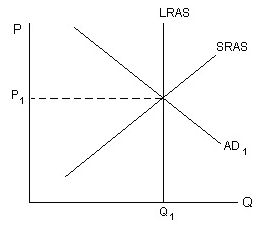
- ANatural Real GDP, where P equals Q.
- BNatural Real GDP, where LRAS exceeds SRAS.
- CNatural Real GDP, where SRAS is a downward sloping line.
- DNatural Real GDP, where LRAS equals SRAS.
34 Suppose the economy is self-regulating, the price level is 132, the quantity demanded of Real GDP is $4 trillion (or $4,000 billion), and the quantity supplied of Real GDP in the short run is $3.9 trillion (or, $3,900 billion). Refer to the graph below.
Will the price level in the long-run equilibrium be greater than, less than, or equal to 132?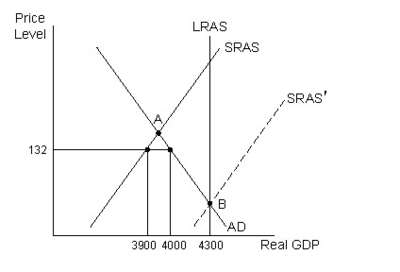
- AGreater than 132
- BEqual to 132
- CLess than 132
- DNegative 132
35Use the following table:
Taxable Income Taxes
$1,000-$5,000 10% of taxable income
$5,001-$10,000 $500 + 12% of everything over $5,000
$10,001-$15,000 $1,100 + 15% of everything over $10,000
$15,001 or more $1,850 +95% of everything over $15,000
If a day laborer’s income is $7,000, how much does he pay in taxes and how much does he keep?- A$620 in taxes and $6,380 to keep
- B$730 in taxes and $6,270 to keep
- C$740 in taxes and $6,260 to keep
- D$850 in taxes and $6,150 to keep
36What is the explanation for why investment falls as the interest rate rises?
- AThe interest rate is the cost of borrowing funds. The higher the cost of borrowing funds is, the fewer funds firms will borrow and invest.
- BBono’s Law: What you don’t have, you don’t need it now.
- CThe cost of borrowing funds is balanced with changes in the stock market.
- DEquilibrium conditions such as this are not observed in the real world.
37An increase in labor productivity would result in the following:
- AThe price level will rise and Real GDP will rotate .
- BThe price level will rise and Real GDP will stay the same .
- CThe price level will stay the same and Real GDP will rise .
- DThe price level will drop and Real GDP will fall .
- EThe price level will fall and Real GDP will rise .
38Happy Birthday, Milton Friedman!
By Gary S. Becker
Newsweek July 1, 2002
Milton Friedman's professional career has been marked by controversy over his many policy proposals. Yet as he approaches his 90th birthday in July, Friedman is increasingly recognized as the most influential economist in a 20th century that witnessed towering contributions from John Maynard Keynes, Paul A. Samuelson, and others.
Friedman is best known for "monetarism," a view that stability in the growth of the money supply is crucial to controlling inflation and recessions. Although the relation between the money supply and the economy has often been highly variable, no less an authority than Federal Reserve Chairman Alan Greenspan has indicated that Friedman's emphasis on a stable monetary framework was instrumental in guiding central banks in Europe and the U.S. toward low inflation during the past two decades.
Before Friedman, economic conventional wisdom held that inflation reduces unemployment because prices rise faster than labor costs. In the late 1960s, Friedman argued instead that there is no permanent reduction in unemployment from continuing inflation because wages eventually catch up to prices as expectations about inflation become more accurate. His analysis has been validated twice since then--by the high U.S. unemployment during the 1970s despite rapid inflation, and the low unemployment during the '90s even though inflation was negligible.
Some of Friedman's contributions to micro policy have been fully implemented, such as his persuasive advocacy of a voluntary army while serving on the Gates Commission set up to reconsider the draft after the Vietnam War. At a recent White House event to honor Friedman on his approaching birthday, I discussed a few of his policy proposals that have only been partially adopted and continue to generate controversy.
Two decades before Chile introduced its revolutionary private individual account retirement system, Friedman's classic 1962 book Capitalism and Freedom criticized the prevailing pay-as- you-go Social Security systems for restricting the ability of individuals to choose how much and in what form to save for retirement, and for mixing a welfare program for elderly poor with a compulsory program that applies to all the elderly. Had his advice been followed 20 years ago, there would be no impending Social Security financing crisis in the U.S. and other developed nations with aging populations.
In the same book, Friedman showed that without any change in the tax base, a flat income tax rate of 23% could bring in the same revenue as the system of rates that ranged in the 1960s from 20% to an incredible 91%. A few years later, he went further by demonstrating that the flat rate could be reduced to 16% without any diminution in tax revenue if all special deductions for mortgage interest, charitable contributions, and the like were eliminated. All nations have since brought down their top rates from frequently above 90% to 50% or less. So the world has moved about halfway toward his flat-tax system.
In the early 1950s, Friedman revived the case for allowing foreign exchange rates to be determined by supply and demand for different currencies. Flexible rates had fallen into intellectual disrepute because exchange rates were unstable during the 1930s, and after the post-World War II Bretton Woods Agreement introduced a worldwide system of supposedly fixed exchange rates.
Controversy over flexible exchange rates continues as American political leaders condemn Treasury Secretary Paul H. O'Neill for his refusal to seek a strong dollar. Meanwhile, exporters want him to promote a weak dollar that would make their goods cheaper to other nations. Secretary O'Neill is right in his commitment to let markets decide the international value of the dollar rather than government officials or business leaders with vested interests.
School vouchers is the micro program most closely identified with Friedman. In the 1950s, he first proposed that governments give tuition vouchers to parents with school-age children that they could use at private or public schools of their choice as long as these met education standards. He was confident that even poor parents would generally select a good education for their children if they had real choices.
Although voucher advocates have largely won the intellectual battle, vouchers have been effectively opposed by teachers' unions and by many suburban parents who fear vouchers would encourage poor children to attend schools in their communities. The U.S. Supreme Court will soon decide the legality of several voucher experiments.
Friedman has displayed enormous courage in sticking to his guns after his work was greeted with hostility and, frequently, nasty personal attacks. It must be gratifying to see how much the world has moved toward his positions. We all owe an enormous debt to this great economist as he completes his ninth decade.
Gary S. Becker, the 1992 Nobel laureate, teaches at the University of Chicago and is a Fellow of the Hoover Institution.
Whereas Keynes was concerned with government spending, the article emphasizes that thinkers like Milton Friedman (and Hayek) would more likely focus on:- AUsing school vouchers to balance international trade.
- BUsing a flat tax to balance GDP with the CPI.
- CStable interest rates and a predictable, transparent regulatory scheme to balance economic fluctuations.
- DPreparing young men and women to give their life in defense of their country as a way to reduce long-term labor supply and unemployment.
39
Use the following table:
Taxable Income Taxes
$1,000-$5,000 10% of taxable income
$5,001-$10,000 $500 + 12% of everything over $5,000
$10,001-$15,000 $1,100 + 15% of everything over $10,000
$15,001 or more $1,850 +95% of everything over $15,000
The table above an example of which kind of tax system:- AThe right-way to happiness system
- BA progressive tax system
- CA proportional or flat tax system
- DA fair tax, or a national consumption tax system
- EA regressive tax system
40Suppose the economy is self-regulating, the price level is 132, the quantity demanded of Real GDP is $4 trillion (or $4,000 billion), and the quantity supplied of Real GDP in the short run is $3.9 trillion (or, $3,900 billion). Refer to the graph below.
What is the quantity supplied of Real GDP in the long run?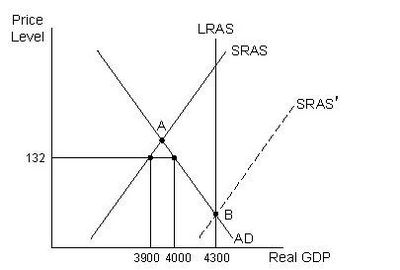
- A$4.3 trillion or $4,300 billion
- B$4.0 trillion or $4,000 billion
- C$3.9 trillion or $3,900 billion
- D$132 billion
41An increase in wealth would result in the following:
- AThe price level will rise and Real GDP will fall .
- BThe price level will rise and Real GDP will stay the same .
- CThe price level will rise and Real GDP will rise .
- DThe price level will drop and Real GDP will fall .
- EThe price level will fall and Real GDP will fall .
42An increase in wealth would:
- ACause a movement along the aggregate demand line.
- BCause a decrease in aggregate demand at every price.
- CCause an increase in aggregate demand at every price.
- DShift the short run aggregate supply line.
43According to the author, the concept that Keynes was the better economist of the last 100 years:
- AWill forever be unquestioned.
- BIs accurate because Milton Friedman was wrong about exchange rates.
- CWill change when people find out about his rap career.
- DMay be changing to recognize Milton Freidman instead.
44Use the following table:
Taxable Income Taxes
$1,000-$5,000 10% of taxable income
$5,001-$10,000 $500 + 12% of everything over $5,000
$10,001-$15,000 $1,100 + 15% of everything over $10,000
$15,001 or more $1,850 +95% of everything over $15,000
If a doctor’s income is $115,000, how much does she pay in taxes and how much does she keep?- A$1,500 in taxes and $113,500 to keep
- B$15,000 in taxes and $100,000 to keep
- C$5,850 in taxes and $109,150 to keep
- D$96,850 in taxes and $18,150 to keep
45What factors will shift the AD curve in the simple Keynesian model?
- AImports, Exports and Net Exports.
- BConsumption, Business Investment, and Government Purchases.
- CLand, Labor and Capital
- DTaxes, Regulation, and International Exchange Rates
46The Minimum Wage and Job Loss from 2006 through 2010
By Staff at the Political Calculations Blog
March 9, 2011
In 2006, the last full year in which the U.S. federal minimum wage was a constant value throughout the whole year, at least before 2010, approximately 6,595,383 individuals in the United States earned $7.25 per hour1 or less.
For 2010, the first full year in which the U.S. federal minimum wage was a constant value through the year since 2006, the U.S. Bureau of Labor Statistics estimates that an average of just 4,361,000 individuals in the United States earned the same equivalent of the current prevailing federal minimum wage of $7.25 or less throughout the year.
In terms of jobs lost, that means that 2,234,383 of the jobs lost in the U.S. economy since 2006 have been jobs that were directly impacted by the series of minimum wage increases that were mandated by the federal government in 2007, 2008 and 2009.
Interestingly, the average number of employed members of the civilian labor force in 2006 was 144,427,000. In 2010, the average number of employed members of the civilian labor force in the U.S. was 5,363,000 less, standing at 139,064,000.
So, in percentage terms of the change in total employment level from 2006 to 2010, jobs affected by the federal minimum wage hikes of 2007, 2008 and 2009 account for 41.8% of the total reduction in jobs seen since 2006.
What would Hayek or Freidman say about this data:- AThis is an example of how Keynes’ sticky wages are not a free market dynamic, but a government regulatory dynamic.
- BInstead of using fiscal stimulus to fix a problem caused by government regulation, simply deregulate the labor market to remove government induced sticky wages.
- CThe good feelings caused by passing a minimum wage increase are out-weighed by the real-world negative impact on the people who can no longer find employment.
- DAll of the above.
47If wage rates are not flexible, can the economy be self-regulating?
- ANo, to achieve a “favorable” balance of trade a country must bring gold and silver into the country and that will maintain domestic employment.
- BNo, according to both the agricultural system of the physiocrats and the laissez-faire of the nineteenth and early twentieth centuries,
- CNo, flexible wages are an essential assumption of the self-regulating economy. Without flexible wages, the SRAS curve would not shift in response to an inflationary gap or a recessionary gap. Without this flexibility, the economy could not move back to its long-run equilibrium, and the economy would not be self-regulating.
- DYes, because I gravitate to answering yes and this is the only answer with the word yes in it.
48Suppose the economy is self-regulating, the price level is 132, the quantity demanded of Real GDP is $4 trillion (or $4,000 billion), and the quantity supplied of Real GDP in the short run is $3.9 trillion (or, $3,900 billion). Refer to the graph below.
In the starting condition (SRAS), is the economy in short-run equilibrium?
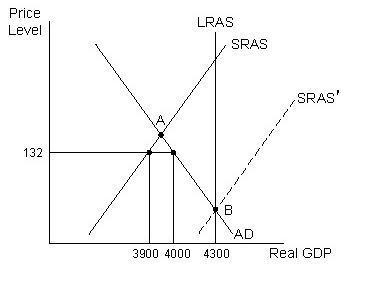
- AYes, SRAS and LRAS are equal
- BYes, SRAS is less than LRAS
- CNo, AD is greater than SRAS
- DNo, AD is less than SRAS
49What is the explanation for why saving rises as the interest rate rises?
- AThe interest rate is the cost of borrowing funds. The higher the cost of borrowing funds is, the more funds firms will borrow and invest.
- BThe higher the interest rate, the higher the reward for saving (or the higher the opportunity cost of consuming), and therefore, the fewer funds consumed and the more funds saved.
- CThe interest rate is the cost of borrowing funds. The lower the cost of borrowing funds is, the more funds firms will borrow and invest.
- DThe higher the interest rate, the higher the reward for saving (or the higher the opportunity cost of consuming), and therefore, the more funds consumed and the more funds saved.
50What does it mean to say the economy is in a recessionary gap?
- AIn a recessionary gap, Real GDP < Natural Real GDP.
- BIn a recessionary gap, Real GDP > Natural Real GDP.
- CIn a recessionary gap, Real GDP = Natural Real GDP.
- DIn a recessionary gap, Real GDP - CPI < Zero
51If the Federal Reserve were to conduct an open market purchase, how would money supply change?
- AMoney supply will increase
- BMoney supply will decrease
- CMoney supply will stay the same
- DIt cannot be determined from the information provided
52How will action by the Federal Reserve to lower the discount rate impact the money supply?
- AMoney supply will increase
- BMoney supply will decrease
- CMoney supply will stay the same
- DIt cannot be determined from the information provided
53U.S. Inflation Targeting: Pro and Con
FRBSF Economic Letter, 98-18; May 29, 1998
In recent years, monetary economists and central bankers have expressed growing interest in inflation targeting as a framework for implementing monetary policy. Explicit inflation targeting has been adopted by a number of central banks around the world, including those in Australia, Canada, Finland, Israel, New Zealand, Spain, Sweden, and the U.K. In the United States, there has been little public debate over inflation targeting, although some bills have been introduced in Congress to mandate the use of explicit targets for inflation.
Issues and questions surrounding inflation targeting formed a major focus of a recent conference on Central Bank Inflation Targeting jointly sponsored by the Federal Reserve Bank of San Francisco and the Center for Economic Policy Research at Stanford University (Rudebusch and Walsh 1998). In this Economic Letter, we set out some of the arguments for and against adopting inflation targeting in the United States discussed at the conference. (For further discussion, see Bernanke and Mishkin 1997, Bernanke, et al., forthcoming, and Keleher 1997.)
What would inflation targeting mean in the U.S.?
There has been some ambiguity about the precise definition of an inflation targeting policy regime, in part because certain institutional arrangements have differed from one inflation targeting country to another--most notably with regard to how the inflation target is set and how deviations from the target are tolerated. For our discussion, we define inflation targeting to be a framework for policy decisions in which the central bank makes an explicit commitment to conduct policy to meet a publicly announced numerical inflation target within a particular time frame. For example, at the start of 1993, Sweden's central bank announced an inflation target for the consumer price index of between 1 and 3 percent by 1995. Similarly, if the Federal Reserve wanted to adopt inflation targeting, it would publicly commit to achieving a particular numerical goal for inflation (a target point or range) within a set time span of, say, a couple of years. Also, as part of an ongoing policy framework for targeting inflation, the Fed's semiannual Humphrey-Hawkins report, which currently provides a near-term (one-year) outlook for inflation, could be augmented to include a discussion of whether the medium-term (two- or three-year) inflation forecast is consistent with the announced medium-term inflation target. Inflation targeting would not impose a rigid simple rule for the Fed; instead, policy could employ some discretion to take into account special shocks and situations. However, the organizing principle and operational indicator for monetary policy would be focused on inflation and (in light of lags in the effects of policy) inflation forecasts.
Given some earlier ambiguity, it is important to be clear about how we interpret the ultimate goals of inflation targeting monetary policy. In particular, an inflation targeting central bank need not care only about inflation. Indeed, most inflation targeting central banks continue to recognize multiple goals for monetary policy with no single primary one. (In New Zealand--an exception--the start of inflation targeting coincided with a legislative mandate that the central bank's "primary function" was price stability, while in Canada--as is more typical--such legislation was never passed.) Accordingly, an operational policy framework of inflation targeting would still be consistent with the Fed's current legislated objectives of low inflation and full employment. An inflation targeting regime can accommodate a goal of output stabilization by having wide inflation target bands, long inflation target horizons, and explicit exemptions for supply shocks. Thus, the adoption of an inflation targeting regime does not necessarily require that price stability or low inflation be the preeminent goal of monetary policy. As with monetary targeting, inflation targeting is an operational framework for monetary policy, not a statement of ultimate policy goals. (For further discussion, see Rudebusch and Svensson, 1998.)
Arguments pro
By focusing attention on a goal the Fed can achieve, by making monetary policy more transparent and increasing public understanding of the Fed's strategy and tactics, by creating institutions that foster good policy, and by improving accountability, the adoption of inflation targeting would represent a desirable change in the U.S. monetary policy.
1. The announcement of explicit inflation targets for the Fed would provide a clear monetary policy framework that would focus attention on what the Fed actually can achieve. Bad monetary policy often has resulted from demands that central banks attempt to achieve the unachievable. Most notably, few macroeconomists believe that monetary policy can be used to lower the average rate of unemployment permanently, but central banks often are pressured to achieve just that through expansionary policy; such policy instead only results in higher average inflation without leading to a systematically lower average rate of unemployment. In contrast, implementing explicit inflation targets would help to insulate the Fed from such political pressure.
2. Transparent inflation targets in the U.S. would help anchor inflation expectations in the economy. When making real and financial investment decisions and planning for the future, businesses and individuals must form expectations about future inflation. Inflation targets would provide a clear path for the medium-term inflation outlook, reducing the size of inflation "surprises" and their associated costs. Inflation targets also likely would boost the Fed's credibility about maintaining low inflation in the long run, in part, because they mitigate the political pressure for expansionary policy. Since long-term interest rates fluctuate with movements in inflation expectations, targeting a low rate of inflation would lead to more stable and lower long-term rates of interest. Together, the reduced uncertainty about future medium-term and long-term inflation would have beneficial effects for financial markets, for price and wage setting, and for real investment.
3. The establishment of inflation targets in the U.S. would help institutionalize good monetary policy. Recent U.S. monetary policy has been generally considered excellent, but earlier in the postwar period, monetary policy clearly failed by allowing inflation to ratchet up significantly several times. To some extent, the quality of policy over time has reflected the skills and attitudes of the people involved in the policy process. Monetary policy is an area in which it is especially important to implement institutional structures that will help to avoid bad policies. Inflation targets can provide this institutional structure and help ensure that monetary policy is not dependent on always having the good luck to appoint the best people.
4. In the current system, there is some ambiguity about how and why the Fed operates. For example, although monetary aggregates play a very modest role in the policy process,they are the only variables that the Fed is required to set target ranges for and report about to Congress. As noted above, inflation targets would focus discussion on what the Fed actually could achieve. Furthermore, an inflation target provides a clear yardstick by which to measure monetary policy. Given forecasts of future inflation, it is easy to compare them to the announced inflation target and hence judge the appropriate tightness or looseness of current monetary policy. Also, on a retrospective basis, an explicit target allows Fed performance to be easily monitored. Thus, Congress and the public will be better able to assess the Fed's performance and hold it accountable for maintaining low inflation.
Arguments con
Inflation targeting, even without imposing a rigid rule, would unduly reduce the flexibility of the Fed to respond to new economic developments in an uncertain world. Furthermore, publicly committing solely to an inflation target would not enhance overall accountability or transparency given the multiple objectives of monetary policy.
1. The purpose of inflation targeting is to focus the attention of monetary policy on inflation. However, concentrating on numerical inflation objectives (even with caveats or escape clauses) also reduces the flexibility of monetary policy, especially with respect to other policy goals. That is, inflation targets place some constraints on the discretionary actions of central banks. Such constraints can be quite appropriate in countries where monetary policy has performed poorly, exhibiting sustained unproductive inflationary tendencies; however, this is not the case in the United States. U.S. monetary policy has operated quite well for almost two decades, so limiting the flexibility and discretion of the Fed to respond to new economic developments would be ill-advised. Why change a system that is working? Certainly, adept policymakers are one reason for the good performance of recent monetary policy, but there is also a strong institutional structure--stronger than existed at the start of the 1970s--that is already in place at the Fed that fosters good monetary policy.
2. Monetary policy requires the careful balancing of competing goals--financial stability, low inflation, and full employment--in an uncertain world. There is uncertainty about the contemporaneous state of the economy, the impact policy actions will have on future economic activity and inflation, and the evolving priority to be given to different policy objectives. However, because monetary policy actions affect inflation with a lag, inflation targeting means, in practice, that the Fed would need to rely heavily on forecasts of future inflation. Given the uncertainties the Fed faces, an inflexible and undue reliance on inflation forecasts can create policy problems. For example, most forecasts in the mid-1990s of inflation in the late 1990s over-estimated the inflation we are currently experiencing. If the Fed had been inflation targeting in the mid-1990s, it might well have raised the funds rate based on its inflation forecasts. Yet with today's low inflation and robust economy, it is difficult to argue that the Fed was too expansionary and that the more contractionary policy implied by inflation targeting would have produced a better outcome. As in this instance, it seems unlikely that a mechanical dependence on inflation forecasts to achieve inflation targets will improve policy.
3. Proponents of inflation targeting argue that it promotes accountability. However, as is generally agreed, low inflation is only one of the objectives of monetary policy. While monetary policy may not affect average real growth or unemployment over time, it does have an important role to play in helping to stabilize the economy. Even if average inflation is the one thing the Fed can control in the long run, it does not follow that the Fed should be held accountable only for its inflation record. Inflation targeting actually could reduce the Fed's overall accountability by allowing it to avoid responsibility for damping short-run fluctuations in real economic activity and unemployment. Making the Fed publicly accountable for only one policy goal may make it harder for Congress and others to monitor the Fed's contribution to good overall macroeconomic policy.
4. Similarly, with regard to the transparency and public understanding of policy, inflation targeting highlights the inflation objective of central banks but tends to obscure the other goals of policy. Just as uncertainty about future inflation impedes good economic decision making, so does uncertainty about the future level of output and employment. Inflation targeting sweeps the latter concerns under the rug (often by adjusting the amount of time that deviations are allowed from the inflation target). Given the multiple legitimate goals of policy, the single public focus of inflation targeting does not enhance overall transparency.
Glenn D. Rudebusch, Research Officer and Carl E. Walsh, Professor of Economics, UC Santa Cruz
Under inflation targeting, the organizing principle and operational indicator for monetary policy would be focused on:- AUnemployment and labor force participation.
- BInflation and inflation forecasts.
- CGold prices and the dollar exchange rate.
- DManaging the debt of the Federal Government and Social Security.
54U.S. Inflation Targeting: Pro and Con
FRBSF Economic Letter, 98-18; May 29, 1998
In recent years, monetary economists and central bankers have expressed growing interest in inflation targeting as a framework for implementing monetary policy. Explicit inflation targeting has been adopted by a number of central banks around the world, including those in Australia, Canada, Finland, Israel, New Zealand, Spain, Sweden, and the U.K. In the United States, there has been little public debate over inflation targeting, although some bills have been introduced in Congress to mandate the use of explicit targets for inflation.
Issues and questions surrounding inflation targeting formed a major focus of a recent conference on Central Bank Inflation Targeting jointly sponsored by the Federal Reserve Bank of San Francisco and the Center for Economic Policy Research at Stanford University (Rudebusch and Walsh 1998). In this Economic Letter, we set out some of the arguments for and against adopting inflation targeting in the United States discussed at the conference. (For further discussion, see Bernanke and Mishkin 1997, Bernanke, et al., forthcoming, and Keleher 1997.)
What would inflation targeting mean in the U.S.?
There has been some ambiguity about the precise definition of an inflation targeting policy regime, in part because certain institutional arrangements have differed from one inflation targeting country to another--most notably with regard to how the inflation target is set and how deviations from the target are tolerated. For our discussion, we define inflation targeting to be a framework for policy decisions in which the central bank makes an explicit commitment to conduct policy to meet a publicly announced numerical inflation target within a particular time frame. For example, at the start of 1993, Sweden's central bank announced an inflation target for the consumer price index of between 1 and 3 percent by 1995. Similarly, if the Federal Reserve wanted to adopt inflation targeting, it would publicly commit to achieving a particular numerical goal for inflation (a target point or range) within a set time span of, say, a couple of years. Also, as part of an ongoing policy framework for targeting inflation, the Fed's semiannual Humphrey-Hawkins report, which currently provides a near-term (one-year) outlook for inflation, could be augmented to include a discussion of whether the medium-term (two- or three-year) inflation forecast is consistent with the announced medium-term inflation target. Inflation targeting would not impose a rigid simple rule for the Fed; instead, policy could employ some discretion to take into account special shocks and situations. However, the organizing principle and operational indicator for monetary policy would be focused on inflation and (in light of lags in the effects of policy) inflation forecasts.
Given some earlier ambiguity, it is important to be clear about how we interpret the ultimate goals of inflation targeting monetary policy. In particular, an inflation targeting central bank need not care only about inflation. Indeed, most inflation targeting central banks continue to recognize multiple goals for monetary policy with no single primary one. (In New Zealand--an exception--the start of inflation targeting coincided with a legislative mandate that the central bank's "primary function" was price stability, while in Canada--as is more typical--such legislation was never passed.) Accordingly, an operational policy framework of inflation targeting would still be consistent with the Fed's current legislated objectives of low inflation and full employment. An inflation targeting regime can accommodate a goal of output stabilization by having wide inflation target bands, long inflation target horizons, and explicit exemptions for supply shocks. Thus, the adoption of an inflation targeting regime does not necessarily require that price stability or low inflation be the preeminent goal of monetary policy. As with monetary targeting, inflation targeting is an operational framework for monetary policy, not a statement of ultimate policy goals. (For further discussion, see Rudebusch and Svensson, 1998.)
Arguments pro
By focusing attention on a goal the Fed can achieve, by making monetary policy more transparent and increasing public understanding of the Fed's strategy and tactics, by creating institutions that foster good policy, and by improving accountability, the adoption of inflation targeting would represent a desirable change in the U.S. monetary policy.
1. The announcement of explicit inflation targets for the Fed would provide a clear monetary policy framework that would focus attention on what the Fed actually can achieve. Bad monetary policy often has resulted from demands that central banks attempt to achieve the unachievable. Most notably, few macroeconomists believe that monetary policy can be used to lower the average rate of unemployment permanently, but central banks often are pressured to achieve just that through expansionary policy; such policy instead only results in higher average inflation without leading to a systematically lower average rate of unemployment. In contrast, implementing explicit inflation targets would help to insulate the Fed from such political pressure.
2. Transparent inflation targets in the U.S. would help anchor inflation expectations in the economy. When making real and financial investment decisions and planning for the future, businesses and individuals must form expectations about future inflation. Inflation targets would provide a clear path for the medium-term inflation outlook, reducing the size of inflation "surprises" and their associated costs. Inflation targets also likely would boost the Fed's credibility about maintaining low inflation in the long run, in part, because they mitigate the political pressure for expansionary policy. Since long-term interest rates fluctuate with movements in inflation expectations, targeting a low rate of inflation would lead to more stable and lower long-term rates of interest. Together, the reduced uncertainty about future medium-term and long-term inflation would have beneficial effects for financial markets, for price and wage setting, and for real investment.
3. The establishment of inflation targets in the U.S. would help institutionalize good monetary policy. Recent U.S. monetary policy has been generally considered excellent, but earlier in the postwar period, monetary policy clearly failed by allowing inflation to ratchet up significantly several times. To some extent, the quality of policy over time has reflected the skills and attitudes of the people involved in the policy process. Monetary policy is an area in which it is especially important to implement institutional structures that will help to avoid bad policies. Inflation targets can provide this institutional structure and help ensure that monetary policy is not dependent on always having the good luck to appoint the best people.
4. In the current system, there is some ambiguity about how and why the Fed operates. For example, although monetary aggregates play a very modest role in the policy process,they are the only variables that the Fed is required to set target ranges for and report about to Congress. As noted above, inflation targets would focus discussion on what the Fed actually could achieve. Furthermore, an inflation target provides a clear yardstick by which to measure monetary policy. Given forecasts of future inflation, it is easy to compare them to the announced inflation target and hence judge the appropriate tightness or looseness of current monetary policy. Also, on a retrospective basis, an explicit target allows Fed performance to be easily monitored. Thus, Congress and the public will be better able to assess the Fed's performance and hold it accountable for maintaining low inflation.
Arguments con
Inflation targeting, even without imposing a rigid rule, would unduly reduce the flexibility of the Fed to respond to new economic developments in an uncertain world. Furthermore, publicly committing solely to an inflation target would not enhance overall accountability or transparency given the multiple objectives of monetary policy.
1. The purpose of inflation targeting is to focus the attention of monetary policy on inflation. However, concentrating on numerical inflation objectives (even with caveats or escape clauses) also reduces the flexibility of monetary policy, especially with respect to other policy goals. That is, inflation targets place some constraints on the discretionary actions of central banks. Such constraints can be quite appropriate in countries where monetary policy has performed poorly, exhibiting sustained unproductive inflationary tendencies; however, this is not the case in the United States. U.S. monetary policy has operated quite well for almost two decades, so limiting the flexibility and discretion of the Fed to respond to new economic developments would be ill-advised. Why change a system that is working? Certainly, adept policymakers are one reason for the good performance of recent monetary policy, but there is also a strong institutional structure--stronger than existed at the start of the 1970s--that is already in place at the Fed that fosters good monetary policy.
2. Monetary policy requires the careful balancing of competing goals--financial stability, low inflation, and full employment--in an uncertain world. There is uncertainty about the contemporaneous state of the economy, the impact policy actions will have on future economic activity and inflation, and the evolving priority to be given to different policy objectives. However, because monetary policy actions affect inflation with a lag, inflation targeting means, in practice, that the Fed would need to rely heavily on forecasts of future inflation. Given the uncertainties the Fed faces, an inflexible and undue reliance on inflation forecasts can create policy problems. For example, most forecasts in the mid-1990s of inflation in the late 1990s over-estimated the inflation we are currently experiencing. If the Fed had been inflation targeting in the mid-1990s, it might well have raised the funds rate based on its inflation forecasts. Yet with today's low inflation and robust economy, it is difficult to argue that the Fed was too expansionary and that the more contractionary policy implied by inflation targeting would have produced a better outcome. As in this instance, it seems unlikely that a mechanical dependence on inflation forecasts to achieve inflation targets will improve policy.
3. Proponents of inflation targeting argue that it promotes accountability. However, as is generally agreed, low inflation is only one of the objectives of monetary policy. While monetary policy may not affect average real growth or unemployment over time, it does have an important role to play in helping to stabilize the economy. Even if average inflation is the one thing the Fed can control in the long run, it does not follow that the Fed should be held accountable only for its inflation record. Inflation targeting actually could reduce the Fed's overall accountability by allowing it to avoid responsibility for damping short-run fluctuations in real economic activity and unemployment. Making the Fed publicly accountable for only one policy goal may make it harder for Congress and others to monitor the Fed's contribution to good overall macroeconomic policy.
4. Similarly, with regard to the transparency and public understanding of policy, inflation targeting highlights the inflation objective of central banks but tends to obscure the other goals of policy. Just as uncertainty about future inflation impedes good economic decision making, so does uncertainty about the future level of output and employment. Inflation targeting sweeps the latter concerns under the rug (often by adjusting the amount of time that deviations are allowed from the inflation target). Given the multiple legitimate goals of policy, the single public focus of inflation targeting does not enhance overall transparency.
Glenn D. Rudebusch, Research Officer and Carl E. Walsh, Professor of Economics, UC Santa Cruz
The article discusses inflation targeting. What entity would implement this policy?- AThe Federal Reserve
- BThe U.S. Department of the Treasury
- CIndividual Federal Reserve Districts such as the Federal Reserve Bank of San Francisco
- DThe World Trade Organization
55Not Enough Money
From the Apr. 4, 2011, issue of National Review.
‘To economists reading this essay in 2010, perhaps the most remarkable single fact to note about monetary policy at the end of the interwar period” — the author, Columbia University economist Charles Calomiris, is of course also talking about the end of the Great Depression — “is that its architects were, for the most part, quite pleased with themselves. Far from learning about the errors of their ways during the interwar period, Fed officials congratulated themselves on having adhered to appropriate principles, and to the extent that they were self-critical, it was because they thought that they had been too expansionary.”
Almost all economists today agree that monetary policy during the Depression, especially its early stages, was disastrously tight, indeed that this contractionary policy is the principal reason the Depression became Great. But perhaps we should not judge the central bankers of America in the 1930s too harshly. For one thing, as Calomiris notes, smart economists are still arguing about the precise nature of the Fed’s policy mistakes. He himself presents evidence against the received view that the Federal Reserve precipitated the “recession within a recession” of 1937 by raising banks’ reserve requirements and thus discouraging lending.
More important — and more disturbing — is that it is not at all clear that we have learned from the mistakes of the 1930s. Those central bankers believed that money was easy because interest rates were low and the monetary base (the supply of money under the Fed’s control) had expanded. They worried that further easing would reduce confidence in the dollar. British economist R. G. Hawtrey, writing in the late 1930s, described the climate of opinion in his country at the start of the decade: “Fantastic fears of inflation were expressed. That was to cry ‘Fire! Fire!’ in Noah’s Flood.” The economy was actually deflating, not inflating. Under the influence of the “real-bills doctrine,” some central bankers believed that the money supply should respond only to traders’ need for credit. Anything else would only fuel speculative excess.
Today’s inflation hawks employ the same reasoning that those firefighters did. And they are not wholly wrong. Easier money can lead to a destabilizing run on the currency. Inflation can be associated with low real interest rates and an expanded monetary base. But not always: Not in the 1930s, and almost certainly not today, either. The late Milton Friedman, perhaps the most famous inflation hawk of his generation, spotted the fallacy in his analysis of 1990s Japan:
Low interest rates can also be a symptom of an excessively tight monetary policy that has choked off opportunities for growth. A looser policy, by increasing expectations of future economic growth, could actually raise real interest rates.
To see why changes in the monetary base are also an unreliable guide to whether money is loose or tight, I’m afraid it’s necessary to look at an equation. Friedman and others familiarized us with the equation of exchange: MV=PY. What that means is that the money supply (M) times the speed with which money changes hands (V, for velocity) must equal the price level (P) times the size of the real economy (Y). If velocity holds constant and the money supply goes up, either prices must go up or the economy must expand or both.
If, on the other hand, velocity drops — if people have an increased desire to hold money balances — then either prices must drop or the economy must shrink or both. And prices, especially wages, are sticky. They won’t automatically and evenly fall in response to a shock. So at least some of the reduction in PY, and maybe a lot of it, will have to come from real economic contraction. What this suggests is that if velocity drops unexpectedly, stabilizing the economy will require increasing the money supply to make up for it. Another way of putting it is that if the demand for money balances increases, the money supply has to grow to accommodate it. If the Fed does not increase the money supply, its inaction in the face of changing economic conditions amounts to passive tightening.
The money supply is itself the product of the monetary base (B) and the “money multiplier” (m), which measures how changes in the base are being converted into changes in commonly used monetary assets such as checking and money-market accounts. So — I promise this is the last equation — BmV=PY. David Beckworth, a conservative economics professor at Texas State University who maintains a blog, has shown that at the height of the financial crisis in late 2008, velocity dropped significantly and the money multiplier fell off a cliff. The monetary base grew a lot too: The inflation hawks are right about that. But it grew enough to offset only the fall in the money multiplier. It didn’t offset the fall in velocity.
Beckworth’s interpretation: The Fed was increasing the base to save the financial system, not the economy overall. At the same time the Fed was injecting money into the financial system, it instituted a policy of paying banks interest on their reserves — a policy that made them less likely to lend out those reserves (and thus kept m down). That policy helped the banks’ solvency but not the economy. The financial system would almost certainly have benefited more from a broader policy: A rising tide lifts all banks. Both m and V remain well below their pre-crisis levels.
Beckworth is among those economists who argue that Fed policy should aim to stabilize the growth of nominal spending — roughly, the total value of the economy in current dollars, which is equal to PY (and therefore to MV and BmV). That policy is superior to trying to grow the base at a steady rate, a much-discussed idea in the past, because it allows the base to change in response to changes in the money multiplier and velocity. It is superior to trying to hold inflation constant because it allows the price level to respond to changes in productivity. It would create a stable environment in which economic actors could make their decisions and contracts.
Josh Hendrickson — an economist at the University of Toledo, and like Beckworth a right-leaning blogger — has shown that the Fed did a pretty good job of stabilizing the growth of nominal income at roughly 5 percent per year during the “great moderation” that lasted from the mid-1980s until the current recession. (Although Beckworth notes that growth was slightly above trend during the housing boom, for which he faults the Fed.) Most debts — notably, most mortgage debts — are contracted in nominal terms, with no inflation adjustment. If people are used to 5 percent growth in nominal incomes each year and make their arrangements accordingly, then an unexpected drop will make their debt burdens heavier and also make them reluctant to make plans for a suddenly uncertain future.
That’s what happened during the recent crisis. Scott Sumner — yet another right-of-center econoblogger, this one based at Bentley University — often notes that in late 2008 and early 2009, we saw the sharpest fall in nominal income since 1938. In his view, much of what we think we know about the recession of 2007–09 is wrong. Not only has money not been loose since the crisis began, but tight money is the fundamental reason the recession was so severe and the recovery has been so halting. He argues that it was more fundamental than the housing bust, since residential-construction employment started falling long before the crisis hit.
An alternative theory of the crisis goes something like this: While a recession may have been inevitable, it was the Fed’s passive tightening that made it a disaster. The recession began in late 2007, although many observers knew it only after the fact. The Fed passively tightened mildly in mid-2008. In the fall of 2008, the financial crisis caused velocity (and the money multiplier) to drop dramatically — in part, perhaps, because political and financial leaders were scaring everyone. The Fed did not act aggressively enough to accommodate the increased demand for money balances, and what had been a mild recession became a severe one.
As panic subsided, velocity stopped falling, and the economy then began to recover. But in mid-2010, the eurozone crisis resulted in a flight to the dollar. Increased demand for dollars again had a contractionary effect, and the Fed took months to respond to it. Finally, in the late summer, it began letting it be known that it would dramatically increase the money supply — an initiative called quantitative easing, or QE2, the first QE having been the injection of money into the financial system in late 2008 — and then, in the fall, it followed through.
A number of justifications were offered for QE2. The most plausible was that if people expected it to move nominal income to a permanently higher path, asset values would increase to reflect this higher expected income stream. Both consumers and investors would then spend more money. The demand for money, in other words, would decline at the same time as the supply increased, restoring equilibrium.
As the market became convinced that the Fed planned to act, both expectations of inflation and expectations of real growth increased: the former indicated in the spreads between inflation-indexed bonds and non-indexed bonds, the latter in real interest rates. Nominal income thus moved closer to trend, if not as much as it would have with a bolder Fed initiative. (An explicit announcement that the Fed is willing to do what it takes to restore the trend might itself change expectations enough to make great exertions by it unnecessary.) Stocks picked up too. QE2, though flawed, worked. It began to work even before being formally implemented.
Conservative politicians and conservative pundits nonetheless blasted it. They seized on the rise in long-term interest rates as proof it was not stimulating the economy: the precise kind of confusion about the meaning of interest-rate changes that Friedman had warned against. They blamed QE2 for a boom in commodities prices, largely ignoring the role of rising Asian demand for those commodities. And they fretted about runaway inflation, even though, in the aftermath of QE2, the spreads mentioned above were forecasting inflation rates below 2 percent for years to come — a lower average inflation rate than in each of the last five decades.
The argument for stabilizing the growth of nominal income implies that if the Fed overshoots its target in one year it should undershoot it the next, and vice versa: The key is to keep to the targeted long-term trend. Any rational person would want as much of the growth in nominal income to be made up of real economic gains, and as little of it of inflation, as possible. But a modest uptick in inflation that helps to bring nominal income back to trend is better than staying below trend.
There is a reasonable argument — made by Beckworth, among others — that over time the Fed should gradually reduce the average growth of nominal income from 5 percent per year to something closer to 3 percent. The idea would be to move the economy to a lower average inflation rate, or even to a mild and gradual deflation. But such a move should neither be abrupt nor begin in the midst of a shaky recovery, let alone a crisis.
In warning about inflation, conservatives are crying “fire” in, if not Noah’s flood, at least a torrential rain. It may be that they are stuck not so much in the 1930s as in the 1970s — the time when conservatism forged much of its current outlook on economics, and a time when monetary restraint was badly needed. Conservatives also tend to think that loosening monetary policy is a kind of intervention in free markets, and therefore to be suspicious of it. But this is an error. Professor Hendrickson points out that in a system of free banking, with competitive note issue rather than a central bank, the desire for profit and the need for solvency would lead to the supply of banknotes roughly equaling the demand. In a fiat-money regime such as the one under which we, for better or worse, live, a central bank’s withholding of a sufficient supply of money is just as much of an intervention in the economy as its overproduction of it.
The economy, post-QE2, seems to be on the mend. But events overseas — a renewed eurozone crisis, or trouble in the Middle East — could again boost demand for dollars. If so, will the Fed accommodate that demand? Or will it be dissuaded by the vehement criticism its efforts to date have already drawn from conservatives? Congressional Republicans are at the moment blocking the confirmation of Peter Diamond, a Nobel Prize–winning economist, to the Federal Reserve’s board of governors because of their opposition to the inflation they believe is just around the corner.
We are not likely to see a second Great Depression. But it would be tragic if conservatives, moved by hostility to the Fed, led it to repeat, even on a smaller scale, the worst mistakes in its history.
— Ramesh Ponnuru is a senior editor for National Review.
The author suggests that the central bank’s withholding of a sufficient supply of money is just as much of an intervention in the economy as its overproduction. If you wanted to prevent this mistake of withholding money supply which would you do:- AFollow a drop in velocity with a Federal rule to increase credit card use to offset the decline in nominal wages.
- BFollow a drop in velocity with an invasion of France
- CFollow a drop in velocity with a corresponding Federal Reserve decrease in money supply.
- DFollow a drop in velocity with a corresponding Federal Reserve increase in money supply.
56Four Nations, Four Lessons, Published: October 22, 2011
By N. GREGORY MANKIW
AS the economy languishes, politicians and pundits are debating what to do next. When we look around the world, it’s hard to find positive role models. But as we search for answers, it is useful to keep in mind those fates that we would like to avoid. The recent economic histories of four nations are noteworthy: France, Greece, Japan and Zimbabwe. Each illustrates a kind of policy mistake that could, if we are not careful, presage the future of the United States economy. Think of them as the four horsemen of the economic apocalypse.
Let’s start with Zimbabwe. If there were an award for the world’s worst economic policy, it might well have won it several times over the past decade. In particular, in 2008 and 2009, it experienced truly spectacular hyperinflation. Prices rose so fast that the central bank eventually printed 100 trillion-dollar notes for people to carry. The nation has since abandoned using its own currency, but you can still buy one of those notes as a novelty item for about $5 (American, that is).
Some may find it hard to imagine that the United States would ever go down this route. But reckless money creation is apparently a concern of Gov. Rick Perry of Texas, who is seeking the Republican nomination for president. He suggested in August that it would be “almost treasonous” if Ben S. Bernanke, chairman of the Federal Reserve, were to print too much money before the election. Mr. Perry is not alone in his concerns. Many on the right fear that the Fed’s recent policies aimed at fighting high unemployment will mainly serve to ignite excessive inflation. Mr. Bernanke, however, is less worried about the United States turning into Zimbabwe than he is about it turning into Japan.
Those old enough to remember the 1980s will recall that Japan used to be an up-and-coming economic superpower. Many people then worried (too much, in my view) that Japan’s rapid growth was a threat to prosperity in the United States, in much the same way that many people worry today (too much, in my view) about rapid growth in China.
The concerns about Japanese hegemony came to a quick end after bubbles in the real estate and stock markets burst in the early 1990s. Since then, Japan has struggled to regain its footing. Critics of the Bank of Japan say it has been too focused on quelling phantom inflationary threats and insufficiently concerned about restoring robust economic growth.
One of those critics was Mr. Bernanke, before he became Fed chairman. Watching Japanese timidity and failures has surely made him more willing to experiment with unconventional forms of monetary policy in the aftermath of our own financial crisis.
The economists in the Obama administration are also well aware of the Japanese experience. That is one reason they are pushing for more stimulus spending to prop up the aggregate demand for goods and services.
Yet this fiscal policy comes with its own risks. The more we rely on deficit spending to keep the economy afloat, the more we risk the kind of sovereign debt crisis we have witnessed in Greece over the past year. The Standard & Poor’s downgrade of United States debt over the summer is a portent of what could lie ahead. In the long run, we have to pay our debts — or face dire consequences.
To be sure, the bond market doesn’t seem particularly worried about the solvency of the federal government. It is still willing to lend to the United States at low rates of interest. But the same thing was true of Greece four years ago. Once the bond market starts changing its mind, the verdict can be swift, and can lead to a vicious circle of rising interest rates, increasing debt service and budget deficits, and falling confidence.
Bond markets are now giving the United States the benefit of the doubt, partly because other nations look even riskier, and partly in the belief that we will, in time, get our fiscal house in order. The big political question is how.
The nation faces a fundamental decision about priorities. To maintain current levels of taxation, we will need to substantially reduce spending on the social safety net, including Social Security, Medicare, Medicaid and the new health care program sometimes called Obamacare. Alternatively, we can preserve the current social safety net and raise taxes substantially to pay for it. Or we may choose a combination of spending cuts and tax increases. This brings us to the last of our cautionary tales: France.
Here are two facts about the French economy. First, gross domestic product per capita in France is 29 percent less than it is in the United States, in large part because the French work many fewer hours over their lifetimes than Americans do. Second, the French are taxed more than Americans. In 2009, taxes were 24 percent of G.D.P. in the United States but 42 percent in France.
Economists debate whether higher taxation in France and other European nations is the cause of the reduced work effort and incomes there. Perhaps it is something else entirely — a certain joie de vivre that escapes the nose-to-the-grindstone American culture.
We may soon be running a natural experiment to find out. If American policy makers don’t rein in entitlement spending over the next several decades, they will have little choice but to raise taxes close to European levels. We can then see whether the next generation of Americans spends less time at work earning a living and more time sipping espresso in outdoor cafes.
N. Gregory Mankiw is a professor of economics at Harvard.
The author’s comparison between Zimbabwe and Japan can be summarized as:- AZimbabwe has low inflation and a stable economy; Japan is the opposite.
- BZimbabwe had high inflation and abandoned its currency; Japan tried so hard to prevent inflation they hurt long-term growth.
- CJapan had high inflation and abandoned its currency; Zimbabwe tried so hard to prevent inflation they hurt long-term growth.
- DJapan has low inflation causing a low growth but stable economy; Zimbabwe’s has high inflation causing other nations to adopt the Zimbabwe currency.
57 Refer to the graph below:
Suppose the economy starts out at point A. Next, the public anticipates that the Fed will shift the AD curve from AD1 to AD2. What happens, instead, is that the Fed does not raise aggregate demand as much as the public expects-it pushes the AD curve from AD1 to AD3. As a result, according to new classical theory the economy moves to point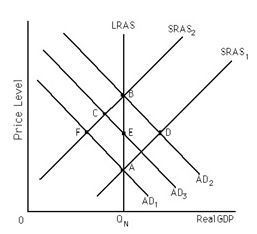
- APoint "A"
- BPoint "F"
- CPoint "C"
- DPoint "D"
58U.S. Inflation Targeting: Pro and Con
FRBSF Economic Letter, 98-18; May 29, 1998
In recent years, monetary economists and central bankers have expressed growing interest in inflation targeting as a framework for implementing monetary policy. Explicit inflation targeting has been adopted by a number of central banks around the world, including those in Australia, Canada, Finland, Israel, New Zealand, Spain, Sweden, and the U.K. In the United States, there has been little public debate over inflation targeting, although some bills have been introduced in Congress to mandate the use of explicit targets for inflation.
Issues and questions surrounding inflation targeting formed a major focus of a recent conference on Central Bank Inflation Targeting jointly sponsored by the Federal Reserve Bank of San Francisco and the Center for Economic Policy Research at Stanford University (Rudebusch and Walsh 1998). In this Economic Letter, we set out some of the arguments for and against adopting inflation targeting in the United States discussed at the conference. (For further discussion, see Bernanke and Mishkin 1997, Bernanke, et al., forthcoming, and Keleher 1997.)
What would inflation targeting mean in the U.S.?
There has been some ambiguity about the precise definition of an inflation targeting policy regime, in part because certain institutional arrangements have differed from one inflation targeting country to another--most notably with regard to how the inflation target is set and how deviations from the target are tolerated. For our discussion, we define inflation targeting to be a framework for policy decisions in which the central bank makes an explicit commitment to conduct policy to meet a publicly announced numerical inflation target within a particular time frame. For example, at the start of 1993, Sweden's central bank announced an inflation target for the consumer price index of between 1 and 3 percent by 1995. Similarly, if the Federal Reserve wanted to adopt inflation targeting, it would publicly commit to achieving a particular numerical goal for inflation (a target point or range) within a set time span of, say, a couple of years. Also, as part of an ongoing policy framework for targeting inflation, the Fed's semiannual Humphrey-Hawkins report, which currently provides a near-term (one-year) outlook for inflation, could be augmented to include a discussion of whether the medium-term (two- or three-year) inflation forecast is consistent with the announced medium-term inflation target. Inflation targeting would not impose a rigid simple rule for the Fed; instead, policy could employ some discretion to take into account special shocks and situations. However, the organizing principle and operational indicator for monetary policy would be focused on inflation and (in light of lags in the effects of policy) inflation forecasts.
Given some earlier ambiguity, it is important to be clear about how we interpret the ultimate goals of inflation targeting monetary policy. In particular, an inflation targeting central bank need not care only about inflation. Indeed, most inflation targeting central banks continue to recognize multiple goals for monetary policy with no single primary one. (In New Zealand--an exception--the start of inflation targeting coincided with a legislative mandate that the central bank's "primary function" was price stability, while in Canada--as is more typical--such legislation was never passed.) Accordingly, an operational policy framework of inflation targeting would still be consistent with the Fed's current legislated objectives of low inflation and full employment. An inflation targeting regime can accommodate a goal of output stabilization by having wide inflation target bands, long inflation target horizons, and explicit exemptions for supply shocks. Thus, the adoption of an inflation targeting regime does not necessarily require that price stability or low inflation be the preeminent goal of monetary policy. As with monetary targeting, inflation targeting is an operational framework for monetary policy, not a statement of ultimate policy goals. (For further discussion, see Rudebusch and Svensson, 1998.)
Arguments pro
By focusing attention on a goal the Fed can achieve, by making monetary policy more transparent and increasing public understanding of the Fed's strategy and tactics, by creating institutions that foster good policy, and by improving accountability, the adoption of inflation targeting would represent a desirable change in the U.S. monetary policy.
1. The announcement of explicit inflation targets for the Fed would provide a clear monetary policy framework that would focus attention on what the Fed actually can achieve. Bad monetary policy often has resulted from demands that central banks attempt to achieve the unachievable. Most notably, few macroeconomists believe that monetary policy can be used to lower the average rate of unemployment permanently, but central banks often are pressured to achieve just that through expansionary policy; such policy instead only results in higher average inflation without leading to a systematically lower average rate of unemployment. In contrast, implementing explicit inflation targets would help to insulate the Fed from such political pressure.
2. Transparent inflation targets in the U.S. would help anchor inflation expectations in the economy. When making real and financial investment decisions and planning for the future, businesses and individuals must form expectations about future inflation. Inflation targets would provide a clear path for the medium-term inflation outlook, reducing the size of inflation "surprises" and their associated costs. Inflation targets also likely would boost the Fed's credibility about maintaining low inflation in the long run, in part, because they mitigate the political pressure for expansionary policy. Since long-term interest rates fluctuate with movements in inflation expectations, targeting a low rate of inflation would lead to more stable and lower long-term rates of interest. Together, the reduced uncertainty about future medium-term and long-term inflation would have beneficial effects for financial markets, for price and wage setting, and for real investment.
3. The establishment of inflation targets in the U.S. would help institutionalize good monetary policy. Recent U.S. monetary policy has been generally considered excellent, but earlier in the postwar period, monetary policy clearly failed by allowing inflation to ratchet up significantly several times. To some extent, the quality of policy over time has reflected the skills and attitudes of the people involved in the policy process. Monetary policy is an area in which it is especially important to implement institutional structures that will help to avoid bad policies. Inflation targets can provide this institutional structure and help ensure that monetary policy is not dependent on always having the good luck to appoint the best people.
4. In the current system, there is some ambiguity about how and why the Fed operates. For example, although monetary aggregates play a very modest role in the policy process,they are the only variables that the Fed is required to set target ranges for and report about to Congress. As noted above, inflation targets would focus discussion on what the Fed actually could achieve. Furthermore, an inflation target provides a clear yardstick by which to measure monetary policy. Given forecasts of future inflation, it is easy to compare them to the announced inflation target and hence judge the appropriate tightness or looseness of current monetary policy. Also, on a retrospective basis, an explicit target allows Fed performance to be easily monitored. Thus, Congress and the public will be better able to assess the Fed's performance and hold it accountable for maintaining low inflation.
Arguments con
Inflation targeting, even without imposing a rigid rule, would unduly reduce the flexibility of the Fed to respond to new economic developments in an uncertain world. Furthermore, publicly committing solely to an inflation target would not enhance overall accountability or transparency given the multiple objectives of monetary policy.
1. The purpose of inflation targeting is to focus the attention of monetary policy on inflation. However, concentrating on numerical inflation objectives (even with caveats or escape clauses) also reduces the flexibility of monetary policy, especially with respect to other policy goals. That is, inflation targets place some constraints on the discretionary actions of central banks. Such constraints can be quite appropriate in countries where monetary policy has performed poorly, exhibiting sustained unproductive inflationary tendencies; however, this is not the case in the United States. U.S. monetary policy has operated quite well for almost two decades, so limiting the flexibility and discretion of the Fed to respond to new economic developments would be ill-advised. Why change a system that is working? Certainly, adept policymakers are one reason for the good performance of recent monetary policy, but there is also a strong institutional structure--stronger than existed at the start of the 1970s--that is already in place at the Fed that fosters good monetary policy.
2. Monetary policy requires the careful balancing of competing goals--financial stability, low inflation, and full employment--in an uncertain world. There is uncertainty about the contemporaneous state of the economy, the impact policy actions will have on future economic activity and inflation, and the evolving priority to be given to different policy objectives. However, because monetary policy actions affect inflation with a lag, inflation targeting means, in practice, that the Fed would need to rely heavily on forecasts of future inflation. Given the uncertainties the Fed faces, an inflexible and undue reliance on inflation forecasts can create policy problems. For example, most forecasts in the mid-1990s of inflation in the late 1990s over-estimated the inflation we are currently experiencing. If the Fed had been inflation targeting in the mid-1990s, it might well have raised the funds rate based on its inflation forecasts. Yet with today's low inflation and robust economy, it is difficult to argue that the Fed was too expansionary and that the more contractionary policy implied by inflation targeting would have produced a better outcome. As in this instance, it seems unlikely that a mechanical dependence on inflation forecasts to achieve inflation targets will improve policy.
3. Proponents of inflation targeting argue that it promotes accountability. However, as is generally agreed, low inflation is only one of the objectives of monetary policy. While monetary policy may not affect average real growth or unemployment over time, it does have an important role to play in helping to stabilize the economy. Even if average inflation is the one thing the Fed can control in the long run, it does not follow that the Fed should be held accountable only for its inflation record. Inflation targeting actually could reduce the Fed's overall accountability by allowing it to avoid responsibility for damping short-run fluctuations in real economic activity and unemployment. Making the Fed publicly accountable for only one policy goal may make it harder for Congress and others to monitor the Fed's contribution to good overall macroeconomic policy.
4. Similarly, with regard to the transparency and public understanding of policy, inflation targeting highlights the inflation objective of central banks but tends to obscure the other goals of policy. Just as uncertainty about future inflation impedes good economic decision making, so does uncertainty about the future level of output and employment. Inflation targeting sweeps the latter concerns under the rug (often by adjusting the amount of time that deviations are allowed from the inflation target). Given the multiple legitimate goals of policy, the single public focus of inflation targeting does not enhance overall transparency.
Glenn D. Rudebusch, Research Officer and Carl E. Walsh, Professor of Economics, UC Santa Cruz
According to the author, a primary benefit of an explicit inflation target would be:- ATo increase the average inflation rate overtime
- BTo “anchor” inflation expectations
- CTo eliminate all annual CPI increases
- DTo raise salaries for UC Santa Cruz Professors
59 The Federal Reserve System was created by the Federal Reserve Act of 1913. The act divided the country into Federal Reserve Districts; each has a Federal Reserve Bank with its own president. It includes a Board of Governors and a Federal Open Market Committee. Which list below correctly identifies all of their major functions:
- AControlling the Money Supply; Supplying the Economy with Paper Money (Federal Reserve Notes); Providing Check-Clearing Services; Handling the sale of U.S. Treasury Securities (Auctions)
- BControlling the Money Supply; Supplying the Economy with Paper Money (Federal Reserve Notes); Providing Check-Clearing Services; Holding Depository Institutions’ Reserves; Supervising Member Banks; Serving as the Government’s Banker; Serving as a Lender of Last Resort; Handling the sale of U.S. Treasury Securities (Auctions)
- COverseeing the sale of Senators and Representatives votes on the U.S. Capital to the highest corporate bidders; hoarding gold supplies away from the free men and women that work hard and make America great; maintaining the President’s collection of bobble-head basketball player figurines; providing Chris Brown a new luxury poncho every day; providing prosthetic hands to economists injured by saying, “on the other hand” to often.
- DControlling the Money Supply; Supplying the Economy with Paper Money (Federal Reserve Notes); Providing Check-Clearing Services; Supervising Member Banks; Serving as the Government’s Banker; Serving as a Lender of Last Resort; Handling the sale of U.S. Treasury Securities (Auctions); Administering the North American Free Trade Agreement
- EAdministering the North American Free Trade Agreement; Awarding the Noble Prize in Economics; Overseeing the Congressional Budget Office; Providing Rating Agency Services to Federal Agencies; Running Federal Open Market Committee Meetings; Handling meetings of the Governors of the Federal Reserve Districts.
60 If the interest rate falls, the bank’s opportunity cost of holding money __________ and the consumer’s quantity demanded of money __________.
- Arises; rises
- Brises; falls
- Cfalls; rises
- Dfalls; falls
61How will action by the Federal Reserve to conduct an open market sale impact the money supply?
- AMoney supply will increase
- BMoney supply will decrease
- CMoney supply will stay the same
- DIt cannot be determined from the information provided
62Suppose the Fed buys government securities from a commercial bank. At the end of the transaction, the Fed has more government securities than before, and the commercial bank has fewer. What the commercial bank does have, however, is a higher balance in its account at the Fed. Since deposits at the Fed are part of reserves (reserves = deposits at the Fed + vault cash), then reserves in the banking system have risen. Since the United States has a fractional reserve banking system, only a fraction of the increased amount of reserves has to be placed in required reserves. The remainder, or the positive excess reserves, can be used to extend more loans, create more demand deposits, and increase the money supply. Which statement below describes the likely real world policy implications of this process:
- AThis would be an effective contractionary policy to follow when there is an inflationary gap in the economy.
- BThis would be an effective expansionary policy to follow when there is a recessionary gap in the economy.
- CThis would not be as effective as invading a country with a stable crop and razing it to reduce international competition and boost the sales of domestic companies.
- DThis would be an effective investment strategy to follow when there is an inadequate supply of banks in the country.
63If the interest rate is below the equilibrium interest rate, then the quantity demanded of money exceeds the quantity __________ of money, and there is a __________ of money.
- Arequested; glut
- Bdesired; surplus
- Csupplied; shortage
- Dsupplied; surplus
64Is the following true or false:
Credit cards are not money, but rather devices by which money is lent—money that must be paid back. If we counted the value of credit card balances, as well as the value of the money that must be used to pay those balances off, we would be guilty of double counting in the money supply. For the consumer, a credit card is not an expenditure of their own money supply but a high interest rate loan that allows access to another entity’s money supply.- ATrue
- BFalse
65The Fed creates $100,000 in new money that is deposited in someone’s checking account in a bank. What is the maximum change in the money supply if the required reserve ratio is 5 percent?
- A1 / 0.05 × $100,000 = $2,000,000
- B1 / 0.1 × $100,000 = $1,000,000
- C1 / 0.2 × $100,000 = $500,000
- D1 / 0.50 × $100,000 = $20,000,000
66What is M1 Currency?
- ACredit Cards
- BOnly cash and coins held by consumers
- CSavings deposits of any type
- DObjects of barter between two trading partners
- EAll currency held outside banks + checkable deposits + traveler’s checks
67The Friedman natural rate theory states that
- Ain both the short run and the long run the economy stays at its natural rate of unemployment.
- Bthe economy will not return to its natural rate of unemployment in either the short run or the long run.
- Cthe economy stays at its natural rate of unemployment in the short run, but not in the long run.
- Din the long run the economy returns to its natural rate of unemployment.
68The short-run Phillips Curve holds that:
- Ahigh inflation and high unemployment can occur together.
- Blow inflation and high unemployment can occur together.
- Chigh inflation and low unemployment can occur together.
- DB and C
69If the Federal Reserve were to lower the required reserve ratio, how would money supply change?
- AMoney supply will increase
- BMoney supply will decrease
- CMoney supply will stay the same
- DIt cannot be determined from the information provided
70If the Federal Reserve raises the discount rate, how will money supply change?
- AMoney supply will increase
- BMoney supply will decrease
- CMoney supply will stay the same
- DIt cannot be determined from the information given
71Not Enough Money
From the Apr. 4, 2011, issue of National Review.
‘To economists reading this essay in 2010, perhaps the most remarkable single fact to note about monetary policy at the end of the interwar period” — the author, Columbia University economist Charles Calomiris, is of course also talking about the end of the Great Depression — “is that its architects were, for the most part, quite pleased with themselves. Far from learning about the errors of their ways during the interwar period, Fed officials congratulated themselves on having adhered to appropriate principles, and to the extent that they were self-critical, it was because they thought that they had been too expansionary.”
Almost all economists today agree that monetary policy during the Depression, especially its early stages, was disastrously tight, indeed that this contractionary policy is the principal reason the Depression became Great. But perhaps we should not judge the central bankers of America in the 1930s too harshly. For one thing, as Calomiris notes, smart economists are still arguing about the precise nature of the Fed’s policy mistakes. He himself presents evidence against the received view that the Federal Reserve precipitated the “recession within a recession” of 1937 by raising banks’ reserve requirements and thus discouraging lending.
More important — and more disturbing — is that it is not at all clear that we have learned from the mistakes of the 1930s. Those central bankers believed that money was easy because interest rates were low and the monetary base (the supply of money under the Fed’s control) had expanded. They worried that further easing would reduce confidence in the dollar. British economist R. G. Hawtrey, writing in the late 1930s, described the climate of opinion in his country at the start of the decade: “Fantastic fears of inflation were expressed. That was to cry ‘Fire! Fire!’ in Noah’s Flood.” The economy was actually deflating, not inflating. Under the influence of the “real-bills doctrine,” some central bankers believed that the money supply should respond only to traders’ need for credit. Anything else would only fuel speculative excess.
Today’s inflation hawks employ the same reasoning that those firefighters did. And they are not wholly wrong. Easier money can lead to a destabilizing run on the currency. Inflation can be associated with low real interest rates and an expanded monetary base. But not always: Not in the 1930s, and almost certainly not today, either. The late Milton Friedman, perhaps the most famous inflation hawk of his generation, spotted the fallacy in his analysis of 1990s Japan:
Low interest rates can also be a symptom of an excessively tight monetary policy that has choked off opportunities for growth. A looser policy, by increasing expectations of future economic growth, could actually raise real interest rates.
To see why changes in the monetary base are also an unreliable guide to whether money is loose or tight, I’m afraid it’s necessary to look at an equation. Friedman and others familiarized us with the equation of exchange: MV=PY. What that means is that the money supply (M) times the speed with which money changes hands (V, for velocity) must equal the price level (P) times the size of the real economy (Y). If velocity holds constant and the money supply goes up, either prices must go up or the economy must expand or both.
If, on the other hand, velocity drops — if people have an increased desire to hold money balances — then either prices must drop or the economy must shrink or both. And prices, especially wages, are sticky. They won’t automatically and evenly fall in response to a shock. So at least some of the reduction in PY, and maybe a lot of it, will have to come from real economic contraction. What this suggests is that if velocity drops unexpectedly, stabilizing the economy will require increasing the money supply to make up for it. Another way of putting it is that if the demand for money balances increases, the money supply has to grow to accommodate it. If the Fed does not increase the money supply, its inaction in the face of changing economic conditions amounts to passive tightening.
The money supply is itself the product of the monetary base (B) and the “money multiplier” (m), which measures how changes in the base are being converted into changes in commonly used monetary assets such as checking and money-market accounts. So — I promise this is the last equation — BmV=PY. David Beckworth, a conservative economics professor at Texas State University who maintains a blog, has shown that at the height of the financial crisis in late 2008, velocity dropped significantly and the money multiplier fell off a cliff. The monetary base grew a lot too: The inflation hawks are right about that. But it grew enough to offset only the fall in the money multiplier. It didn’t offset the fall in velocity.
Beckworth’s interpretation: The Fed was increasing the base to save the financial system, not the economy overall. At the same time the Fed was injecting money into the financial system, it instituted a policy of paying banks interest on their reserves — a policy that made them less likely to lend out those reserves (and thus kept m down). That policy helped the banks’ solvency but not the economy. The financial system would almost certainly have benefited more from a broader policy: A rising tide lifts all banks. Both m and V remain well below their pre-crisis levels.
Beckworth is among those economists who argue that Fed policy should aim to stabilize the growth of nominal spending — roughly, the total value of the economy in current dollars, which is equal to PY (and therefore to MV and BmV). That policy is superior to trying to grow the base at a steady rate, a much-discussed idea in the past, because it allows the base to change in response to changes in the money multiplier and velocity. It is superior to trying to hold inflation constant because it allows the price level to respond to changes in productivity. It would create a stable environment in which economic actors could make their decisions and contracts.
Josh Hendrickson — an economist at the University of Toledo, and like Beckworth a right-leaning blogger — has shown that the Fed did a pretty good job of stabilizing the growth of nominal income at roughly 5 percent per year during the “great moderation” that lasted from the mid-1980s until the current recession. (Although Beckworth notes that growth was slightly above trend during the housing boom, for which he faults the Fed.) Most debts — notably, most mortgage debts — are contracted in nominal terms, with no inflation adjustment. If people are used to 5 percent growth in nominal incomes each year and make their arrangements accordingly, then an unexpected drop will make their debt burdens heavier and also make them reluctant to make plans for a suddenly uncertain future.
That’s what happened during the recent crisis. Scott Sumner — yet another right-of-center econoblogger, this one based at Bentley University — often notes that in late 2008 and early 2009, we saw the sharpest fall in nominal income since 1938. In his view, much of what we think we know about the recession of 2007–09 is wrong. Not only has money not been loose since the crisis began, but tight money is the fundamental reason the recession was so severe and the recovery has been so halting. He argues that it was more fundamental than the housing bust, since residential-construction employment started falling long before the crisis hit.
An alternative theory of the crisis goes something like this: While a recession may have been inevitable, it was the Fed’s passive tightening that made it a disaster. The recession began in late 2007, although many observers knew it only after the fact. The Fed passively tightened mildly in mid-2008. In the fall of 2008, the financial crisis caused velocity (and the money multiplier) to drop dramatically — in part, perhaps, because political and financial leaders were scaring everyone. The Fed did not act aggressively enough to accommodate the increased demand for money balances, and what had been a mild recession became a severe one.
As panic subsided, velocity stopped falling, and the economy then began to recover. But in mid-2010, the eurozone crisis resulted in a flight to the dollar. Increased demand for dollars again had a contractionary effect, and the Fed took months to respond to it. Finally, in the late summer, it began letting it be known that it would dramatically increase the money supply — an initiative called quantitative easing, or QE2, the first QE having been the injection of money into the financial system in late 2008 — and then, in the fall, it followed through.
A number of justifications were offered for QE2. The most plausible was that if people expected it to move nominal income to a permanently higher path, asset values would increase to reflect this higher expected income stream. Both consumers and investors would then spend more money. The demand for money, in other words, would decline at the same time as the supply increased, restoring equilibrium.
As the market became convinced that the Fed planned to act, both expectations of inflation and expectations of real growth increased: the former indicated in the spreads between inflation-indexed bonds and non-indexed bonds, the latter in real interest rates. Nominal income thus moved closer to trend, if not as much as it would have with a bolder Fed initiative. (An explicit announcement that the Fed is willing to do what it takes to restore the trend might itself change expectations enough to make great exertions by it unnecessary.) Stocks picked up too. QE2, though flawed, worked. It began to work even before being formally implemented.
Conservative politicians and conservative pundits nonetheless blasted it. They seized on the rise in long-term interest rates as proof it was not stimulating the economy: the precise kind of confusion about the meaning of interest-rate changes that Friedman had warned against. They blamed QE2 for a boom in commodities prices, largely ignoring the role of rising Asian demand for those commodities. And they fretted about runaway inflation, even though, in the aftermath of QE2, the spreads mentioned above were forecasting inflation rates below 2 percent for years to come — a lower average inflation rate than in each of the last five decades.
The argument for stabilizing the growth of nominal income implies that if the Fed overshoots its target in one year it should undershoot it the next, and vice versa: The key is to keep to the targeted long-term trend. Any rational person would want as much of the growth in nominal income to be made up of real economic gains, and as little of it of inflation, as possible. But a modest uptick in inflation that helps to bring nominal income back to trend is better than staying below trend.
There is a reasonable argument — made by Beckworth, among others — that over time the Fed should gradually reduce the average growth of nominal income from 5 percent per year to something closer to 3 percent. The idea would be to move the economy to a lower average inflation rate, or even to a mild and gradual deflation. But such a move should neither be abrupt nor begin in the midst of a shaky recovery, let alone a crisis.
In warning about inflation, conservatives are crying “fire” in, if not Noah’s flood, at least a torrential rain. It may be that they are stuck not so much in the 1930s as in the 1970s — the time when conservatism forged much of its current outlook on economics, and a time when monetary restraint was badly needed. Conservatives also tend to think that loosening monetary policy is a kind of intervention in free markets, and therefore to be suspicious of it. But this is an error. Professor Hendrickson points out that in a system of free banking, with competitive note issue rather than a central bank, the desire for profit and the need for solvency would lead to the supply of banknotes roughly equaling the demand. In a fiat-money regime such as the one under which we, for better or worse, live, a central bank’s withholding of a sufficient supply of money is just as much of an intervention in the economy as its overproduction of it.
The economy, post-QE2, seems to be on the mend. But events overseas — a renewed eurozone crisis, or trouble in the Middle East — could again boost demand for dollars. If so, will the Fed accommodate that demand? Or will it be dissuaded by the vehement criticism its efforts to date have already drawn from conservatives? Congressional Republicans are at the moment blocking the confirmation of Peter Diamond, a Nobel Prize–winning economist, to the Federal Reserve’s board of governors because of their opposition to the inflation they believe is just around the corner.
We are not likely to see a second Great Depression. But it would be tragic if conservatives, moved by hostility to the Fed, led it to repeat, even on a smaller scale, the worst mistakes in its history.
— Ramesh Ponnuru is a senior editor for National Review.
At the height of the financial crisis in late 2008, what happened?- AVelocity dropped significantly
- BThe money multiplier dropped.
- CMonetary base grew, but not enough.
- DAll of the above.
- ENone of the above.
72Four Nations, Four Lessons,Published: October 22, 2011
By N. GREGORY MANKIW
AS the economy languishes, politicians and pundits are debating what to do next. When we look around the world, it’s hard to find positive role models. But as we search for answers, it is useful to keep in mind those fates that we would like to avoid. The recent economic histories of four nations are noteworthy: France, Greece, Japan and Zimbabwe. Each illustrates a kind of policy mistake that could, if we are not careful, presage the future of the United States economy. Think of them as the four horsemen of the economic apocalypse.
Let’s start with Zimbabwe. If there were an award for the world’s worst economic policy, it might well have won it several times over the past decade. In particular, in 2008 and 2009, it experienced truly spectacular hyperinflation. Prices rose so fast that the central bank eventually printed 100 trillion-dollar notes for people to carry. The nation has since abandoned using its own currency, but you can still buy one of those notes as a novelty item for about $5 (American, that is).
Some may find it hard to imagine that the United States would ever go down this route. But reckless money creation is apparently a concern of Gov. Rick Perry of Texas, who is seeking the Republican nomination for president. He suggested in August that it would be “almost treasonous” if Ben S. Bernanke, chairman of the Federal Reserve, were to print too much money before the election. Mr. Perry is not alone in his concerns. Many on the right fear that the Fed’s recent policies aimed at fighting high unemployment will mainly serve to ignite excessive inflation. Mr. Bernanke, however, is less worried about the United States turning into Zimbabwe than he is about it turning into Japan.
Those old enough to remember the 1980s will recall that Japan used to be an up-and-coming economic superpower. Many people then worried (too much, in my view) that Japan’s rapid growth was a threat to prosperity in the United States, in much the same way that many people worry today (too much, in my view) about rapid growth in China.
The concerns about Japanese hegemony came to a quick end after bubbles in the real estate and stock markets burst in the early 1990s. Since then, Japan has struggled to regain its footing. Critics of the Bank of Japan say it has been too focused on quelling phantom inflationary threats and insufficiently concerned about restoring robust economic growth.
One of those critics was Mr. Bernanke, before he became Fed chairman. Watching Japanese timidity and failures has surely made him more willing to experiment with unconventional forms of monetary policy in the aftermath of our own financial crisis.
The economists in the Obama administration are also well aware of the Japanese experience. That is one reason they are pushing for more stimulus spending to prop up the aggregate demand for goods and services.
Yet this fiscal policy comes with its own risks. The more we rely on deficit spending to keep the economy afloat, the more we risk the kind of sovereign debt crisis we have witnessed in Greece over the past year. The Standard & Poor’s downgrade of United States debt over the summer is a portent of what could lie ahead. In the long run, we have to pay our debts — or face dire consequences.
To be sure, the bond market doesn’t seem particularly worried about the solvency of the federal government. It is still willing to lend to the United States at low rates of interest. But the same thing was true of Greece four years ago. Once the bond market starts changing its mind, the verdict can be swift, and can lead to a vicious circle of rising interest rates, increasing debt service and budget deficits, and falling confidence.
Bond markets are now giving the United States the benefit of the doubt, partly because other nations look even riskier, and partly in the belief that we will, in time, get our fiscal house in order. The big political question is how.
The nation faces a fundamental decision about priorities. To maintain current levels of taxation, we will need to substantially reduce spending on the social safety net, including Social Security, Medicare, Medicaid and the new health care program sometimes called Obamacare. Alternatively, we can preserve the current social safety net and raise taxes substantially to pay for it. Or we may choose a combination of spending cuts and tax increases. This brings us to the last of our cautionary tales: France.
Here are two facts about the French economy. First, gross domestic product per capita in France is 29 percent less than it is in the United States, in large part because the French work many fewer hours over their lifetimes than Americans do. Second, the French are taxed more than Americans. In 2009, taxes were 24 percent of G.D.P. in the United States but 42 percent in France.
Economists debate whether higher taxation in France and other European nations is the cause of the reduced work effort and incomes there. Perhaps it is something else entirely — a certain joie de vivre that escapes the nose-to-the-grindstone American culture.
We may soon be running a natural experiment to find out. If American policy makers don’t rein in entitlement spending over the next several decades, they will have little choice but to raise taxes close to European levels. We can then see whether the next generation of Americans spends less time at work earning a living and more time sipping espresso in outdoor cafes.
N. Gregory Mankiw is a professor of economics at Harvard.
The author's overall conclusion is:- AThe French are taxed more than Americans. In 2009, taxes were 24 percent of G.D.P. in the United States but 42 percent in France.
- BThe economists in the Obama administration are also well aware of the Japanese experience. That is one reason they are pushing for more stimulus spending to prop up the aggregate demand for goods and services.
- CThe bond market doesn’t seem particularly worried about the solvency of the federal government. It is still willing to lend to the United States at low rates of interest. But the same thing was true of Greece four years ago.
- DIf American policy makers don’t rein in entitlement spending over the next several decades, they will have little choice but to raise taxes close to European levels.
73Not Enough Money
From the Apr. 4, 2011, issue of National Review.
‘To economists reading this essay in 2010, perhaps the most remarkable single fact to note about monetary policy at the end of the interwar period” — the author, Columbia University economist Charles Calomiris, is of course also talking about the end of the Great Depression — “is that its architects were, for the most part, quite pleased with themselves. Far from learning about the errors of their ways during the interwar period, Fed officials congratulated themselves on having adhered to appropriate principles, and to the extent that they were self-critical, it was because they thought that they had been too expansionary.”
Almost all economists today agree that monetary policy during the Depression, especially its early stages, was disastrously tight, indeed that this contractionary policy is the principal reason the Depression became Great. But perhaps we should not judge the central bankers of America in the 1930s too harshly. For one thing, as Calomiris notes, smart economists are still arguing about the precise nature of the Fed’s policy mistakes. He himself presents evidence against the received view that the Federal Reserve precipitated the “recession within a recession” of 1937 by raising banks’ reserve requirements and thus discouraging lending.
More important — and more disturbing — is that it is not at all clear that we have learned from the mistakes of the 1930s. Those central bankers believed that money was easy because interest rates were low and the monetary base (the supply of money under the Fed’s control) had expanded. They worried that further easing would reduce confidence in the dollar. British economist R. G. Hawtrey, writing in the late 1930s, described the climate of opinion in his country at the start of the decade: “Fantastic fears of inflation were expressed. That was to cry ‘Fire! Fire!’ in Noah’s Flood.” The economy was actually deflating, not inflating. Under the influence of the “real-bills doctrine,” some central bankers believed that the money supply should respond only to traders’ need for credit. Anything else would only fuel speculative excess.
Today’s inflation hawks employ the same reasoning that those firefighters did. And they are not wholly wrong. Easier money can lead to a destabilizing run on the currency. Inflation can be associated with low real interest rates and an expanded monetary base. But not always: Not in the 1930s, and almost certainly not today, either. The late Milton Friedman, perhaps the most famous inflation hawk of his generation, spotted the fallacy in his analysis of 1990s Japan:
Low interest rates can also be a symptom of an excessively tight monetary policy that has choked off opportunities for growth. A looser policy, by increasing expectations of future economic growth, could actually raise real interest rates.
To see why changes in the monetary base are also an unreliable guide to whether money is loose or tight, I’m afraid it’s necessary to look at an equation. Friedman and others familiarized us with the equation of exchange: MV=PY. What that means is that the money supply (M) times the speed with which money changes hands (V, for velocity) must equal the price level (P) times the size of the real economy (Y). If velocity holds constant and the money supply goes up, either prices must go up or the economy must expand or both.
If, on the other hand, velocity drops — if people have an increased desire to hold money balances — then either prices must drop or the economy must shrink or both. And prices, especially wages, are sticky. They won’t automatically and evenly fall in response to a shock. So at least some of the reduction in PY, and maybe a lot of it, will have to come from real economic contraction. What this suggests is that if velocity drops unexpectedly, stabilizing the economy will require increasing the money supply to make up for it. Another way of putting it is that if the demand for money balances increases, the money supply has to grow to accommodate it. If the Fed does not increase the money supply, its inaction in the face of changing economic conditions amounts to passive tightening.
The money supply is itself the product of the monetary base (B) and the “money multiplier” (m), which measures how changes in the base are being converted into changes in commonly used monetary assets such as checking and money-market accounts. So — I promise this is the last equation — BmV=PY. David Beckworth, a conservative economics professor at Texas State University who maintains a blog, has shown that at the height of the financial crisis in late 2008, velocity dropped significantly and the money multiplier fell off a cliff. The monetary base grew a lot too: The inflation hawks are right about that. But it grew enough to offset only the fall in the money multiplier. It didn’t offset the fall in velocity.
Beckworth’s interpretation: The Fed was increasing the base to save the financial system, not the economy overall. At the same time the Fed was injecting money into the financial system, it instituted a policy of paying banks interest on their reserves — a policy that made them less likely to lend out those reserves (and thus kept m down). That policy helped the banks’ solvency but not the economy. The financial system would almost certainly have benefited more from a broader policy: A rising tide lifts all banks. Both m and V remain well below their pre-crisis levels.
Beckworth is among those economists who argue that Fed policy should aim to stabilize the growth of nominal spending — roughly, the total value of the economy in current dollars, which is equal to PY (and therefore to MV and BmV). That policy is superior to trying to grow the base at a steady rate, a much-discussed idea in the past, because it allows the base to change in response to changes in the money multiplier and velocity. It is superior to trying to hold inflation constant because it allows the price level to respond to changes in productivity. It would create a stable environment in which economic actors could make their decisions and contracts.
Josh Hendrickson — an economist at the University of Toledo, and like Beckworth a right-leaning blogger — has shown that the Fed did a pretty good job of stabilizing the growth of nominal income at roughly 5 percent per year during the “great moderation” that lasted from the mid-1980s until the current recession. (Although Beckworth notes that growth was slightly above trend during the housing boom, for which he faults the Fed.) Most debts — notably, most mortgage debts — are contracted in nominal terms, with no inflation adjustment. If people are used to 5 percent growth in nominal incomes each year and make their arrangements accordingly, then an unexpected drop will make their debt burdens heavier and also make them reluctant to make plans for a suddenly uncertain future.
That’s what happened during the recent crisis. Scott Sumner — yet another right-of-center econoblogger, this one based at Bentley University — often notes that in late 2008 and early 2009, we saw the sharpest fall in nominal income since 1938. In his view, much of what we think we know about the recession of 2007–09 is wrong. Not only has money not been loose since the crisis began, but tight money is the fundamental reason the recession was so severe and the recovery has been so halting. He argues that it was more fundamental than the housing bust, since residential-construction employment started falling long before the crisis hit.
An alternative theory of the crisis goes something like this: While a recession may have been inevitable, it was the Fed’s passive tightening that made it a disaster. The recession began in late 2007, although many observers knew it only after the fact. The Fed passively tightened mildly in mid-2008. In the fall of 2008, the financial crisis caused velocity (and the money multiplier) to drop dramatically — in part, perhaps, because political and financial leaders were scaring everyone. The Fed did not act aggressively enough to accommodate the increased demand for money balances, and what had been a mild recession became a severe one.
As panic subsided, velocity stopped falling, and the economy then began to recover. But in mid-2010, the eurozone crisis resulted in a flight to the dollar. Increased demand for dollars again had a contractionary effect, and the Fed took months to respond to it. Finally, in the late summer, it began letting it be known that it would dramatically increase the money supply — an initiative called quantitative easing, or QE2, the first QE having been the injection of money into the financial system in late 2008 — and then, in the fall, it followed through.
A number of justifications were offered for QE2. The most plausible was that if people expected it to move nominal income to a permanently higher path, asset values would increase to reflect this higher expected income stream. Both consumers and investors would then spend more money. The demand for money, in other words, would decline at the same time as the supply increased, restoring equilibrium.
As the market became convinced that the Fed planned to act, both expectations of inflation and expectations of real growth increased: the former indicated in the spreads between inflation-indexed bonds and non-indexed bonds, the latter in real interest rates. Nominal income thus moved closer to trend, if not as much as it would have with a bolder Fed initiative. (An explicit announcement that the Fed is willing to do what it takes to restore the trend might itself change expectations enough to make great exertions by it unnecessary.) Stocks picked up too. QE2, though flawed, worked. It began to work even before being formally implemented.
Conservative politicians and conservative pundits nonetheless blasted it. They seized on the rise in long-term interest rates as proof it was not stimulating the economy: the precise kind of confusion about the meaning of interest-rate changes that Friedman had warned against. They blamed QE2 for a boom in commodities prices, largely ignoring the role of rising Asian demand for those commodities. And they fretted about runaway inflation, even though, in the aftermath of QE2, the spreads mentioned above were forecasting inflation rates below 2 percent for years to come — a lower average inflation rate than in each of the last five decades.
The argument for stabilizing the growth of nominal income implies that if the Fed overshoots its target in one year it should undershoot it the next, and vice versa: The key is to keep to the targeted long-term trend. Any rational person would want as much of the growth in nominal income to be made up of real economic gains, and as little of it of inflation, as possible. But a modest uptick in inflation that helps to bring nominal income back to trend is better than staying below trend.
There is a reasonable argument — made by Beckworth, among others — that over time the Fed should gradually reduce the average growth of nominal income from 5 percent per year to something closer to 3 percent. The idea would be to move the economy to a lower average inflation rate, or even to a mild and gradual deflation. But such a move should neither be abrupt nor begin in the midst of a shaky recovery, let alone a crisis.
In warning about inflation, conservatives are crying “fire” in, if not Noah’s flood, at least a torrential rain. It may be that they are stuck not so much in the 1930s as in the 1970s — the time when conservatism forged much of its current outlook on economics, and a time when monetary restraint was badly needed. Conservatives also tend to think that loosening monetary policy is a kind of intervention in free markets, and therefore to be suspicious of it. But this is an error. Professor Hendrickson points out that in a system of free banking, with competitive note issue rather than a central bank, the desire for profit and the need for solvency would lead to the supply of banknotes roughly equaling the demand. In a fiat-money regime such as the one under which we, for better or worse, live, a central bank’s withholding of a sufficient supply of money is just as much of an intervention in the economy as its overproduction of it.
The economy, post-QE2, seems to be on the mend. But events overseas — a renewed eurozone crisis, or trouble in the Middle East — could again boost demand for dollars. If so, will the Fed accommodate that demand? Or will it be dissuaded by the vehement criticism its efforts to date have already drawn from conservatives? Congressional Republicans are at the moment blocking the confirmation of Peter Diamond, a Nobel Prize–winning economist, to the Federal Reserve’s board of governors because of their opposition to the inflation they believe is just around the corner.
We are not likely to see a second Great Depression. But it would be tragic if conservatives, moved by hostility to the Fed, led it to repeat, even on a smaller scale, the worst mistakes in its history.
— Ramesh Ponnuru is a senior editor for National Review.
According to the author, QE2:- AWorked because it was an expansionary policy launched during a recessionary period and because it created expectations that the Fed would continue to manage the economy for growth.
- BHelped correct a problem with a lack of money supply.
- CDid not cause the inflation some predicted.
- DAll of the above.
- ENone of the Above
74If the Federal Reserve takes action to raise the required reserve ratio, what will be the impact on the money supply?
- AMoney supply will increase
- BMoney supply will decrease
- CMoney supply will stay the same
- DIt cannot be determined from the information given
75In monetarism with velocity and natural GDP static, how will a decrease in the money supply affect the price level in the short run?
- AA decrease in M will tend to keep the price level static.
- BA decrease in M will tend to increase the price level.
- CA decrease in M will tend to decrease the price level.
- DNone of the above
Informações
- Descrição
- Macroeconomics Final
- Autor
- Koda M
- Idioma
- English
- Visualizações
- 2.030
- Etiquetas
- Avaliação
- 4,0 de 5 · 1 avaliação Avalie este quiz