
Quiz
P7 Quiz - Lenses and Telescopes, Mapping the Universe, The Astronomical Community
Este quiz tem tipos de pergunta que abrem no player de sempre.
Perguntas do quiz (31)
1The speed of a wave (eg light) is affected by the [blank_start]medium[blank_end] it passes through. When light passes from one substance into one with a different optical [blank_start]density[blank_end], it will speed up or slow down. Because the [blank_start]frequency[blank_end] (number of cycles in a given time period) of the light remains constant, the [blank_start]wavelength[blank_end] changes, and this causes a change in direction. This effect is called [blank_start]refraction[blank_end].
Light rays slow down when passing from the air into the Perspex block, so they bend [blank_start]towards[blank_end] the normal (a line drawn at [blank_start]90[blank_end]o from the edge of the block of Perspex at the point where the light hits it). As they leave the block and pass into the [blank_start]air[blank_end], they [blank_start]speed up[blank_end] and bend [blank_start]away[blank_end] from the normal.- Amedium
- Bdensity
- Cfrequency
- Dwavelength
- Erefraction
- Ftowards
- G90
- Hair
- Ispeed up
- Jaway
2If a wave is travelling into the more dense material along the normal, it will not be refracted.
- AVerdadeiro
- BFalso
3Label the diagram of a converging (convex) lens.
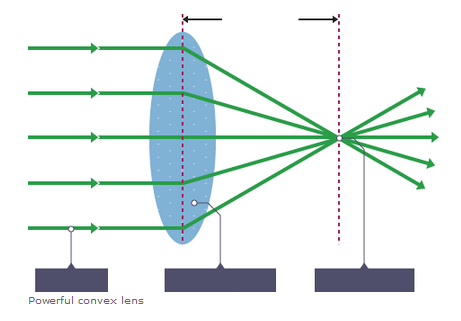
- AFocal Length
- BFocal Point
- CConvex Lens
- DLight Rays
4The power of a lens can be calculated using the following formula:
power of lens (dioptres) = magnification/focal length of lens (metres)- AVerdadeiro
- BFalso
5When drawing ray diagrams of distant objects, we consider the rays to be parallel when they enter the lens as they are coming from so far away.
- AVerdadeiro
- BFalso
6How many lenses are needed to make the image from a telescope the correct way up?
- A2
- B3
- C4
- D1
7Diffraction is increased when waves pass through a ...
- A.... smaller gap
- B.... larger gap
8What is a diffraction grating?
- AA set of narrow, evenly spaced parallel lines ruled onto a thin sheet of glass or a shiny surface, which allows different wavelengths of light to diffract different amounts when light shines on the grating, creating a spectrum.
- BA prism which light shines through, causing the different wavelengths to separate and form a spectrum.
- CA hole which a wave passes through, causing diffraction depending on its size and position, as well as the wavelength of the wave.
9Professional [blank_start]telescopes[blank_end] are quite large. One reason for this is that they need to collect visible light and other [blank_start]electromagnetic[blank_end] radiation to detect faint objects.
Radiation is [blank_start]diffracted[blank_end] by the aperture of a telescope. The aperture is the hole through which the [blank_start]light[blank_end] must pass. In order to produce [blank_start]sharp[blank_end] images, the aperture must be very much [blank_start]larger[blank_end] than the wavelength of the radiation which is detected by the telescope.- Aelectromagnetic
- Btelescopes
- Cdiffracted
- Dlight
- Esharp
- Flarger
10Which of the following are advantages of using mirrors over lenses in telescopes?
- AThey can be made very smooth - resulting in undistorted images.
- BMirrors reflect rays of all colours in the same way.
- CSuitable reflectors can be used to focus all types of electromagnetic radiation.
- DObjective lenses can have a maximum diameter of approximately 1 metre before it begins to sag, whereas a mirror of several metres in diameter can be used.
- EThey are quicker to make
- FThey are cheap
- GThey are not affected by light pollution
11The angular magnification of a telescope can be calculated using the following formula:
angular magnification = focal length of objective lens/focal length of eyepiece lens- AVerdadeiro
- BFalso
12Major optical and infrared astronomical observatories on Earth are mostly located in Chile, Hawaii, Australia and the Canary Islands. Why are these locations favourable?
- AThey are at high altitudes so there is less atmospheric gas above them for light to pass through.
- BThey have frequent cloudless nights.
- CThey have dry air with very little atmospheric pollution which would disturb light from space.
- DThey are far from streetlights and other sources of light pollution.
- EIt is cheaper to build them there.
- FThey are in the southern hemisphere.
13Operating a telescope remotely means that the astronomer is in the same place as the telescope. Operating it locally means that the astronomer could be as far away as a different country.
- AVerdadeiro
- BFalso
14Telescopes are usually controlled by [blank_start]computer[blank_end]. This has the following advantages:
- astronomers can work [blank_start]remotely[blank_end]
- telescopes can be programmed to [blank_start]track[blank_end] objects so that data can be collected over a [blank_start]long[blank_end] period of time
- the telescope can be [blank_start]precisely[blank_end] positioned to find a distant object
- the [blank_start]data[blank_end] can be recorded and [blank_start]processed[blank_end] by computer- Acomputer
- Bremotely
- Ctrack
- Dlong
- Eprecisely
- Fprocessed
- Gdata
15What are the disadvantages of space telescopes?
- Ano atmosphere - therefore light from distant stars is not absorbed or refracted
- Bthey can use parts of the electromagnetic spectrum that are absorbed by the atmosphere
- Cthey are very expensive to manufacture and place in orbit around Earth
- Dtelescopes can be programmed to track objects so that data can be collected over a long period of time
- Emaintaining and repairing a space telescope is very expensive
- Fspace programmes can be unpredictable and at risk from funding cuts and changes in government policies
16The majority of recent developments in astronomical telescopes have been as a result of international co-operation. This has two main advantages:
- the cost of the venture can be shared
- expertise can be shared- AVerdadeiro
- BFalso
17Parallax makes stars that are nearer to [blank_start]Earth[blank_end] appear to move over the course of a [blank_start]year[blank_end], relative to stars that are [blank_start]further[blank_end] away. In fact, it is caused by the [blank_start]movement[blank_end] of the Earth around the Sun. The parallax angle of a star is defined as half the angle that a [blank_start]star[blank_end] moves in six months, against a [blank_start]background[blank_end] of very distant stars. The effect of [blank_start]parallax[blank_end] can be used to measure how far stars are from Earth. The [blank_start]smaller[blank_end] the parallax angle, the further away the star is.
- AEarth
- Byear
- Cfurther
- Dmovement
- Estar
- Fbackground
- Gparallax
- Hsmaller
18Finish labelling the diagram of parallax.
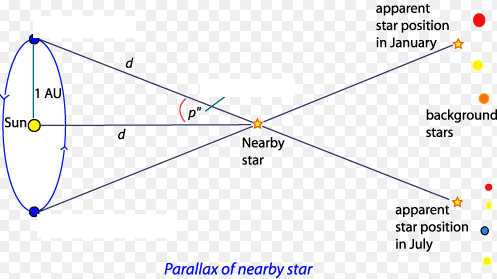
- AEarth in July
- BEarth in January
- CParallax angle
19The nearer the star, the ..... the parallax angle.
- Alarger
- Bsmaller
- Cwider
20A parsec (pc) is a unit of distance that astronomers use. A parsec is defined as being the distance to a star with a parallax angle of 1 second of an arc.
- AVerdadeiro
- BFalso
21An arcsecond = 1/x degrees. What is x?
- A60
- B3600
- C2
22distance (parsecs) = 1/parallax angle (seconds of arc)
- AVerdadeiro
- BFalso
23The brightness of a star can also be used to estimate its [blank_start]distance[blank_end]. However, this is not straightforward because a [blank_start]distant[blank_end] star that is very bright (luminous) might appear, to someone on Earth, as being very similar to a nearer star that is less [blank_start]bright[blank_end].
The [blank_start]luminosity[blank_end] of a star depends on two things:
its size
its temperature
Cepheid variable stars do not have a [blank_start]constant[blank_end] luminosity. They [blank_start]pulse[blank_end] light and their luminosity depends on the [blank_start]period[blank_end] of their pulses (how long each pulse lasts).This relationship allows astronomers to [blank_start]estimate[blank_end] the distance to Cepheid variable stars - as long as they know how bright the star [blank_start]actually[blank_end] is and how bright the star appears to be.- Adistance
- Bdistant
- Cbright
- Dluminosity
- Econstant
- Fpulse
- Gperiod
- Hestimate
- Iactually
24If you know the period of a cepheid, you can work out its luminosity. Then, if you compare the luminosity to the apparent brightness of the star from Earth, you can work out how far away it is from Earth.
- AVerdadeiro
- BFalso
25Supernovae can be used to calculate [blank_start]distances[blank_end] in space. A supernova is an explosion of a red [blank_start]giant[blank_end]/red supergiant at the [blank_start]end[blank_end] of its life. All type 1a supernovae have the same peak [blank_start]luminosity[blank_end], so we can compare the peak luminosity to the [blank_start]apparent[blank_end] brightness to estimate the distance.
However, supernovae are very rare, and it is necessary to follow supernovae from [blank_start]beginning[blank_end] to end to ensure it is a type 1a.- Adistances
- Bgiant
- Cend
- Dluminosity
- Eapparent
- Fbeginning
26In [blank_start]1920[blank_end], two leading astronomers - Heber Curtis and Harlow Shapley - disagreed on whether there was [blank_start]one[blank_end] galaxy or many galaxies in the [blank_start]universe[blank_end]. Observations with telescopes had identified that the Sun was one of many [blank_start]stars[blank_end] in our galaxy (the [blank_start]Milky[blank_end] Way). Astronomers had also seen lots of fuzzy objects in the sky at night. Astronomers called these objects [blank_start]nebulae[blank_end].
- A1920
- Bone
- Cuniverse
- Dstars
- EMilky
- Fnebulae
27Curtis argued that:
- AThe Milky Way was not the only galaxy in the universe.
- BThe Milky Way was the only galaxy in the universe.
- CThese nebulae were distant galaxies.
- DThe nebulae were gas clouds within the Milky Way.
28Shapley argued that:
- AThe Milky Way was not the only galaxy in the universe.
- BThe Milky Way was the only galaxy in the universe.
- CThe nebulae were gas clouds within the Milky Way.
- DThese nebulae were distant galaxies.
29The debate wasn't solved until a few years later, when [blank_start]Edwin Hubble[blank_end] measured the distance to some [blank_start]Cepheid[blank_end] Variables and found that they were much [blank_start]further[blank_end] away than either Curtis or Shapley imagined the Milky Way galaxy to be. Hubble found that they were part of the [blank_start]Andromeda[blank_end] spiral nebula, which was a galaxy in its own right (over [blank_start]2.5 million[blank_end] light years away!).
- AEdwin Hubble
- BCepheid
- Cfurther
- DAndromeda
- E2.5 million
30Using redshift, Hubble worked out the recession speed (v) of some nearby galaxies which he knew the distance to.
- AVerdadeiro
- BFalso
31Hubble found that the [blank_start]further[blank_end] away a galaxy is, the faster it is moving away from us. The Hubble [blank_start]Constant[blank_end] was originally 500km/s per Mpc, but it is currently stated as (70.6 +-3.1)km/s per Mpc. It has changed because our methods are improving and becoming [blank_start]more[blank_end] accurate. Hubble's ideas and constant provide evidence for the [blank_start]Big Bang[blank_end].
Hubble's law: the speed of [blank_start]recession[blank_end] of a galaxy is directly [blank_start]proportional[blank_end] to its distance from the Earth - speed of recession = Hubble's constant x [blank_start]distance[blank_end].- Afurther
- BConstant
- Cmore
- DBig Bang
- Erecession
- Fproportional
- Gdistance
Informações
- Descrição
- GCSE Physics (P7) Quiz sobre P7 Quiz - Lenses and Telescopes, Mapping the Universe, The Astronomical Community, criado por Leah Firmstone em 24-01-2016.
- Autor
- Leah Firmstone
- Idioma
- English
- Visualizações
- 71
- Etiquetas
- Avaliação
- Ainda sem avaliações Avalie este quiz