
Quiz
Aeroscience
Perguntas do quiz (40)
1A fly-by-wire system is one that:
- ARequires the pilot to stabilise the aircraft manually
- BUses a system of wires connected to pulleys linked to the pilot’s controls
- CConverts the movements of flight controls to electronic signals that are transmitted by wires, and uses flight control computers to determine how to move the actuators at each control surface to provide the ordered response
- DUses a system consisting of three gyroscopes and three accelerometers
2A Shock stall is:
- A1. Also known as a high-speed stall
- B2. The breakdown in lift as the result of a shock wave
- C3. When an aerofoil exceeds the critical angle and there is insufficient lift to support the aircraft's weight, causing the aircraft to stall
- D4. Both 1 and 2 are correct
3An aircraft takes off with an IAS of 200 kt and maintains the IAS to an altitude of 31,000 ft. What would the Mach number at 10,000 ft be compared to at 31,000 ft?
- ALower
- BHigher
4As subsonic flow converges, the velocity __________ and the pressure __________, while the density is said to __________.
- Adecreases, increases, remain constant
- Bdecreases, increases, decrease
- Cincreases, decreases, remain constant
- Dincreases, decreases, decrease
5As subsonic flow diverges, the velocity __________ and the pressure __________, while the density is said to __________.
- Adecreases, increases, increase
- Bincreases, decreases, remain constant
- Cincreases, decreases, increase
- Ddecreases, increases, remain constant
6As supersonic flow converges, the velocity __________ and the pressure __________, while the density and temperature is said to __________.
- Adecreases, increases, increase
- Bincreases, decreases, decrease
- Cincreases, decreases, increase
- Ddecreases, increases, decrease
7As supersonic flow diverges, the velocity __________ and the pressure __________, while the density and temperature is said to __________.
- Adecreases, increases, decrease
- Bdecreases, increases, increase
- Cincreases, decreases, increase
- Dincreases, decreases, decrease
8At what speed does the detached bow wave form?
- ABeyond MFS 2.0
- BMCRIT to 1.0
- CMFS 1.1–1.5
- DMCRIT
9Coffins corner is:
- AWhen the TAS and MCRIT/MMO arrive at the same value
- BWhen the stall speed and MCRIT/MMO arrive at the same value
- CWhen the stall speed and TAS arrive at the same value
- DWhen the TAS and LSS arrive at the same value
10Critical Mach number (MCRIT) is defined as:
- AThe Mach number relative to the local speed of sound measured at a specific point on the aircraft. Depending on where this measurement is taken, this speed may be greater or less than the free-stream Mach number.
- BThe Mach number of the airflow at a point unaffected by the pressure of the aircraft but measured relative to it
- CThe Mach number of the airflow at a point where the drag coefficient rapidly rises. This is due to the flow separation and adverse pressure gradient behind the shock wave.
- DThe lowest free-stream Mach number at which a local Mach number of 1.0 will occur at any point on the aircraft
11For an aircraft to be laterally stable:
- AIt must have the ability to return to normal following a stall.
- BIt must have the ability to return to normal following a disturbance about the vertical axis.
- CIt must have the ability to return to normal following a disturbance about the longitudinal axis.
- DIt must have the ability to return to normal following a disturbance about the lateral axis.
12How is the wingtip vortex reduced?
- AWinglets
- BWing fences
- CLeading-edge sawtooth
- DAll of these
13If an aircraft were climbing at constant Mach above the tropopause, IAS would __________, and TAS would __________.
- Aincrease; decrease
- Bdecrease; remain constant
- Cremain constant; decrease
- Ddecrease; decrease
14Mach buffet is:
- AThe decreased turbulent flow behind the shock wave. It strikes the tailplane section with enough force to buffet the controls.
- BAn aerofoil exceeding the critical angle. The airflow breaks away from the aerofoil and strikes the tailplane.
- CA low-speed buffet
- DThe increased turbulent flow behind the shock wave. It strikes the tailplane section with enough force to buffet the controls.
15Mach Number is defined as:
- AThe ratio of the indicated airspeed (IAS) to the local speed of sound (LSS)
- BThe ratio of the calibrated airspeed (CAS) to the local speed of sound (LSS)
- CThe ratio of the local speed of sound (LSS) to the true airspeed (TAS)
- DThe ratio of the true airspeed (TAS) to the local speed of sound (LSS)
16Select the most correct answer in regards to Mack tuck.
- AAs an aircraft accelerates through the transonic range, the centre of pressure moves rearwards in conjunction with the aft-moving spread of supersonic flow. From a starting position of approximately 15% of the chord, the C of P may end up at 20% chord, well behind the point of maximum camber (depending on the wing). This rearward shift of the C of P increases the moment arm between the centre of pressure and the centre of gravity, causing a nose-down pitching moment.
- BAs an aircraft accelerates through the transonic range, the centre of pressure moves forwards in conjunction with the aft-moving spread of supersonic flow. From a starting position of approximately 25% of the chord, the C of P may end up at 50% chord, well behind the point of maximum camber (depending on the wing). This forward shift of the C of P increases the moment arm between the centre of pressure and the centre of gravity, causing a nose-down pitching moment.
- CAs an aircraft accelerates through the transonic range, the centre of pressure moves rearwards in conjunction with the aft-moving spread of supersonic flow. From a starting position of approximately 25% of the chord, the C of P may end up at 50% chord, well behind the point of maximum camber (depending on the wing). This rearward shift of the C of P increases the moment arm between the centre of pressure and the centre of gravity, causing a nose-down pitching moment.
- DAs an aircraft accelerates through the transonic range, the centre of pressure moves rearwards in conjunction with the aft-moving spread of supersonic flow. From a starting position of approximately 5% of the chord, the C of P may end up at 70% chord, well behind the point of maximum camber (depending on the wing). This rearward shift of the C of P increases the moment arm between the centre of pressure and the centre of gravity, causing a nose-down pitching moment.
17State the speed of sound formula.
- A38.94 × √T°K
- B39.84 × √T°K
- C38.94 × √T°C
- D39.84 × √T°C
18The area rule states that:
- AThe aircraft should be as large as possible.
- BThe aircraft should be as small as possible.
- CThe aerodynamic shape of the surface in question should change in cross-sectional area as sharply as possible, increasing rapidly to a maximum, then decreasing just as rapidly.
- DThe aerodynamic shape of the surface in question should change in cross-sectional area as smoothly as possible, increasing gradually to a maximum, then decreasing just as gradually.
19The main benefit of a sweptback wing is:
- AA higher critical angle
- BA lower critical angle
- CThe decreased critical Mach number
- DThe increased critical Mach number
20The only thing that affects the speed of sound through the air is:
- AAir density
- BAir temperature
- CAir pressure
- DAir pollution
21The speed of sound is defined as:
- AThe distance travelled by a sound wave propagating through the air
- BThe distance travelled by a light wave propagating through a given medium
- CThe distance travelled by a sound wave propagating through a given medium
- DThe distance travelled by a sound wave propagating through the water
22The transonic range is typically between:
- AMach 0.8 and below (approx. 530 kt)
- BMach 0.8 and 1.2 (approx. 530–790 kt)
- CMach 1.2 and 5.0 (approx. 790–300 kt)
- DMach 5.0 and 10.0 (approx. 3,300–6,600 kt)
23What does number 2 on the graph correspond to?
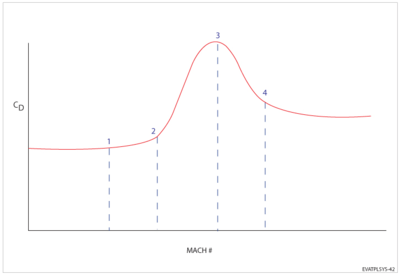
- ACritical drag rise Mach number (also known as drag divergence Mach number, or MCDR) is reached. This is the Mach number where the amount of drag experienced rapidly rises. The large increase in drag is caused by the formation of a shock wave on the upper surface of the airfoil.
- BThe MFS reaches Mach 1.0.
- CMDET is reached. This is the speed where all airflow over the aircraft is supersonic. The amount of drag is slightly higher than the subsonic range due to the presence of the bow wave.
- DMCRIT is reached.
24Wave drag is:
- AA form of induced drag
- BThe drag caused by the turbulent boundary layer generated by the shock wave.
- CTypically seen on aircraft flying in the subsonic speed range
- DTypically seen on aircraft flying in the supersonic speed range
25What does the number 3 correspond to on the graph?
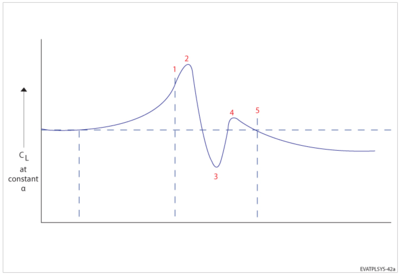
- AMDET is reached, where all airflow over the wing is supersonic (>M1.0). The detached bow wave has formed and interferes with the airflow over the wing. Although a stable flow, lift is slightly reduced.
- BBoth shock waves, above and below the wing, have reached the trailing edge. The airflow over the wing is now supersonic, and a stable laminar flow is aiding in the production of lift.
- CCL increases with an increase in speed. The airflow accelerates over the wing, increasing lift. MCRIT is reached where the airflow over the aircraft is now supersonic in some places
- DShock waves formed above and below the wing interfere with the airflow behind the shock wave. This causes separation of the air from the wing behind the shock wave, creating drag and the reduction in lift.
26What effect does increasing the angle of attack have on critical Mach number?
- AReduces the critical Mach number. When you increase angle of attack, you are effectively increasing the velocity of the air over the upper section of the aerofoil. As a result, the first shock wave (normal shock wave) develops at a lower free-stream Mach number, and it is for this reason that the MCRIT is reached at a lower Mach number.
- BIncreases the critical Mach number. When you decrease angle of attack, you are effectively increasing the velocity of the air over the upper section of the aerofoil. As a result, the first shock wave (normal shock wave) develops at a lower free-stream Mach number, and it is for this reason that the MCRIT is reached at a higher Mach number.
- CReduces critical Mach number. When you increase angle of attack, you are effectively decreasing the velocity of the air over the upper section of the aerofoil. As a result, the first shock wave (normal shock wave) develops at a lower free-stream Mach number, and it is for this reason that the MCRIT is reached at a lower Mach number.
- DIncreases the critical Mach number. When you increase angle of attack, you are effectively increasing the velocity of the air over the upper section of the aerofoil. As a result, the first shock wave (normal shock wave) develops at a lower free-stream Mach number, and it is for this reason that the MCRIT is reached at a higher Mach number.
27What is the ‘crossover altitude’?
- AThe point where the aircraft will change from climbing at constant Mach to constant IAS
- BWhere a descending aircraft would change from constant IAS to constant Mach
- CThe point at which a pilot would change the subscale on the altimeters from area QNH to standard 1013 hPa
- DWhere a climbing aircraft would change from climbing at constant IAS to constant Mach
28What would happen to the Mach and TAS of an aircraft descending at constant IAS below the tropopause?
- AMach would decrease; TAS would decrease
- BMach would increase; TAS would increase
- CMach would increase; TAS would decrease
- DMach would decrease; TAS would increase
29Free-stream Mach number (MFS) is defined as:
- AThe Mach number relative to the local speed of sound measured at a specific point on the aircraft. Depending on where this measurement is taken, this speed may be greater or less than the free-stream Mach number.
- BThe Mach number of the airflow at a point unaffected by the pressure of the aircraft but measured relative to it
- CThe Mach number of the airflow at a point where the drag coefficient rapidly rises. This is due to the flow separation and adverse pressure gradient behind the shock wave.
- DThe lowest free-stream Mach number at which a local Mach number of 1.0 will occur at any point on the aircraft
30 Local Mach number (ML) is defined as:
- AThe lowest free-stream Mach number at which a local Mach number of 1.0 will occur at any point on the aircraft
- BThe Mach number of the airflow at a point where the drag coefficient rapidly rises. This is due to the flow separation and adverse pressure gradient behind the shock wave.
- CThe Mach number of the airflow at a point unaffected by the pressure of the aircraft but measured relative to it
- DThe Mach number relative to the local speed of sound measured at a specific point on the aircraft. Depending on where this measurement is taken, this speed may be greater or less than the free-stream Mach number.
31Critical drag rise Mach number (MCDR) (also known as Drag Divergence Mach Number) is defined as:
- AThe Mach number relative to the local speed of sound measured at a specific point on the aircraft. Depending on where this measurement is taken, this speed may be greater or less than the free-stream Mach number.
- BThe Mach number of the airflow at a point unaffected by the pressure of the aircraft but measured relative to it
- CThe Mach number of the airflow at a point where the drag coefficient rapidly rises. This is due to the flow separation and adverse pressure gradient behind the shock wave.
- DThe lowest free-stream Mach number at which a local Mach number of 1.0 will occur at any point on the aircraft
32Detachment Mach number (MDET) is defined as:
- AThe Mach number where all of the airflow over the wing is supersonic. This usually occurs around MFS 1.2 to 1.3.
- BThe lowest free-stream Mach number at which a local Mach number of 1.0 will occur at any point on the aircraft
- CThe Mach number of the airflow at a point where the drag coefficient rapidly rises. This is due to the flow separation and adverse pressure gradient behind the shock wave.
- DThe Mach number relative to the local speed of sound measured at a specific point on the aircraft. Depending on where this measurement is taken, this speed may be greater or less than the free-stream Mach number.
33The Supersonic range is typically between:
- AMach 0.8 and below (approx. 530 kt)
- BMach 0.8 and 1.2 (approx. 530–790 kt)
- CMach 1.0 to Mach 5.0 (approx. 790–3,300 kt)
- DMach 5.0 and 10.0 (approx. 3,300–6,600 kt)
34What does the number 4 correspond to on the graph?
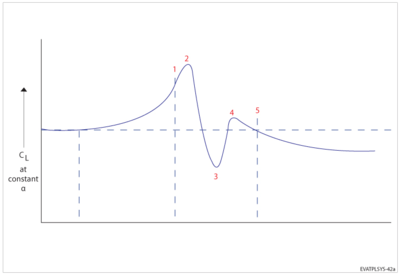
- AMDET is reached, where all airflow over the wing is supersonic (>M1.0). The detached bow wave has formed and interferes with the airflow over the wing. Although a stable flow, lift is slightly reduced.
- BBoth shock waves, above and below the wing, have reached the trailing edge. The airflow over the wing is now supersonic, and a stable laminar flow is aiding in the production of lift.
- CCL increases with an increase in speed. The airflow accelerates over the wing, increasing lift. MCRIT is reached where the airflow over the aircraft is now supersonic in some places
- DShock waves formed above and below the wing interfere with the airflow behind the shock wave. This causes separation of the air from the wing behind the shock wave, creating drag and the reduction in lift.
35What does the number 5 correspond to on the graph?
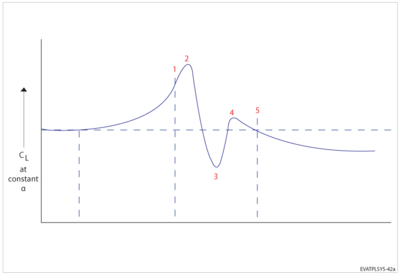
- AMDET is reached, where all airflow over the wing is supersonic (>M1.0). The detached bow wave has formed and interferes with the airflow over the wing. Although a stable flow, lift is slightly reduced.
- BBoth shock waves, above and below the wing, have reached the trailing edge. The airflow over the wing is now supersonic, and a stable laminar flow is aiding in the production of lift.
- CCL increases with an increase in speed. The airflow accelerates over the wing, increasing lift. MCRIT is reached where the airflow over the aircraft is now supersonic in some places
- DShock waves formed above and below the wing interfere with the airflow behind the shock wave. This causes separation of the air from the wing behind the shock wave, creating drag and the reduction in lift.
36What does the number 1 correspond to on the graph?
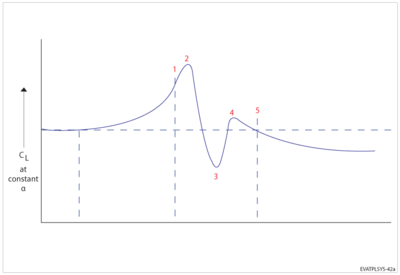
- ACL increases with an increase in speed. The airflow accelerates over the wing, increasing lift. MCRIT is reached where the airflow over the aircraft is now supersonic in some places
- BShock waves formed above and below the wing interfere with the airflow behind the shock wave. This causes separation of the air from the wing behind the shock wave, creating drag and the reduction in lift.
- CBoth shock waves, above and below the wing, have reached the trailing edge. The airflow over the wing is now supersonic, and a stable laminar flow is aiding in the production of lift.
- DMDET is reached, where all airflow over the wing is supersonic (>M1.0). The detached bow wave has formed and interferes with the airflow over the wing. Although a stable flow, lift is slightly reduced.
37What does number 3 on the graph correspond to?
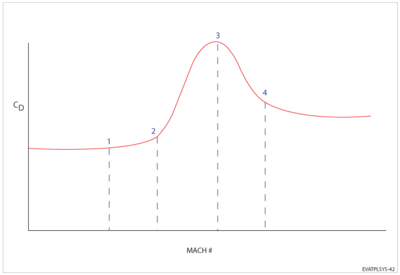
- AThe MFS reaches Mach 1.0.
- BMDET is reached. This is the speed where all airflow over the aircraft is supersonic. The amount of drag is slightly higher than the subsonic range due to the presence of the bow wave.
- CCritical drag rise Mach number (also known as drag divergence Mach number, or MCDR) is reached. This is the Mach number where the amount of drag experienced rapidly rises. The large increase in drag is caused by the formation of a shock wave on the upper surface of the airfoil.
- DMCRIT is reached.
38What does number 4 on the graph correspond to?
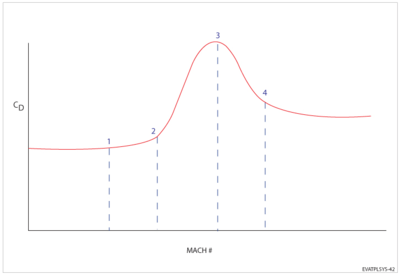
- AMCRIT is reached
- BCritical drag rise Mach number (also known as drag divergence Mach number, or MCDR) is reached. This is the Mach number where the amount of drag experienced rapidly rises. The large increase in drag is caused by the formation of a shock wave on the upper surface of the airfoil.
- CThe MFS reaches Mach 1.0.
- DMDET is reached. This is the speed where all airflow over the aircraft is supersonic. The amount of drag is slightly higher than the subsonic range due to the presence of the bow wave.
39If an aircraft were climbing at constant IAS above the tropopause, the Mach number would __________, and TAS would __________.
- AIncrease, Increase
- BIncrease, Decrease
- CDecrease, Decrease
- DDecrease, Increase
40Dutch roll is characterised by __________________________________________. This is a form of oscillatory instability that is characterised by a combined rolling and yawing motion in which the rolling motion dominates.
- Astronger lateral stability with weaker directional stability
- Bstronger lateral stability and strong directional stability
- Cweaker lateral stability with stronger directional stability
- Dweak lateral stability with weaker directional stability
Informações
- Descrição
- NZCAA ATPL Aeroscience
- Autor
- Andrew Lee
- Idioma
- English
- Visualizações
- 44
- Etiquetas
- Avaliação
- Ainda sem avaliações Avalie este quiz