
Quiz
Lectures 3-6 Cardiac Physiology
Este quiz tem tipos de pergunta que abrem no player de sempre.
Perguntas do quiz (34)
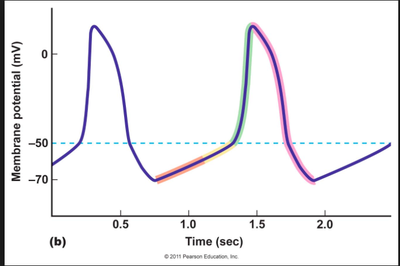
1Which of the following statements are TRUE regarding cardiac myocytes?
- Athe vast majority of intracellular proteins are fixed and carry a positive charge
- BThe equilibrium membrane potential for Na+ is higher than the potential for K+
- CAction potentials are initiated by the opening of voltage gated Calcium channels
- DThe delayed opening of voltage gated sodium channels are responsible for maintaining the plateau of the action potential
- EThis graph is an accurate representation of the predicted membrane potential over time.
2The Na+/K+ ATPase helps maintain the resting membrane potential of roughly -85mV in cardiac myocytes.
For each unit of ATP expended [blank_start]3[blank_end] [blank_start]Na+[blank_end] Ions are pumped out and [blank_start]2[blank_end] [blank_start]K+[blank_end] ions pumped in- A3
- B2
- C1
- DNa+
- EK+
- F2
- G1
- H3
- IK+
- JNa+
3During Diastole which of the following movement of ions are occurring in cardiac myocytes.
- AThere is a Net Passive movement of Na+ ions into the cell
- BThere is a Net Passive movement of Na+ ions out of the cell
- CThere is a Net Passive movement of K+ ions into the cell
- DThere is a Net Passive movement of K+ ions out of the cell
- EThere is a Net Passive movement of Ca2+ ions into the cell
- FThere is a Net Passive movement of Ca2+ ions out of the cell
- GNa+ is being actively pumped into the cell in exchange for K+ which is being pumped out
- HNa+ is being actively pumped into the cell in exchange for Ca2+ which is being pumped out
- IK+ is being actively pumped into the cell in exchange for Na+ which is being pumped out
- JCa2+ is being actively pumped into the cell in exchange for Na+ which is being pumped out
4Which of the following statements are correct?
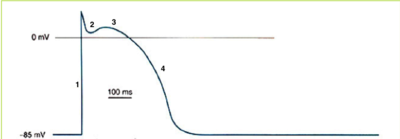
- AAt Point 1 there is a large movement of Na+ ions into the Cell
- BAt Point 1 Voltage Gated Sodium channels are Open
- CAt Point 1 Voltage Gated Potassium channels are Open
- DAt Point 2 Voltage Gated Potassium channels are Open
- EAt Point 2 Voltage Gated Sodium channels are Open
- FAt Point 2 the dip in membrane potential is due to efflux of Ca2+ through voltage gated channels
- GPoint 3 represents the plateau, which is maintained by Calcium efflux
- HPoint 3 represents the plateau, which is maintained by Calcium influx
- IDuring Stage 4 passive movement of K+ though only leak channels returns the membrane potential to rest
- JDuring Stage 4 the net movement of chloride is from the ICF to the ECF
5Which of the following statements is FALSE regarding the refractory period of a cardiac myocyte Action Potential?
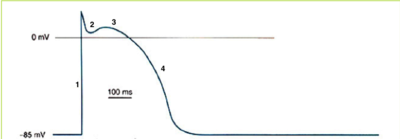
- AThe Absolute refractory period is due to the rapid inactivation of Na+ channels after they open, these channels are not reactivated until membrane potential is below 65mV
- BDue to the extended refractory period, cardiac muscle can not be tetanized
- CAnother Action Potential can not be initiated during any of the stages 1-4
- DThe inactivation of VO Na+ channels causes a change in the shape of the protein channel, blocking the passage of Na+ ions.
- EAll of the above are true
6Fast response action potentials occur in the SA Node
- AVerdadeiro
- BFalso
7Order the following from those most permeable to sodium and calcium, to those least permeable to sodium and calcium.
1. [blank_start]SA Node[blank_end]
2. [blank_start]AV Node[blank_end]
3. [blank_start]Bundle of His[blank_end]
4. [blank_start]Purkinje Fibres[blank_end]
Options:
Bundle of His
SA Node
Purkinje Fibres
AV Node- ASA Node
- BAV Node
- CBundle of His
- DPurkinje Fibres
8Which of the following are true of pacemaker cells in the AV Node
- AResting Membrane potential is stable
- BResting Membrane potential is unstable
- CVoltage Gated Sodium Channels are present
- DVoltage Gated Calcium Channels are present
- EThreshold is higher compared to Cardiac Myocytes
- FThreshold is lower compared to Cardiac Myocytes
- GAmplitude of the Action Potential is higher compared to Cardiac Myocytes
- HAmplitude of the Action Potential is lower compared to Cardiac Myocytes
- ISodium Influx into the cell does not occur at any point in time
- JThere is a greater permeability to Calcium than the SA Node
9Parasympathetic/Vagal Innervation of the SA Node will result in
- AIncreased Heart Rate
- BDecreased Heart Rate
- CIncreased Permeability to Calcium
- DIncreased Permeability to Sodium
- EIncreased Permeability to Potassium
- FHyperpolarisation
- GDepolarisation
- HAcetylcholine is the neurotransmitter
- INoradrenaline is the neurotransmitter
- JThe neurotransmitter binds to Beta 1 Receptors.
10Which of the following are TRUE regarding conduction velocity
- AIs the same across the heart
- BSmaller fibres conduct faster than larger fibres
- CLarger fibres conduct faster than smaller fibres
11Which of the following are functions of the cardiac skeleton
- AIt is always fortified by cartilage and bone
- BProvides electrical discontinuity between atria and ventricles
- CProvides support for the AV Valves
- DProvides support for the Pulmonic and Aortic Valves
- EProvides an attachment site for ventricular muscles
- FProvides an attachment site for atrial muscles
- GAssists in Ventricular Contraction
12Pacemaker Tissue is located in the
- AEpicardium
- BMyocardium
- CEndocardium
- DPericardium
13Adipose tissue can be found in the
- AEndocardium
- BEpicardium
- CMyocardium
- DPericardium
14Order the following events correctly
[blank_start]HBLIADECJFMKG[blank_end]
Your answer should be of the form ABCDE
Options:
A Activation of Ryanodine receptor channels in the Sarcoplasmic reticulum
B Opening of Voltage Gated Sodium Channels
C Tropomyosin shifts out of the actin cleft
D Influx of Calcium from the Sarcoplasmic Reticulum
E Calcium Binds to Troponin
F Crossbridge Cycle Occurs and Tension of Myocyte Increases
G Membrane Potential restored by the Na+/K+ ATPase and the Na+/Ca2+ Exchanger
H Depolarisation of Myocyte Above Threshold, Action Potential Initiated
I Influx of Calcium from the ECF
J Actin may now bind to Myosin
K Voltage Gated Calcium Channels Close
L Opening of Voltage Gated Calcium Channels
M Ca2+ ATPase activated, Calcium pumped back into the Sarcoplasmic Reticulum- AHBLIADECJFMKG
15Which of the following statements regarding an Isotonic Contraction are true?
- AMuscles fibres shorten but not force is developed
- BThere is nothing to develop force against
- CMuscle Shortens with Maximal Velocity
- DForce generated at a Specific Length
- EForce generated at this length if a measure of the maximum ability to produce tension
- FMuscle shortens slowly
- GMuscle shortens with Maximal Force
16Which of the following are likely to increase Afterload for the Left Ventricle
- AIncreased sympathetic innervation
- BHypovolaemic Shock
- CSystemic Hypertension
- DPulmonary Hypertension
- EIncreased Parasympathetic Innervation
- FStenotic Aortic Valve
- GIncompetent Aortic Valve
- HStenotic Pulmonary Valve
- IIncompetent Pulmonary Valve
- JImpaired Venous Return
17Preload is synonymous with
- AESV
- BEDV
- CCO
- DVenous Return
- ESV
- FHR
- GSystolic Blood Pressure
- HDiastolic Blood Pressure
- ITPR
18On Trace 1 Person A has leads attached to the upper arms and thighs. On Trace 2 Person A has leads attached to the forearms and lower legs.
If all other variables are constant, following Einthoven's Hypothesis, the ECG for Trace 1 and 2 would be identical.- AVerdadeiro
- BFalso
19The Magnitude of the Dipole on a ECG is determined by
- AHow many cells are depolarising
- BHeart Rate
- CVector Analysis of Simultaneous Dipoles
- DNone of the above
20A Dog has the positive lead on his left arm, and the negative lead on his right arm, and the ground lead attached to the right leg. This arrangement is described as:
- ALead 1
- BLead 2
- CLead 3
- DNone of the Above
21Which lead is considered most useful
- ALead 1
- BLead 2
- CLead 3
- DAll Leads are equally useful
22Atrial depolarisation occurs during the
- AP Wave
- BQRS Complex
- CT Wave
- DNone of the Above
23The T Wave is highly variable in domestic animals, it could be positive or negative deflection, or sometimes not even noticeable.
- AVerdadeiro
- BFalso
24A Patient presents with a prolonged P-R Interval on their ECG. All other intervals are within normal range. This could suggest
- AA Delay between Atrial Depolarisation and Ventricular Depolarisation
- BA Blockage at the AV Node
- CLeft Sided Congestive Heart Failure
- DSinus Tachycardia
- ESinus Bradycardia
25Exercise, Anxiety and Fever would most likely cause
- ASinus Tachycardia
- BSinus Bradycardia
- CSinus Arrythmias
- DNone of the above
26A Patient presents with an absence of P waves on their ECG. The QRS and T Waves are normal.
The Patient most likely has a- ASA Block
- B1st Degree AV Block
- C2nd Degree AV Block
- D3rd Degree AV Block
- ENone of the Above
27A Patient has a 3rd Degree AV Block. Which of the following features would you expect to be present on their ECG.
- AP wave and QRS/T Waves are Independent
- BP wave and QRS/T Waves are dependent, but have an abnormally long conduction time between them
- CThere isn't 1 QRS complex for every P Wave
- DVentricular Rate is Slow
- EAtrial Contraction is Slower than normal
28A Patient's ECG shows QRS Complexes that are not always preceded by a clear P Wave. Which of the following are possible
- AVPC's
- BParoxysmal Tachycardia
- CAtrial Fibrilation
- DVentricular Fibrilation
- EAV Block
- FSA Block
29Atrial Contraction contributes what percentage to ventricular filling?
- A0%
- B20%
- C40%
- D60%
- E80%
- F100%
- G50%
30With an Increase in Heart Rate, Atrial Contribution to Ventricular filling also increases
- AVerdadeiro
- BFalso
31During the 1st Phase of Ventricular Systole which of the following statements are true?
- AThe contraction is Isometric
- BEjection is Rapid
- CMitral Valve is Closed
- DTricuspid Valve is Closed
- EAortic Valve is Closed
- FPulmonary Valve is Closed
- GAtrial Pressure wave, c wave, occurs in the venous system
- HPressure within the ventricle increases
- IPressure within the ventricle decreases
- JAortic Pressure Rises
32Which of the statements regarding the Dichrotic Notch are incorrect
- AIt occurs at the conclusion of Ventricular Systole
- BIt is a result of blood flowing back into the leaves of Aortic Valve after it closes
- CResults in a sharp decrease in Aortic Pressure
- DWould be less noticeable in animal with an incompetent Aortic Valve
- EAll the above are correct
33Which of the following are incorrect
- ACardiac Output is proportional to Stroke Volume
- BAn Increase in Heart Rate would result in a corresponding increase in Stroke Volume
- CEDV and Venous Return are synonymous
- DEjection Fraction = SV/EDV
- EA decrease in Preload will decrease Cardiac Output
34The 4th Heart Sound is caused by the vibration of ventricular wall due to deceleration of blood leaving the ventricles
- AVerdadeiro
- BFalso
Informações
- Descrição
- Veterinary Bioscience 1: Cardiovascular System (Anatomy and Physiology Lectures) Quiz sobre Lectures 3-6 Cardiac Physiology, criado por Daniel Mosele em 28-08-2016.
- Autor
- Daniel Mosele
- Idioma
- English
- Visualizações
- 110
- Etiquetas
- Avaliação
- Ainda sem avaliações Avalie este quiz