
Quiz
PhysicsFinal
Crie uma conta grátis para terminar este quiz
Salve seu progresso e veja sua nota final.
Já tem uma conta? Inicie sessão
Perguntas do quiz (200)
1A baseball of mass m is thrown upward with some initial speed. A gravitational force is exerted on the ball
- AAt all points in its motion
- BAt all points in its motion except at the highest point
- CAt no points in its motion
- DOnly at downward part of its direction
2The kinetic friction will always be
- ALess than static friction
- BGreater than static friction
- CEqual to the static friction
- DNegative
3The unit of coefficient of friction in SI system is
- ANewton
- BDyne
- CNone of these
- DNo unit
4Whenever a constant force is applied on a body then it will move with __________.
- AConstant Speed
- BConstant Velocity
- CConstant Acceleration
- DNone of them
5Power is a __________.
- AScalar Quantity
- BVector Quantity
- CNone of these
- DRate of force
6The dot product of force and velocity is called __________.
- AWork
- BPower
- CEnergy
- DMomentum
7When the force and displacement are perpendicular to each other, then work is __________.
- Azero
- BMaximum
- CNone of these
- DDepends on force magnitude
8Centripetal acceleration and tangential acceleration are always __________
- AParallel to Each other, but in opposite direction
- BPerpendicular to each other
- CNone of these
- DParallel to Each other, but in the same direction
9The dimensions of angular momentum are __________.
- AMLT-1
- BMLT-2
- CML2T-2
- DML2T-1
10The moment of inertia of a wheel about its axle does not depend upon its:
- ADiameter
- BMass
- Cdistribution of mass
- Dspeed of rotation
11Two waves have the same frequency. Which wave characteristic must also be identical for both waves?
- APhase
- BAmplitude
- CIntensity
- DPeriod
12A mechanical wave generally does NOT
- Amove the medium from one place to another
- Bmove through a medium
- Cmove through solids
- Ddisturb the medium
13The moment of inertia of a body depends on
- Athe angular velocity
- Bthe angular acceleration
- Cthe mass distribution
- Dthe torque acting on the body
14A skater can spin faster by pulling in her arms closer to her body or spin slower by spreading her arms out from her body. This is due to
- AConservation of momentum
- BConservation of energy
- CNewton’s third law
- DConservation of angular momentum
15The SI units for Coulomb constant ke are:
- AN·m2/C2
- BN·m/C
- CN·m/C2
- Dm2/C2
- ENo correct answer
16The electric field vector E can be expressed as:
- AE=Fe/q
- BE=Fe/q2
- CE=Fe·q
- DE=Fe·q2
- ENo correct answer
17Which statements are correct?
- ACharges of opposite sign attract one another and charges of the same sign repel one another. Total charge in an isolated system is conserved. Charge is quantized.
- BCharges of opposite sign repel one another and charges of the same sign attract one another. Total charge in an isolated system is conserved. Charge is quantized.
- CCharges of opposite sign attract one another and charges of the same sign repel one another. Total charge in an isolated system is not conserved. Charge is quantized.
- DCharges of opposite sign repel one another and charges of the same sign attract one another. Total charge in an isolated system is ot conserved. Charge is not quantized.
- ENo correct answer
18Which statements are correct?
- AConductors are materials in which electrons move freely. Insulators are materials in which electrons do not move freely.
- BInsulators are materials in which electrons move freely. Conductors are materials in which electrons do not move freely.
- CConductors are materials in which electrons don’t move freely. Insulators are materials in which electrons move freely.
- DAll answers are correct
- ENo correct answer
19If the electric field is uniform and makes an angle θ with the normal to a surface of area A, the electric flux through the surface is:
- AΦE=EAcosθ
- BΦE=EAsinθ
- CΦE=Acosθsinθ
- DΦE=Ecosθ
- ENo correct answer
20Gauss’s law says that the net electric flux ΦE through any closed gaussian surface is equal to:
- AΦE=qin/ε0
- BΦE=qin·ε0
- CΦE= ε0/qin
- DΦE=qinqout/ε0
- ENo correct answer
21A conductor in electrostatic equilibrium has the following properties:
- A1. The electric field is zero everywhere inside the conductor. 2. Any net charge on the conductor resides entirely on its surface. 3. The electric field just outside the conductor is perpendicular to its surface and has a magnitude σ/ε0, where σ is the surface charge density at that point. 4. On an irregularly shaped conductor, the surface charge density is greatest where the radius of curvature of the surface is the smallest.
- B1. The electric field is zero everywhere inside the conductor. 2. Any net charge on the conductor resides partially on its surface, partially inside the conductor. 3. The electric field just outside the conductor is parallel to its surface and has a magnitude σ/ε0, where σ is the surface charge density at that point. 4. On an irregularly shaped conductor, the surface charge density is greatest where the radius of curvature of the surface is the smallest.
- C1. The electric field is non zero everywhere inside the conductor. 2. Any net charge on the conductor resides entirely on its surface. 3. The electric field just outside the conductor is perpendicular to its surface and has a magnitude σ/ε0, where σ is the surface charge density at that point. 4. On an irregularly shaped conductor, the surface charge density is greatest where the radius of curvature of the surface is the biggest.
- D1. The electric field is zero everywhere inside the conductor. 2. Any net charge on the conductor resides entirely inside the conductor. 3. The electric field just outside the conductor is perpendicular to its surface and has a magnitude σ/ε0, where σ is the surface charge density at that point. 4. On an irregularly shaped conductor, the surface charge density is smallest where the radius of curvature of the surface is the smallest.
- ENo correct answer
22The potential difference between two points A and B in a uniform electric field E, where s (d=|s|) is a vector that points from A to B and is parallel to E is:
- A∆V=-Ed
- B∆V=0
- C∆V=Ed
- D∆V=-Edsinθ
- ENo correct answer
23Which statements are correct?
- AAn equipotential surface is one on which all points are at the same electric potential. Equipotential surfaces are perpendicular to electric field lines.
- BAn equipotential surface is one on which all points are at the same electric potential. Equipotential surfaces are parallel to electric field lines.
- CAn equipotential surface is one on which all points are not at the same electric potential. Equipotential surfaces are perpendicular to electric field lines.
- DAn equipotential surface is one on which all points are at the same electric potential. Equipotential surfaces are perpendicular to gravitation field lines.
- ENo correct answer
24The SI unit of capacitance is:
- AC/V
- BV/C
- CC/V2
- DC/V·m
- ENo correct answer
25The equivalent capacitance of a parallel combination of capacitors is:
- ACeq=C1+C2+C3+...
- B1/Ceq=1/C1+1/C2+1/C3+...
- CCeq=C1=C2=C3=...
- DCeq=C1·C2·C3·...
- ENo correct answer
26If two or more capacitors are connected in series, the equivalent capacitance of the series combination is given by:
- ACeq=C1+C2+C3+...
- B1/Ceq=1/C1+1/C2+1/C3+...
- CCeq=C1=C2=C3=...
- DCeq=C1·C2·C3·...
- ENo correct answer
27The electric dipole moment p of an electric dipole has a magnitude:
- Ap=2aQ
- Bp=Q
- Cp=Q2
- Dp=-2aQ
- ENo correct answer
28The torque acting on an electric dipole in a uniform electric field E is:
- Aτ=pxE
- Bτ=p·E
- Cτ=p/E
- Dτ=qpxE
- ENo correct answer
29The potential energy of the system of an electric dipole in a uniform external electric field E is:
- AU=- p·E
- BU= pxE
- CU= p·E
- DNo correct answer
- EU= p/E
30The average current in a conductor is related to the motion of the charge carriers through the relationship:
- AIav=nqvdA
- BIav=nqvd
- CIav=qvdA
- DIav=nq/vdA
- ENo correct answer
31The magnitude of the current density J in a conductor is:
- AJ=I/A
- BJ=IA
- CJ=IA2
- DJ=I2/A
- ENo correct answer
32Ohm’s law in the differential form is:
- AJ=σE
- BI=U/R
- CI=R/U
- DJ=σ/E
- ENo correct answer
33Ohm’s law in the integral form is:
- AJ=σE
- BI=U/R
- CI=R/U
- DJ=σ/E
- ENo correct answer
34The resistance R of a conductor is defined as:
- AR=∆V/I
- BR=σE
- CR=∆V·I
- DR=I/∆V
- ENo correct answer
35The power supplied to the element, is:
- AP=I∆V
- BP=I/∆V
- CP=I2∆V
- DP=I∆V2
- ENo correct answer
36The power delivered to a resistor can be defined as:
- AP=I2R
- BP=IR
- CP=IR2
- DP=I2/R
- ENo correct answer
37The equivalent resistance of a set of resistors connected in series is:
- AReq=R1+R2+R3+...
- B1/Req=1/R1+1/R2+1/R3+...
- CReq=1/(R1+R2+R3+...)
- DReq=R1+R2+R3+...R4
- ENo correct answer
38Circuits involving more than one loop are conveniently analyzed with the use of Kirchhoff’s rules:
- A1. The sum of the currents entering any junction in an electric circuit must equal the sum of the currents leaving that junction. 2. The sum of the potential differences across all elements around any circuit loop must be zero.
- B1. The product of the currents entering any junction in an electric circuit must equal the sum of the currents leaving that junction. 2. The sum of the potential differences across all elements around any circuit loop must be constant.
- C1. The sum of the currents at any circuit loop must be zero. 2. The sum of the potential differences across all elements around any circuit loop must be zero.
- D1. The sum of the currents entering any junction in an electric circuit must equal the sum of the currents leaving that junction. 2. The product of the potential differences across all elements around any circuit loop must be zero.
- ENo correct answer
39Two objects, with different sizes, masses, and temperatures, are placed in thermal contact. Energy travels
- AFrom the larger object to the smaller object,
- BFrom the object with more mass to the one with less,
- CFrom the object at higher temperature to the object at lower temperature,
- DEnergy doesn’t travel,
- EFrom the object at lower temperature to the object at higher temperature,
40On a day when the temperature reaches 50°F, what is the temperature in degrees Celsius and in kelvins?
- A50 C, 323 K,
- B40 C, 313 K,
- C30 C, 303 K,
- D20 C, 293 K,
- E10 C, 283 K.
41A helium-filled rubber balloon is left in a car on a cold winter night. Compared to its size when it was in the warm car the afternoon before, the size the next morning is
- ALarger
- BSmaller
- CUnchanged
42The first law of thermodynamics can be given as ________.
- Afor any spontaneous process, the entropy of the universe increases
- Bthe entropy of a pure crystalline substance at absolute zero is zero
- CΔS = Q/T at constant temperature
- DΔE = Q + W
43 The second law of thermodynamics can be given as __________
- Afor any spontaneous process, the entropy of the universe increases
- Bthe entropy of a pure crystalline substance at absolute zero is zero
- CΔS = Q/T at constant temperature
- DΔE = Q + W
44Which of the following is not a state function?
- APressure
- BVolume
- CTemperature
- DMole
45Two containers hold an ideal gas at the same temperature and pressure. Both containers hold the same type of gas but container B has twice the volume of container A. The average translational kinetic energy per molecule in container B is
- Atwice that for container A
- Bthe same as that for container A
- Chalf that for container A
- Dimpossible to determine.
46Two containers hold an ideal gas at the same temperature and pressure. Both containers hold the same type of gas but container B has twice the volume of container A. The internal energy of the gas in container B is
- Atwice that for container A
- Bthe same as that for container A
- Chalf that for container A
- Dimpossible to determine
47Two containers hold an ideal gas at the same temperature and pressure. Both containers hold the same type of gas but container B has twice the volume of container A. The rms speed of the gas molecules in container B is
- Atwice that for container A
- Bthe same as that for container A
- Chalf that for container A
- Dimpossible to determine
48How does the internal energy of an ideal gas change as it follows path i->f in figure?
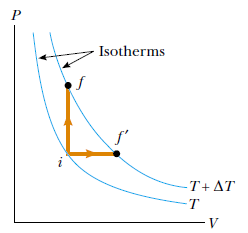
- AEint increases
- BEint decreases
- CEint stays the same
- DThere is not enough information to determine how Eint changes
49How does the internal energy of an ideal gas as it follows path f->f1 along the isotherm labeled T + deltaT in figure ?
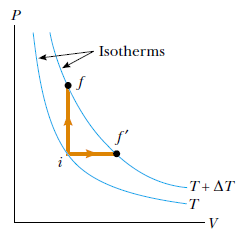
- Aincreases
- Bdecreases
- Cstays the same
- DThere is not enough information to determine how changes
50 Latent heat is
- Athe heat released or absorbed by a thermodynamic system during a process that occurs without a change in temperature
- Bthe amount of energy needed to raise the temperature of sample by 1°C
- Cthe heat capacity per unit mass
- Dthe amount of heat required to change a unit mass of a substance by one degree in temperature
- Eamount of energy necessary to raise the temperature of 1 g of water from 14.5°C to 15.5°C.
51Adiabatic process is
- Aprocess that occurs at constant volume
- Bprocess that occurs at constant temperature
- Cprocess that occurs at constant pressure
- Dprocess in which the net heat transfer between the system and its surroundings is zero
- Eprocess that obeys the relation: pVn=C
52A diatomic gas molecule has ... degrees of freedom
- A3
- B5
- C6
- D7
- Emore
53Energy may be transferred by
- Awork
- Bconduction
- Cconvection
- Dradiation
- Eall answers are correct
54 The molar specific heat of a gas is measured at constant volume and found to be 11R/2. The gas is most likely to be
- Amonatomic
- Bdiatomic
- Cmonatomic or diatomic, depends on the conditions
- Dpolyatomic
- Eall answers are incorrect
55Parallel wires carrying currents I1 and I2 respectively
- Arepel if they are directed opposite
- Bwill attract if they are directed opposite
- Cwill not interact
56What are the opposite ends of a magnet called?
- AIts terminals
- BIts north and south poles
- CIts magnetic fields
- DIts electromagnetic poles
57How are electrical charges and magnetic poles similar?
- AUnlike attract and the same type repel
- BBoth are plus and minus
- CMagnetic poles attract electrons
- DBoth change positive to negative charges
58How can you show that electricity creates a magnetic field?
- AUse a compass near a wire with current flowing through it
- BOnly magnets create magnetic fields
- CMove a wire through a magnetic field
- DConnect a battery to the magnetic field
59How can you make an electromagnet?
- AAttach a natural magnet to a battery
- BRun current through a wire wrapped around an iron rod
- CLine up the N and S poles of a magnet with an electric wire
- DWrap a magnet around a piece of wire with current flowing through it
60What happens when you turn off the current in an electromagnet?
- AThe magnetism is turned off
- BThe current keeps flowing because of the magnetic force
- CThe electromagnet reverses its polarity
- DThe electromagnet becomes a generator
61How can you create electricity with a magnet?
- AAttach a magnet to a battery
- BBy putting a current through a wire around a magnet
- CBy moving a wire through a magnetic field
- DYou can't, because only friction on electric charges creates electricity
62Can you create electricity with a magnet?
- ANo, because only friction on electric charges or batteries create electricity
- BYes, by moving a wire through a magnetic field
- CYes, by putting a current through a wire around a magnet
- DYes because magnets use electricity to stay effective
63The geomagnetic field
- Amakes the Earth like a huge horseshoe magnet
- Bruns exactly through the geographic poles
- Cmakes a compass work
- Dmakes an electromagnet work
64A material that can be permanently magnetized is generally said to be
- Amagnetic
- Belectromagnetic
- Cpermanently magnetic
- Dferromagnetic
65The magnetic flux around a straight current-carrying wire
- Agets stronger with increasing distance from the wire
- Bis strongest near the wire
- Cdoes not vary in strength with distance from the wire
- Dconsists of straight lines parallel to the wire
66The gauss is a unit of
- Aoverall magnetic field strength
- Bampere-turns
- Cmagnetic flux density
- Dmagnetic power
67If a wire coil has 10 turns and carries 500 mA of current, what is the magnetomotive force in ampere-turns?
- A5,000
- B50
- C5.0
- D0.02
68Which of the following is not generally observed in a geomagnetic storm?
- ACharged particles streaming out from the Sun
- BFluctuations in the Earth’s magnetic field
- CDisruption of electrical power transmission
- DDisruption of microwave propagation
69A device that reverses magnetic field polarity to keep a dc motor rotating is
- Aa solenoid
- Ban armature coil
- Ca commutator
- Da field coil
70When the speed at which a conductor is moved through a magnetic field is increased, the induced voltage
- Aincreases
- Bdecreases
- Cremains constant
- Dreaches zero
71The induced voltage across a coil with 250 turns that is located in a magnetic field that is changing at a rate of 8 Wb/s is
- A1,000 V
- B2,000 V
- C31.25 V
- D3.125 V
72For a given wirewound core, an increase in current through the coil
- Areverses the flux lines
- Bdecreases the flux density
- Cincreases the flux density
- Dcauses no change in flux density
73If the cross-sectional area of a magnetic field increases, but the flux remains the same, the flux density
- AIncreases
- Bdecreases
- Cremains the same
- Ddoubles
74When the current through the coil of an electromagnet reverses,
- Adirection of the magnetic field reverses
- Bdirection of the magnetic field remains unchanged
- Cmagnetic field expands
- Dmagnetic field collapses
75What is the reluctance of a material that has a length of 0.07 m, a cross-sectional area of 0.014 m2, and a permeability of 4,500 Wb/At × m?
- A1111 At/Wb
- B111 At/Wb
- C11 At/Wb
- D1 At/Wb
76A coil of wire is placed in a changing magnetic field. If the number of turns in the coil is decreased, the voltage induced across the coil will
- Aincrease
- Bdecrease
- Cremain constant
- Dbe excessive
77What is the flux density when the flux is 5.5 Wb and the cross-sectional area is 6 × 10⁻³ m2?
- A91.7 µT
- B917 µT
- C91 T
- D9.7 T
78If the steel disk in a crankshaft position sensor has stopped with the tab in the magnet's air gap, the induced voltage
- Aincreases
- Bdecreases
- Cis zero
- Dwill remain constant
79What is the flux density in a magnetic field in which the flux in 0.1 m2 is 600 Wb?
- A6,000 µT
- B600 µT
- C600 T
- D6 T
80A parallel-plate capacitor with air between the plates has an area A=2.00·104 m2 and a plate separation d=1.00 mm. Find its capacitance.
- AC=1.77 pF
- BC=1.77 F
- CC=1.77 mF
- DC=1.77 nF
- ENo correct answer
81Find the equivalent capacitance between a and b for the combination of capacitors shown in Figure. All capacitances are in microfarads.
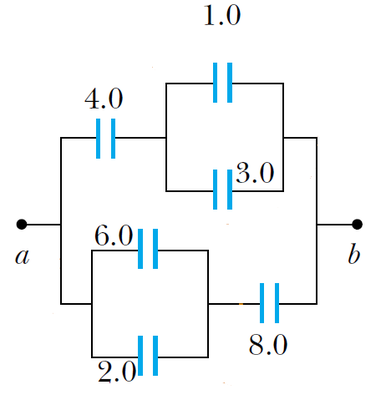
- A6.0 μF
- B6.0 F
- C5.0 μF
- D6.0 nF
- ENo correct answer
82A parallel-plate capacitor has plates of dimensions 2.0 cm by 3.0 cm separated by a 1.0-mm thickness of paper. Find its capacitance (k = 3.7, ε0=8.85·10-12 C2/N·m2).
- A20 pF
- B20 F
- C40 pF
- D60 pF
83Find the electric flux Φe though the spherical surface, covers the point-like charges q1=5 nC and q2=-2 nC. (ε0=8.85·10-12 C2/N·m2)
- AΦe=339 N·m2/C
- BΦe=0.339 N·m2/C
- CΦe=339 N/C
- DΦe=339 N·m2
- ENo correct answer
84Find the attractive force F between nuclei of hydrogen atom and electron. Radius of hydrogen atom is r=0.5·10-10 m; modules charge of nuclei are equal and opposite to charge sign of electron (ε0=8.85·10-12 C2/N·m2).
- AF=92.3·10-9 N
- BF=92.3 N
- CF=92.3·10-9 N/m2
- DF=923·10-9 N
- ENo correct answer
85Two point-like charges in air (ε=1) at the distance r1=20 sm from each other interact with some force. At what distance r2 one needs to place this charges in oil (ε2=5) to get the same force of interaction?
- Ar2=8.94 sm
- Br2=8.94 m
- Cr2=8.94·103 m
- Dr2=8.94·10-3 m
- ENo correct answer
86The electron and proton of a hydrogen atom are separated (on the average) by a distance of approximately 5.3·10-11 m. Find the magnitudes of the electric force between the two particles. (ke=8.99·109 N·m2/C2)
- A8.2·10-8 N
- B8.2 N
- C8.2·10-9 N
- D8.2·109 N
- ENo correct answer
87Calculate the resistance of an aluminum cylinder that has a length of 10.0 cm and a cross-sectional area of 2.00·10-4 m2 (ρ=2.82·10-8 Ω·m).
- AR=1.4·10-5 Ω
- BR=1.4·10-3 Ω
- CR=1.4 Ω
- DR=1.4·105 Ω
- ENo correct answer
88Calculate the resistance of an glass cylinder that has a length of 10.0 cm and a cross-sectional area of 2.00·10-4 m2 (ρ=3·1010 Ω·m).
- AR=1.5·10^13 Ω
- BR=1.5·10^-13 Ω
- CR=1.5·10^3 Ω
- DNo correct answer
89Calculate the resistance per unit length of a 22-gauge Nichrome wire, which has a radius of 0.321 mm (The resistivity of Nichrome is 1.5·10-6 Ω·m).
- A4.6 Ω/m
- B4.6 Ω
- C4.6 Ω·m
- D4.6·10-3 Ω/m
- ENo correct answer
90If a potential difference of 10 V is maintained across a 1.0-m length of the Nichrome wire with resistance 4.6 Ω, what is the current in the wire?
- A2.2 A
- B0.46 A
- C2.2·10-3 A
- D0.46·103 A
- ENo correct answer
91An electric heater is constructed by applying a potential difference of 120 V to a Nichrome wire that has a total resistance of 8.00 Ω. Find the current carried by the wire.
- A15 A
- B0.06 A
- C15·10-3 A
- D0.06·10-3 A
- ENo correct answer
92An electric heater is constructed by applying a potential difference of 120 V to a Nichrome wire that has a total resistance of 8.00 Ω. Find the power rating of the heater.
- A1.8 kW
- B1.8 W
- C120 W
- D0.1 kW
- ENo correct answer
93A battery has an emf of 12.0 V and an internal resistance of 0.05 Ω. Its terminals are connected to a load resistance of 3.00 Ω. Find the terminal voltage of the battery.
- A11.8 V
- B8.07 V
- C11.95 A
- DAll answers are correct
- ENo correct answer
94Calculate the power delivered to the load resistor, if the current in the circuit is 3.93 A, the load resistance is 3.00 Ω.
- A46.3 W
- B11.79 W
- C35.37 W
- DAll answers are correct
- ENo correct answer
95Calculate the power delivered to the internal resistance of the battery, if the current in the circuit is 3.93 A, the internal resistance of 0.05 Ω.
- A0.772 W
- B0.1965 W
- C0.01 W
- DAll answers are correct
- ENo correct answer
96Four resistors are connected as shown in Figure. Find the equivalent resistance between points a and b
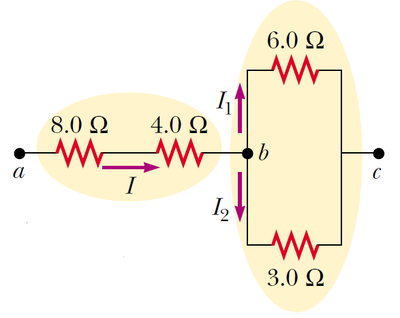
- A12 Ω
- B2.7 Ω
- C5.37 Ω
- DAll answers are correct
- ENo correct answer
97Four resistors are connected as shown in Figure. Find the equivalent resistance between points b and c.
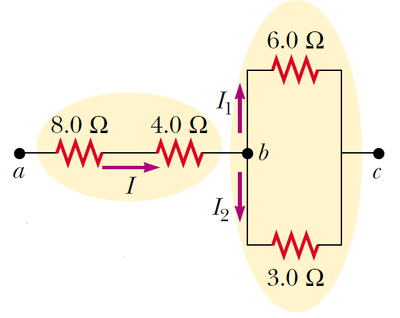
- A2 Ω
- B0.5 Ω
- C9 Ω
- DAll answers are correct
- ENo correct answer
98Four resistors are connected as shown in Figure. Find the equivalent resistance between points a and c.
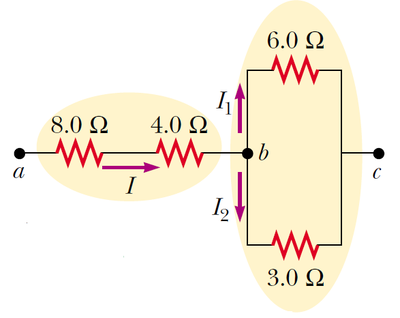
- A14 Ω
- B2.5 Ω
- C4.7 Ω
- D3.2 Ω
- ENo correct answer
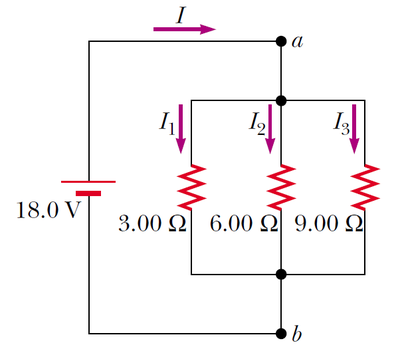
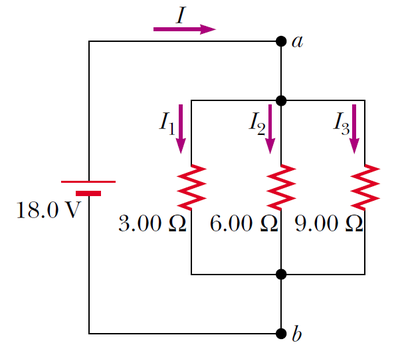
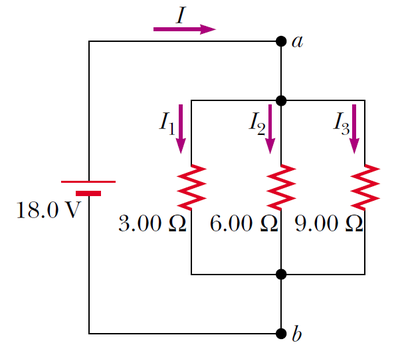
99Three resistors are connected in parallel as shown in Figure. A potential difference of 18.0 V is maintained between points a and b. Find the current I1.
- AI1=6.00 A
- BI1=3.00 A
- CI1=2.00 A
- DAll answers are correct
- ENo correct answer
100Three resistors are connected in parallel as shown in Figure. A potential difference of 18.0 V is maintained between points a and b. Find the current I2.
- AI1=6.00 A
- BI1=3.00 A
- CI1=2.00 A
- DAll answers are correct
- ENo correct answer
101Three resistors are connected in parallel as shown in Figure. A potential difference of 18.0 V is maintained between points a and b. Find the current I3.

- AI1=6.00 A
- BI1=3.00 A
- CI1=2.00 A
- DAll answers are correct
- ENo correct answer
102Three resistors are connected in parallel as shown in Figure. A potential difference of 18.0 V is maintained between points a and b. Calculate the power delivered to resistor R1.
- AP1=108 W
- BP1=54 W
- CP1=36 W
- DAll answers are correct
- ENo correct answer
103Three resistors are connected in parallel as shown in Figure. A potential difference of 18.0 V is maintained between points a and b. Calculate the equivalent resistance of the circuit.

- AReq=1.64 Ω
- BReq=0.61 Ω
- CReq=18 Ω
- DAll answers are correct
- ENo correct answer
104A single-loop circuit contains two resistors and two batteries, as shown in Figure. (Neglect the internal resistances of the batteries.) Find the current in the circuit.
- AI=-0.33 A
- BI=0.33 A
- CI=1 A
- DI=-3 A
- ENo correct answer
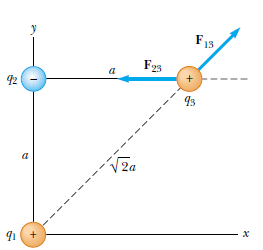
105Consider three point charges located at the corners of a right triangle as shown in Figure, where q1 = q3 = 5.0 μC, q2 =-2.0 μC, and a = 0.10 m. Find the resultant force exerted on q3
- AF3=(-1.1i+7.9j)N
- BF3=(7.9i-1.1j)N
- CF3=(1.1i-7.9j)N
- DF3=(1.1i+7.9j)N
- ENo correct answer
106An electric dipole is defined as a positive charge q and a negative charge -q separated by a distance 2a. For the dipole shown in Figure, find the electric field E at P due to the dipole, where P is a distance y » a from the origin.
- AE≈(k * 2qa)/y^3
- BE≈(k*2q)/a^3
- CE≈(k*2)/y^5
- DE≈2qa/y^3
- ENo correct answer
107A rod of length l has a uniform positive charge per unit length λ and a total charge Q. Calculate the electric field at a point P that is located along the long axis of the rod and a distance a from one end.

- AE=(k* Q)/(a(l+a))
- BE=(k*Q)/(l+a)
- CE=(k*Q)/al
- DE=k/(a(l+a))
- ENo correct answer
108Calculate the ratio of the electrostatic to gravitational interaction forces between two electrons, between two protons. At what value of the specific charge q/m of a particle would these forces become equal (in their absolute values) in the case of interaction of identical particles? (γ=6.67·10-11 m3/(kg·s2), me=9·10-31kg, mp=1·10-27kg, ke=8.99·109 N·m2/ C2)
- A4·1042 (for electrons); 1·1036 (for proton); q/m=0.86·10-10 C/kg
- B4·1042 (for proton); 1·1036 (for electrons); q/m=0.86·10-10 C/kg
- C4·1045 (for proton); 1·1038 (for electrons); q/m=0.86·10-13 C/kg
- D4·1043 (for electrons); 1·1035 (for proton); q/m=0.86·10-11 C/kg
- ENo correct answer
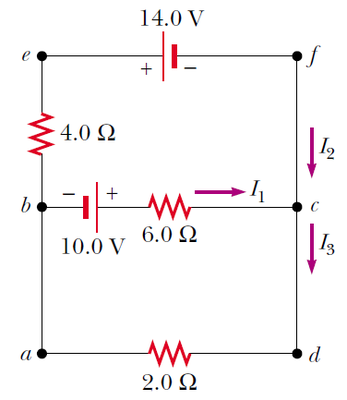
109Find the currents I1, I2, and I3 in the circuit shown in Figure.
- AI1=2 A, I2=-3 A, I3=-1 A
- BI1=-2 A, I2=3 A, I3=1 A
- CI1=2 A, I2=-3 A, I3=-5 A
- DI1=3 A, I2=2 A, I3=1 A
- ENo correct answer
110The water (H2O) molecule has an electric dipole moment of 6.3·10-30 C·m. A sample contains 1021 water molecules, with the dipole moments all oriented in the direction of an electric field of magnitude 2.5·105 N/C. How much work is required to rotate the dipoles from this orientation (θ=0°) to one in which all the moments are perpendicular to the field (θ=90°)?
- A1.6·10-24 J
- B1.6·10-3 J
- C-1.6·10-3 J
- D1.6·10-25 J
- ENo correct answer
111A ball is thrown upward. While the ball is in free fall, does its acceleration
- AIncreases
- BDecreases
- CIncreases and then decreases
- DDecreases and then increases
- ERemain constant
112After a ball is thrown upward and is in the air, its speed in all path
- AIncreases
- BDecreases
- CIncreases and then decreases
- DDecreases and then increases
- ERemain the same
113If vector B is added to vector A, which two of the following choices must be true in order for the resultant vector to be equal to zero?
- AA and B are parallel in the same direction and have same magnitude
- BA and B are parallel in opposite directions, but have same magnitude
- CA and B have the same magnitude
- DA and B are perpendicular but have same magnitude
- ENone of them is right
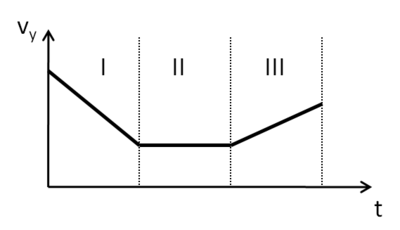
114A car moves along y-axes. In the figure, velocity of the car as a function of time is shown in three parts (I, II, III). Which statement is ALWAYS true?
- AVelocity is constant in part II
- BA car drives backward in part I
- CVelocity is negative in part III
- DVelocity is negative in part I
115What is the cross product of two vectors A and B, if the angle between them is 30 degree, and magnitudes are |A|=4, |B|=2
- A5.6
- B4
- C0
- D8
- E2.5
116When a box rests on the floor, it is acted upon by the gravitational and the _________________ force.
- ACentrifugal
- BAcceleration
- CNormal
- DInertia
- EFriction
117Motion is produced by
- Aall forces
- Bunbalanced forces
- Cbalanced forces
- Dthe absence of force
- Enone of them
118Force is that agent which produces or tends to produce the __________.
- ASpeed in the body
- BAcceleration in the body
- CConstant velocity in the body
- DConstant angular velocity in the body
119A force of 3N acts perpendicularly to a force of 4N. Their resultant has magnitude of ______
- A1N
- B5N
- C7N
- D9N
- E25N
120In inelastic collision between the two bodies __________.
- AOnly momentum of the system is conserved
- BOnly the kinetic Energy of the system is conserved
- CBoth the kinetic Energy and Momentum of the system remain the same
- DTotal energy is not conserved
121Work done by a grass cutter is maximum when he pulls it __________.
- AMaking an angle 450 with the floor
- BMaking an angle 900 with the floor
- CAlong a line parallel to the floor
- DMaking an angle 600 with the floor
122A man does the work if he ___________.
- AGoes to fifth floor of the building
- BGoes to fifth floor of the building and comes back to ground floor
- CRemain on the ground floor
- DGoes to the basement and comes back to ground floor
123In elastic collision between the two bodies __________.
- AOnly momentum of the system is conserved
- BOnly the kinetic Energy of the system is conserved
- CBoth the kinetic Energy and Momentum of the system remain the same
- DTotal energy is not conserved
124When the force and displacement are parallel to each other, then work is __________.
- AMinimum
- BMaximum
- CNone of these
- DDepends on force magnitude
125In rotational motion, the quantity, which plays the same role as the inertial mass in linear motion, is called ___________.
- AInertia
- BAngular momentum
- CMoment of inertia
- DTorque
- ECenter of mass
126Four identical particles, each with mass m, are arranged in the x, y plane as shown. They are connected by light sticks to form a rigid body. If m = 2.0 kg and a = 1.0 m, the rotational inertia of this array about the y-axis is:
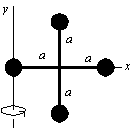
- A4.0 kg m2
- B12 kg m2
- C9.6 kg m2
- D4.8 kg m2
- Enone of these
127Sound travels faster in
- Aa vacuum
- Bwater
- Csteel
- Dair
- ESound travels at about the same speed in all of the above media.
128A woman sits on a spinning stool with her arms folded. When she extends her arms, which of the following occurs
- AShe increases her moment of inertia, thus increasing her angular speed
- BShe increases her moment of inertia, thus decreasing her angular speed.
- CShe decreases her moment of inertia, thus increasing her angular speed
- DShe decreases her moment of inertia, thus decreasing her angular speed
- EHer angular speed remains constant by conservation of angular momentum
129The pressure at the surface of the ocean is 1 atm (1 x 10⁵ Pa). At what approximate depth in the ocean water (ρ = 1025 kg/m3) would the absolute pressure be 2 atm?
- A1 m
- B5 m
- C10 m
- D100 m
- E1000 m
130A plane loop of wire consisting for the bowling ball that rotates about z-axis?
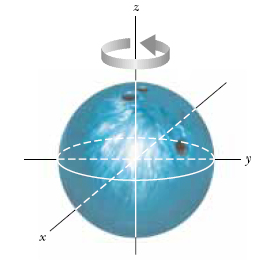
- A+y
- B–y
- C+x
- D–x
- E+z
- F–z
131A segment of steel railroad track has a length of 30.000 m when the temperature is 0.0°C. What is its length when the temperature is 40.0°C? (Average linear expansion coefficient for steel is α=11* 10-6 °C-1).
- A0.013 m.
- B30.013 m.
- C30.130 m.
- D30.003 m.
- E31.013 m.
132An ideal gas occupies a volume of 100 cm3 at 20°C and 100 Pa. Find the number of moles of gas in the container (Universal gas constant R= 8.314 J/mol*K).
- A4.11 * 10-5 mol
- B20.11 * 10-6 mol
- C20.11 * 10-5 mol
- D1.20 * 10-6 mol
- E4.11 * 10-6 mol
133The concrete sections of a certain superhighway are designed to have a length of 25.0 m. The sections are poured and cured at 10.0°C. What minimum spacing should the engineer leave between the sections to eliminate buckling if the concrete is to reach a temperature of 50.0°C? (Average linear expansion coefficient for concrete is α=12* 10-6 °C-1).
- A1.20 cm
- B1.25 cm
- C1.35 cm
- D25.20 cm
- E25.40 cm
134Just 9.00 g of water is placed in a 2.00-L pressure cooker and heated to 500°C. What is the pressure inside the container? (Molar mass of water M(H2O) = 18 g/mol, universal gas constant R= 8.314 J/mol*K ).
- A16.1 Pa
- B1.61 Pa
- C1.61 MPa
- D161 MPa
- E161 Pa
135The temperature of a silver bar rises by 10.0°C when it absorbs 1.23 J of energy by heat. The mass of the bar is 525 g. Determine the specific heat of silver.
- A128 J/kg . °C
- B234 J/kg . °C
- C380 J/kg . °C
- D860 J/kg . °C
- E2 010 J/kg . °C
136A 50.0-g sample of copper is at 25.0°C. If 1 200 J of energy is added to it by heat, what is the final temperature of the copper? (Specific heat of copper c= 387 J/kg . °C).
- A50 °C
- B62 °C
- C77 °C
- D87°C
- E99 °C
137Determine the work done on a fluid that expands from i to f as indicated in Figure.
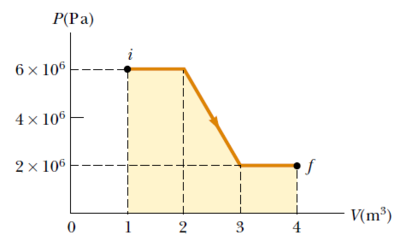
- A12 MJ
- B-12 J
- C-12 MJ
- D-6 J
- E6 MJ
138A gas is taken through the cyclic process described in Figure. Find the net energy transferred to the system by heat during one complete cycle.
- A12 kJ
- B12 J
- C1200 kJ
- D4 kJ
- E6 kJ
139An ideal gas initially at 300 K undergoes an isobaric expansion at 2.50 kPa. If the volume increases from 1.00 m3 to and 12.5 kJ is transferred to the gas by heat, what is the change in its internal energy?
- A6.5 kJ
- B6.5 J
- C7.5 kJ
- D13.5 kJ
- E25 kJ
140 A glass window pane has an area of 3.00 m2 and a thickness of 0.600 cm. If the temperature difference between its faces is 25.0°C, what is the rate of energy transfer by conduction through the window? (Thermal conductivity of glass k= 0.8 W/m* °C)
- A10 W
- B100 W
- C100 kW
- D1 kW
- E10 kW
141A cylinder contains a mixture of helium and argon gas in equilibrium at 150°C. What is the average kinetic energy for each type of gas molecule? (Boltzmann constant kB= 1.38* 10-23 J/K).
- A8.76* 10-23 J
- B8.76* 10-21 J
- C10.8* 10-21 J
- D10.8* 10-23 J
- E87.6* 10-21 J
142Calculate the change in internal energy of 3.00 mol of helium gas when its temperature is increased by 2.00 K (Universal gas constant R= 8.314 J/mol*K ).
- A49.9 J
- B4.99 J
- C499 J
- D748 J
- E74.8 J
143A 2.00-mol sample of a diatomic ideal gas expands slowly and adiabatically from a pressure of 5.00 atm and a volume of 12.0 L to a final volume of 30.0 L. What is the final pressure of the gas?
- A5.33 atm
- B4.21 atm
- C3.39 atm
- D2.91 atm
- E1.39 atm
144A 2.00-mol sample of a diatomic ideal gas expands slowly and adiabatically from a pressure of 5.00 atm and a volume of 12.0 L to a final volume of 30.0 L. What are the initial and final temperatures? (Universal gas constant R= 8.314 J/mol*K, 1 atm= 1.013* 105 Pa )
- A365 K, 253 K
- B355 K, 243 K
- C345 K, 233 K
- D335 K, 223 K
- E325 K, 213 K
145A 2.00-mol sample of a diatomic ideal gas expands slowly and adiabatically from a pressure of 5.00 atm and a volume of 12.0 L to a final volume of 30.0 L. Find Q, ΔEint, and W (Universal gas constant R= 8.314 J/mol*K).
- A0 J, -4.66 kJ, 4.66 kJ
- B0 J, 4.66 kJ, - 4.66 kJ
- C0 J, -4.66 kJ, - 4.66 kJ
- D0 J, 4.66 kJ, 4.66 kJ
- E0.66 J, -4.66 kJ, - 4.66 kJ
146A heat engine takes in 360 J of energy from a hot reservoir and performs 25.0 J of work in each cycle. Find the efficiency of the engine.
- A6.94 %
- B14.4 %
- C23.25 %
- D45.2 %
- E100 %
147A heat engine performs 200 J of work in each cycle and has an efficiency of 30.0%. For each cycle, how much energy is (a) taken in and (b) expelled by heat?
- A637 J, 437 J
- B647 J, 447 J
- C657 J, 457 J
- D667 J, 467 J
- E677 J, 477 J
148A particular heat engine has a useful power output of 5.00 kW and an efficiency of 25.0%. The engine expels 8 000 J of exhaust energy in each cycle. Find the energy taken in during each cycle
- A10.7 kJ
- B11.7 kJ
- C12.7 kJ
- D13.7 kJ
- E14.7 kJ
149The unit for permeability is
- AWb/At × m
- BAt/m
- CAt/Wb
- DWb
150What is the magnetomotive force in a 75-turn coil of wire when there are 4 A of current through it?
- A18.75 At
- B30 At
- C300 At
- D187 At
151The direction of a magnetic field within a magnet is
- Afrom south to north
- Bfrom north to south
- Cback to front
- Dfront to back
152When the north poles of two bar magnets are brought close together, there will be
- Ano force
- Ba downward force
- Ca force of attraction
- Da force of repulsion
153The ability of a material to remain magnetized after removal of the magnetizing force is known as
- Apermeability
- Breluctance
- Chysteresis
- Dretentivity
154The voltage induced across a certain coil is 200 mV. A 120 resistor is connected to the coil terminals. The induced current is
- A1.7 mA
- B16 mA
- C12 mA
- D120 mA
155The induced voltage across a stationary conductor in a stationary magnetic field is
- Azero
- Breversed in polarity
- Cincreased
- Ddecreased
156When a solenoid is activated, the force that moves the plunger is
- Aan electromagnetic field
- Ba permanent magnetic field
- Cvarying voltage
- Da steady current
157What is the magnetomotive force (mmf) of a wire with 8 turns carrying three amperes of current?
- A2,400 At
- B240 At
- C24 At
- D2.4 At
158If a loop in a basic dc generator suddenly begins rotating at a faster speed, the induced voltage
- Aremains unchanged
- Breverses polarity
- Cincreases
- Ddecreases
159If an electron moves perpendicular to the uniform magnetic field of magnitude 0.35 T with the speed equal to 4.69×10⁶, what is the radius of its circular orbit? (me = 9.11×10⁻³¹kg)
- A7.63×104
- B7.63×10-5
- C7.63×106
- D0.73×10-6
160Calculate the maximum kinetic energy of protons in a cyclotron of radius 0.50 m in a magnetic field of 0.35 T.
- A1.46 KeV
- B1.46 meV
- C1.46 MeV
- D0.146 eV
161A rectangular copper strip 1.5 cm wide and 0.1 cm thick carries a current of 5 A. A 1.2 T magnetic field is applied perpendicular to the strip. Find the Hall voltage that should be produced.
- A0.442 µV
- B0.442 mV
- C4.42 V
- D44.2 V
162A toroidal winding carrying a current of 5 A is wound with 300 turns/m of wire. The core is iron, which has a magnetic permeability of 5000µ0 under the given conditions. Find B inside the iron core.
- A9.43×〖10〗^(-3)T
- B9.43×〖10〗^(-2)T
- C0.943 T
- D9.43 T
163Assume that a motor having coils with a resistance of 10 Ω is supplied by a voltage of 120 V. When the motor is running at its maximum speed, the back emf is 70V. Find the current in the coils when the motor is first turned on.
- A10 A
- B12 A
- C1 A
- D1.2 A
164Assume that a motor having coils with a resistance of 10 Ω is supplied by a voltage of 120 V. When the motor is running at its maximum speed, the back emf is 70 V. Find the current in the coils when the motor has reached maximum speed.
- A3 A
- B4 A
- C5 A
- D6 A
165Calculate the inductance of a solenoid containing 300 turns if the length of the solenoid is 25 cm and its cross-sectional area is 4 cm2.
- A0.181 mH
- B0.181 H
- C1.81 mH
- D1.81 H
166Calculate the self-induced emf in the solenoid containing 300 turns if the length of the solenoid is 25 cm and the current through it is decreasing at the rate of 50 A/s.
- A0.905 mV
- B9.05 mV
- C0.905 V
- D9.05 V
167Calculate the time constant of RL circuit consisting of a 30 mH inductor in series with 6 Ω resistor and 12 V battery.
- A180 ms
- B60 ms
- C5 ms
- D2 ms
168Three identical capacitors connected in series. What single capacitance C is “equivalent” to this combination?
- A6C
- B3C
- C(1/6)C
- D(1/3)C
- E2C
169You charge parallel-plate capacitor. When you pull the plates apart to a larger separation and battery remains connected to the capacitor
- ADecreases
- BRemains the same
- CAlternates
- DIncreases
- EChanges in an unpredictable way
170The resonant angular frequency of series RLC circuit is
- A1/(LC)1/2
- BLC
- C(LC)2
- D(LC)1/2
- E1/(LC)
171A wire of area 2 mm2 carries a current of 0.4mA. The average current density is
- A0.02A/m2
- B0.2 A/m2
- C2 A/m2
- D200 A/m2
- E20 A/m2
172A square loop of side 0.1m carries 2A current. The magnetic dipole moment of the loop is
- A10-1 Am2
- B2*10-2 Am2
- C1 Am2
- D10 Am2
- E100 Am2
173Current 0.5A flows in square wire loop of 10 cm side. What is magnetic dipole moment of the loop?
- A50 Am2
- B0.005 Am2
- C0.05 Am2
- D5 Am2
- E0.5 Am2
174Of the three chief kinds of magnetic materials (diamagnetic, paramagnetic and ferromagnetic), which are used to make permanent magnets?
- AOnly paramagnetic
- BAll three
- CParamagnetic and ferromagnetic
- DOnly ferromagnetic
- EOnly diamagnetic
175In a photoelectric experiment at a frequency above cut off, the stopping potential is proportional to:
- AThe energy of the most energetic electron before it is ejected
- BThe energy of the least energetic electron before it is ejected
- CThe energy of the most energetic electrons after it is ejected
- DThe electron potential energy at the surface of the sample
- EThe energy of the least energetic electron after it is ejected
176What is the maximal number of electrons at shell with n=3
- A11
- B18
- C9
- D7
- E3
177For the serial circuit work out the readings on the voltmeters V1 and V2 given the following values for R1=2Ohm and R2=10 Ohm, I1=1A, I2=1A
- AV1=1V; V2=5V;
- BV1=5V; V2=10V;
- CV1=4V; V2=1V;
- DV1=10V; V2=2V;
- EV1=2V; V2=10V;
178What is a good insulator of electricity?
- ASilicon
- BIron
- CRubber
- DSteel
- ESalt water
179Induction current opposes the reason causing it. It is the shortest formulation of
- AEinstein’s law
- BLentz law
- CBiot-Savart law
- DFaraday’s law
- EAmpere’s law
180Potential energy of current carrying loop with magnetic dipole moment µ=1Am2 in magnetic field B of 0.1T, when B and µ make angle 600 is
- A-0.05J
- B-1J
- C1J
- D0.5J
- E0J
181Paramagnetism is closely associated with
- AThe torque
- BThe force exerted by electron dipole moments on each other
- CThe tendency of electron dipole moments to align with an applied magnetic field
- DThe exchange force between electrons
- EThe tendency of electrons dipole moments to align opposite to an applied magnetic field
182In an electromagnetic wave E0=3*106V/m. B0 equals
- A10T
- B10-2T
- C100T
- D1T
- E10-8T
183What is an insulator of electricity?
- AA material that doesn’t allow the free electrons to easily travel through it.
- BA material that protects the free electrons from excess heat
- CA material that protects the free electrons from internal energy propagation
- DA material that allows the free ions to easily travel through it
- EA material that allows the free electrons to easily travel through it
184Ohm’s law in differential form is
- AI={φ1-φ2±ε}/R
- Bω=γE2
- CI=V/R
- DI= ε/(R+r)
- Ej=γE, where j is a current density, γ is a conductivity
185The total number of electron states with n=3 and l=1 for an atom is:
- AFour
- Beight
- Ctwo
- Dten
- Esix
186The thermal conductivity is the analog to:
- AThermal expansion
- BResistivity
- CElasticity
- DDiffusivity
- EViscosity
187
Resistance of metals in classical theory of electric conductivity is caused by- ACollision of free electrons with dislocations or clasters
- BCollision of free electrons with impurity atoms in internodes
- CCollision of free electrons with each other
- DCollision of free electrons with vacancy defects
- ECollision of free electrons with ions of crystal structure
188Which relation defines equipotential surface:
- A|E ⃗|=const
- BE ⃗(Δr) ⃗=const
- CE ⃗=const
- Dφ=const
- Edφ/dz=const
189Electric theory of dispersion was evaluated by:
- ALorentz
- BNewton
- CEinstein
- DMinkovsky
- EMaxwell
190Loop is uniformly rotating with angular velocity ω in uniform magnetic field. Loop has N coils and area of the loop is S. Rotating axis lies on loop’s plane and perpendicular to induction. What is the maximal EMF appeared in the loop:
- ANBS/2
- BNBS
- CNBS cos(ωt)
- DNBSω/2
- ENBSω
191Current I=1A goes through the inductance with inductivity L=10-3H. What is the magnetic flux through inductance:
- A2·10-10Wb
- B2·10-3Wb
- C4π·10-10Wb
- D0.5·10-3Wb
- E10-3Wb
192A toaster is rated at 600W when connected to a 120V source. What current does the toaster carry?
- A2A
- B1A
- C3A
- D4A
- E5A
193Charge carries in metals are
- Aelectrons and holes
- Bonly electrons
- Conly holes
- Dpositive ions
- Enegative ions
194An electrton traveling with speed v around a circle of radius r is equivalent to a current of:
- Aevr/2
- Bev/r
- C2πer/v
- D2πev/r
- Eev/2πr
195The emf inducted in an isolated circuit when the current in the circuit is changing by 10 A/s is 0.3 V. What is the self-inductance?
- A3 mH
- B3 µH
- C30 µH
- D30 mH
- E30 H
196The magnetic field for a given electromagnetic wave has Bmax = 10-6T. Emax equals
- A3*102 V/m
- B10-8 V/m
- C5 V/m
- D3 V/m
- E100 V/m
197An electromagnetic field propagates in +x direction. The electric field at a point in space is momentarily oriented in –z direction. The magnetic field at that point is momentarily oriented in
- A–y direction
- B+y direction
- C+z direction
- D+x direction
- E-x direction
198In RLC circuit angular frequency of AC source rises. Inductive reactance
- ARemains the same
- BIncreases
- COscillates about certain value
- DAlternates
- EDecreases
199Magnetic flux through closed conducting loop changed from 10Wb to 5Wb in 10ms. The average EMF induced in the loop is
- A50V
- B500V
- C-5V
- D-500V
200The magnitude of emf induced in an isolated circuit when the current in the circuit is changing by -10A/s is 0.2 V. What is the self-inductance?
- A2µH
- B20mH
- C20µH
- D20H
- E2mH
Informações
- Descrição
- Quiz sobre PhysicsFinal, criado por Alina Targaryen em 05-01-2017.
- Autor
- Alina Targaryen
- Idioma
- English
- Visualizações
- 1.136
- Histórico
- Criado em 5 jan 2017 · atualizado em 17 jan 2017
- Avaliação
- Ainda sem avaliações Avalie este quiz