
Quiz
Alzheimer's Disease
Este quiz tem tipos de pergunta que abrem no player de sempre.
Perguntas do quiz (75)
1The volumes of the [blank_start]hippocampus[blank_end] (associated with memory) declines about 3x's as much among those who have negative stereotypes about aging compared to those who do not
- Ahippocampus
2Which of the following is not TRUE about Dementia?
- ADefined as a degenerative organic mental deficiency
- BProgressive illness (like Parkinson’s)
- CCauses memory loss, confusion, and the inability to think and communicate effectively
- DConsciousness and perception are usually affected
3[blank_start]Alzheimer’s[blank_end] disease is the most prevalent neurodegenerative disorder
- AAlzheimer’s
4Which of the following statements are true about Alzheimer's disease?
- AGradual progressive dementia affecting cognition, behavior, and functional status
- BNo cure for AD, medications used are to reduce or slow Alzheimer’s disease symptoms
- CAlzheimer's Disease is eventually fatal
- DGets progressively worst after the age of 60
5Early onset Alzheimer's disease (age 40-64) progresses faster than late onset Alzheimer's
- AVerdadeiro
- BFalso
6Patients diagnosed with Alzheimer's disease have a projected survival of [blank_start]4-6[blank_end] years. The disease itself is the [blank_start]5th[blank_end] leading cause of death for persons 65 and older in the U.S. Death generally arises from [blank_start]pneumonia[blank_end] and/or malnourishment instead of the disease itself.
- A4-6
- B5th
- Cpneumonia
7Alzheimer's disease is the most expensive disease in the United States after what other disease states? ($236 billion)
- Aheart disease
- Blung disease
- Ckidney disease
- Dcancer
8[blank_start]Alzheimer's[blank_end] disease is the most common cause of dementia
- AAlzheimer's
9Caused by a decreased blood flow to parts of the brain
Caused by small strokes that block the arteries
Confusion and inability to think
Symptoms overlap with AD, however memory may NOT be affected- AVascular dementia
- BLewy body dementia
- CFrontotemporal dementia (Pick's disease)
10Similar in decline to AD
Problems with memory, judgment, and behavioral changes
Difference: symptoms fluctuate daily
Lots of visual hallucinations and sometimes muscle rigidity and tremors occur- AVascular dementia
- BLewy body dementia
- CFrontotemporal dementia (Pick's disease)
11Nerve cells in the front and side of brain are affected
Difference: big difficulty with language- AVascular dementia
- BLewy body dementia
- CFrontotemporal dementia (Pick’s disease)
12Which of the following are REVERSIBLE causes of dementia?
- Athyroid dysfunction
- BVitamin B-12 deficiency
- CDepression
- DNormal-pressure hydrocephalus
13Early onset Alzheimer's (40-65) account for [blank_start]1[blank_end]% of cases.
- A1
14Gene defects on what chromosomes are responsible for the early onset Alzheimer's (40-65)?
- A1
- B14
- C21
- D18
- E25
15The majority and most aggressive early-onset cases are attributed to mutations of a gene located on chromosome [blank_start]14[blank_end], which produces a protein called [blank_start]presenilin 1[blank_end]. structurally similar protein, presenilin 2, is produced by a gene on chromosome [blank_start]1[blank_end].
- A14
- B1
- C7
- Dpresenilin 1
- Epresenilin 2
- Fpresenilin 3
- Gpresenilin 4
- H1
- I2
- J7
- K14
16Both presenilin 1 and presenilin 2 encode for membrane proteins that may be involved in [blank_start]amyloid precursor protein (APP)[blank_end] processing which is encoded on chromosome [blank_start]21[blank_end]
- Aapp
- B21
17Alzheimer's disease can be cause by which of the following etiologies?
- Agenetic causes
- Benviornmental causes (toxins, pesticides, manganese)
- Cchronic inflammation
- Dimmunologic and nutritional factors
18This hypothesis states that there is an imbalance between the production and clearance of Aβ peptides resulting in aggregation that causes accumulation of Aβ ultimately leading to Alzheimer's disease
- AAmyloid Cascade Theory
- BNeurofibrillary Tangles
- CInflammatory Theory
- DCholinergic Theory
19[blank_start]Amyloid cascade[blank_end] hypothesis seems most applicable in cases of early-onset, autosomal dominant AD
- AAmyloid cascade
- BNeurofibrillary Tangles
- CInflammatory Theory
- DCholinergic Theory
20Tau protein provides structural support to microtubules, the cell’s transportation and skeletal support system. When tau filaments undergo abnormal phosphorylation at a specific site, they cannot bind effectively to microtubules, and the microtubules collapse. Without an intact system of microtubules, the cell cannot function properly and eventually dies. The density of the NFTs correlates with the severity of the dementia. What pathophysiological theory is this?
- ANeurofibrillary Tangles
- BAmyloid Cascade Theory
- CInflammatory Theory
- DCholinergic Theory
21[blank_start]Inflammatory/immunologic[blank_end] hypotheses argue that although Aβ may have direct neurotoxicity, at least some of its toxicity might actually be an indirect consequence of an Aβ protofibril-induced microglia activation and astrocyte recruitment. release of cytokines, nitric oxide, and other radical species, and complement factors that can both injure neurons and promote ongoing inflammation.
- AInflammatory/immunologic
- BNeurofibrillary Tangles
- CAmyloid Cascade Theory
22Levels of multiple [blank_start]cytokines[blank_end] and chemokines are elevated in AD brains, and certain proinflammatory gene polymorphisms are reported to be associated with AD.4
- Acytokines
23Cholinergic cell loss is the source of memory and cognitive impairment in Alzheimer's disease. Loss of cholinergic activity correlates with AD severity
- ACholinergic theory
- BInflammatory Theory
- CNeurofibrillary Tangles
- DAmyloid Cascade Theory
24[blank_start]Glutamate[blank_end] is the major excitatory neurotransmitter in the cortex and hippocampus
- AGlutamate
25Glutamate and other excitatory amino acid neurotransmitters have been implicated as potential neurotoxins in Alzheimer's disease
- AVerdadeiro
- BFalso
26blockade of [blank_start]N-methyl-D-aspartate (NMDA)[blank_end] receptors decreases activity of glutamate in the synapse and may hypothetically lessen the degree of cellular injury in AD
- ANMDA
27Dysregulated [blank_start]glutamate[blank_end] activity is thought to be one of the primary mediators of neuronal injury after stroke or acute brain injury.
- Aglutamate
28Cardiovascular risk factors that are also risk factors for dementia include hypertension, hypercholesterolemia, and diabetes.
- AVerdadeiro
- BFalso
29Patients with alzheimer's disease begin to lose the ability to perform task that requires [blank_start]acetylcholine[blank_end] as a neurotransmitter
- Aacetylcholine
30Which of the following statement is not true?
- AMen are 2 times more likely to be diagnosed with Alzheimer's disease
- BPeople with fewer years of education appear to be at higher risk being diagnosed with Alzheimer's disease
- CAfrican Americans and Hispanics are more likely to be diagnosed with Alzheimer's disease
- DHead/brain trauma, reduces mental activity, and vascular disease can contribute to the development of alzheimer's disease
31Inability to recall information is one of the early warning signs of Alzheimer’s disease
- AVerdadeiro
- BFalso
32Loss of daily function is observed more in the early stages of Alzheimer's disease
- AVerdadeiro
- BFalso
33Conditions that may cause memory loss or dementia:
[blank_start]Medication[blank_end] side effects
Chronic [blank_start]alcoholism[blank_end]
Tumor/infections in the brain
Blood clots in the [blank_start]brain[blank_end]
Vitamin [blank_start]B-12[blank_end] deficiency
Thyroid, kidney or liver disorders
Stroke
[blank_start]Parkinson’s[blank_end] disease
[blank_start]Sleep[blank_end] disturbances- AMedication
- Balcoholism
- Cbrain
- DB-12
- EParkinson’s
- FSleep
34Patients who have neuronal damage in their bimesiotemporal section of the brain are likely to present what?
- Amemory loss
- Bvisuospatial changes
- Cexecutive dysfunction
- Dlanguage dysfunction
35Patients who have neuronal damage in their lateral temporal area of the brain are likely to present what?
- Amemory loss
- Bvisuospatial changes
- Cexecutive dysfunction
- Dlanguage dysfunction
36Patients who have neuronal damage in their parietal cortical area of the brain are likely to present what?
- Amemory loss
- Bvisuospatial changes
- Cexecutive dysfunction
- Dlanguage dysfunction
37Patients who have neuronal damage in their dorsal lateral portion of the brain are likely to present what?
- Aexecutive dysfunction
- Bvisuospatial changes
- Clanguage dysfunction
- Dmemory loss
38Clinical presentation of COGNITIVE symptoms for alzheimer's disease
memory loss
[blank_start]aphasia[blank_end]- partial loss of the power to use and understand words
[blank_start]apraxia[blank_end]- inability to perform complex muscle movements
[blank_start]agnosia[blank_end]- inability to recognize familiar objects and osouns
disorientation
impaired executive function- Aaphasia
- Bapraxia
- Cagnosia
- Dapraxia
- Eaphasia
- Fagnosia
- Gagnosia
- Haphasia
- Iapraxia
39Which of the follow are NON-COGNITIVE symptoms of Alzheimer's disease?
- Adepression
- Bpsychotic symptoms hallucinations
- Cbehavioral disturbances
- Dmemory loss
40Inability to care for self (lack of bathing, inability to feed one's self, etc.) is an example of what kind of symptom presented in alzheimer's disease?
- Acognitive
- Bnon-cognitive
- Cfunctional
41______ is the primary excitatory neurotransmitter responsible for stimulation of the NMDA receptor.
- Aglutamate
- Bacetylcholine
- Cnorepinephrine
- Dserotonin
42The incidence of early-onset Alzheimer’s disease with cognitive dysfunction before the age of 65 y.o. is estimated at:
- A1-6%
- B10-15%
- C20-70%
- D25-30%
43This rapid screening instrument is used to detect mild cognitive dysfunction. It checks for the patient's ability to make decisions and use words appropriately. The screening instrument also tests for memory, attention, language, and delayed recall
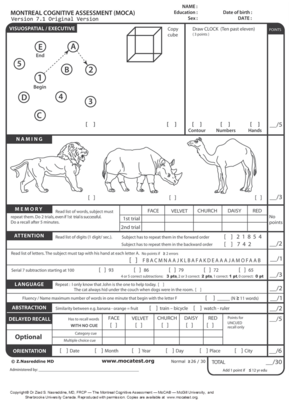
- AMontreal cognitive assessment
- BHodkinson Abbreviated Test
- CAlzheimer’s Disease Assessment
- DMMSE test
44This screening instrument is primarily used in nursing home settings and are required to be filled out by social workers or psychological groups (Alzheimer's treatment reimbursement). It determine whether or not if the patient is cognitively impaired. The usefulness of the exam however is limited by time constraints and practicality.
- AHodkinson Abbreviated Test
- BAlzheimer’s Disease Assessment
- CMMSE
- DMontreal Cognitive Assessment
45This screening instrument is the most preferred and often used. It should be done initially when there is a suspicion of dementia or Alzheimer's disease. The assessment should be repeated 6 months later and if there's a decline in the cognitive score of the patient by 2-4 points you would consider changes to medication regimen. This screening tool test for memory, orientation, and arithmetic and determines the degree of dementia within a patient.
- AMMSE (folstein test)
- BAlzheimer’s Disease Assessment
- CHodkinson Abbreviated Test
- DMontreal Cognitive Assessment
46Complete the table by selecting the appropriate ranges for each classification
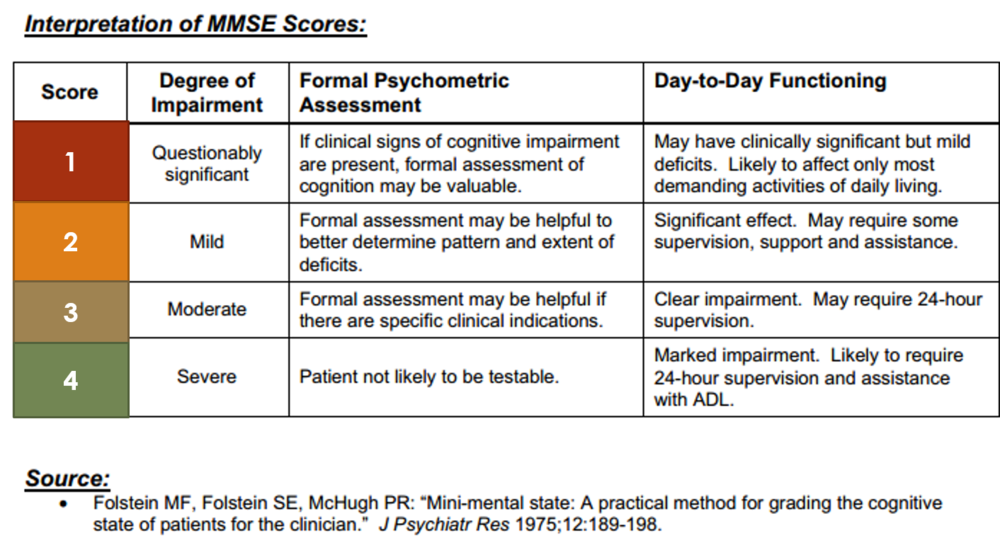
- A25-30
- B20-25
- C10-20
- D0-10
- E25-30
- F20-25
- G10-20
- H0-10
- I25-30
- J20-25
- K10-20
- L0-10
- M25-30
- N20-25
- O10-20
- P0-10
47Diagnosis of Alzheimer's disease
-[blank_start]Cognitive[blank_end] decline from a previously higher baseline has occurred
-changes in social or [blank_start]occupational[blank_end] functioning are present
-Review of current [blank_start]medication[blank_end] (can contribute to cognitive impairment)- ACognitive
- Boccupational
- Cmedication
48Select the medications that can cause cognitive impairment
- ABenzodiazepines
- BSedative Hypnotics
- CAnticholinergics
- DOpioid Analgesics
- EAntipsychotics
- FAnticonvulsants
49Laboratory Tests for Alzheimer's Disease
- Rule out vitamin [blank_start]B-12[blank_end] and [blank_start]folate[blank_end] deficiency
- Rule out [blank_start]HYPOthyroidism[blank_end] with thyroid tests
- [blank_start]Blood[blank_end] cell counts (presence of infection), serum [blank_start]electrolytes[blank_end] (sodium & calcium), [blank_start]liver[blank_end] function tests
- Other tests: CT or MRI scans
- [blank_start]Genotyping[blank_end] being performed in patients < 60 years old and also have a parent who developed AD prior to the age of 60. Demonstrates the presence of [blank_start]APOE-4[blank_end]- AB-12
- Bfolate
- CHYPOthyroidism
- Delectrolytes
- Eliver
- FBlood
- GGenotyping
- HAPOE 4
50[blank_start]Primary[blank_end] goal of treatment in treating Alzheimer’s disease is to symptomatically treat cognitive difficulties and preserve patient function as long as possible.
[blank_start]Secondary[blank_end] goal of treatment in treatment Alzheimer's disease is to treat the behavioral and psychiatric issues that occur as a result of the disease- APrimary
- BSecondary
- CSecondary
- DPrimary
51Management of Brain Vascular Health
-Management includes: monitoring BP, glucose, cholesterol, and [blank_start]homocysteine[blank_end]
-Adding [blank_start]ASA[blank_end] (low dose) with significant brain vascular disease (81mg QD)
-Staying physically, mentally and socially active
-Adopting a low-fat, low-cholesterol diet rich in dark vegetables and fruit, managing [blank_start]body weight[blank_end] (Mediterranean and Dash diets)- Ahomocysteine
- Baspirin
- Cbody weight
52Non-pharmacologic Therapy (first line theapy in the treatment of Alzheimer's Disease)
Education
Consider vision, [blank_start]hearing[blank_end] impairments
Avoid confrontation
Maintain a consistent, [blank_start]structured[blank_end] environment
Guidance
Keep requests and demands [blank_start]simple[blank_end]
Monitor for [blank_start]discomfort[blank_end]
[blank_start]Environmental[blank_end] changes- Ahearing
- Bsimple
- Cdiscomfort
- DEnvironmental
- Estructured
53Other Non-conventional Approaches in the treatment of Alzheimer's Disease
[blank_start]Diet[blank_end] (Dash and Mediterranean)
Aroma therapy
[blank_start]Cognitive[blank_end] training
Incorporation of new [blank_start]hobbies[blank_end]
Massage and touch
Acupuncture
Music- ACognitive
- Bhobbies
- CDiet
54Aromatherapy
[blank_start]Lavender[blank_end]: calming effect; can be use for depression, irritability, and anger
[blank_start]Peppermint[blank_end]: energizer and it stimulates the mind and calms the nerves
[blank_start]Rosemary[blank_end]: similar to peppermint in addition to stimulating appetite
[blank_start]Lemon balm:[blank_end] calms and relaxes people, improves memory
[blank_start]Ginger[blank_end]: constipation and can be used as an aid in digestion- ALavender
- BPeppermint
- CRosemary
- DLemon balm
- EGinger
- FPeppermint
- GLavender
- HRosemary
- ILemon balm
- JGinger
- KRosemary
- LPeppermint
- MLavender
- NLemonbalm
- OGinger
- PLemon balm:
- QGinger
- RLavender
- SPeppermint
- TRosemary
- UGinger
- Vlavender
- Wpeppermint
- Xrosemary
- Ylemon balm
55What are the pharmacologic treatment options in mild to moderate alzheimer's disease?
- ADonepezil (Aricept)
- BRivastigmine (Exelon)
- CGalantamine (Razadyne)
- DMemantine (Namenda)
56Which of the following drugs are cholinesterase inhibitors?
- ADonepezil (Aricept)
- BRivastigmine (Exelon)
- CGalantamine (Razadyne)
- DMemantine (Namenda)
57Cholinesterase Inhibitors
Inhibit the hydrolysis of [blank_start]acetylcholine[blank_end] through reversible inhibition of cholinesterase
Increases the levels acetylcholine in the [blank_start]cerebral cortex[blank_end] by decreasing the degradation of acetylcholine- Aacetylcholine
- Bcerebral cortex
58[blank_start]Memantine[blank_end] is the only NMDA-antagonist
Blocks glutamatergic neurotransmission by antagonizing [blank_start]NMDA[blank_end]
For mild to severe AD as monotherapy and in combination with [blank_start]Donepezil[blank_end]
Adverse effects include constipation, confusion, dizziness, headache, hallucinations, coughing and hypertension- AMemantine
- BNMDA
- CDonepezil
59Complete the table
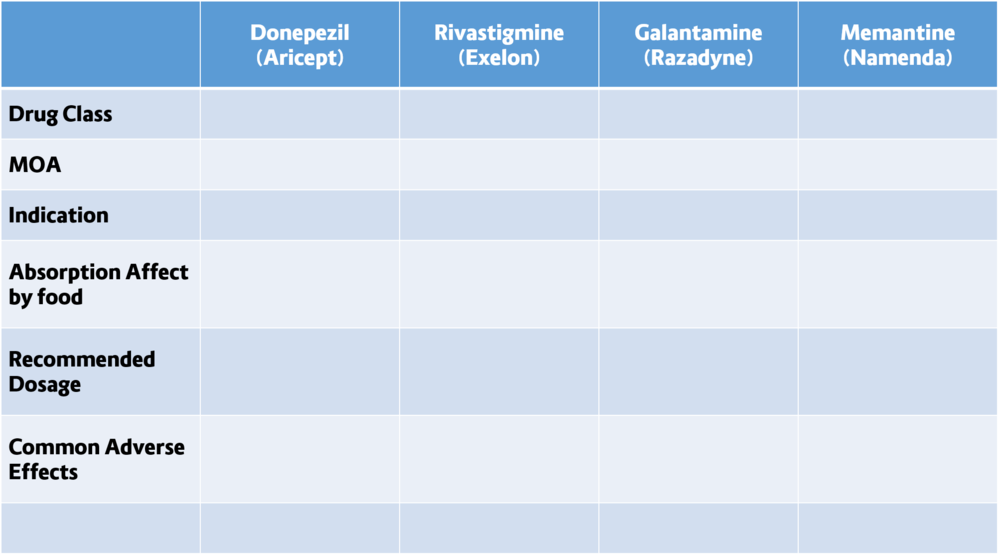
- Acholinesterase inhibitor
- BNMDA receptor antagonist
- Ccholinesterase inhibitor
- DNMDA receptor antagonist
- Echolinesterase inhibitor
- FNMDA receptor antagonist
- Gcholinesterase inhibitor
- HNMDA receptor antagonist
- Iprevents breakdown of ACH in the brain
- Jprevents breakdown of ACH and BCH
- Kprevent breakdown of ACH, + nicotinic R
- Lregulation of glutamate activity
- Mprevents breakdown of ACH in the brain
- Nprevents breakdown of ACH and BCH
- Oprevent breakdown of ACH, + nicotinic R
- Pregulation of glutamate activity
- Qprevents breakdown of ACH in the brain
- Rprevents breakdown of ACH and BCH
- Sprevent breakdown of ACH, + nicotinic R
- Tregulation of glutamate activity
- Uprevents breakdown of ACH in the brain
- Vprevents breakdown of ACH and BCH
- Wprevent breakdown of ACH, + nicotinic R
- Xregulation of glutamate activity
- Ymild-to-moderate, mod-to-severe
- Zmild-to-moderate, severe (patch)
- AAmild-to-moderate
- ABmod-to-severe
- ACmild-to-moderate, mod-to-severe
- ADmild-to-moderate, severe (patch)
- AEmild-to-moderate
- AFmod-to-severe
- AGmild-to-moderate, mod-to-severe
- AHmild-to-moderate, severe (patch)
- AImild-to-moderate
- AJmod-to-severe
- AKmild-to-moderate, mod-to-severe
- ALmild-to-moderate, severe (patch)
- AMmild-to-moderate
- ANmod-to-severe
- AOyes
- APno
- AQyes
- ARno
- ASyes
- ATno
- AUno
- AVyes
60Donepezil ([blank_start]Aricept[blank_end])
Initial Dose: [blank_start]5[blank_end] mg in the evening
Mild-to-Moderate: [blank_start]5-10[blank_end] mg
Moderate-to-Severe: [blank_start]10-23[blank_end] mg
ADE's: BRADYCARDIA, insomnia, N/V, diarrhea, headache, fatigue, muscle cramps, infection- AAricept
- BExelon
- CRazadyne
- D5
- E10
- F15
- G1.5
- H5-10
- I10-15
- J1-5
- K2-10
- L10-23
- M10-15
- N15-30
61Rivastigmine ([blank_start]Exelon[blank_end])
Initial Dose: [blank_start]1.5[blank_end] mg BID , [blank_start]4.6[blank_end] mg/day (transdermal patch)
Mild-to-Moderate: [blank_start]3-6[blank_end] mg BID , [blank_start]9.5-13.3[blank_end] mg/day (transdermal patch)
ADE's: dizziness, headache, agitation, weight loss, N/V, diarrhea, tremor, muscle weakness- AExelon
- BAricept
- CRazadyne
- D1.5
- E1
- F5
- G4.6
- H5.5
- I2.3
- J3-6
- K2-8
- L5-10
- M9.5-13.3
- N10-15
- O15-20
62Galantamine ([blank_start]Razadyne[blank_end])
Initial Dose: [blank_start]4[blank_end] mg BID , [blank_start]8[blank_end] mg QD in the morning (ER)
Mild-to-Moderate: [blank_start]8-12[blank_end] mg BID, [blank_start]16-24[blank_end]mg (ER)
ADE's: N/V, diarrhea, dizziness, headache, fatigue, weight loss, urinary tract infections- ARazadyne
- BAricept
- CExelon
- D4
- E6
- F5
- G8
- H4
- I10
- J8-12
- K4-6
- L5-10
- M16-24
- N10-15
- O15-20
- P20-25
63Memantine ([blank_start]Namenda[blank_end])
Initial Dose: [blank_start]5[blank_end] mg QD, [blank_start]7[blank_end] mg QD (XR)
Moderate-to-Severe: [blank_start]10[blank_end] mg BID, [blank_start]28[blank_end] mg (XR)
ADE's: Dizziness, confusion, headache, constipation, hypertension- ANamenda
- BAricept
- CExelon
- D5
- E1
- F4
- G10
- H7
- I5
- J10
- K10
- L5
- M20
- N28
- O20
- P25
- Q30
64Combination therapy is used for the treatment of [blank_start]moderate-to-severe[blank_end] Alzheimer's disease
- Amoderate-to-severe
- Bmild-to-moderate
65Of the antipsychotics, which should be avoided in treatment of psychosis in patients with dementia?
- AHaloperidol (Haldol)
- BQuetiapine (Seroquel)
- CRisperidone (Risperdal)
66What are the preferred drugs in the treatment of psychosis in patients with dementia?
- AHaloperidol (Haldol)
- BQuetiapine (Seroquel)
- CRisperidone (Risperdal)
67Quetiapine (Seroquel)
Starting Dose: [blank_start]25[blank_end] mg
Maintenance Dose in Dementia: [blank_start]100-300[blank_end] mg/day- A25
- B10
- C5
- D20
- E100-300
- F25-50
- G300-500
68Risperidone (Risperdal)
Starting Dose: [blank_start]0.25[blank_end] mg
Maintenance Dose in Dementia: [blank_start]0.75-2[blank_end] mg/day- A0.25
- B1
- C.5
- D0.75-2
- E.5-1
- F1-2
- G.25-.5
69What antidepressants are recommended for treating depression in patients with dementia?
- ACitalopram (10mg, 10-20mg/day)
- BSertraline (25mg, 75-100mg/day)
- CTrazodone (25mg, 75-150mg/day)
- DFluoxetine (5mg, 10-40mg/day)
70BDZ’s can also be used in the treatment of depression in dementia patients, but not recommended because they can cause impairment of cognition, worsen breathing problems, and cause falls in elderly people
- AVerdadeiro
- BFalso
71[blank_start]Carbamazepine[blank_end] and [blank_start]Valproic Acid[blank_end] are recommended for the treatment of agitation and aggression in dementia patients.
- ACarbamazepine
- BSetraline
- CHaolperidol
- DValproic Acid
- EParoxetine
- FEscitalopram
72Risk for Alzheimer's disease doubles after the age of [blank_start]65[blank_end]
- A65
73[blank_start]NFTs[blank_end] are commonly found in the cells of the hippocampus and cerebral cortex in persons with AD and are composed of abnormally hyperphosphorylated tau protein
- ANFTs
- Bamyloid plaques
74[blank_start]APOE 4[blank_end] is associated with increasing deposition of Aβ and is thought to act as an accelerating modulator in vascular dementia. Elevated cholesterol levels in brain neurons may alter membrane functioning and result in the cascade leading to plaque formation and AD
- AAPOE 4
75Disturbances in [blank_start]insulin[blank_end]-signaling pathways, both in the periphery and the brain, have been linked to AD. Insulin may also regulate the metabolism of Aβ and [blank_start]tau[blank_end] protein
- Ainsulin
- Btau
Informações
- Descrição
- NAPLEX Pharmacy (Neuro ) Quiz sobre Alzheimer's Disease , criado por Mark W. em 08-01-2017.
- Autor
- Mark W.
- Idioma
- English
- Visualizações
- 18
- Etiquetas
- Avaliação
- Ainda sem avaliações Avalie este quiz