
Quiz
Cranial Nerves
Crie uma conta grátis para terminar este quiz
Salve seu progresso e veja sua nota final.
Já tem uma conta? Inicie sessão
Perguntas do quiz (54)
1Which nerve innervates the horn in cattle and is blocked when de-horning?
- AInfratrochlear nerve, a branch of the ophthalmic division of the trigeminal nerve
- BFrontal nerve, a branch of the ophthalmic division of the trigeminal nerve
- CInfraorbital nerve, a branch of the maxillary division of the trigeminal nerve
- DCornual nerve, a branch of the maxillary division of the trigeminal nerve
- EAuriculopalpebral nerve, a branch of the facial nerve
2Which ONE of the following statements regarding the innervation of the eye and adnexa is FALSE?
- AThe sphincter muscle of the iris receives voluntary, motor innervation via the Optic nerve (CN II).
- BThe lacrimal gland receives parasympathetic innervation from the facial nerve.
- CThe extraocular muscles that control the position of the eye in the orbit receive motor innervation from cranial nerves III (oculomotor), IV (trochlear) and VI (abducens).
- DThe cornea receives sensory innervation via a branch of the Trigeminal nerve.
3Concerning the motor innervation of the rostral and caudal bellies of the digastricus muscle:
- ABoth the rostral and caudal bellies are innervated by the mylohoideus nerve a branch of the mandibular division of Trigeminal
- BThe rostral belly is innervated by the digastric nerve a branch of the mandibular division of trigeminal whilst the caudal belly is innervated by the mylohyoideus nerve a branch of the facial nerve.
- CThe rostral belly of digastricus is innervated by the hypoglossal nerve whilst the caudal belly is innervated by the mandibular division of Trigeminal nerve.
- DThe rostral belly is innervated by the mylohoideus nerve a branch of the mandibular division of trigeminal nerve whilst the caudal belly is innervated by the digastric nerve a branch of the facial nerve.
4All of the following are components of the auditory pathways to conscious level EXCEPT:
- ACochlear division of cranial nerve VIII (vestibulocochlear)
- BCaudal colliculus
- CCochlear nuclei
- DMedial geniculate nucleus
- EVestibular nuclei
5Which of the following statements concerning location of nerve cell bodies is FALSE?
- ACell bodies of neurones supplying the horn in small ruminants are located in the trigeminal ganglion
- BCell bodies of motor neurones innervating the trapezius muscle are located in the 1st 4 cervical segments of the spinal cord.
- CCell bodies of preganglionic parasympathetic neurones supplying the stomach are located in the parasympathetic nucleus of X
- DCell bodies of cranial nerve I (olfactory) are located in the olfactory bulb
- ECell bodies of the neurones forming cranial nerve II (optic) are located in the ganglion cell layer of the retina
6A cat comes into your practice for an eye examination. You test the ocular reflexes and you find:
- a normal bilateral menace response
- a normal direct pupillary light reflex (PLR) in the right eye but no consensual PLR in the left eye
- no direct PLR in the left eye but a normal consensual PLR in the right eye
- a drooping upper eyelid on the left side
Where is the lesion most likely to be?- ARight optic nerve (CNII)
- BLeft oculomotor nerve (CNIII)
- CRight oculomotor nerve (CNIII)
- DLeft lateral geniculate nucleus
7Why would paralysis of the dorsal and ventral buccal branches of the right facial nerve (CNVII) result in marked clinical signs in the horse?
- AThe dorsal and ventral buccal branches are very superficial
- BThe horse lacks a firm muzzle and therefore facial asymmetry is more evident than in other species
- CThe right dorsal and ventral buccal branches have more nerve fibres than the left
- DThe horse's facial musculature is well innervated
Check
8Guttural pouch disease frequently causes neurological signs that can include cranial nerve deficits. This is because five cranial nerves pass through the walls of the guttural pouch of the horse. One of these passes through the lateral compartment and is rarely affected by disease, the other four run through the medial compartment and are commonly affected by disease.
Which four cranial nerves run through the medial compartment of the guttural pouch?- AGlossopharyngeal (CNIX), vagus (CNX), accessory (CNXI) and hypoglossal (CNXII) nerves
- BFacial (CNVII), vagus (CNX), accessory (CNXI) and hypoglossal (CNXII) nerves
- CVestibulocochlear (CNVIII), glossopharyngeal (CNIV), vagus (CNX) and accessory (CNXI) nerves
- DTrigeminal (CNV), glossopharyngeal (CNIV), vagus (CNX) and accessory (CNXI) nerves
9Which nerve does the chorda tympani (a branch of the facial nerve (CNVII) join outside of the tympanic bulla?
- APterygopalatine nerve
- BHypoglossal nerve
- CLingual nerve
- DGlossopharyngeal nerve
10The image below shows a dog head from a right lateral view. The skin and superficial muscles have been removed. Which branch of the trigeminal nerve (CNV) is indicated by A?
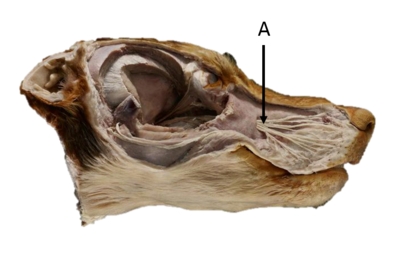
- AInfraorbital nerve
- BMental nerve
- CMandibular nerve
- DVentral buccal branch
11You are a vet in small animal general practice. You examine a dog and find the following:
- atrophy of the left temporalis and masseter muscles
- hypertrophy of the right temporalis and masseter muscles
- no lateral palpebral reflex on the left lower eye tested.
- normal blinking was observed during the consultation- AMaxillary and mandibular nerves
- BMandibular and facial nerves
- CFacial and ophthalmic nerves
- DOphthalmic and maxillary nerves
12Which cranial nerve provides motor innervation to the tongue?
- AHypoglossal nerve (CNXII)
- BFacial nerve (CNVII)
- CTrigeminal nerve (CNV)
- DGlossopharyngeal nerve (CNIX)
13Which extrinsic muscles of the eye does the oculomotor nerve (CN III) provide motor innervation to?
- AMedial rectus, dorsal rectus, ventral rectus, retractor bulbi muscles.
- BLateral rectus, medial rectus, ventral rectus and ventral oblique muscles.
- CMedial rectus, dorsal rectus, ventral rectus and ventral oblique muscles
- DLateral rectus, medial rectus, dorsal rectus and ventral rectus muscles.
14Nerve fibres can be classified according to: distribution, tissue supplied and signal direction. Using these three categories how would the accessory nerve (CNXI) be classifed?
- ASpecial somatic efferent (SSE)
- BGeneral somatic efferent (GSE or SE)
- CGeneral visceral efferent (GVE or VE)
- DGeneral somatic afferent (GSA)
15The image below shows the canine cranium from a left ventral oblique view. What is the name of the opening from the cranium (i.e. fissure, foramen or canal) indicated by the arrow? Which cranial nerve emerges from it?
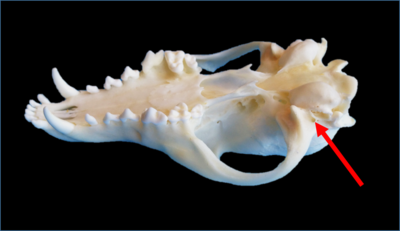
- AHypoglossal canal; hypoglossal nerve (CNXII)
- BJugular foramen; vagus nerve (CNX)
- COval foramen; trigeminal nerve mandibular branch(CNV3)
- DStylomastoid foramen; facial nerve (CNVII)
16Which cranial nerve branch passes all the way through the middle ear cavity?
- ACochlear component of the vestibulocochlear nerve
- BChorda tympani
- CVestibular component of the vestibulocochlear nerve
- DMajor petrosal nerve
17Which cranial nerve is the only one to attach to the brain at the pons?
- ATrigeminal nerve (CNV)
- BTrochlear nerve (CN IV)
- CFacial nerve (CNVII)
- DOculomotor nerve (CNIII)
18Which cranial nerve(s) attach to the midbrain?
- ACNIII & CNIV
- BCNII
- CCNV
- DCNIII, CNIV & CNV
- ECNIX & CNX
19Which one of these cranial nerves does NOT attach to the Medulla oblongata?
- ACN VI
- BCN VII
- CCN VIII
- DCN IX
- ECN X
- FCN XI
- GCN XII
- HCN V
20What are the cranial nerves which provide parasympathetic supply?
- ACN III, CN VII, CN IX & CN X
- BCN II, CN III, CN VII & CN X
- CCN II, CN III, CN VII & CN IX
- DCN I, CN II , CN VII & CN X
21Which cranial nerve provides parasympathetic supply to constrict the pupil size?
- ACN III
- BCN VII
- CCN IX
- DCN X
22Which cranial nerve provides parasympathetic nerve supply to the lacrimal gland and the salivary glands sublingual and mandibular?
- ACN VII
- BCN III
- CCN IX
- DCN X
23Which cranial nerve provides parasympathetic nerve supply to the parotid salivary gland?
- ACN IX
- BCN III
- CCN VII
- DCN X
24Which cranial nerve provides parasympathetic nerve supply to the viscera of viscera of cervical, thorax and abdomen?
- ACN X
- BCN III
- CCN VII
- DCN IX
25Which cranial nerve(s) pass through the orbital fissure?
- ACN III, CN IV, CN V & CN VI
- BCN VII
- CCN X & CN XI
- DCN I, CN III & CN III
26Which cranial nerve(s) pass through the jugular foramen?
- ACN IX, CN X & CN XI
- BCN XII
- CCN VII
- DCN III, CN IV & CN V
27Which cranial nerve(s) passes through the hypoglossal canal?
- ACN XII
- BCN IX, CN X N & CN XI
- CCN VII
- DCN VIII
28Which cranial nerve provides the sensory input for taste of the caudal 1/3 of the tongue?
- ACN IX
- BCN VII
- CCN X
- DCN XI
29Which cranial nerve is the smallest in size?
- ACN IV
- BCN V
- CCN VI
- DCN III
30Which cranial nerve is the largest in size?
- ACN V
- BCN IV
- CCN III
- DCN VI
31The Parasympathetic pathway where Preganglionic fibres run to the cilary ganglion describes which cranial nerve?
- ACN III
- BCN VII
- CCN IX
- DCN X
32The Parasympathetic pathway where Preganglionic fibres run to the pterygopalatine and mandibular ganglion describes which cranial nerve?
- ACN VII
- BCN III
- CCN IX
- DCN X
33The Parasympathetic pathway where Preganglionic fibres run to the otic ganglion describes which cranial nerve?
- ACN IX
- BCN X
- CCN III
- DCN VII
34The Parasympathetic pathway where Preganglionic fibres run to the terminal ganglion describes which cranial nerve?
- ACN X
- BCN III
- CCN VII
- DCN IX
35Which trigeminal branch CN V provides sensory input from the cornea and upper eyelids?
- ACN V1 Opthalmic
- BCN V2 Maxillary
- CCN V3 Mandibular
36Which trigeminal nerve branch CN V provides sensory input from the lower eye lids?
- ACN V1 Opthalmic
- BCN V2 Maxillary
- CCN V3 Mandibular
37What cranial nerve must have a dysfunction for a ventrolateral strabismus?
- ACN III
- BCN IV
- CCN VI
- DCN VII
38What cranial nerve must have a dysfunction for a extorsional strabismus?
- ACN IV
- BCN III
- CCN VI
- DCN VII
39What cranial nerve must have a dysfunction for a medial strabismus?
- ACN VI
- BCN IV
- CCN III
- DCN VII
40What branch of CNV arises from the rostral alar foramen?
- ACN V2 Maxillary
- BCN V1 Opthalmic
- CCN V3 Mandibular
41What muscle(s) does CN IV innervate?
- ADorsal oblique
- BLateral rectus & retractor bulbi
- CMedial, ventral & dorsal rectus and the ventral oblique
42What muscle(s) does CN VI innervate?
- ALateral rectus & retractor bulbi
- BDorsal oblique
- CMedial, dorsal & ventral rectus and the ventral oblique.
43What muscle(s) does CN III innervate?
- AMedial, ventral & dorsal rectus and the ventral oblique
- BDorsal oblique
- CLateral rectus & retractor bulbi
44What cranial nerve is innervates muscles for neck turning?
- ACN XI
- BCN XII
- CCN X
- DCN IX
- ECN VII
45Which of the following groups of cranial nerves all contain general visceral Efferent (GVE) components?
- AIII, VII, IX, X
- BV, VI, VII, XI
- CV, VII, IX, X, XI
- DIX, X, XI, XII
- EIII, IV, VI, XII
46The extrinsic muscles of the tongue receive motor innervation from?
- AHypoglossal
- BGlossopharyngeal
- CVagus
- DTrigeminal
- EFacial
47Which nerve supplies motor innervation to muscles such as levator nasolabialis?
- AMaxillary V
- BMental branch of mandibular V
- CInfraorbital branch of maxillary V
- DMandibular V
- EFacial VII
48Which branch of which nerve supplies cutaneous sensation to the chin?
- AMental branch of mandibular V
- BInfraorbital branch of maxillary V
- CAuriculotemporal branch of V
- DMaxillary V
- EFacial VII
49Which cranial nerve passes through the cribiform plate of the skull?
- AOptic (II)
- BTrochlear (IV)
- COculomotor (III)
- DTrigeminal (V)
- EOlfactory (I)
50The upper premolars and molars are innervated by:
- AAuriculopalpebral (VII)
- BFacial (VII)
- CMandibular (V)
- DInfraorbital (V)
- EAuriculotemporal (V)
51The cornual nerve supplies sensory innervation to the bovine horn. From which nerve is it derived?
- ADorsal buccal (VII)
- BMandibular n. (V3)
- CMaxillary n. (V2)
- DAuriculopalpebral (VII)
- EOphthalmic (V)
52Which cranial nerve supplies sensory innervation to the larynx?
- AAccessory (XI)
- BFacial (VII)
- CVagus (X)
- DHypoglossal (XII)
- EGlossopharyngeal (IX)
53the carotid sinus at the origin of the internal carotid artery is innervated by
- AFacial n (VII)
- BVagus n (X)
- CAbducens n (VI)
- DAccessory n (XI)
- EGlossopharyngeal n (IX)
54The cornea receives sensory innervation from the long ciliary nerves of
- AMaxillary n (V)
- BOculomotor n (III)
- COphthalmic n (V)
- DAuriculopalpebral n (VII)
- EDorsal buccal n (VII)
Informações
- Descrição
- Principles and animal form and fucntion (Unit 5 Nervous System) Quiz sobre Cranial Nerves, criado por Jack Fawsitt em 18-02-2017.
- Autor
- Jack Fawsitt
- Idioma
- English
- Visualizações
- 298
- Etiquetas
- Avaliação
- 5,0 de 5 · 3 avaliações Avalie este quiz