
Sem título
Slides do conjunto (15)
-
ISYS6264 Testing and System Implementation
- •Defect Management
- •Benefit of Defect Analysis
- •Bugs and Root Causes
- •Levels of Importance to Bug
- •Bug Life Cycle
- •Bug Report
- •Steps for Better Bug Reports
- •Managing Bug Tracking
-
- 1. Make sure you already have the pdf version of our reference book,
- Rex Black. (2009). Managing The Testing Process. 03. Wiley Publishing Inc. Indianapolis. ISBN: 978-0-470-40415-7.
- 2. The solutions for last week exercise will be discussed later.
- 3. Make sure you are still preparing for upcoming mid-exam! If you still do not understand the materials yet, allocate some time to come to tutorial sessions.
-
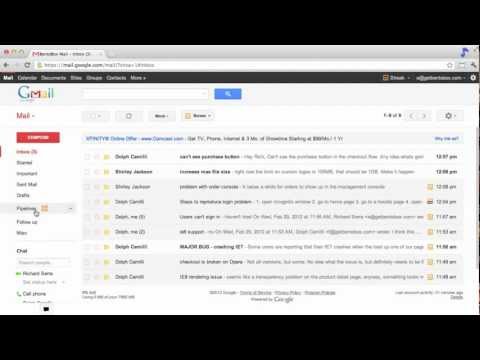
- Using Streak for Bug Tracking (Incorporar)
- Legenda: Source: https://www.youtube.com/watch?v=1XpobUYYPUY
-
What do you know about bug or defect?
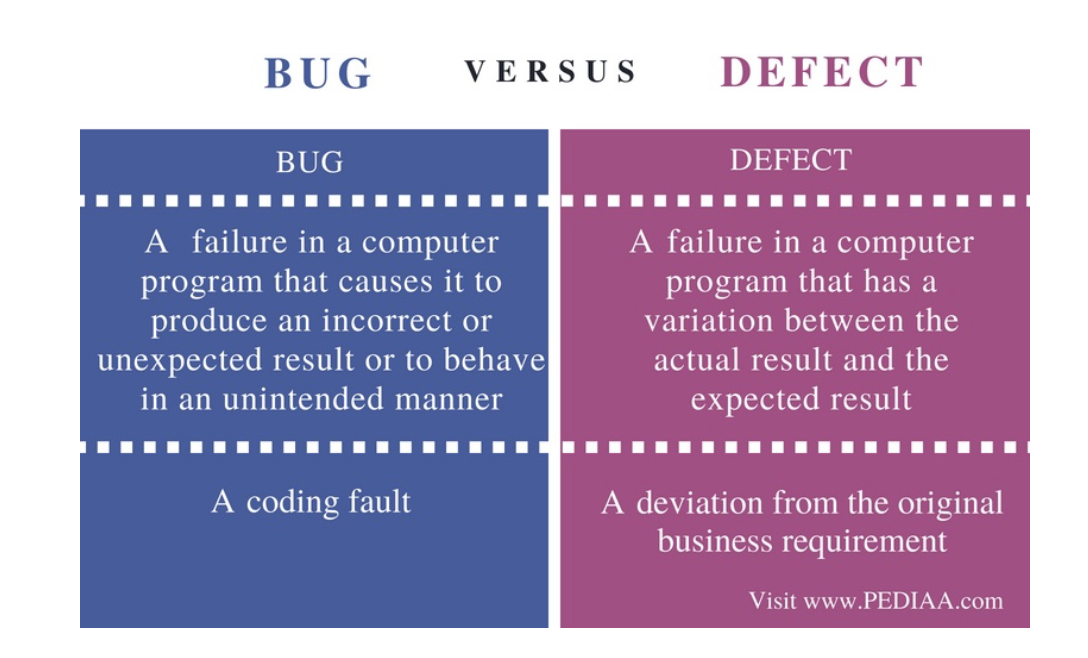
- Legenda: Source: http://pediaa.com/difference-between-bug-and-defect/
-
- How to classify defects?
- The impact on users (often called criticality), the necessary effort to correct the defect, the component where this defect is initially present, etc.
- Why defect classification is important?
- To avoid repeated reporting of already discovered defects.
-
We, therefore, need a bug report!
- Legenda: Source: Rex Black. (2009). Managing The Testing Process. 03. Wiley Publishing Inc. Indianapolis. ISBN: 978-0-470-40415-7.
-
- What is a bug report?
- A bug report is a technical document that describes the various symptoms or failure modes associated with a single bug.
- What makes a good bug report?
- Ability to provide the project management team with the information they need to decide when and whether to fix a problem and capture the information a programmer will need to fix and debug the problem.
-
So, what seems to be the problems?
- The failure description.
- Failure description is the message of the bug report, used to communicate clearly with the programmers and the project team about a problem.
- Done properly,
- Failure description captures in simple prose the essentials of bug.
- Done poorly,
- Failure description obfuscates the bug and misleads the readers.
-
What a good failure description looks like?
-
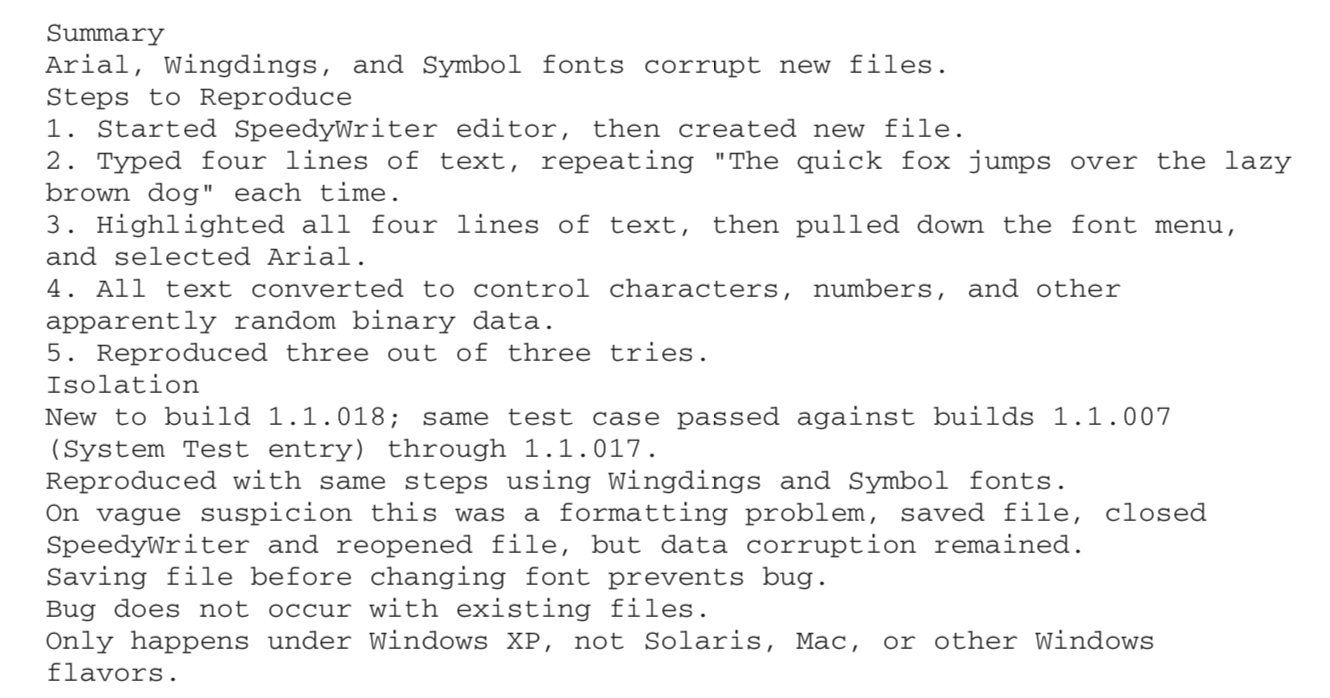
Summary, Steps to reproduce, and Isolation
- The summary is a one- or two-sentence description of the bug, emphasizing its impact on the customer or the system user. The summary tells managers, developers, and other readers why they should care about the problem.
- The sentence, ‘‘I had trouble with screen resolutions’’ is a lousy summary; the sentence, ‘‘Setting screen resolution to 800 by 1024 renders the screen unreadable’’ is much better. A succinct, hard-hitting summary hooks the reader and puts a label on the report. Consider it your one chance to make a first impression.
- •
-
Summary, Steps to reproduce, and Isolation
- The steps to reproduce provides a precise description of how to repeat the failure.
- For most bugs, write down a sequence of steps that re-create the problem. Be concise yet complete, unambiguous, and accurate. This information is critical for developers, who use the report as a guide to duplicate the problem as a first step to debugging it.
- Isolation refers to the results and information the tester gathered to confirm that the bug is a real problem and to identify those factors that affect the bug’s manifestation.
- Legenda: Source: Rex Black. (2009). Managing The Testing Process. 03. Wiley Publishing Inc. Indianapolis. ISBN: 978-0-470-40415-7.
-
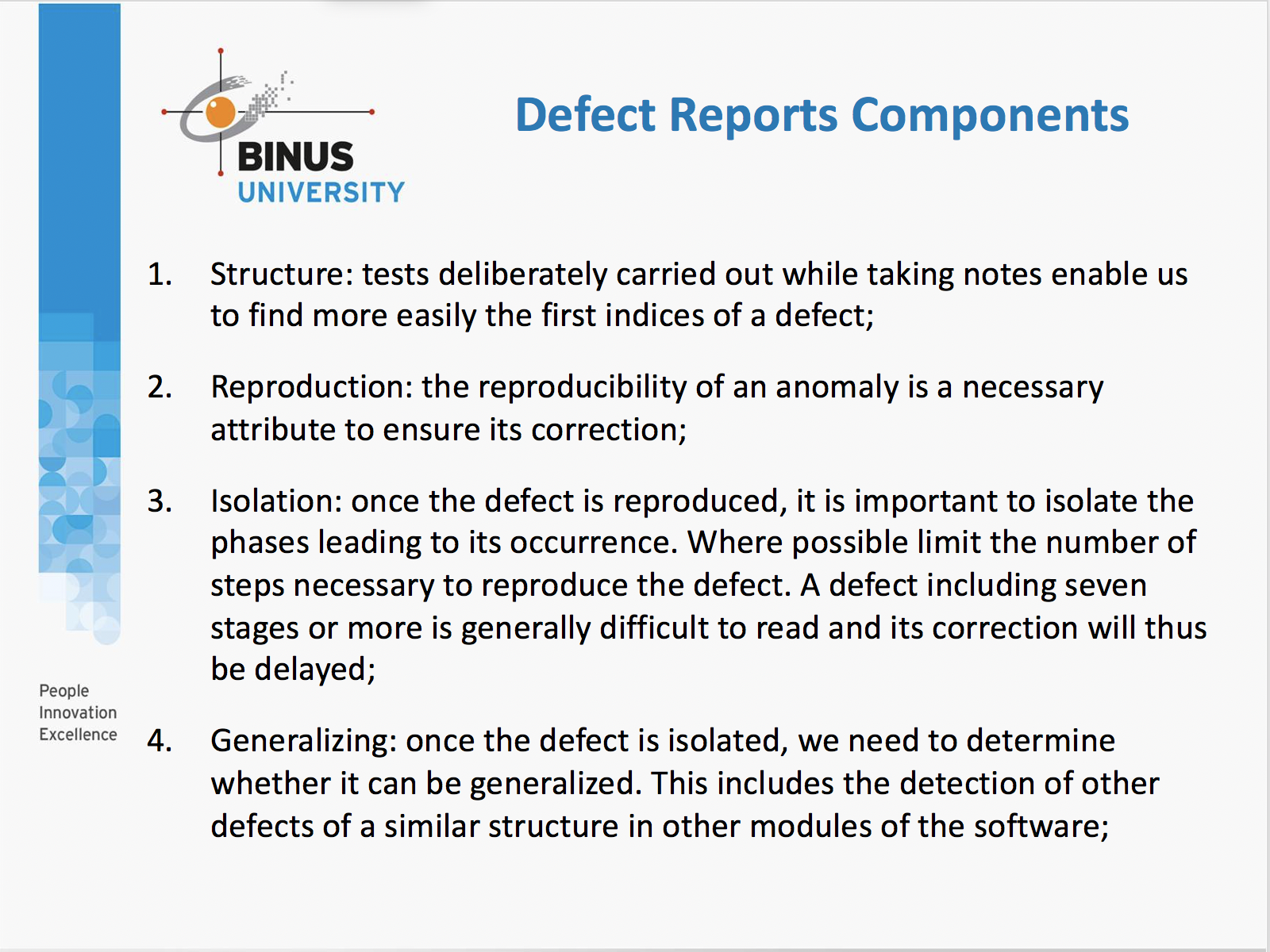
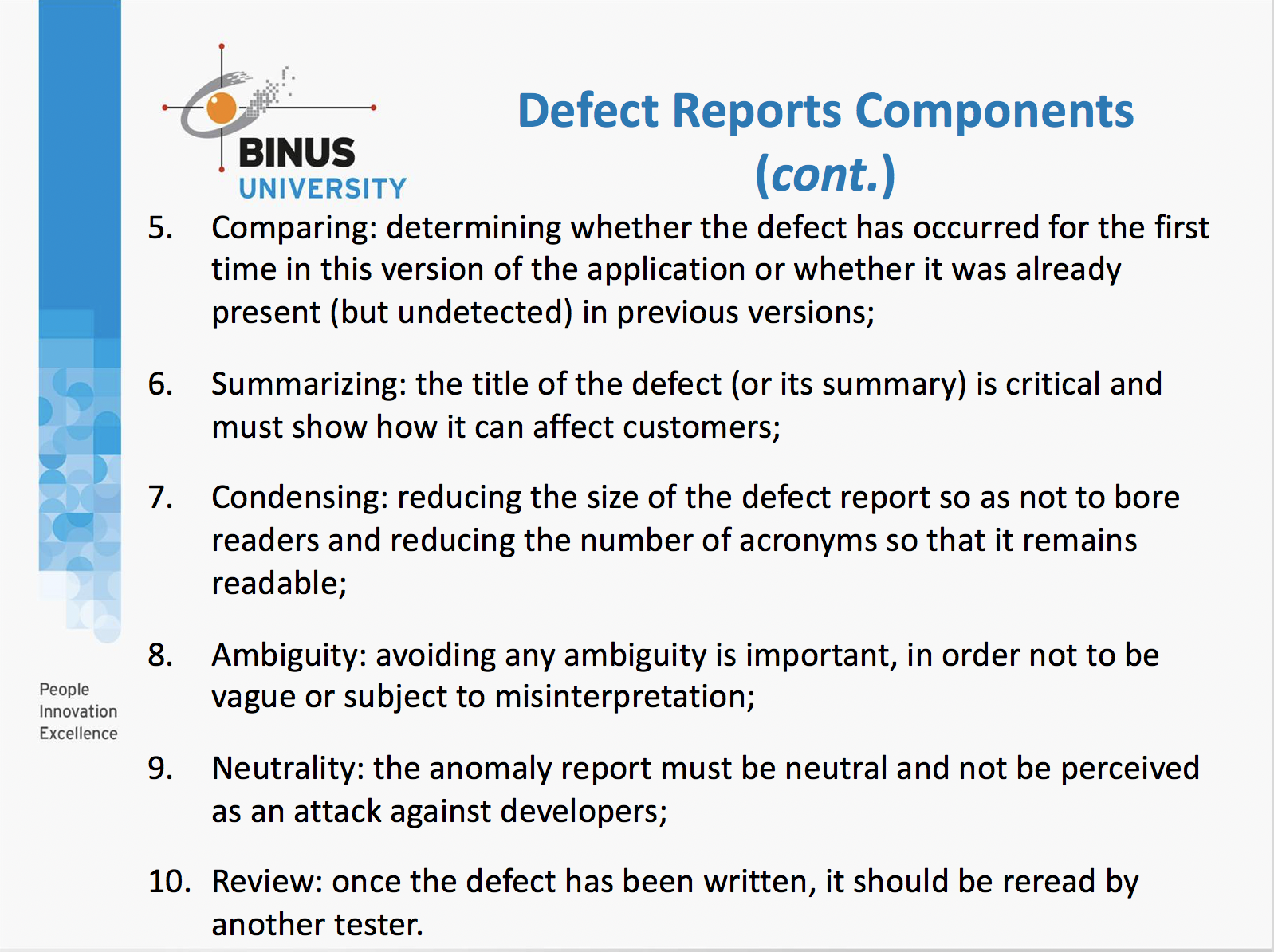
A ten-step process to be considered to prevent problems caused by bad bug reports
-
In-Class Exercise 1. Making a bug report
- Write a good bug report
Informações
- Descrição
- Slides sobre Sem título, criado por Ainun Jariyah em 01-11-2018.
- Criado por
- Ainun Jariyah · nov 2018
- Atualizado
- 1 nov 2018
- Visualizações
- 0
- Avaliação