
Flashcards
BABOK v3.0 Chapter 1
Flashcards do conjunto (40)
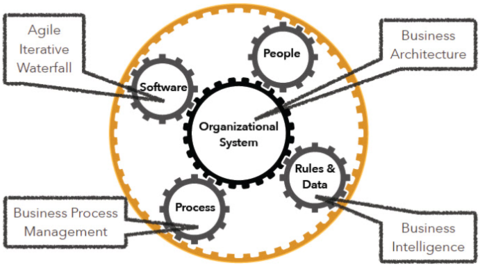
- 1What are Perspectives?Disciplines within the profession of business analysis
- 2Name 5 Perspectives_Information technology (IT)
_Business process management
_Business intelligence
_Business architecture
_Agile - 3Underlying CompetenciesProvide a description of the behaviours, characteristics, knowledge, and personal qualities that support the practice of business analysis
- 4TechniquesMeans through which to perform business analysis Tasks
- 5Knowledge Areas areAreas of specific business analysis expertise that encompass certain tasks which must be executed in proper coordination in order to produce greater value to the change.
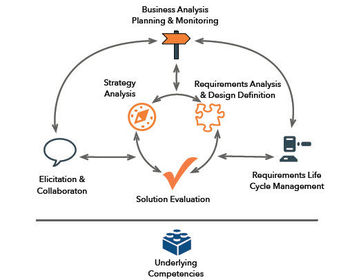
- 6Name the 6 Knowledge Areas1. Business Analysis Planning and Monitoring
2. Elicitation and Collaboration
3. Requirements Life Cycle Management
4. Strategy Analysis
5. Requirements Analysis and Design Definition
6. Solution Evaluation - 7Draw a diagram of the relationship between Knowledge Areas
- 8Define TASKAn essential piece of work that is performed as part of business analysis. Business analysts are likely to perform Tasks from all Knowledge Areas in rapid succession, iteratively, or simultaneously.
- 98 Part Structure of a Task1. Purpose
2. Description
3. Inputs
4. Elements
5. Guidelines/Tools
6. Techniques
7. Stakeholders
8. Outputs - 10Task PurposeReason for and value created through performing the task
- 11Task DescriptionExplains in great detail why the task was performed, what the task is, what it should accomplish
- 12Task Inputs1. Information necessary for a task to begin
2. Information that is consumed or transformed to produce an output
3. Needs to be sufficiently complete to allow successive work to begin - 13Task ElementsDescribe key concepts that are needed to understand how to perform the task. Elements are not mandatory as part of performing a task.
- 14Task Guidelines & ToolsGuideline: provides instructions or descriptions on why or how to undertake a task.
Tool: something used to undertake a task.
Both are resources used to turn the input into an output. - 15Task TechniquesMeans to perform business analysis tasks.
- 16Task StakeholdersEach task includes a listing of generic stakeholders who are likely to participate in performing that task or who will be affected by it
- 17Task OutputResult produced by performing the task. Outputs are created, transformed or changed in state as a result of a successful completion of a task.
- 18What is a Deliverable?A product of a development process.
- 19Form of Outputs depend on these 3+1. The type of initiative underway
2. Standards adopted by the organization
3. Best judgment of the BA as to an appropriate way to address the information needs of key stakeholders - 20Task Underlying Competencies1. Knowledge
2. Skills
3. Behaviours
4. Characteristics
5. Personal qualities
That help one successfully perform the role of the BA - 21Structure of Underlying Competencies1. Purpose
2. Definition
3. Effectiveness Measures - 22Task: Underlying Competencies: PurposeThe purpose of an Underlying Competency describes why it is beneficial for business analysts to have this competency.
- 23Task: Underlying Competencies: DefinitionThe definition of an Underlying Competency describes the skills and expertise involved in the application of this competency.
- 24Task: Underlying Competencies: Effectiveness MeasuresThe effectiveness measures of an Underlying Competency describe how to effectively measure whether a person is demonstrating skills in this Underlying Competency.
- 25Task TechniquesProvide additional information on ways that a Task may be performed.
- 26Structure of Techniques1. Purpose
2. Description
3. Elements
4. Usage Considerations - 27Task: Techniques: PurposeDescribes what the Technique is used for and the circumstances under which it is most likely to be applicable
- 28Task: Techniques: DescriptionDescribes what the Technique is and how it is used
- 29Task: Techniques: ElementsDescribe key concepts that are needed to understand how to use the Technique
- 30Task: Techniques: Usage ConsiderationsDescribe conditions under which the Technique may be more or less effective
- 31Draw the BA Perspectives Diagram
- 32Structure of Perspectives1. Change Scope
2. Business Analysis Scope
3. Impact on Knowledge Areas
4. Methodologies and Techniques
5. Underlying Competencies - 33Perspectives: Change ScopeDescribes what parts of the enterprise the change likely encompasses in this perspective and to what extent it impacts the high-level objectives and day-to-day operations of the enterprise.
- 34Perspectives: Business Analysis Scope1. Describes the key stakeholders in the Perspective, including a profile of the likely types of sponsors, the target stakeholders, and the business analyst's role within an initiative.
2. Defines likely outcomes that would be expected from BA work in this perspective. - 35Perspectives: Structure: Methodologies & TechniquesUnique to each Perspective. Describes the approaches, methodologies, or techniques, and (depending on perspective) references models that are common and specific to the application of business analysis in this Perspective.
- 36Perspectives: Structure: Underlying CompetenciesDescribe the competencies that are most prevalent in the discipline of the Perspective
- 37Perspectives: Structure: Impact on Knowledge AreasExplains how specific business analysis practices within a perspective are mapped to practices as defined by the BABOK. Using perspective-specific terminology where appropriate, this section describes how the Knowledge Areas are applied or modified.
- 38Define KA: Business Analysis Planning & MonitoringA layout of the steps for the Business Analysis effort, the approach & actions, organization and coordination of BA efforts.
- 39KA: Elicitation & CollaborationCollect BAI through engaging stakeholders for their needs/requirements (process of elicitation) and then cross referencing and aligning stakeholders of that BAI (process of collaboration) to assure the requirements are cohesively pointing toward a complimentary solution and that the requirements are further developed (discovered) validated.
- 40KA: Requirements Life Cycle ManagementEnsure that the requirements, designs, and other business analysis information appropriately, effectively, and accurately represent a common understanding of the stakeholders' needs. This is done through constant verification of requirements and development as new BAI is discovered.
Informações
- Descrição
- FlashCards sobre BABOK v3.0 Chapter 1, criado por Simran Batala em 04-07-2014.
- Criado por
- Simran Batala
- Visualizações
- 1.426
- Tags
- Avaliação