
Flashcards
CBAP BABOK v3.0 Ch2
Flashcards do conjunto (21)
- 1Six Core Concepts, BACCMChange, Context, Stakeholders, Solution, Value, Need
- 2BACCM: ChangeControlled, deliberate transformation of the enterprise.
- 3BACCM: ContextThe circumstances that form the setting for the change. The environment of the change inclusive of things like beliefs, attitudes, infrastructure, sales, profits, technology.
- 4BACCM: SolutionA specific way of satisfying one or more needs in a context.
1. Solves a problem for stakeholder
2. Allows stakeholder to take advantage of an opportunity
3. Enforces a requested constraint
4. Permits an activity by removing a constraint or within a created constraint - 5BACCM: StakeholdersA group or individual with a relationship to the change or solution.
Have some form of interest or influence over the change. Grouped according to their relationship to the need, change and solution. - 6BACCM: Value1. The worth or usefulness of something to a stakeholder within a context (value can be relative).
2. Potential or realized gains, returns, profits or the reverse, losses, risks, costs.
3. Tangible, as in monetary value, or intangible, as in employee morale or customer sat. - 7BACCM: Need1. A problem, opportunity, or constraint with potential value to a stakeholder.
2. Needs can cause change by motivating stakeholders to act.
3. Needs can also be caused by changes which erode or enhance the value delivered by solutions. - 8BACCM Questions1. What is the kind of change we're doing?
2. What are the needs we're trying to satisfy?
3. What are the solutions we're creating or changing?
4. Who are the stakeholders involved?
5. What do stakeholders consider to be of value?
6. What is the context that we and the solution are in? - 9Key Terms: Business Analysis InformationAny and all input output data. Includes:
1. Elicitation Results
2. Requirements
3. Designs
4. Solutions
5. Scope
6. Strategy Information - 10Key Terms: DesignUsable representations that focus on both the solution and understanding how value might be realized by a solution if it is built. Designs, like requirements, do not realize value themselves.
- 11Key Terms: EnterpriseOrganizations and the solutions they use to pursue a set of common goals. People, Tools and Processes, plus vendors and external suppliers of an organization that are part of the change. Small initiatives with only a few people working on the solution is still considered an enterprise.
- 12Key Terms: OrganizationAutonomous group of people under the management of a single individual, group, or board, with a clearly defined boundary, that works towards common goals and objectives
- 13Key Terms: PlansDetailed proposal for doing or achieving something.
1. Set of events
2. Dependencies among events
3. Expected sequence
4. Schedule
5. Results or outcomes
6. Materials and resources needed
7. Stakeholders involved - 14Key Terms: RequirementUsable representations that focus on needs and understanding what kind of value could be delivered if a solution is built.
Usable Representation Forms:
Documents, Simulations, wire-frames, mock-ups, prototypes, diagrams, storyboards, and recordings can all be requirements. - 15Key Terms: RiskUncertain event or decision that can can cause a stakeholder to experience a loss.
Failure to mitigate risks could affect the value of the solution. - 16Q: How do you control risk?Controlling risk can involve reducing the chances of it occurring or reducing the consequences of the event if it occurs.
- 17Q: Why should you mitigate risk?Failure to mitigate risks could affect the value of the solution.
- 18Requirements Classifications Scheme1. Business
2. Stakeholder
3. Solution
4. Transition - 19List of Stakeholders1. BA
2. Change Control Board
3. Customer
4. Domain (SME) Subject Matter Expert
5. End User
6. Implementation SME
5. Operational Support
6. Project Manager
7. Project Manager
8. Regulator
9. Sponsor
10. Supplier
11. Tester - 20The BA uses activities found in what techniques to transform a request/need into a requirement or design?Strategy Analysis, Elicitation, Requirements Analysis and Design Definition, and Solution Evaluation
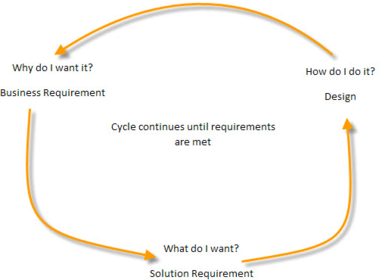
- 21Draw Requirements and Design Cycle
Informações
- Descrição
- FlashCards sobre CBAP BABOK v3.0 Ch2, criado por Simran Batala em 04-07-2014.
- Criado por
- Simran Batala
- Visualizações
- 241
- Avaliação