Flashcards
Fundamentals of the Nervous System
Flashcards do conjunto (39)
- 1NERVOUS SYSTEM: master ________ and _____________ system?Control, communication
- 2NERVOUS SYSTEM: 3 overlapping functions?1. Sensory Input
2. Integration
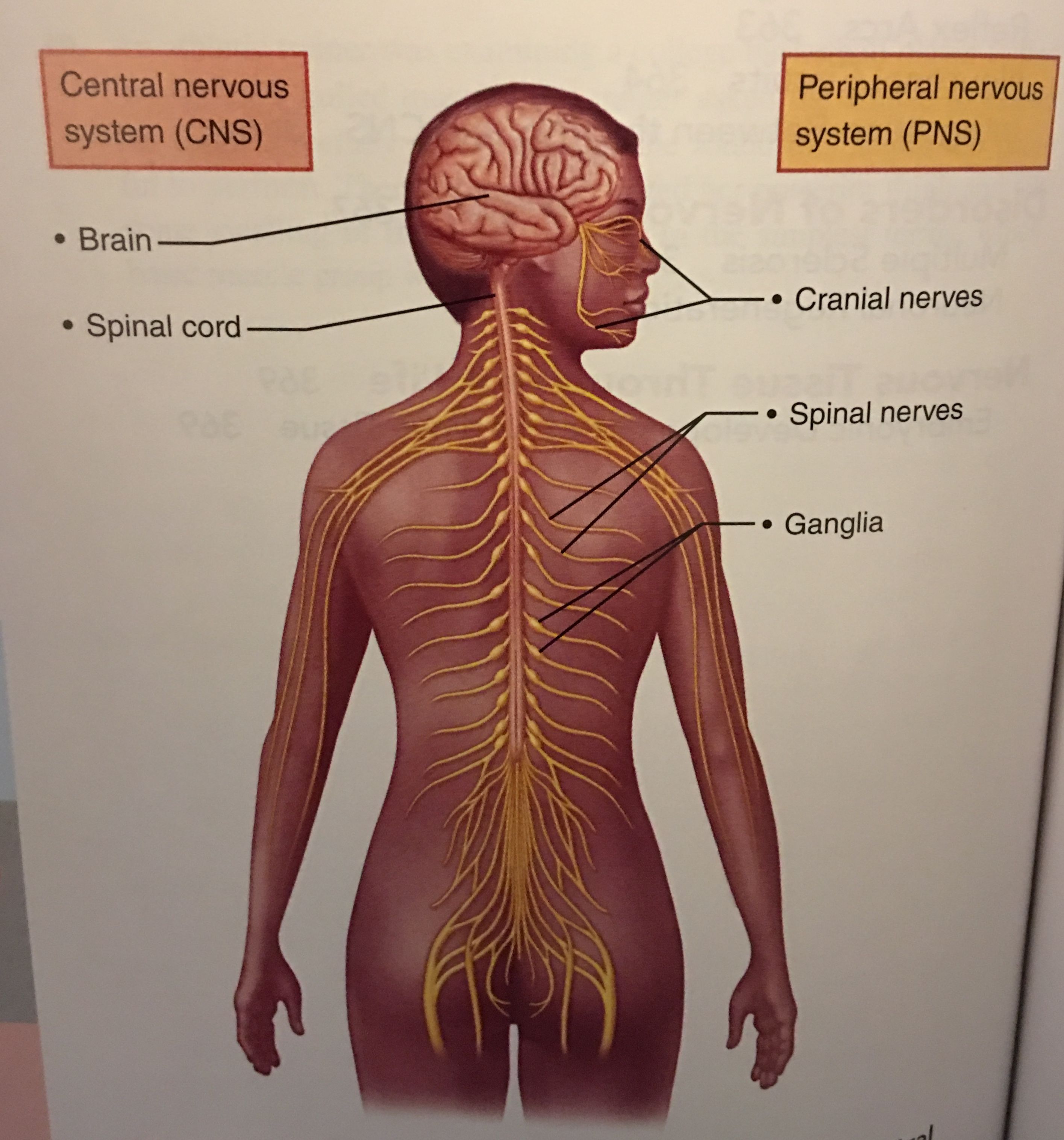
3. Motor output - 32 divisions of of the nervous system?1. CNS
2. PNS - 4CNS: what does it include? _________ and _________ center? Where are most cell bodies found?- brain and spinal cord
- integrating, command
- in the CNS - 5PNS: where is it located? Where do nerves extend from? What types of nerves are included? What is ganglia?- located outside CNS
- nerves extend from brain and spinal cord
- cranial, spinal and peripheral nerves
- GANGLIA= clusters of neuronal cell bodies (found outside cell) - 6—See picture prior.
- 7NERVOUS TISSUE: how are cell described?- densely packed and intertwined
- 8NERVOUS TISSUE: 2 main cell types? Describe them?1. neurons- transmit electrical signals (cells that conduct AP)
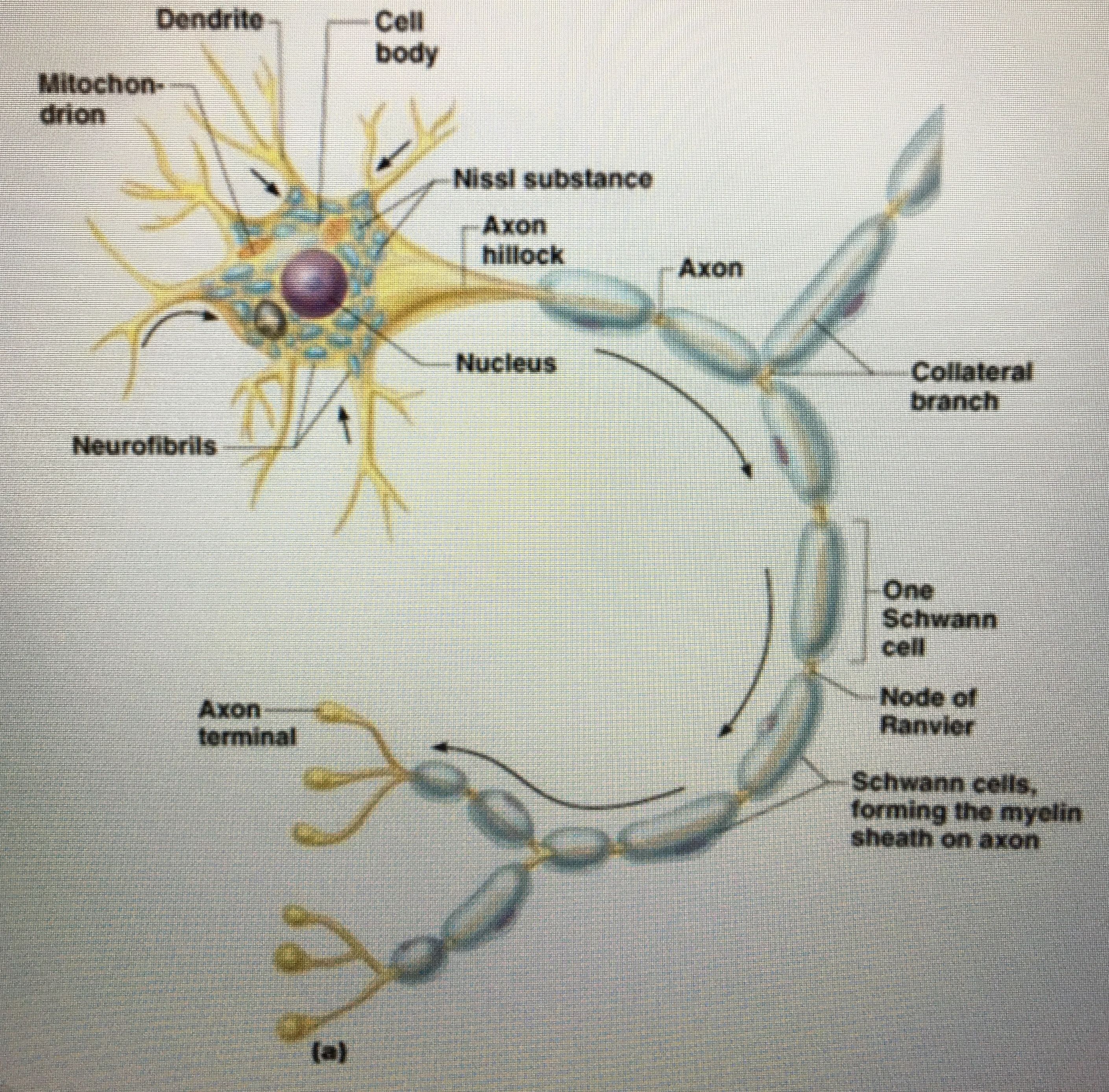
2. support cells- nonexcitable, surround and wrap neurons. - 9THE NEURON: what is it? What does it conduct and where? Action ________?- basic structural unit of the nervous system
- conducts electrical impulses along the plasma membrane
- potential - 10—See prior photo.
- 11THE NEURON: other characteristics. They have? Do not? What do fetal neurons lose? What type of metabolic rate do they have? What does that require? Neurons die after how many minutes?- have longevity (can live/function forever)
- do not divide
- fetal neurons lose ability to undergo mitosis
- high metabolic rate
- require LOTS of O2 and glucose
- after 5 mins - 12STRUCTURAL CLASSIFICATION OF NEURONS: multipolar. How many processes? How many dendrites? How many axons? What types of neurons are the majority of these?- more than two processes
- lots of dendrites
- one axon
- vast majority are neurons in CNS - 13—See prior photo.
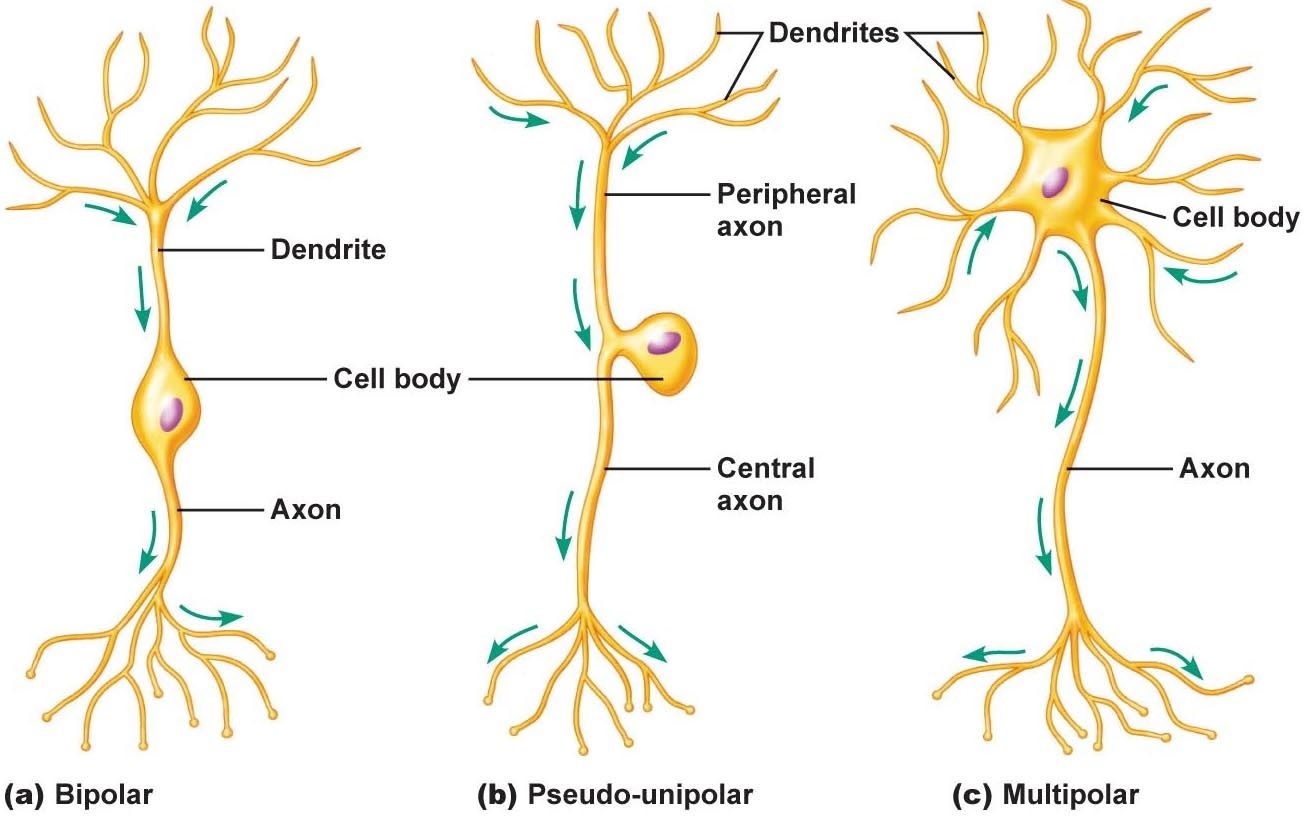
- 14STRUCTURAL CLASSIFICATION OF NEURONS: bipolar. How many processes? Is it rare or not? Found in what senses?- posses two processes
- rare
- found in eye, ear, and nose (special sensory organs) - 15—See prior photo.
- 16STRUCTURAL CLASSIFICATION OF NEURONS: unipolar. How many processes? How do they start? What senses are unipolar?- possess one, short process
- start as bipolar neurons
- all general senses - 17—See prior photo.
- 18FUNCTIONAL CLASSES OF NEURONS: interneurons. Always found where? What does it mean to say they are "integrative"? What percentage of neurons fall in this category? What type of -polar are they?- CNS
- integrative= process, store, retrieve, make decisions
- 90%
- multipolar - 19FUNCTIONAL CLASSES OF NEURONS: motor (efferent). Where do they end (terminate)? What -polar are they?- end on effector cells (either muscles or glands- skeletal, smooth, cardiac, and glands)
- multipolar - 20SUPPORTING CELLS: how many types? how many in CNS and PNS? What does it provide? What does it cover?- 6 types
- 4 in CNS (called neuroglia)
- 2 in PNS (called neuroglia)
- provide supportive function for neurons
- cover nonsynaptic regions of neurons - 21NEUROGLIA: nicknames (2)? Have _________ ____________ and a central _________ _________? What percentage of the mass of the brain?- a.k.a "glia" or "glial cells"
- branching processes, cell body
- 50% - 22SUPPORTING CELLS: NEUROGLIA IN CNS. Astrocytes. How abundant are they? What do they help with? Responsible for what?- MOST abundant
- help with glutamate uptake for synapses and ion control
- responsible for blood brain barriers - 23—See prior pic.
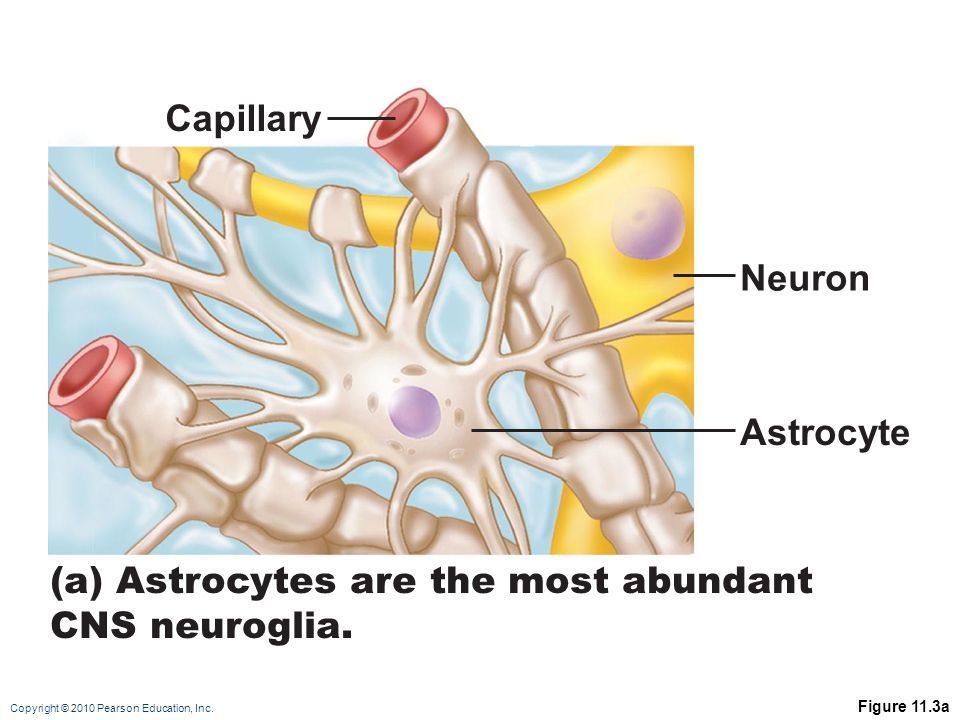
- 24SUPPORTING CELLS: NEUROGLIA IN CNS. Microglia. How abundant? What does it engulf? Removes? Cell are found? Acts as?- LEAST
- engulfs invading microorganisms
- remove dead neurons
- cells of immune system
- acts as immune system - 25—See prior pic.
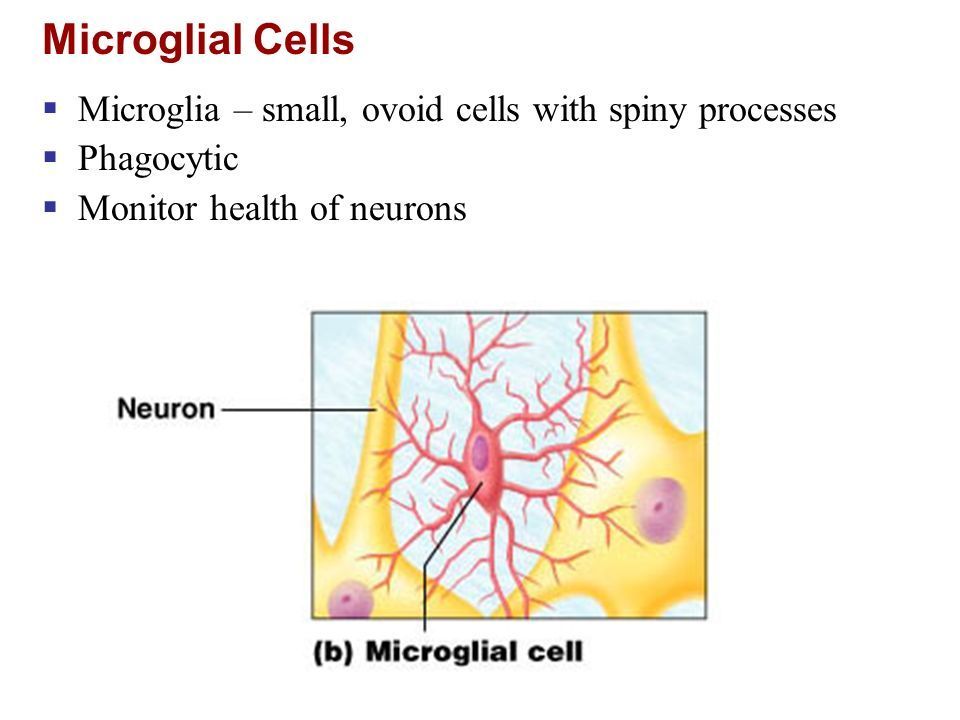
- 26SUPPORTING CELLS: NEUROGLIA IN CNS. Ependymal. Circulate what? Makes what from blood plasma? What does it line?- circulate CSF
- makes CSF
- lines CNS central cavity - 27—See prior pic.
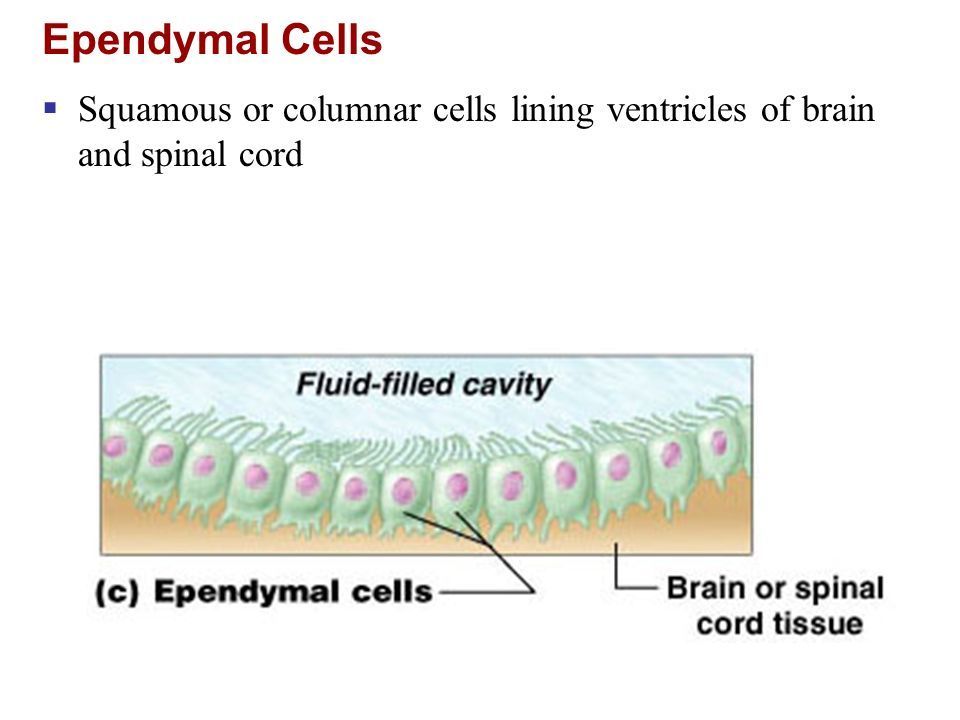
- 28SUPPORTING CELLS: NEUROGLIA IN CNS. Oligodendrocytes. Wrap around what? Produce what? How many cells to how many axons?- wrap around axons in CNS
- produce myelin sheath
- one cell to many axon - 29—See prior pic.
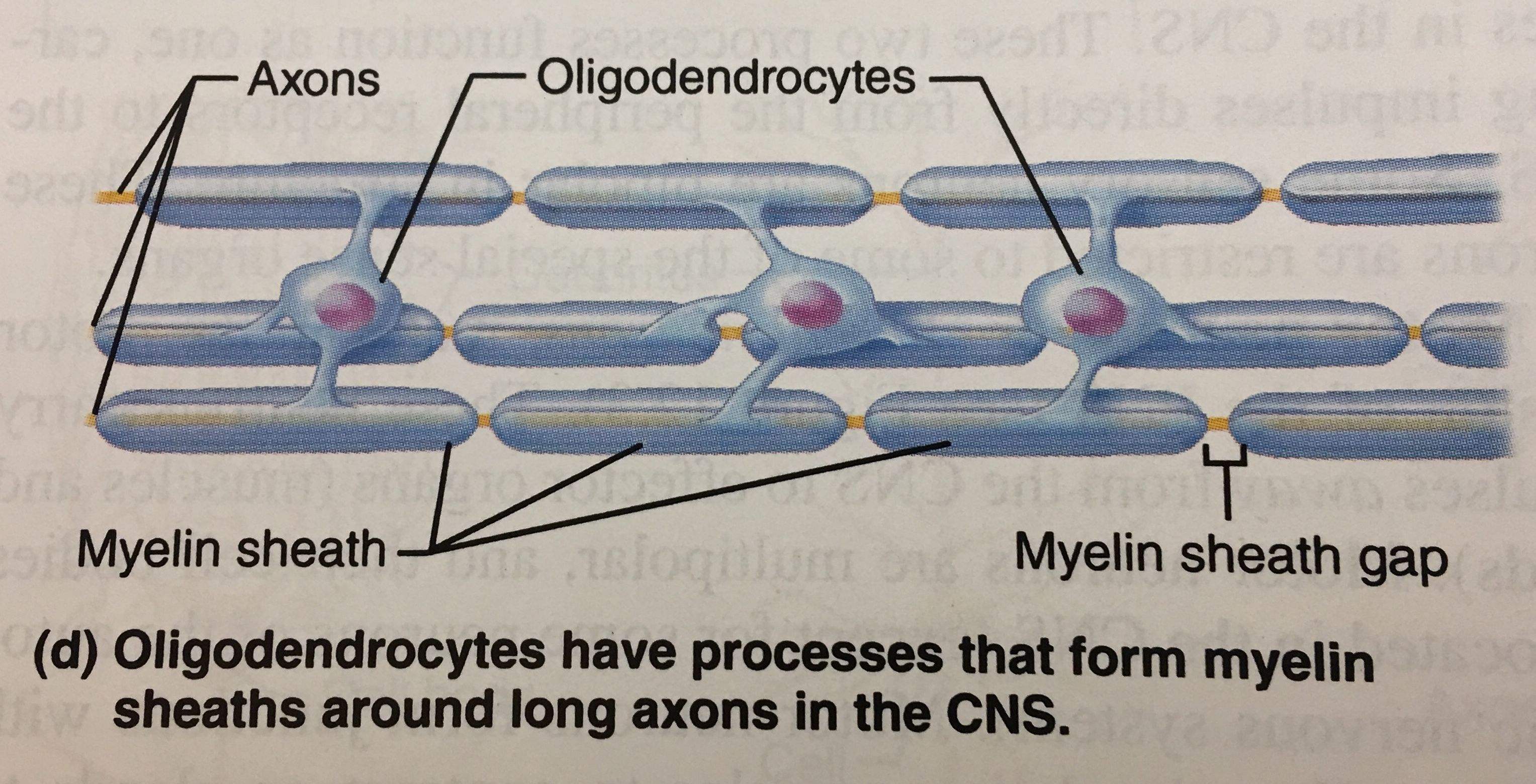
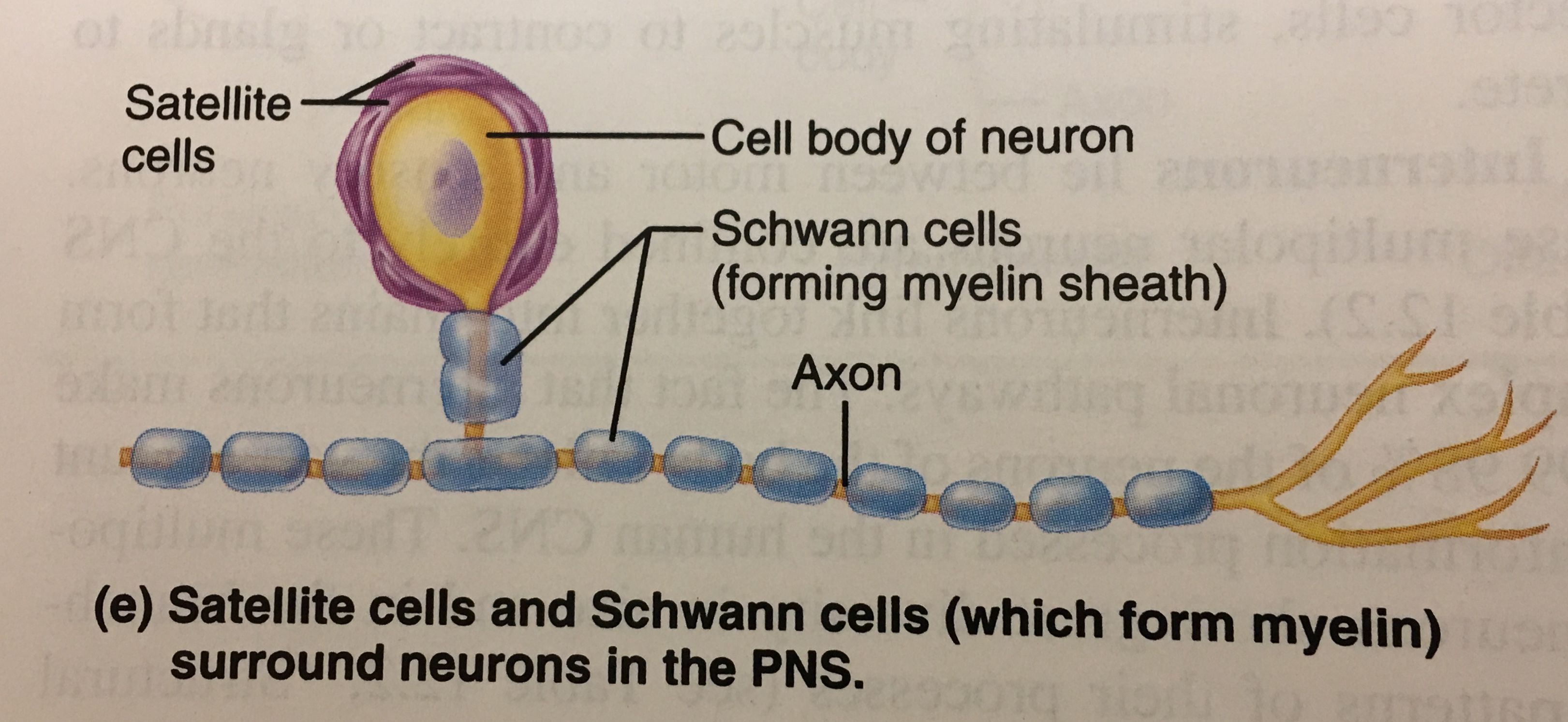
- 30SUPPORTING CELLS: NEUROGLIA IN PNS. Satellite Cells. Surround what? Thought to give cells bodies what? Thought to eliminate what? Keep cell bodies from what?- surround cell bodies in ganglia
- thought to give cell bodies nutrition
- thought to eliminate waste
- thought to keep cell bodies from fusing into one - 31SUPPORTING CELLS: NEUROGLIA IN PNS. Schwann Cells. Surround what? Form what around axons of PNS. How many axons? How many schwann cells?- surround axon in the PNS
- form myelin sheath around axons of the PNS
- one axon
- many schwann cells - 32—See prior pic.
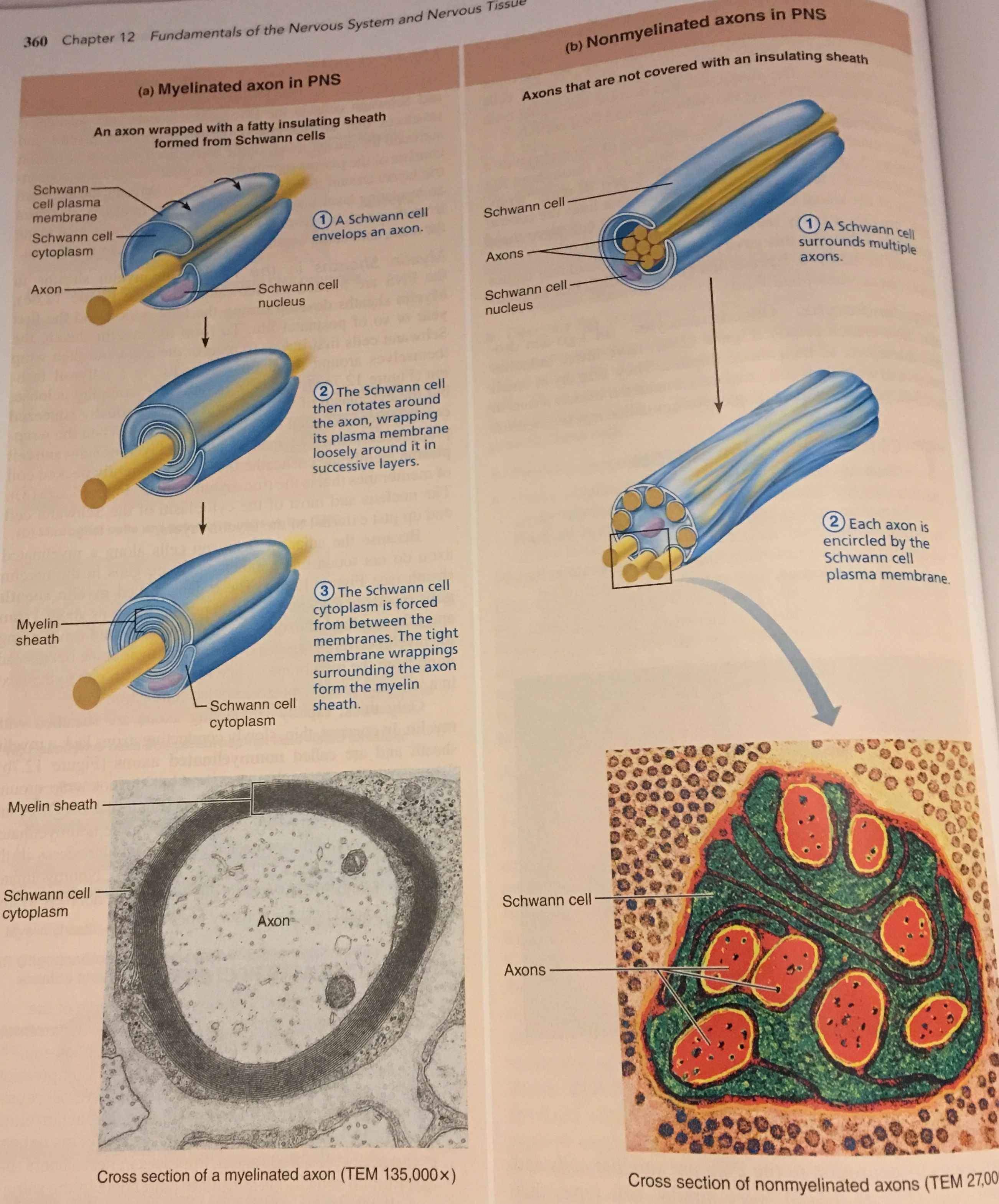
- 33MYELIN SHEATHS: what types of structures? Composed of? Surround what? Forming what? Prevents action potential from?- segmented structures
- composed of the lipoprotein myelin
- surround thicker axons
- form an insulating layer
- prevents ap from stopping - 34MYELIN SHEATH: functions. Prevents leakage of? Increases the speed of?- of electrical current
- impulse conduction - 35—See prior pic.
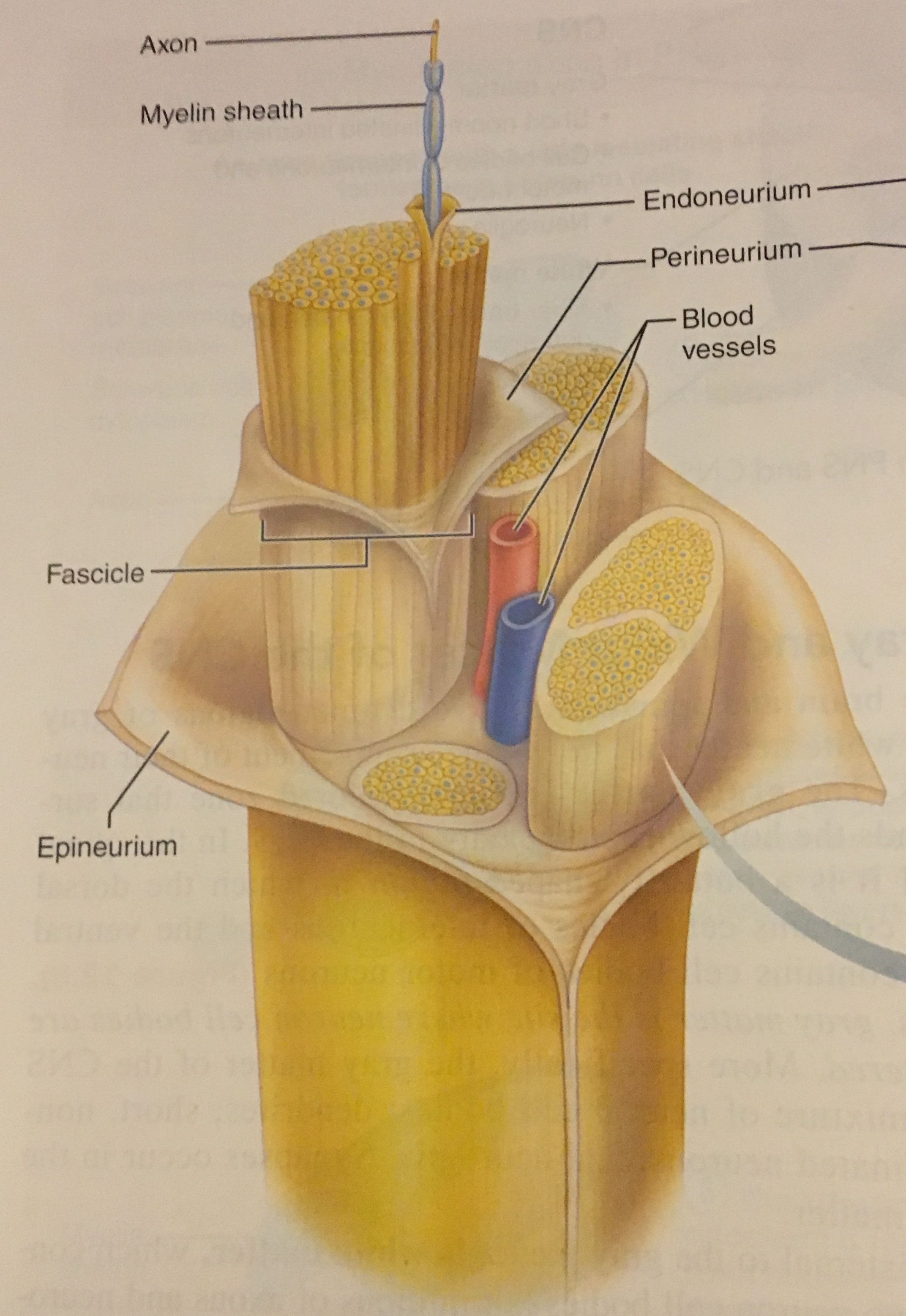
- 36NERVES OF SPINAL CORD: ________-________ organs in the PNS? How many axons? What are they wrapped in? Surrounded by what type of cells?- cable-like
- numerous axons
- wrapped in connective tissue
- surrounded by schwann cells - 37—See prior pic.
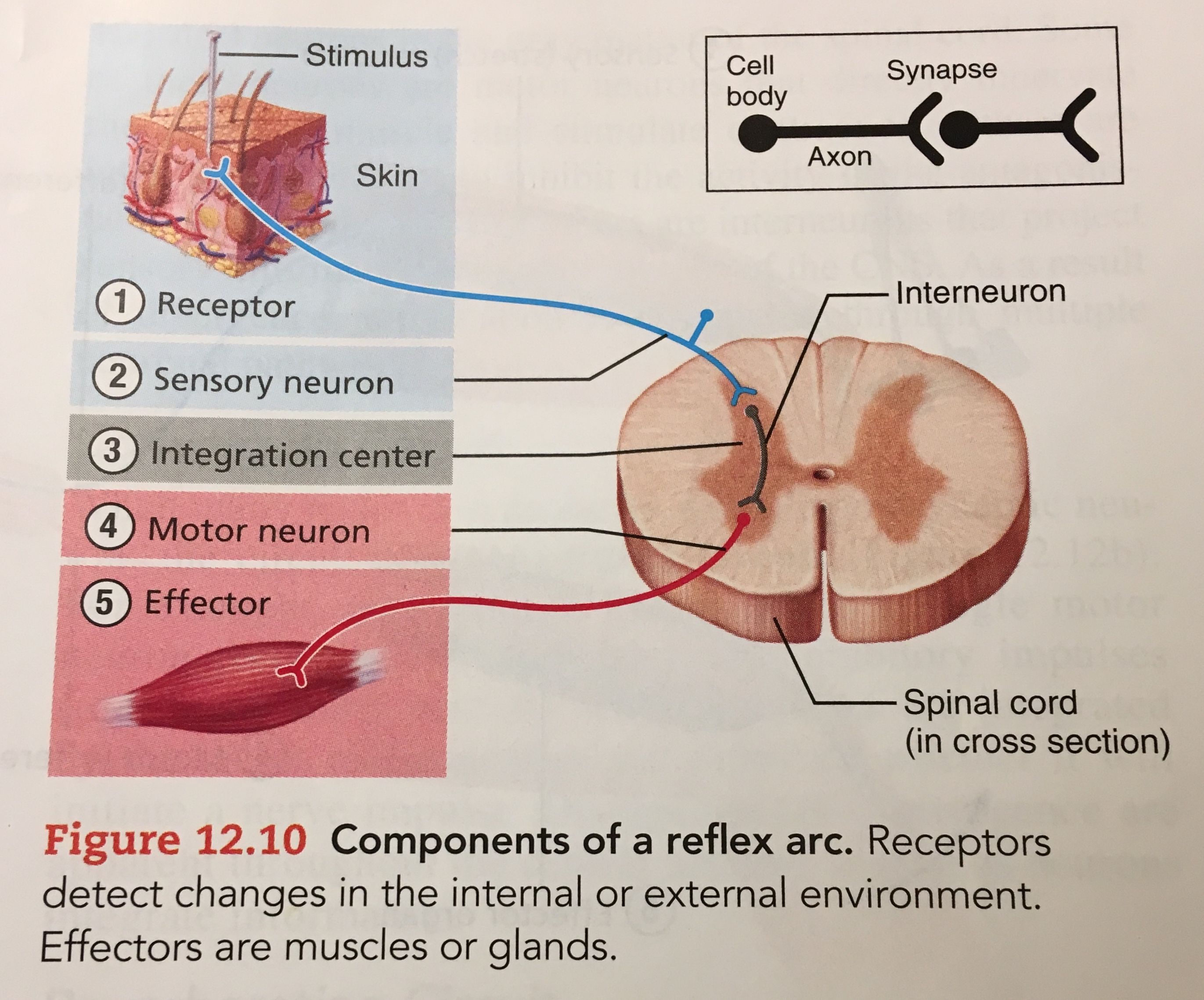
- 38REFLEX ARCS: _______ ________ of neurons? Explain reflexes? Can be what or what?- simple chains
- rapid, autonomic motor responses
- can be visceral (affects internal organs) or somatic (affects skeletal muscle) - 39—See prior pic.