
Flashcards
The Central Nervous System Pt. 1

Flashcards do conjunto (38)
- 1THE SPINAL CORD: Functions. What are the 3?1. sensory and motor innervation
2. provides 2-way conduction pathway
3. major center for reflexes - 2THE SPINAL CORD: location of the spinal cord. What does it run through? Extends from where to where?- runs through the vertebral canal (dorsal body cavity)
- extends from the foramen magnum to about L1 or L2 - 3THE SPINAL CORD: what is the conus medullaris? How is it shaped?- inferior end of the spinal cord
- like a cone - 4THE SPINAL CORD: filum terminale. What is it made of? Where does it go? Attaches to the coccyx where? Made of?- long filament of connective tissue
- goes from conus medullaris to coccyx
- attaches inferiorly
- made of pia matter (meninges) - 5THE SPINAL CORD: cervical and lumbar enlargements. What comes out?- nerve for upper and lower limbs come out
- 6THE SPINAL CORD: cauda equine. What is it collection of? Where is it located? How are they in spinal cord?- collection of spinal nerve roots
- below conus medullaris
- loose - 7THE SPINAL CORD: spinal nerves. What is it? How many pairs? Where do they lie?- nerves exiting spinal cord
- 31 pairs of nerves (8C, 12T, 5L, 5S, 1C
- lie in the intervertebral foramen - 8GROSS ANATOMY OF THE SPINAL CORD: 6 contents.1. white matter
2. gray matter
3. dorsal root ganglian
4. roots
5. central canal
6. meninges - 9PROTECTION OF THE SPINAL CORD: protected from injury by?- vertebrae (bone)
- meninges
- CSF - 10PROTECTION OF THE SPINAL CORD: meninges. Explain dura mater? Arachnoid matter? Pia matter? What type of layer is it? Extends to? Explain denticulate ligamnets?- a single layer surrounding spinal cord
- lies deep to the dura mater
- innermost layer
- delicate layer of connective tissue
- extends to coccyx
- lateral extensions of pia mater - 11PROTECTION OF THE SPINAL CORD: CSF. Fills what? Carries what between part of the CNS? Provides _________ cushion? And provides _________? Removes? What is not suppose to be in CSF?- hollow cavities of the brain & spinal cord
- carries chemical signals between parts of the CNS
- provides a liquid cushion
- provides nourishment
- removes waste
- cells - 12BASIC PARTS & ORGANIZATIONS OF BRAIN: divided into how many regions? What are those regions?- 4 regions
1. brain stem
2. cerebellum
3. diencephalon
4. cerebrum - 13VENTRICLES OF THE BRAIN: exapansion of? Filled with what and lined with? What are they continuous with?- expansions of the brain's central cavity
- filled with CSF and lines by ependymal cells
- continuous with one another and with central canal of SC - 14VENTRICLES OF THE BRAIN: lateral ventricles. Located where? What shape?- located in cerebral hemisphere
- horseshoe-shaped - 15VENTRICLES OF THE BRAIN: third ventricles. Lies where? Connected with? What does cerebral aqueduct connect?- lies in diencephalon
- connected with lateral ventricles by interventricular foramen
- cerebral aqueduct= connects 3rd and 4th ventricles - 16VENTRICLES OF THE BRAIN: forth ventricle. Lies where? Connects what of the spinal cord?- lies in hindbrain
- connects to the central canal of the spinal cord - 17—See prior pic.
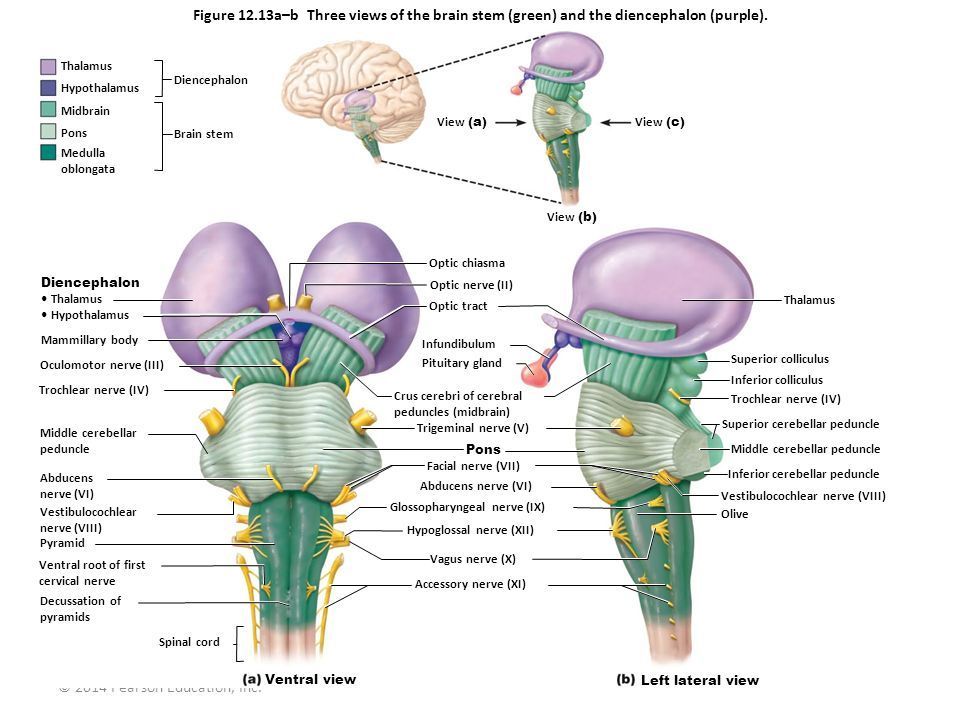
- 18THE BRAIN STEM: what part of the brain is it? What does caudal mean? What are the three major regions?- most caudal part of brain
- caudal= tail-like
1. medulla oblongata
2. pons
3. midbrain - 19THE BRAIN STEM: functions. Passageway for fiber tracts between? Innervation of? Produces what? Integrates?- passageway of fiber tracts between cerebrum and SC
- innervation of face and head (10 out of 12 CN)
- produces automatic behaviors for survival
- integrates auditory and visual reflexes - 20THE BRAIN STEM: Medulla Oblongata. Continuous with what at where? What CN? Describe pyramids? Points of decussation?- continuous with spinal cord at foramen magnum
- CN IX, X, XI, XII
- pyramids= ridges on ventral side of medulla
- points of decussation= cross over to opposite side of body - 21Medulla Oblongata: functions. What are the three things it regulates?1. heart beat and rate (cardiac center)
2. blood pressure (vasomotor center)
3. rhythm and rate of breathing (respiratory center) - 22THE BRAIN STEM: Pons. A "bridge" between what? How is it separated? From where? What CN?- between the midbrain and medulla oblongata
- dorsally separated from cerebellum by 4th ventricle
- CN V. VI, VII, VIII - 23THE PONS: Functions. What does it control inputs for? What does it regulate? (there are 8)- respiration and bladder control inputs
1. hearing 2. facial sensations
3. taste 4. saliva 5. tears
6. facial expression 7. equilibrium
8. eye movement - 24THE BRAIN STEM: Midbrain. Where does it lie?- between the diencephalon and the pons
- 25THE BRAIN STEM: Midbrain- Cerebral Aqueduct. What cavity is it? What is another name for "roof"? What type of attachment?- central cavity
- "roof"= tectum
- cerebral attachment (peduncles) - 26THE BRAIN STEM: Midbrain- Periaqueductal Gray Matter. Surrounds what? What type of reaction does it produce? Mediates what?- surrounds the cerebral aqueduct
- flight-or-fight reaction
- mediates response to visceral pain - 27THE BRAIN STEM: Midbrain- Substantia Nigra. Works with? Sends what? Controls what? Sickness and 1 s/s?- works with basal nuclei of the cerebrum
- sends inhibitory signals
- controls unwanted muscle movement
- Parkinson's Disease and resting tremors - 28THE BRAIN STEM: Midbrain- Red Nucleus. What type of function? What type of movements of limbs?- minor motor function
- flexion movement of limbs - 29THE BRAIN STEM: Midbrain- Corpora Quadrigemina. Explain superior colliculi? Explain inferior colliculi?- superior= visual reflexes
- inferior= auditory reflexes - 30—See prior pic.
- 31THE CEREBELLUM: functions. What does it do for body movements? Helps with? Receives?- smoothes and coordinates body movements
- helps with posture & equilibrium
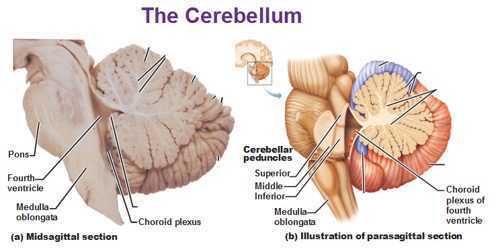
- receives input from other regions of the brain - 32THE CEREBELLUM: structure. There are 7 parts.1. anterior lobe 2. posterior lobe
3. f.n. lobe 4. folia
5. fissures 6. arbor vitae
7. vermis - 33—See prior pic.
- 34THE DIENCEPHALON: Thalamus. Makes up how much of the Diencephalon? What type of area? Acts as? Surrounds what?- 80%
- sensory routing area
- act as a relay station for incoming sensory message
- surrounds 3rd ventricle - 35THE DIENCEPHALON: Hypothalamus. Where is it located?- inferior portion of diencephalon
- 36THE DIENCEPHALON: Hypothalamus. Controls what? What type of regulation? Intake of what? What type of rhythms? What type of secretions? What type of responses? What type of behavior? What type of formation?- control of the ANS
- thermoregulation
- food and water intake
- sleep and circadian rhythms
- hormone secretion
- emotional responses
- motivational behavoir
- memory formation - 37THE DIENCEPHALON: Epithalamus. What part of diencephalon? Forms what? Pineal gland secretes what?- most dorsal part of diencephalon
- forms part of roof of 3rd ventricle
- secreates meatonin - 38—See prior pic.