
Flashcards
Transpiration
Flashcards do conjunto (17)
- 1What is transpiration?Transpiration is the process of water movement through a plant and its evaporation from aerial parts, such as leaves, stems and flowers
- 2What factors affect transpiration?Light intensity
Temperature
Humidity
Wind - 3How does light intensity affect the rate of transpiration?Stomata open when it gets light = increased rate of transpiration
- 4How does temperature affect the rate of transpiration?Water molecules have more kinetic energy to evaporate from the cells
This increases the water vapour potential gradient between the inside and outside, making diffusion faster - 5How does humidity affect the rate of transpiration?Low humidity = fast transpiration
The water vapour potential gradient increases, therefore transpiration rate increases - 6How does wind affect the rate of transpiration?Air movement blows away H₂O molecules from around the stomata
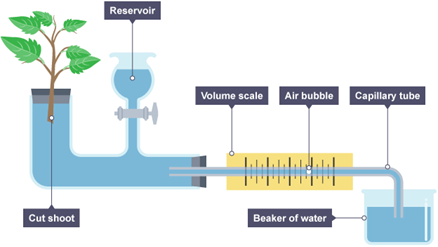
This increases the water vapour potential gradient - 7What instrument is used to measure the rate of transpiration?Potometer
- 8When using a potometer, what assumption is made?It is assumed that water uptake is directly related to water loss by the leaves
- 9Outline the method used to measure water uptake using a potometer1. Cut a shoot underwater and at a slant
2. Insert the shoot to the potometer under water
3. Dry the leaves, allowing time for the shoot to acclimatise
4. Record the starting position of the air bubble
5. Start a stopwatch and record the distance moved by the bubble per unit time
6. Change only one variable at a time (e.g. temperature) - 10Why is the shoot cut underwater?To prevent air from entering the xylem
- 11Why is the shoot cut at a slant?To increase surface area for water uptake
- 12What are xerophytic plants?Xerophytes grow in dry climates
- 13Give two examples of xerophytic plantsCacti
Marram grass - 14What are the adaptations of cacti to dry climates?Thick waxy layer on epidermis (waterproof)
Spines instead of leaves (reduces surface area)
Close stomata at the hottest times of the day - 15What are the adaptations of marram grass to dry climates?Stomata sunk in pits, sheltered from wind
Hairs on epidermis (traps moist air around stomata)
Rolled leaves (traps moist air and reduces surface area)
Thick waxy layer on epidermis (waterproof) - 16What are hydrophytic plants?Hydrophytes live in aquatic habitats with adaptations to help with low oxygen levels
- 17What are the adaptations of hydrophytes?Air spaces in tissues (help plants float and can act as an oxygen store)
Waterlilies float to increase amount of light
Stomata present o the upper surface of floating leaves (helps maximise gas exchange)
Flexible leaves and stems (prevent damage by water currents)
Informações
- Descrição
- O usuário eliminou as informações de disciplina FlashCards sobre Transpiration, criado por Usuário eliminado em 05-03-2018.
- Criado por
- Usuário eliminado
- Visualizações
- 23
- Histórico
-
- Criado por Yinka F · 2 fev 2018
- Copiado por Yinka F · 5 mar 2018
- Avaliação