
Flashcards
Components and function of the cytoskeleton
Flashcards do conjunto (18)
- 1Cytoskeleton overviewComponents:
- Actin filaments aka microfilaments
-Microtubules
-Intermediate filaments
Function:
'the dynamic muscles and bones of the cell': Gives cell structure, provides mechanical force for movement and changing shape, internal force for organelle movement, provides mechanical force for cell division - 2Actin filaments aka microfilamentsStructure:
- 7nm in diameter
- Twisted chains of identical globular actin
-Strong yet flexible
-Has structural polarity- a barbed end and a pointed end
- Treadmilling- ATP binds faster to barbed end, leading to a net growth on barbed end and a net loss on pointed end. - 3Actin filaments aka microfilaments cont Nucleation of microfilamentsNucleation: the process by which new actin filaments are formed.
- 3 actin monomers must associate, which is difficult as the rate of disassociation is high, making it a genetically unfavourable process. However, once the trimers have formed, the rate of disassociation decreases, and the molecule becomes more stable.
- ATP hydrolysis acts as a timer for actin filament assembly/disassembly- ATP bound to the filament is hydrolysed into ADP- decreasing stability - 4Different structures formed by actin filaments in cells- Lamellipodia- branched actin forms the protrusion for cell migration
- Filopodia- projections that protrude beyond the lamellipodia in parallel bundles for cell migration
- Stress fibres- link with myosin II to form anti-parallel bundles that maintain cell structure
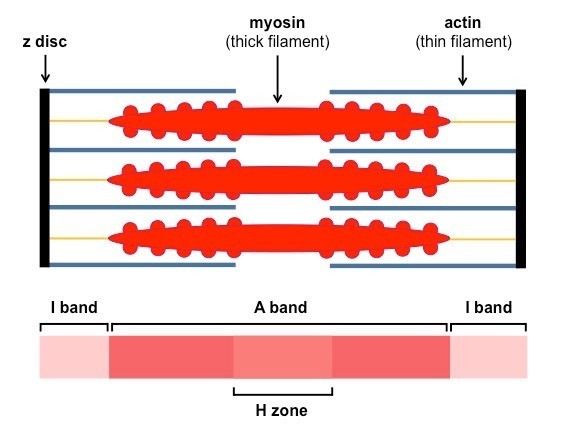
- Skeletal muscle cells- actin and myosin filaments work together - 5Actin polymerisation- regulated by actin binding proteins- Actin monomer binding proteins
- Actin nucleators
- Actin filament elongation factors
- Actin filament capping proteins
- Actin filament severing proteins
- Actin filament cross-linking proteins - 6Cell migration- Lamellipodium are positioned on the the surface of the cell membrane, with the barbed end facing the plasma membrane
- The actin filaments of the lamellipoduim then extend at the barbed end, pushing cell forward, allowing it to migrate
- The retraction of the cell at the rear is then mediated by myosin. - 7Actin in human movement- Myosin II is bound to actin in skeletal muscle cells
-Myosin II contains 2 heavy and 2 light chains, filaments are wound together to form thick filaments with myosin heads
- Sacrcomere consists of thick and thin filaments
- During muscle contraction, myosin II walk towards disks, in direction of the barbed ends - 8Microtubules: Structure- Composed of dimers of a- and b- tubulin, bound to GTP or GDP
- Form hollow tubes composed of 13 parallel protofilaments
- All tubulin dimers face in the same direction
- - Largest 25mn in diameter - 9Microtubules: assembly- Ennuculate from microtubule organising centres (MTOCS, which are made of y-tubulin rings)
- Microtubules positive end grow towards the cell periphery from the centrosome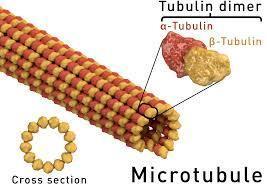
- 10Microtubules: dynamic instability- Microtubules polymerise and catastrophise quickly
- This instability is driven by GTP hydrolysis- microtubules bound with GDP are unstable
- "GTP cap" keeps microtubules stable
- The function of dynamic instability is to allow microtubules to explore the whole of the cytoplasm - 11Microtubules: function- Seperation of the chromosomes during mitosis
- Form network in cytoplasm for the movement and functioning of organelles
- Provide structure and motility to the cilla and flagella
- Covers cytoplasm tracks for movement of organelles - 12Microtubules: regulation- Microtubules are regulated by microtubule associated proteins, which bind to the side of microtubules.
- 13Microtubule stabilisation: cancer drugs that act on microtubules- Some cancer drugs stabilise microtubes, interfereing with dynamic instability
EG:
- Vinblaste: binds between tubulin dimers
- Taxol: binds B tubulin
- Colchine & nocodazole: bid to tubulin dimers, inhibiting assembly - 14Microtubules: microtubule motor proteinsMicrotubule motor proteins move cargo around the cell- rely on ATP hydrolysis
- Kinesins- move cargo to + end
- Dynesins- move cargo to - end
They are made of 2 globular heads and a tail. - 15Intermediate filaments: structure- Rope-like/ flexible
- Good tensile strength
- 10nm diameter
- Anchor to adjacent cells
- Connected to the extracellular matrix by hemidesosomes
- NOT polarised
- Coiled from monomers into dimers, then into tetrameters. Then 8 tetrameters join together to form the rope-like structure of the intermediate filament - 16Intermediate filaments: function- Strengthen cells against mechanical stress by...
- Preventing excessive stretching of cells/ epithelial tissues
- Reinforcing axons of nerve cells
- forming mesh inside nuclear lamina in nucleus - 17Intermediate filaments: types- Keratins in epithelia
- Vimentin in connective tissue, muscle cells and glial cells
- Neurofilaments in nerve cells
- Nuclear lamins in all animal cells - 18Issues with intermediate filaments resulting in disease- Keratins- blistering skin, brittle hair/nails
- Neurofilaments- neuropathies
- Nuclear lamins- cardiomyopathy
- Nuscular dystrophy
Informações
- Descrição
- Cell bio and neuroscience year one Lecture 2: Components and function of the cytoskeleton
- Criado por
- Rose P
- Visualizações
- 19
- Tags
- Avaliação