
Flashcards
MBA Accounting 505 Flashcards
Flashcards do conjunto (62)
- 1The Accounting EquationAssets = Liabilities + Owner's Equity
- 2Types of Business OrganisationsSole Proprietorship
Partnership
Corporate Company - 3ARR Average Rate of ReturnTotal Cash flow
LESS Initial investment
= Profit
Avg. Profit (divide by # yrs)
Avg. Investment (inv at start + inv at end)/2
Avg. Profit/Avg. Investment
*100 = % - 4NPV Net Present Valuework out NPV for each year referring to NPV table
Add them up
Subtract initial investment
Choose project with higher NPV (or at least a positive NPV) - 5Is financial accounting mostly concerned with external reporting to parties outside the firm?Yes.
And managerial accounting is mostly concerned with providing information for internal management. - 6Owner's equity (a.k.a. stockholder's equity) usually consists of......owner investments in capital stock,
and additional amounts through earnings that have not been paid out to shareholders as dividends - 7Dividends are......distributions to shareholders as a return on their investments
- 8Revenue is......the enhancement resulting from providing goods or services to customers.
(Revenue will contribute to income, and income is added to retained earnings.) - 9Income =Revenue - Expenses
- 10The 3 Cash Flows Sections are...1) operating activities
2) investing activities
3) financing activities - 11Sole Proprietorship (+/-)Advantages (+)
Simplest business type
Not required to submit financial statements or reports to any authority
Disadvantages (-)
Heavily reliant on owner funding = limits expansion of business
Not considered a separate legal entity to owner - 12Partnership (+/-)Advantages (+)
more than one person involved
no statutory requirement to submit financial statements to any authority
do not pay tax on their profits
Disadvantages (-)
not considered separate legal entity to the owners
required to submit tax return on a special partnership form - 13Corporate company (+/-)Advantages (+)
suitable for companies that need large amount of capital
permitted to raise funds from public
ownership spread widely with an unrestricted number of shareholders
ownership & control is separate - 14Debits and Credits describe......the change that is necessitated by a particular transaction.
- 15Debits = Creditsfor every transaction
- 16D-E-A-DDebits increase Expenses, Assets, and Dividends
- 17C-L-E-RCredits increase Liabilities, Equity, and Revenues (Income)
- 18Accruals are......expenses and revenues that gradually accumulate throughout an accounting period.
- 19Examples of Accrued Expenses:* Salaries
* Interest
* Rent
* Utilities - 20Example of Accrued Revenues:events such as client services that are based on hours worked
- 21Current Assets include.......cash and those assets that will be converted into cash or consumed in a relatively short period of time
- 22The Operating Cycle is......the period of time it takes a particular company to convert cash back into cash (i.e. purchase inventory, sell the inventory on account, and collect the receivable). Usually less than 1 year.
- 23Long-term investments include.......land purchased for speculation, funds set aside for plant expansion program, funds redeemable from insurance policies (e.g. cash surrender value of life insurance), and investment in other entities
- 24Property, Plant and Equipment includes......the land, buildings, and equipment productively in use by the company
- 25Intangible Assets.......lack physical existence, and include items like purchased paents and copyrights, "goodwill" (the amount by which the fair value of a purchased business exceeds the entity's identifiable net assets), rights under a franchise agreement, and similar terms
- 26Current Liabilities are......those obligations that will be liquidated within 1 year or the operating cycle, whichever is longer.
Normally current liabilities are paid with current assets. - 27Long-term liabilities relate to......any obligation that is not current, and include bank loans, mortgage notes, certain deferred taxes, and the like.
- 28Direct Write-Off MethodThis is the method to account for uncollectible accounts.
A specific Account Receivable is removed from the accounting records and added to the Uncollectible Accounts Expense - 29FIFOWith first in, first out, the oldest cost (i.e. the first in) is matched against revenue and assigned to cost of goods sold.
Most recent purchases are assigned to units in ending inventory.
FIFO gives highest inventory value. - 30LIFOLast in, first out is the reverse of FIFO. Here recent costs are assigned to goods sold while the oldest costs remain in inventory.
LIFO gives lowest inventory value, and tends to depress profits. (Companies might want to do this for lower tax bill.) - 31Weighted AverageThis method relies on average unit cost to calculate cost of units sold and ending inventory.
Weighted Average gives middle (average) value of inventory. - 32Inventory Turnover Ratio =Cost of Goods Sold / Average Inventory
The best run companies will minimise their investment in inventory.
Inventory is costly and involves potential for loss and spoilage. But being out of stock may result in lost customers... - 33Good liquidity suggests......that the company has no problem in meeting obligations, the debt is manageable, receivables and inventory are turning well, and profits are good.
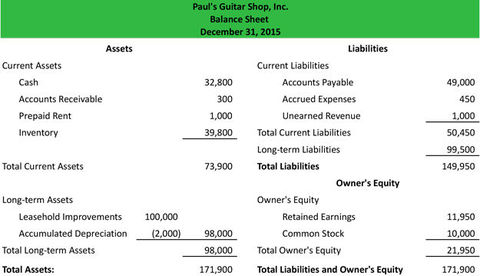
- 34Balance Sheet looks like...
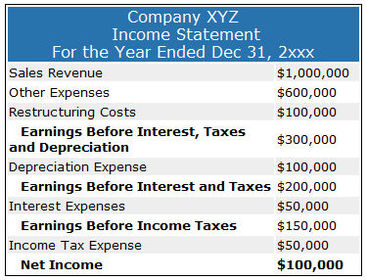
- 35Income Statement looks like....
- 36Financial Ratios for Firm LiquidityCurrentRatio
Acid-Test Ratio
Average Collection Period
Accounts Receivable Turnover
Inventory Turnover - 37Financial Ratios for Operating ProfitabilityOperating Income Return on Investment
Operating Profit Margin
Total Asset Turnover
Accounts Receivable Turnover
Inventory Turnover
Fixed Asset Turnover - 38Financial Ratios for Financing DecisionsDebt Ratio
Times Interest Earned - 39Definition of "Cost"Cost is the 'sacrifice' a business makes in manufacturing something or providing a service.
- 40Definition of Fixed CostA cost which remains the same irrespective of changes in output
- 41Definition of Variable costsvariable costs vary with output
- 42Bad debt is.....an expense
- 43Definition of Indirect CostA cost which is not directly attributable to a cost object (e.g. a project, function or project)
- 44Definition of Product CostProduct cost refers to the costs used to create a product. These costs include direct labor, direct materials, consumable production supplies, and factory overhead. Product cost can also be considered the cost of the labor required to deliver a service to a customer.
- 45Definition of Period CostA period cost is any cost that cannot be capitalized into prepaid expenses, inventory, or fixed assets. A period cost is more closely associated with the passage of time than with a transactional event
- 46Definition of Job CostingJob costing involves the calculation of costs involved in a construction "job" or the manufacturing of goods done in discrete batches.
- 47Definition Process CostingProcess costing is a method of assigning costs to units of production in companies producing large quantities of homogeneous products. Process costing is a type of operation costing which is used to ascertain the cost of a product at each process or stage of manufacture.
- 48Definition of Just-In-Time CostingAn inventory strategy companies employ to increase efficiency and decrease waste by receiving goods only as they are needed in the production process, thereby reducing inventory costs.
- 49Definition of Activity Based Costing (ABC)A costing methodology that identifies activities in an organization and assigns the cost of each activity with resources to all products and services according to the actual consumption by each.
- 50Definition of Variable Costingcosts that vary depending on a company's production volume; they rise as production increases and fall as production decreases. Variable costs differ from fixed costs such as rent, advertising, insurance and office supplies, which tend to remain the same regardless of production output.
- 51What is Managerial Decision Making? Planning, Directing, and ControllingSTEPS:
* Identify decision alternatives
* Log relevant costs/benefits of each one
* Evaluate qualitative issues
* Select the most desirable option - based on judgemental balancing of quantitative and qualitative factors - 52Definition of Cost ControlThe practice of managing and/or reducing business expenses. Cost controls start by the businesses identifying what their costs are and evaluating whether those costs are reasonable and affordable.
- 53Definition of BudgetA budget is a quantitative expression of a plan for a defined period of time. It may include planned sales volumes and revenues, resource quantities, costs and expenses, assets, liabilities and cash flows.
- 54Definition of Inventory Control"the activity of checking a shop's stock". More specifically inventory control may refer to: In operations management, logistics and supply chain management, the technological system and the programmed software necessary for managing inventory.
- 55Definition of Trade Discounta discount on the retail price of something allowed or agreed between traders or to a retailer by a wholesaler.
(usually bulk sales) - 56Definition of Cash DiscountA cash discount is an incentive offered by a seller to a buyer for paying an invoice ahead of the scheduled due date.
- 57Definition of Master BudgetThe master budget is the aggregation of all lower-level budgets produced by a company's various functional areas, and also includes budgeted financial statements, a cash forecast, and a financing plan.
- 58Description of Operating BudgetAn operating budget is a combination of known expenses, expected future costs, and forecasted income over the course of a year. Operating budgets are completed in advance of the accounting period, which is why they require estimated expenses and revenues.
- 59Definition of AssetSomething that will give you some kind of future economic benefit
- 60Definition of a LiabilitySomething with an (economic) obligation to someone else
- 61Definition of EquityEquity is what you own or what you are left with after all your assets and liabilities are resolved = your net worth.
A.k.a. Owner's equity/Stockholder's or Shareholder's equity - 62Beginning Inventory + New Purchases - Ending Inventory = ?Cost of Goods Sold
(COGS)
Informações
- Descrição
- FlashCards sobre MBA Accounting 505 Flashcards, criado por Clair Hat em 29-08-2015.
- Criado por
- Clair Hat
- Visualizações
- 65
- Tags
- Avaliação