
Flashcards
Midterm 2 (Part 2)
Flashcards do conjunto (132)
- 1What is relearning in terms of forgetfulness?It is a measure of retention that requires a participant to memorize information a second time to determine how much time or how many practice trials are saved by having learned it before
- 2What is pseudoforgetting?Something you can't forget that you never learned (lmao idfk, weirdly explained)
-occurs due to lack of attention - 3What are the 5 causes of why we forget?-Ineffective encoding
-Decay
-Interference
-Retrieval failure
-Motivated forgetting - 4What is ineffective encoding?When you can't remember information that you just gathered, causes is due to lack of intention which leads to ineffective encoding
- 5What is decay theory?It proposes that forgetting occurs because memory traces fade with time
- 6What is interference theory?It proposes that people forget information because of competition from other materials
- 7What are the two kinds of interference?-Retroactive interference
-Proactive interference - 8What is retroactive interference?It occurs when new information impairs the retention of previously learned information
- 9What is proactive interference?It occurs when previously learned information interferes with the retention of new information
- 10When does retrieval failure likely occur?They're likely to occur when a mismatch happens between retrieval cues and the encoding of the information
- 11What is a good retrieval cue?It is consistent with the original encoding of the information to be called (like memorizing the sound of the word, then the retrieval cue would be emphasis on the sound of the word)
- 12What is the encoding specificity principle?It states that the value of retrieval cue depends on how well it corresponds to the memory code
- 13What is the tendency to forget things one doesn’t want to think about is called?Motivated forgetting
- 14True or False: You can always trust therapists to never implant false memoriesFalse
- 15What are the seven sins of memory?-Transience
-Absentmindedness
-Blocking
-Misattribution
-Suggestibility
-Bias
-Persistence - 16What is transience (a seven sin of memory) refer to?It is the simple weakening of a memory overtime
- 17What is absentmindedness (a seven sin of memory) refer to?Refers to a memory failure that is often due to a failure to pay attention because we are perhaps preoccupied with other things
- 18What is blocking (a seven sin of memory) refer to?It is an often temporary problem that occurs when we fail to retrieve an item of information such as someone's name when we meet them
- 19What is misattribution (a seven sin of memory) refer to?When we assign a memory to the wrong source
- 20What is suggestibility (a seven sin of memory) refer to?When our memory is distorted, for example, misleading questions
- 21What is bias (a seven sin of memory) refer to?Refers to inaccuracy due to the effect of our current knowledge on our past reconstruction of the past
- 22What is persistence (a seven sin of memory) refer to?Involves unwanted memories or recollections that you cannot forget (memories that haunt you)
- 23What is long-term potentiation (LTP)?It is a long lasting increase in neural excitability at synapses along a specific neural pathway
- 24What is neurogenesis?in simple terms, the forming of new neurons, which may contribute to the sculpting of neural circuits that underlie memory
- 25True or False: Suppressed neurogenesis leads to memory improvements on many types of learning tasks, and that conditions that increase neurogenesis tend to be associated with unenhanced learningFalse
- 26What are the two basic types of amnesia?-Retrograde
-Anterograde - 27What is retrograde amnesia?It involves the loss of memories for events that occurred prior to the onset of amnesia
- 28What is anterograde amnesia?It involves the loss of memories for events that occur after the onset of amnesia
- 29True or False: The hippocampal region is one of the first areas of the brain to sustain significant damage in the course of Alzheimer’s diseaseTrue
- 30What is consolidation?It is a hypothetical process involving the gradual conversion of new unstable memories into stable, durable memory codes stored in long-term memory (suggested to unfold while asleep)
- 31What is reconsolidation?During reconsolidation, the memories may be weakened, strengthened, or updated to take into account more recent information
- 32What is implicit memory?It is apparent when retention is exhibited on a task that does not require intentional remembering
-simply incidental, unintentional remembering - 33What is explicit memory?It involves intentional recollection of previous experiences
-is conscious, is accessed directly and can be assessed with recall or recognition measures of retention - 34What are three differences between implcit and explicit memory?-They differ in types of knowledge stored
-Primary sites in the brain where storage takes place differs
-There are differences in the recall strategies used in accessing or using the information - 35What are the two distinctive systems of memory?-Declarative memory
-Nondeclarative/procedural memory - 36What is the declarative memory system?A memory system that handles factual information (names, definitions, words....)
- 37What is the nondeclarative/procedural memory system?A memory system that houses memory for actions, skills, operations, and conditioned responses (riding a bike, typing, tying a shoe....)
- 38What facts does semantic memory hold?Contains general knowledge that is not tied to the time when the information was learned
- 39What facts does episodic memory hold?Made up of chronological, or temporally dated, recollections of personal experiences
- 40What is prospective memory?It involves remembering to perform actions in the future (remembering to walk the dog...)
- 41What is retrospective memory?It involves remembering events from the past or previously learned information
- 42True or False: A key difference between retrospective and prospective memory is that in the former one prompts the individual to remember the intended actionFalse:
This is explaining retrospective memory - 43What does problem solving refer to?Refers to the active efforts to discover what must be done to achieve a goal that is not readily attainable
- 44What are the three problem classes?-Problems of inducing structure
-Problems of arrangement
-Problems of transformation - 45What are problems of inducing structure?Problems that requires people to discover the relationships among numbers, words, symbols or ideas
- 46What are problems of arrangement?Problems that requires people to arrange the parts of a problem in a way that satisfies some criterion. The parts can usually be arranged in many ways, but only one or a few of them are correct
- 47What are problems of transformation?Problems that requires people to carry out a sequence of transformations in order to reach a specific goal
- 48Fill in the blanks: Common obstacles to effective problem solving include a _____ on irrelevant information, functional ______________, mental ____, and the imposition of ______________ constraints(In order)
-focus
-fixedness
-set
-unnecessary - 49What are 4 barriers to effective problem solving?-Irrelevant information
-Functional fixedness
-Mental set
-Unnecessary constraints - 50What is functional fixedness?It is the tendency to perceive an item only in terms of its most common use
- 51How can you combat functional fixedness?You must successively decompose the problem into their constituent parts
- 52What is a mental set?It exists when people persist in using problem solving strategies that have worked in the past
- 53What are unnecessary constraints?Assuming that there are constraints when they were never mentioned in the problem
- 54What are the 5 techniques to solving problems?-Trial and error heuristics
-Forming subgoals
-Searching for analogies
-Changing the representation of the problem
-Taking a break: incubation - 55What does trial and error heuristics refer to for problem solving?It involves trying possible solutions and discarding those that are in error until one works
- 56What is a heuristic?It is a guiding principle or "rule of thumb" used in solving problems or making decisions
- 57What does forming subgoals refer to for problem solving?When a person sets subgoals of the problem for personal achievement helps lead the individual to quicker success in solving the whole problem
- 58What does searching for analogies refer to for problem solving?If one can spot an analogy between problems, they may be able to use the same solution
- 59What does changing the representation of the problem refer to for problem solving?Changing the representation helps see the problem in a new light which could lead you to solve it quicker
- 60What does taking a break: incubation refer to for problem solving?After a break, the problem could be seen in a different light and new solutions may spring to mind
- 61In the textbook, what does it define decision making as?A decision that involves evaluating alternatives and making choices among them
- 62What is choice overload?An overwhelming situation that occurs when you have a large array of options
- 63What is risky decision making?A decision that involves making choices under conditions of uncertainty
- 64Fill in the blanks: ___________ ________ represents what an outcome is personally worth to an individualSubjective Utility
- 65True or False: If we know an individual’s subjective utilities, we can better understand that person’s risky decision makingTrue
- 66What is subjective probabilty?The subjective bias of an individual that personally estimate their own probability of an outcome
- 67What is the availability heuristic?It involves basing the estimated probability of an event on the ease with which relevant instances come to mind
- 68What is the representativeness heuristic?It involves basing the estimated probability of an event on how similar it is to the typical prototype of that event
- 69What is the conjunction fallacy?It occurs when people estimate that the odds of two uncertain events happening together are greater than the odds of either event happening alone
- 70What is the sunk costs fallacy?It occurs when individuals continue a behaviour because they have already invested time, money, and energy in the action or decision, not because the continuation of the behaviour itself is rational
- 71What is Behavioural Economics?It is a field of study that examines the effects of humans' actual (not idealized) decisions making processes on economic decision
- 72What does framing refer to?It refers to how decisions issues are posed or how choices are structured
- 73What are the two systems of thought referred to in problem solving/decision making?-Thinking Fast (system 1)
-Thinking Slow (system 2) - 74What is the thinking fast system (system 1) about?It is a more automatic mode of thinking which we expand very little effort and over which we have no control
-Involved as we read words on a billboard, detect hostility in someone's voice, answer questions and so on - 75What is the thinking slow system (system 2) about?Is under our control and is more effortful
-Involved in our sense of choice, deliberation, concentration, and personal agency - 76True or False: The first modern psychological tests were invented 50 years ago and began with the work of a British scholar, Sir Francis Galton, in the later part of the 19th centuryFalse:
They were invented over 100 years ago - 77What is a mental age?A number indicated by the mental ability of a child (which to be found you need testing)
- 78What does IQ stand for?Intelligence Quotient
- 79What is a person's chronological age (quite obvious)?The actual age of the person
- 80What is an intelligence quotient (IQ)?A child’s mental age divided by their chronological age then multiplied by 100
- 81What is Spearman's 'g'?An idea about the structure of intellect where specific mental talents are highly intercorrelated and that correlation could be called 'g' (for general)
- 82What were Thurstone's seven independent factors of intelligence (called primary mental abilities)?-Word fluency
-Verbal comprehension
-Spatial ability
-Perceptual speed
Numerical ability
-Inductive reasoning
-Memory - 83True or False: In the 1980s, the developers of IQ tests began moving in the opposite direction, from a focus on a single indicator of IQ to multipleTrue
- 84What does fluid intelligence involve?It involves reasoning ability, memory capacity, and speed of information processing
- 85What does crystallized intelligence involve?It involves the ability to apply acquired knowledge and skills in problem solving
- 86Which form of intelligence involves the prefrontal cortex? Crystallized Intelligence OR Fluid IntelligenceCrystallized Intelligence
- 87What is John Carrol's intelligence model?-Three Statas with 'g' being stratum I
-Eight broad abilities of intelligence in stratum II
-More specific abilities such as spelling at the bottom (Stratum III) - 88True or False: Larger brains are associated with greater intelligenceTrue:
But association is modest - 89What is the testing perspective of intelligence?It emphasizes measuring the amount of intelligence people have and figuring out why some have more than others
- 90What is the cognitive perspective of intelligence?It focuses on how people use their intelligence
- 91What are the three aspects of intelligence according to the cognitive perspective?-Analytical intelligence
-Creative intelligence
-Practical intelligence - 92What is analytical intelligenceIt involves abstract reasoning, evaluation, and judgement
- 93What is creative intelligence?It involves the ability to generate new ideas and to be inventive in dealing with novel problems
- 94What is practical intelligence?It involves the ability to deal effectively with the kinds of problems people encounter in everyday life, such as on the job or at home
- 95What were the eight intelligences that Howard Gardner concluded us humans have?-Logical-mathematical
-Linguistic
-Musical
-Spatial
-Bodily-kinesthetic
-Interpersonal
-Intrapersonal
-Naturalist - 96True or False: the measurement of emotional intelligence cannot enhance the prediction of success at school, work, and interpersonal relationshipsFalse:
It sure as hell can enhance predictions - 97What is Somnambulism?Sleepwalking, it occurs when a person arises and wanders about while remaining asleep
- 98What is emotional intelligence (EQ)?A type of intelligence that consists of the ability to perceive and express emotion, assimilate emotion in though, understand and reason with emotion and regulate emotion
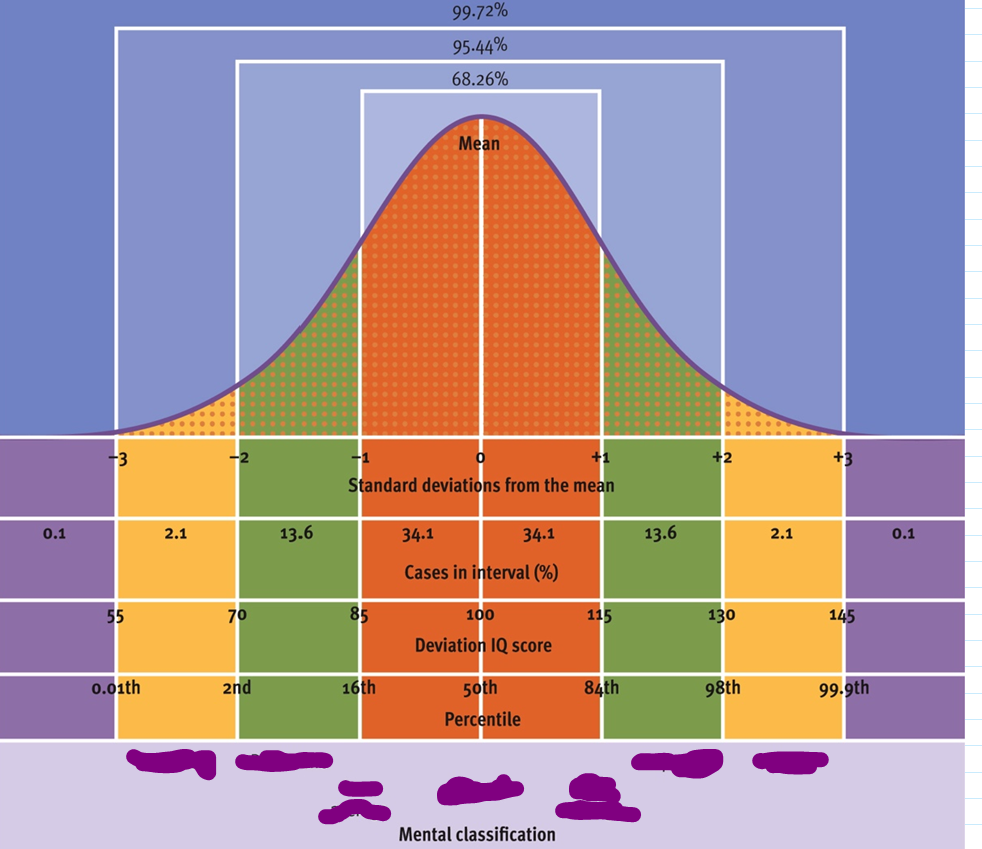
- 99What is a normal distribution?It is a symmetric bell-shaped curve that represents the pattern in which many characteristics are dispersed in the population
- 100What is the mean of most IQ test scores?100
- 101If I, the flash card maker, have an IQ of 1000 (obviously facts), what range would I be in?Beyond gifted (totally not a made up IQ)
- 102Fill in the purple blanks, from left to right, of what the ranges represent-Intellectual Disability
-Borderline
-Low average
-Average
-High average
-Superior
-Gifted - 103If you get a IQ score of 140, what range of intelligence would you be in?Gifted
- 104What is the standard deviation of IQ test?15
- 105What is a percentile score?A score that indicates the percentage of people who score at or below the score one has obtained
- 106Do intelligence tests have adequate reliability?Not all the time because variations in examinees’ motivation to take an IQ test or in their anxiety about the test can sometimes produce misleading scores
- 107True or False: People who score low on IQ tests are more likely than those who score high to end up in high-status jobsFalse:
opposite for those who score high get the high-status job - 108True or False: The relationship between IQ and income is strongFalse:
It actually is weak - 109Why is it problematic when using a culturally specified IQ test on a different culture?Because there are different conceptions of what intelligence is between cultures therefore one will be more "intelligent" in specified areas than others
- 110What is an intellectual disability?It refers to general mental ability accompanied by deficiencies in adaptive skills, originating before the age of 18
- 111What are the 3 adaptive skills in intelligence with examples?-Conceptual skills
(managing money, writing a letter)
-Social skills
(Making friends, coping with others' demands)
-Practical skills
(Preparing meals, using transportation, shopping) - 112What IQ score would be considered a person with an intellectual disability?Anything below a score of 70
- 113What are the levels of intellectual disability?-Mild
Vast majority of those with int'l dis'y
-Moderate
10%
-Severe
-Profound
5% shared with severe - 114What is down syndrome?A condition marked by distinctive physical characteristics (slanted eyes, stubby limbs, and thin hair)
-carries an extra chromosome - 115What are savants? Also could be called savant syndromeA group of people with intellectual disabilities who have also greater than normal abilities (Ex: really good memorization skills)
- 116What efforts are relied on to identify gifted children?IQ test scores
- 117What is the minimum IQ score for gifted programs?Falls somewhere around 130
- 118What are the two main arguments for determinants of intelligence?Heredity vs Environment
(or nature vs nurture) - 119What best evidence supports the heredity side of determining intelligence?Twin studies
- 120What is the correlation coefficient of identical twins and similar intelligence?0.86 (damn high, like I wish I was rn)
- 121What is the correlation coefficient of fraternal twins and similar intelligence?0.60
- 122What is a heritability ration?It is an estimate of the proportion of trait variability in a population that is determined by variations in genetic inheritance
- 123What best evidence supports the environment side of determining intelligence?Adoption studies
- 124Why are adoption studies best defense for what determines intelligence?Because parents/foster parents set the environment for kids, where if they live with some other kid and their intelligence is the same then it's likely due to the environment
- 125True or False: Siblings reared together are more similar in IQ than siblings reared apartTrue
- 126What happens if children are raised in poverty and isolation?Investigators found that environmental deprivation led to predicted erosion in IQ scores, conversely the opposite for those in good environments
- 127What is the Flynn Effect?The fact that IQ tests have steadily increased over generations (almost 3% per decade, we getting smert)
- 128True or False: People have no limit to what IQ score they can achieveFalse:
Genetic makeup places an upper limit on a person’s IQ that can’t be exceeded even when the environment is ideal - 129What also refers to the determined limit of IQ due to genetics?Reaction range
- 130What did Arthur Jensen controversially say about heredity and cultural differences ?“Cultural differences in IQ are largely due to heredity”
- 131What is an argument goes against that cultural differences in IQ are due to heredity?(I'm sure there are many, but in the textbook...)
Lower socioeconomic classes have lower intelligence vs higher socioeconomic classes - 132Why would a lower-class child have less IQ?They tend to be exposed to fewer books, to have fewer learning supplies and less access to computers, to have less privacy for concentrated study and to get less parental assistance in learning
Informações
- Descrição
- This study focuses on (part of) chpt 7 - 9. The best of luck with your studying and may it bless you with a wonderful mark!
- Criado por
- Jonathan Bugeya Miller
- Visualizações
- 200
- Avaliação