
18479309
Description

Quiz by Brooklyn Kostiuk, updated more than 1 year ago

|
Created by Brooklyn Kostiuk
over 6 years ago
|
|
Question 1
Question
Respiratory/ Renal: acid-bases: lungs eliminate volatile carbonic acid by [blank_start]eliminating CO2[blank_end]
-Kidneys eliminate other fixed metabolic acids (phosphoric, uric, and lactic acids and ketones) and prevent [blank_start]metabolic acidosis[blank_end]
Answer
-
eliminating CO2
-
metabolic acidosis
Question 2
Question
Metabolic Acidosis and Alkalosis:
Causes of metabolic acidosis: - Ingestion of too much [blank_start]alcohol[blank_end] (--> acetic acid)
-excessive loss of [blank_start]HCO3-[blank_end] (eg. persistent diarrhea)
- accumulation of [blank_start]lactic acid[blank_end], shock, [blank_start]ketosis[blank_end] in diabetic crisis, starvation and [blank_start]kidney[blank_end] failure
Answer
-
alcohol
-
HCO3-
-
lactic acid
-
ketosis
-
kidney
Question 3
Question
Metabolic Alkalosis: much less common than [blank_start]metabolic acidosis[blank_end]
- indicated by [blank_start]rising blood pH[blank_end] and [blank_start]HCO3-[blank_end]
-caused by [blank_start]vomiting[blank_end] of the acid contents of the stomach or by intake of excess [blank_start]base[blank_end] (eg. antacids)
Answer
-
metabolic acidosis
-
rising blood pH
-
HCO3-
-
vomiting
-
base
Question 4
Question
Effects of Acidosis and Alkalosis:
-blood pH below [blank_start]7[blank_end] --> depression of [blank_start]CNS[blank_end] ---> coma ---> death
-blood pH above [blank_start]7.8[blank_end] --> [blank_start]excitation[blank_end] of nervous system---> muscle [blank_start]tetany[blank_end], extreme nervousness, convulsions, respiratory arrest
Answer
-
7
-
CNS
-
7.8
-
excitation
-
tetany
Question 5
Question
Urinary System Overview
• Kidneys are one of the major [blank_start]excretory[blank_end] organs
• Urinary bladder is the temporary [blank_start]storage reservoir[blank_end] for urine
• [blank_start]Ureters[blank_end] transport urine from the kidneys to the bladder
• [blank_start]Urethra[blank_end] transports urine out of the body
Answer
-
excretory
-
storage reservoir
-
Ureters
-
Urethra
Question 6
Question
What are the functions of kidneys?
• Removal of [blank_start]toxins[blank_end], metabolic wastes, and excess ions from the [blank_start]blood[blank_end]
• Regulation of blood [blank_start]volume[blank_end], chemical composition, and [blank_start]pH[blank_end]
Answer
-
volume
-
pH
-
toxins
-
blood
Question 7
Question
Schematic of Renal Blood Vessels:
Aorta -->[blank_start]Renal[blank_end] artery-->segmental artery-->[blank_start]interlobar[blank_end] artery-->arcuate artery-->cortical radiate atery-->[blank_start]afferent[blank_end] arteriole-->[blank_start]glomerulus[blank_end] (capillaries)-->[blank_start]efferent[blank_end] arteriole --> [blank_start]peritubular[blank_end] capillaries and [blank_start]vasa recta[blank_end] --> cortical radiate vein --> [blank_start]arcuate[blank_end] vein-->interlobar vein-->renal vein--> inferior vena cava
Answer
-
Renal
-
interlobar
-
afferent
-
glomerulus
-
efferent
-
peritubular
-
vasa recta
-
arcuate
Question 8
Question
Nephrons
These are the structural and functional units that form urine
~[blank_start]1 million[blank_end] per kidney
Two main parts:
1. [blank_start]Glomerulus[blank_end]: a tuft of capillaries
2. [blank_start]Renal tubule[blank_end]: begins as cup-shaped glomerular (Bowman’s) capsule surrounding the glomerulus
Answer
-
1 million
-
Glomerulus
-
Renal tubule
Question 9
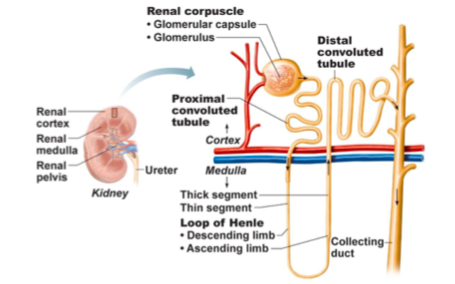
Answer
-
Golmerular capsule
Question 10
Question
Nephrons
• Renal corpuscle
– Glomerulus + its [blank_start]glomerular capsule[blank_end]
• [blank_start]Fenestrated[blank_end] (windows) glomerular endothelium
– Allows filtrate to pass from [blank_start]plasma[blank_end] into the glomerular capsule
Answer
-
glomerular capsule
-
Fenestrated
-
plasma
Question 11
Question
Renal Tubule
• Glomerular capsule
• [blank_start]Parietal[blank_end] layer: simple squamous epithelium
• [blank_start]Visceral[blank_end] layer: branching epithelial [blank_start]podocytes[blank_end]
– Extensions from the epithelial cells terminate in foot processes that cling to [blank_start]basement membrane[blank_end]
– Filtration slits allow filtrate to pass into the [blank_start]capsular[blank_end] space
Answer
-
Parietal
-
Visceral
-
podocytes
-
basement membrane
-
capsular
Question 12
Question
Filtration Membrane
Porous membrane between the [blank_start]blood[blank_end] and the capsular space
Consists of
1. [blank_start]Fenestrated endothelium[blank_end] of the glomerular capillaries
2. [blank_start]Visceral[blank_end] membrane of the glomerular capsule (podocytes with foot processes and filtration slits)
3. Gel-like [blank_start]basement membrane[blank_end] (fused basal laminae of the two other layers)
Answer
-
blood
-
Fenestrated endothelium
-
Visceral
-
basement membrane
Question 13
Question
Filtration Membrane
• Allows passage of [blank_start]water[blank_end] and solutes smaller than most plasma proteins
– Fenestrations prevent filtration of [blank_start]blood cells[blank_end]
– Negatively charged basement membrane repels large anions such as [blank_start]plasma proteins[blank_end]
– Slit diaphragms also help to repel [blank_start]macromolecules[blank_end]
Answer
-
water
-
blood cells
-
plasma proteins
-
macromolecules
Question 14
Question
Nephrons: 2 types
1. [blank_start]Cortical[blank_end] nephrons—85% of nephrons; almost entirely in the cortex. Make urine (not as concentrated)
2. [blank_start]Juxtamedullary[blank_end] nephrons
– Really Long loops of Henle deeply invade the
[blank_start]medulla[blank_end]
– Extensive thin segments (on the loop of henle)
– Important in the production of [blank_start]concentrated[blank_end] urine
Answer
-
Cortical
-
Juxtamedullary
-
medulla
-
concentrated
Question 15
Question
Nephron Capillary Beds
1. Glomerulus
-[blank_start]Afferent[blank_end] arteriole -> glomerulus -> [blank_start]efferent[blank_end] arteriole
-Specialized for [blank_start]filtration[blank_end]
-Blood pressure is [blank_start]high[blank_end] because
-Efferent arterioles are smaller in diameter than afferent arterioles
-Arterioles are [blank_start]high-resistance[blank_end] vessels
Answer
-
Afferent
-
efferent
-
high
-
filtration
-
high-resistance
Question 16
Question
Nephron Capillary Beds
2. Peritubular capillaries
-[blank_start]Low[blank_end]-pressure, porous capillaries adapted for [blank_start]absorption[blank_end]
-Arise from [blank_start]efferent[blank_end] arterioles
-Cling to adjacent [blank_start]renal[blank_end] tubules in cortex
-Empty into [blank_start]venules[blank_end]
Answer
-
Low
-
absorption
-
efferent
-
renal
-
venules
Question 17
Question
Nephron Capillary Beds
3. Vasa recta
-Long vessels parallel to long loops of Henle
-Arise from [blank_start]efferent[blank_end] arterioles of [blank_start]juxtamedullary[blank_end] nephrons
-Function formation of [blank_start]concentrated urine[blank_end]
Answer
-
efferent
-
juxtamedullary
-
concentrated urine
Question 18
Question
Mechanisms of Urine Formation
• The kidneys filter the body’s entire [blank_start]plasma[blank_end] volume 60 times each day
• Filtrate
– Blood plasma minus [blank_start]proteins[blank_end]
• Urine
– <1% of total filtrate
– Contains metabolic [blank_start]wastes[blank_end] and unneeded substances
Answer
-
plasma
-
proteins
-
wastes
Question 19
Question
Mechanisms of Urine Formation
1. [blank_start]Glomerular[blank_end] filtration
2. Tubular [blank_start]reabsorption[blank_end]
-Returns all glucose and amino acids, 99% of water, salt, and other components to the [blank_start]blood[blank_end]
3. Tubular [blank_start]secretion[blank_end]
-Reverse of reabsoprtion: selective addition to [blank_start]urine[blank_end]
Answer
-
Glomerular
-
reabsorption
-
blood
-
secretion
-
urine
Question 20
Question
1. Filtration
Net Filtration Pressure (NFP)
The pressure responsible for [blank_start]filtrate formation[blank_end] (10 mm Hg)
Answer
-
filtrate formation
Question 21
Question
Pressure associated behind it and pressure within it.
[blank_start]Colloid[blank_end] is proteins in the blood vessel drawing fluid back into the blood vessel
This capsule is sitting in fluid which has [blank_start]hydrostatic[blank_end] pressure is about 15 mm Hg
If you add all these up this is 10 net mmHg filtration pressure
We calculate it by subtration of the bottom two factors from the top one.
Answer
-
Colloid
-
hydrostatic
Question 22
Question
Glomerular Filtration Rate (GFR)
• [blank_start]Volume of filtrate[blank_end] formed per minute by the kidneys (120–125 ml/min)
• This rate is controlled by (and directly proportional to)
– Total [blank_start]surface area[blank_end] available for filtration – Filtration membrane [blank_start]permeability[blank_end]
– [blank_start]NFP[blank_end]
Answer
-
Volume of filtrate
-
surface area
-
permeability
-
NFP
Question 23
Question
Renal Tubules/Collecting Ducts
• Proximal [blank_start]CT[blank_end]
– Site of most [blank_start]reabsorption[blank_end]
• 65% of Na+ and water • All nutrients
• Ions
• Small proteins
Answer
-
reabsorption
-
CT
Question 24
Question
•Loop of Henle
• Descending limb: [blank_start]H2O[blank_end]
• Ascending limb: Na+, K+, Cl-
Answer
-
H2O
Question 25
Question
Distal Collecting Tubules
• DCT and collecting duct
– Reabsorption is [blank_start]hormonally[blank_end] regulated • Ca2+ (PTH)
• Water ([blank_start]ADH[blank_end])
• Na+ ([blank_start]aldosterone[blank_end] and [blank_start]ANP[blank_end])
Answer
-
hormonally
-
ADH
-
aldosterone
-
ANP
Question 26
Question
Tubular Secretion
• Can basically be considered as reabsorption in [blank_start]reverse[blank_end]
– What types of substances?
• K+, H+, NH4+, [blank_start]creatinine[blank_end], and [blank_start]organic acids[blank_end] move from [blank_start]peritubular[blank_end] capillaries or tubule cells into filtrate
• Disposes of substances that are bound to [blank_start]plasma proteins[blank_end]
Answer
-
reverse
-
creatinine
-
organic acids
-
peritubular
-
plasma proteins
Question 27
Question
Why is tubular secretion important?
Eliminates undesirable substances that have been passively [blank_start]reabsorbed[blank_end] (e.g., urea and uric acid)
– Rids the body of excess [blank_start]K+[blank_end]
– Controls [blank_start]blood pH[blank_end] by altering amounts of H+ or HCO3– in urine
Answer
-
reabsorbed
-
K+
-
blood pH
Question 28
Question
1. Osmolality – what is it?
– Number of [blank_start]solute[blank_end] particles in 1 kg of H2O
A. Why is osmolality important?
– This value reflects the ability of a fluid to cause [blank_start]osmosis[blank_end]
2. Osmolality of body fluids
– Expressed in [blank_start]milliosmols[blank_end] (mOsm)
– The kidneys maintain osmolality of plasma at
~300 mOsm, using what is known as
countercurrent mechanisms
Answer
-
solute
-
osmosis
-
milliosmols
Question 29
Question
Countercurrent Mechanisms
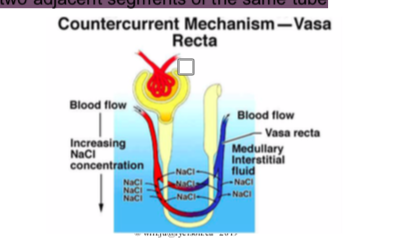
• Occurs when fluid flows in [blank_start]opposite[blank_end] directions in two adjacent segments of the same tube
Answer
-
opposite
Question 30
Question
Countercurrent Mechanism
• Role of countercurrent mechanisms – why do we need this?
– Establish and maintain an [blank_start]osmotic gradient[blank_end] (300 mOsm to 1200 mOsm) from [blank_start]renal cortex[blank_end] through the medulla
– Allow the kidneys to vary urine [blank_start]concentration[blank_end]
Answer
-
osmotic gradient
-
renal cortex
-
concentration
Question 31
Question
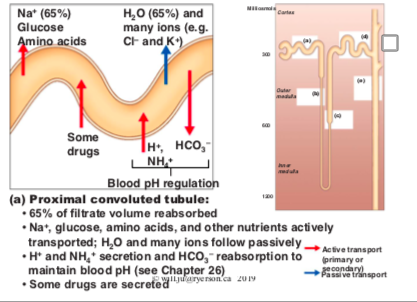
- Proximal convoluted tubule:
• 65% of filtrate volume [blank_start]reabsorbed[blank_end]
• Na+, glucose, amino acids, and other nutrients actively
transported; H2O and many ions follow [blank_start]passively[blank_end] • H+ and NH4+ secretion and HCO3– reabsorption to maintain [blank_start]blood pH[blank_end] (see Chapter 26)
• Some drugs are secreted
Answer
-
reabsorbed
-
passively
-
blood pH
Question 32
Question
Descending limb of loop of Henle
• Freely permeable to [blank_start]H2O[blank_end]
• Not permeable to [blank_start]NaCl[blank_end]
• Filtrate becomes increasingly
concentrated as H2O leaves by
[blank_start]osmosis[blank_end]
Answer
-
H2O
-
NaCl
-
osmosis
Question 33
Question
Ascending limb of loop of Henle
• Impermeable to [blank_start]H2O[blank_end] • Permeable to [blank_start]NaCl[blank_end]
• Filtrate becomes
increasingly dilute as [blank_start]salt[blank_end] is
reabsorbed
Answer
-
H2O
-
NaCl
-
salt
Question 34
Question
Collecting duct
• H2O reabsorption through aquaporins regulated by [blank_start]ADH[blank_end]
• Na+ reabsorption and [blank_start]K+[blank_end] secretion regulated by [blank_start]aldosterone[blank_end]
• H+ and HCO3– reabsorption or secretion to maintain [blank_start]blood pH[blank_end] (see Chapter 26)
• Urea reabsorption increased by [blank_start]ADH[blank_end]
Answer
-
ADH
-
aldosterone
-
K+
-
blood pH
-
ADH
Question 35
Question
Physical Characteristics
• Color and transparency
– Clear, pale to deep [blank_start]yellow[blank_end]
– Drugs, vitamin supplements, and diet can alter the color
– Cloudy urine may indicate a urinary tract infection
Answer
-
yellow
Question 36
Question
Physical Composition of Urine
• 95% water and 5% solutes
• [blank_start]Nitrogenous[blank_end] wastes: urea, uric acid, and creatinine
• Other normal solutes
– Na+, K+, PO43–, and SO42–, – Ca2+, Mg2+ and HCO3–
• Abnormally high concentrations of any constituent may indicate [blank_start]pathology[blank_end]
Answer
-
Nitrogenous
-
pathology
Question 37
Question
Juxtaglomerular Apparatus (JGA)
• [blank_start]One[blank_end] per nephron
• Important in regulation of [blank_start]filtrate formation[blank_end] and blood pressure
• Involves modified portions of the
– Distal portion of the [blank_start]ascending[blank_end] limb of the loop of Henle (DCT)
– [blank_start]Afferent[blank_end] (sometimes [blank_start]efferent[blank_end]) arteriole
Answer
-
One
-
filtrate formation
-
ascending
-
Afferent
-
efferent
Question 38
Question
Juxtaglomerular Apparatus (JGA)
• [blank_start]Granular[blank_end] cells (juxtaglomerular, or JG cells)
– Enlarged, [blank_start]smooth[blank_end] muscle cells of arteriole
– Secretory granules contain [blank_start]renin[blank_end]
– Act as [blank_start]mechanoreceptors[blank_end] that sense blood pressure
• Macula densa
– Tall, closely packed cells of the [blank_start]ascending[blank_end] limb
– Act as [blank_start]chemoreceptors[blank_end] that sense NaCl content of filtrate
Answer
-
Granular
-
smooth
-
renin
-
mechanoreceptors
-
ascending
-
chemoreceptors
Question 39
Question
Renin-Angiotensin System:
Triggered when the granular cells of the JGA release [blank_start]renin[blank_end].
[blank_start]Angiotensinogen[blank_end] (plasma globulin)-->-->[blank_start]renin[blank_end]---> angiotensin 1-->[blank_start]angiotensin converting enzyme[blank_end] (ACE) --->--> angiotensin 2
Answer
-
renin
-
renin
-
Angiotensinogen
-
angiotensin converting enzyme
Question 40
Question
Effects of Angiotensin II
1. Constricts arteriolar [blank_start]smooth[blank_end] muscle, causing [blank_start]MAP[blank_end] to rise
2. Stimulates the reabsorption of [blank_start]Na+[blank_end]
-Acts directly on the renal tubules
-Triggers adrenal cortex to release [blank_start]aldosterone[blank_end]
3. Stimulates the hypothalamus to release [blank_start]ADH[blank_end] and activates the [blank_start]thirst center[blank_end]
4. Constricts [blank_start]efferent[blank_end] arterioles, decreasing peritubular capillary [blank_start]hydrostatic[blank_end] pressure and increasing fluid [blank_start]reabsorption[blank_end]
Answer
-
smooth
-
MAP
-
Na+
-
aldosterone
-
ADH
-
thirst center
-
efferent
-
hydrostatic
-
reabsorption
Question 41
Question
Diuretics
• Chemicals that enhance the [blank_start]urinary output[blank_end]
• There are different classes
– [blank_start]Osmotic[blank_end] diuretics: substances not reabsorbed, (e.g., high glucose in a diabetic patient)
– [blank_start]ADH[blank_end] inhibitors such as alcohol (why the TTC smells on Monday morning)
– Substances that inhibit [blank_start]Na+[blank_end] reabsorption and obligatory [blank_start]H2O[blank_end] reabsorption such as caffeine and many drugs
Answer
-
urinary output
-
Osmotic
-
ADH
-
Na+
-
H2O
Want to create your own Quizzes for free with GoConqr? Learn more.