
Quiz
NMS Semester 2 Set 5 Quiz - The brain and control of movement 1+2
Questions in this quiz (44)
1The spinal cord contains CPG's that can produce locomotor patterns without descending influence.
- ATrue
- BFalse
2What are the three brain centres that can be imposed on SC circuitry?
- AMotor cortex
- BVisual cortex
- CCerebellum
- DCerebral cortex
- EParietal cortex
3Lateral pathways are associated with control of?
- ADistal flexor muscles
- BProximal/axial extensors to control posture
4Ventromedial pathways control what?
- ADistal flexor muscles
- BProximal/axial extensors to control posture
5Ventromedial pathways are under control of the brainstem, whereas lateral pathways execute voluntary actions.
- ATrue
- BFalse
6Name the lateral motor pathways
- ACorticospinal
- BRubrospinal
- CReticulospinal
- DTectospinal
- EVestibulospinal
7Name the ventromedial motor pathways
- ARubrospinal
- BCorticospinal
- CReticulospinal
- DVestibulospinal
- ETectospinal
8Where does the vestibulospinal tract run from and what is its function?
- AVestibular nucleus to the spinal cord
- BSolitary nucleus to the spinal cord
- CIt relays gravitational sensory information from CN VIII and co-ordinates postural responses such as the balance of the head and neck
- DIt relays gravitational sensory information from CN X and co-ordinates postural responses such as the balance of the head and neck
9Where does the tectospinal tract run from and what is its function?
- AVestibular nucleus to the spinal cord
- BSuperior colliculus to the spinal cord
- CIt relays visual information from the visual cortex and retina and orientates the head and eyes
- DIt relays gravitational sensory information from CN VIII and co-ordinates postural responses such as the balance of the head and neck
10The reticulospinal tract originates from the reticular formation.
- ATrue
- BFalse
11The pontine reticulospinal tract modulates voluntary override of the medullary reticulospinal tract.
- ATrue
- BFalse
12The pontine reticulospinal tract modulates posture via leg extensors.
- ATrue
- BFalse
13The motor cortex is the only brain centre required for co-ordinated movement.
- ATrue
- BFalse
14What is the function of the supplementary motor area (SMA)?
- APlanning and initiation of the final action to be taken
- BBimanual coordination
- CControl of movement sequencing
- DControl of the distal musculature
15What is the function of the pre-motor cortex?
- APlanning and initiation of the final action to be taken
- BBimanual coordination
- CControl of movement sequencing
- DControl of the distal musculature
16What is the function of the primary motor cortex?
- APlanning and initiation of the final action to be taken
- BBimanual coordination
- CControl of movement sequencing
- DControl of the distal musculature
17The motor homunculus (the somatotopic arrangement) is evenly distributed for all areas of the body.
- ATrue
- BFalse
18The SMA, Pre-motor cortex and Primary motor cortex contribute what percentage of motor fibres to the corticospinal tract?
- A50%
- B25%
- C40%
- D70%
19Corticospinal tract fibres innervate small groups of muscle instead of single muscles and encode the force and direction of movement.
- ATrue
- BFalse
20Stroke/tumours may damage UMN, what can this lead to?
- AHypertonia
- BHypotonia
- CHyperreflexia
- DHyporeflexia
21UMN damage will affect the side of the body contralateral to the damage. This means UMN damage will affect the same side that the damage occurs.
- ATrue
- BFalse
22What is the output of the spino-cerebellum pathway?
- AReticular nucleus
- BRed nucleus
- CVestibular nucleus
- DPre-motor cortex
23What is the output of the cerebro-cerebellum pathway?
- APre-motor cortex
- BVestibular nucleus
- CRed nucleus
- DReticular nucleus
24What is the output of the vestibulo-cerebellum pathway?
- AVestibular nucleus
- BRed nucleus
- CReticular nucleus
- DPre-motor cortex
25What does the spino-cerebellum tract help to control?
- AAxial musculature and posture
- BSends compensatory signals to the primary motor cortex
- CControl over posture, balance and eye movement.
26What does the cerebro-cerebellum tract help to control?
- AAxial musculature and posture
- BSends compensatory signals to the primary motor cortex
- CControl over posture, balance and eye movement.
27What does the vestibulo-cerebellum tract help to control?
- AControl over posture, balance and eye movement.
- BSends compensatory signals to the primary motor cortex
- CAxial musculature and posture
28Damage to the spino-cerebellum pathway could lead to what?
- AHypotonia, Ataxia, Dysmetria
- BAsynergy, Ataxia, Dysarthia
- CSlow saccade impairment, nystagmus
29Damage to the cerebro-cerebellum pathway could lead to what?
- AAsynergy, Ataxia, Dysarthia
- BHypotonia, Ataxia, Dysmetria
- CSlow saccades, nystagmus
30Damage to the vestibulo-cerebellum pathway could lead to what?
- ASlow saccades, nystagmus
- BAsynergy, Ataxia, Dysarthia
- CHypotonia, Ataxia, Dysmetria
31The vestibulo-ocular reflex is performed by the vestibulo-cerebellum pathway and samples visual disparities. It then provides a correction signal to do what?
- AKeep an observed image on the retina as the head moves via oculomotor muscles
- BMake sure the oculomotor muscles contract to a proper extent
- CTurn the eyes in the same direction as head movement
32The function of the cerebellum overall is to act as...?
- AA sampler - compare inputs and make necessary changes
- BA timer - coordinating smooth movements
- CA predictor - executing movements from learnt behaviour
- DTo modulate posture
33Name 1. on the cortico-basalgangliga-cortical loop.
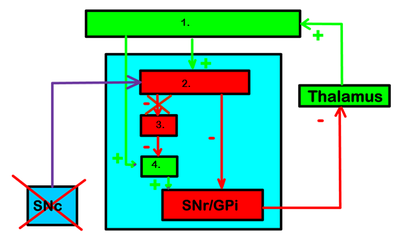
- AStratium
- BGlobus Pallidus external
- CSub thalamic nucleus
- DCortex
34Name 2. on the cortico-basalgangliga-cortical loop.
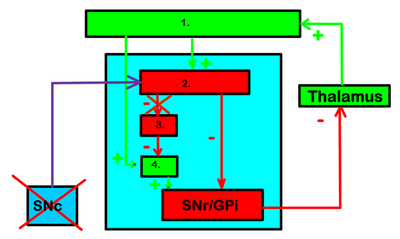
- AStratium
- BGlobus Pallidus external
- CSub thalamic nucleus
- DCortex
35Name 3. on the cortico-basalgangliga-cortical loop.
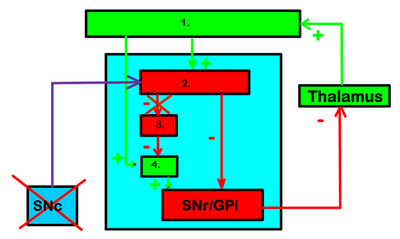
- AStratium
- BGlobus Pallidus external
- CSub thalamic nucleus
- DCortex
36Name 4. on the cortico-basalgangliga-cortical loop.
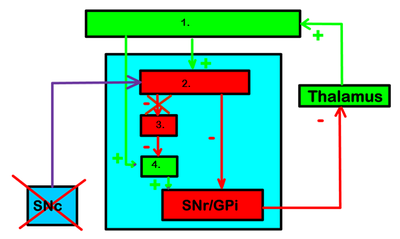
- ACortex
- BStriatum
- CGlobus Pallidus external
- DSub thalamic nucleus
37Name the hypokinetic disorder
- AParkinsons
- BHuntingtons
38Name the hyperkinetic disorder
- AParkinsons
- BHuntingtons
39In parkinsons, the death of SNc dopaminergic neurons has what effect on cortex feedback?
- ADecreased stimulation of the striatium leads to less inhibitory drive and therefore higher excitatory drive from the sub-thalamic nucleus, leading to excessive stimulation of an inhibitory signal to the thalamus and thus excitatory signals back to the cortex are reduced. (hypokineticism)
- BDecreased stimulation of the striatium leads to less inhibitory drive and therefore higher excitatory drive from the sub-thalamic nucleus, leading to excessive stimulation of an inhibitory signal to the thalamus and thus excitatory signals back to the cortex are increased. (hyperkineticism)
40In huntingtons, the lack of an inhibitory striatum signal to the GPe leads to what?
- ALack of an inhibitory signal to the GPe means that the GPe sends out excess inhibitory signals to the STN. The STN is therefore inhibited and sends out fewer excitatory signals to the SNr/GPi. This in turn causes fewer inhibitory signals to the thalamus and therefore excitatory signals from the thalamus to the cortex increase.
- BLack of an excitatory signal to the GPe means that the GPe sends out excess inhibitory signals to the STN. The STN is therefore inhibited and sends out fewer excitatory signals to the SNr/GPi. This in turn causes fewer inhibitory signals to the thalamus and therefore excitatory signals from the thalamus to the cortex increase.
41What are the symptoms of parkinsons?
- ATremor
- BAkinesia
- CBradykinesia
- DExcessive movement
- ERapid motor patterns
42What are the symptoms of huntingtons?
- ATremor
- BAkinesia
- CBradykinesia
- DExcessive movement
- ERapid motor patterns
43What is ataxia and is it usually associated with basal ganglia or cerebellar dysfunction?
- ABasal ganglia
- BCerebellar dysfunction
- CSlow movement
- DLack of voluntary coordination of muscle movements
44Basal ganglia disorders such as Parkinson's have symptoms such as an intention tremor.
- ATrue
- BFalse
Information
- Description
- dd
- Author
- . .
- Language
- English
- Views
- 72
- Tags
- Rating
- No ratings yet Rate this quiz