
4119258


Question 1
Question
The three dimensional or tertiary structure of a protein is determined by its secondary structure.
Answer
- True
- False
Question 2
Question
Proteins that that help primary structure to fold spontaneously in an aqueous solution are called
Answer
-
chaperones
-
camerones
-
SSBP
-
retinols
Question 3
Question
The fact that most proteins can be folded and unfolded in dilute solution without any help from other molecules shows that the primary sequence contains all the information necessary for correct folding.
Answer
- True
- False
Question 4
Question
There may be one or more partially folded intermediate states formed transiently along the pathway to the final folded...
Answer
-
native state
-
major transition state
-
intermediate state
-
denatured state
Question 5
Question
MOST SOLUBLE PROTEINS ARE MIXTURES OF POLAR AND NON-POLAR RESIDUES OFTEN DISTRIBUTED WITH NO REAL PATTERN ALONG THE AMINO ACID CHAIN. WHEN THIS TYPE OF SEQUENCE IS SYNTHESISED IN WATER CAN IT REMAIN AS AN EXTENDED POLYMER?
Answer
-
Yes
-
No
Question 6
Question
What peptide groups will be able to H-bond to water
Answer
-
Polar and charged R groups
-
Non-polar R groups
-
Long R groups
-
Short R groups
Question 7
Question
Why do non-polar R groups tend to clump together
Answer
-
To minimise the disruption of the protein
-
To enable covalent bonding
-
To change the affinity of the protein
Question 8
Question
The clustering of hydrophobic side chains from different parts of the same molecule is called the
Answer
-
Hydrophilic effect
-
Hydrophobic effect
Question 9
Question
This has two favourable outcomes, it minimises the total hydrophobic surface area in contact with water and it brings the polarisable hydrophobic groups together allowing van derWaals interactions to take place. What process can cause the mentioned outcome?
Answer
-
hydrophobic effect
-
hydrophilic effect
-
protein denaturation
-
protein condensation reaction
Question 10
Question
What process that this image describe
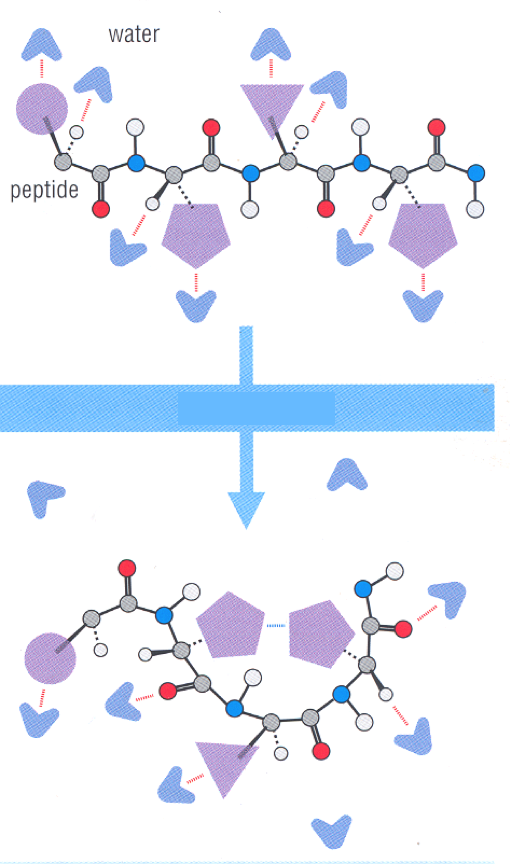
Answer
-
Condensation
-
Hydrolysis
-
Hydrophilic effect
-
Dissociation
Question 11
Question
Polar and charges residues tend to be on the [blank_start]surface[blank_end] making H-bonding contact with [blank_start]water[blank_end].
Polar backbone amide groups dragged into the more hydrophobic interior of the protein satisfy their H-bonds by forming [blank_start]secondary[blank_end] structural elements with other main chain donors and acceptors.
Not all [blank_start]hydrophobic[blank_end] residues can be buried and some are found in contact with water. This unfavourable outcome is offset by the many more favourable contacts made in the protein as a whole.
When hydrophobic residues cluster on the surface of a protein they usually from part of a specific [blank_start]binding[blank_end] site or form a patch of mutually interacting [blank_start]non-polar[blank_end] groups.
Protein folding is a thermodynamic compromise and is energetically very [blank_start]complex[blank_end]. Suffice it to say that although there are many hundreds of interactions stabilising a folded protein the difference in free energy between the folded and unfolded state is generally [blank_start]not that large[blank_end].
Answer
-
surface
-
inside
-
water
-
amino acids
-
secondary
-
primary
-
tertiary
-
hydrophobic
-
hydrophylic
-
binding
-
inhibiting
-
non-polar
-
polar
-
complex
-
favourable
-
slow
-
not that large
-
large
Question 12
Question
Because the free energy difference between the native and the denatured state in proteins is not large it is often not very difficult to denature proteins
Answer
- True
- False
Question 13
Question
a loss in biological activity or is evidenced by the unfolded state is called.
Answer
-
Denaturation
-
Inhibition
-
Binding
-
Folding
-
Hydrophylic effect
Question 14
Question
Factors that cause denaturation
Answer
-
Heat
-
Detergents
-
pH
-
Pressure
-
IR
Question 15
Question
Urea and Guanidinium hydrochloride compete for hydrogen bonds with the polar groups of the backbone and side chains. Urea and Guanidinium hydrochloride are..
Answer
-
Detergents
-
Denaturants
-
Heating factors
Question 16
Question
Some proteins are very much more stable than others and this tend to be dictated by the
Answer
-
compactness of their structure
-
size of their structure
-
by the number of glycine residues
Question 17
Question
The final folded polypeptide chain held together by a number of mostly non-covalent forces in its most stable structure iS the
Answer
-
Tertiary structure of a protein
-
Secondary structure of a protein
-
Quaternary structure of a protein
Question 18
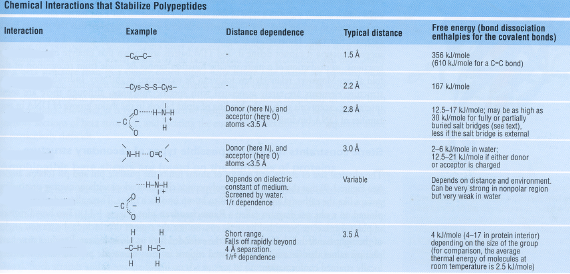
Answer
-
covalent bond
-
Disulfide bond
-
Salt bridge
-
Hydrogen bond
-
Long-range electrostatic interaction
-
Van der Waals interaction
Question 19
Question
In a folded protein the secondary structural elements fold into a compact shape stabilised by weak interactions involving polar and non-polar groups. This compact folded form is the [blank_start]tertiary structure[blank_end].
Helical segments and beta-strands are often connected by [blank_start]beta turns[blank_end].
However there are often many long stretches of amino acids between [blank_start]secondary structural elements[blank_end].
These loops are usually found at the [blank_start]surface[blank_end] of the protein and often protrude out into the solvent.
The loops are often involved in [blank_start]ligand[blank_end] binding, substrate recognition or membrane binding.
Loops [blank_start]do not contribute[blank_end] much to the stability of the tertiary structure and thus can tolerate mutation more readily.
It is often the loop regions of the [blank_start]tertiary[blank_end] structure that are involved in function and their mutatability provides a mechanism for [blank_start]molecular evolution[blank_end] in proteins.
Answer
-
tertiary structure
-
secondary structure
-
primary structure
-
quaternary structure
-
beta turns
-
alpha turns
-
covalent bonds
-
hydrogen bonds
-
secondary structural elements
-
tertiary structural elements
-
primary structural elements
-
quaternary structural elements
-
surface
-
core
-
ligand
-
inhibition
-
covalent
-
hydrogen
-
do not contribute
-
contribute
-
tertiary
-
secondary
-
primary
-
quaternary
-
molecular evolution
-
biosynthesis
-
physiological regulation
-
horizontal gene transfer
Question 20
Question
Here we see porcine elastase with the many polar groups at its surface interacting with water. Match the label with the structure
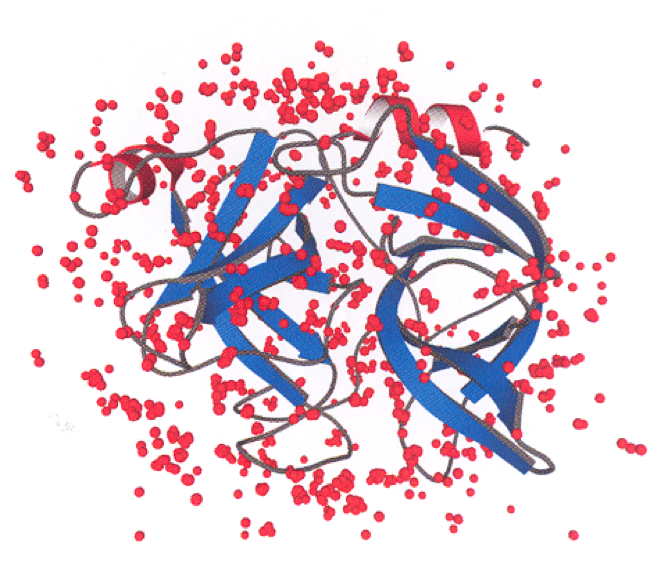
Answer
-
water
-
Beta sheet
-
Helix
-
Loop
Question 21
Question
Here we see porcine elastase with the many polar groups at its surface interacting with water.
This forms a hydration shell around the protein which represents a layer of bound water around the protein. This is seen in few proteins
Answer
- True
- False
Question 22
Question
Some water molecules can be trapped inside the [blank_start]tertiary[blank_end] structure of proteins in internal cavities or in clefts/interfaces etc. These water molecules are all part of the [blank_start]tertiary structure[blank_end] and may be important for the proteins functional activity.
Answer
-
tertiary
-
secondary
-
primary
-
quaternary
-
tertiary structure
-
secondary structure
-
primary structure
-
quaternary structure
Question 23
Question
Because most of the forces that stabilise tertiary structure are [blank_start]non-covalen[blank_end]t these weak interactions can break and reform readily.
Thus a protein molecule is more flexible than a molecule in which only [blank_start]covalent forces stabilse[blank_end] the structure.
Protein structures continually fluctuate around an equilibrium structure as seen in this molecular dynamics simulation of interactions between two [blank_start]helices[blank_end].
In proteins fluctuations in shape can vary from tiny ones of hundreths of an [blank_start]Angstrom[blank_end] to very large movements of a segment of a structure relative to the rest of the molecule.
This type of flexibility is often key to protein function. Eg. An enzyme might change shape upon binding substrate or a receptor when it binds its [blank_start]agonist[blank_end].
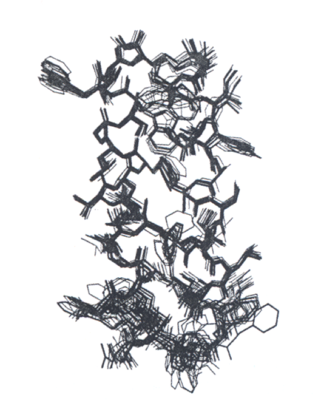
Answer
-
non-covalen
-
covalent
-
covalent forces stabilse
-
non-covalent forces stabilise
-
covalent forces disrupt
-
non-covalent forces disrupt
-
helices
-
beta sheets
-
Angstrom
-
Armstrongs
-
Kelvin
-
Joules
-
Moles
-
Amstrons
-
agonist
-
antagonist
-
protagonist
-
acceptor site
Question 24
Question
A protein [blank_start]tertiary[blank_end] structure is the most thermodynamically stable structure achievable in aqueous solution. It is primarily driven by the [blank_start]hydrophobic[blank_end] effect and by a series of many [blank_start]non-covalent[blank_end] forces. There are however some addition stabilising factors which aid in the formation of the most appropriate [blank_start]tertiary structure[blank_end].
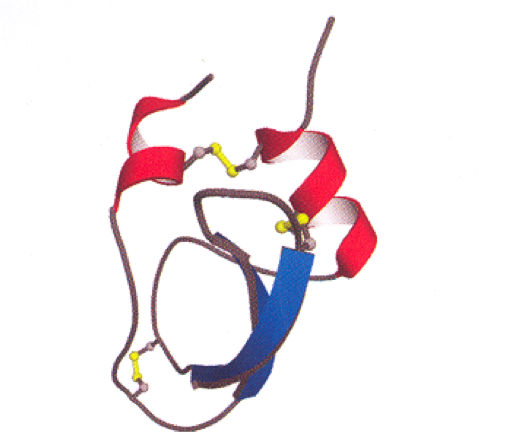
Many proteins are additionally stabilised by [blank_start]disulphide[blank_end] bonds between segments of secondary structure in the native state. These proteins go through many intermediates on the folding pathway and tend to be more stable [blank_start]than tertiary structures[blank_end] without covalent interactions. Proteins that have [blank_start]disulphide bonds[blank_end] (formed between appropriately positioned cyteine residues), include immunoglobulins, ribonuclease, insulin and pancreatic trypsin inhibitor (shown here).
Answer
-
tertiary
-
quaternary
-
primary
-
secondary
-
hydrophobic
-
hydrophilic
-
non-covalent
-
covalent
-
tertiary structure
-
primary structure
-
quaternary structure
-
secondary structure
-
disulphide
-
phosphodiester
-
hydrogen
-
than tertiary structures
-
than secondary structure
-
than primary structure
-
than quaternary structure
-
disulphide bonds
-
phosphodiester bonds
-
hydrogen bonds
Question 25
Question
Determine the bond in trypsin inhibitor
Answer
-
Disulphode bond
-
Phosphodiester bond
-
Hydrogen bond
-
Peptide bond
Question 26
Question
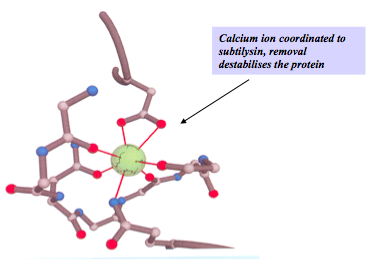
The coordination of a metal ion to several protein side chains is a quite common [blank_start]stabilising[blank_end] factor in proteins. [blank_start]30%[blank_end] of all proteins have metal ions associated with them and the bonding can be very tight or very loose. [blank_start]Water[blank_end] can also be involved in this interaction. The most common stabilising metal ions are [blank_start]calcium[blank_end] and zinc although potassium and sodium are also sometimes found. Stabilising metal ions are distinct from metal ions found in the [blank_start]active site[blank_end] of metalloproteins and they have no chemical function other than providing stability.
Answer
-
stabilising
-
inhibition
-
binding
-
30%
-
40%
-
50%
-
60%
-
Water
-
DNA
-
Sulphate
-
Oxygen
-
Cofactors
-
calcium
-
iron
-
mercury
-
active site
-
binding site
-
inhibition site
Question 27
Answer
-
Pyridoxal phosphate
-
Haem group
-
PQQ
-
Haem porhyrin ring with iron
Question 28
Question
Post translational modification can also change and stabilise tertiary structure This includes
Answer
-
phosphorylation
-
glycosylation
-
ubiquitination
-
transamination
-
condensation
-
hydrolysis
Question 29
Question
Tertairy structures can exist as various domains and proteins can exhibit stable tertiary structure with distinct catalytic, binding, recognition, control, swithching and other domains.
Proteins can be classified by their domain structure and grouped into genus based on the domains they contain
Answer
- True
- False
Question 30
Question
Proteins composed of more than one polypeptide chain are said to be oligomeric and exhibit
Answer
-
quaternary structure
-
primary structure
-
tertiary structure
-
secondary structure
Question 31
Question
Individual subunits are called
Answer
-
monomers
-
polymers
-
oligomers
Question 32
Question
Quarternary structures are held together by [blank_start]non-covalent[blank_end] forces [blank_start]allowing[blank_end] movements between subunits and at the interfaces between subunits
Answer
-
non-covalent
-
covalent
-
allowing
-
inhibiting
Question 33
Question
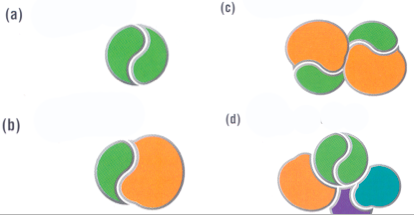
The subunits of proteins with quarternary structure are not always identical. Eg. If two identical subunits make up the protein it is termed a homodimer, but if two non-identical subunits make up the protein it is a heterodimer.
There are a whole range of oligomeric possibilities.
Answer
-
Homodimer a2
-
Heterotetrame a2b2
-
Heterodimer ab
-
Heteropentamer a2bcd
Question 34
Question
Quarternary structure depends on the precise fit between the interacting interfaces between subunits. This COMPLEMENTARITY is a function of the PRIMARY sequence of the protein and to some extent to the nature of the SECONDARY structures and final QUATERNARY structure of each subunit.
Answer
- True
- False
Question 35
Question
The fit between one subunit and another depends on more than just shape it depends on many factors:
Answer
-
Hydrogen bond donors are opposite and close enough to acceptor groups.
-
Non-polar groups are a opposite other non-polar groups.
-
Positive charges are opposite negative charges.
Question 36
Question
Tight binding between subunits can be achieved if there are a large enough number of weak interactions at the [blank_start]interface.[blank_end]
This is maximised [blank_start]if the interfaces[blank_end] fit closely together.
This principle of complementarity is observed in all binding interactions in proteins whether it is at interfaces or at binding sites for [blank_start]ligands[blank_end] or substrates.
Importantly, complementarity does not rule out flexibility in the protein molecule as we shall see later flexibility is key to the [blank_start]function[blank_end] of many proteins.
Answer
-
interface
-
binding site
-
if the interfaces
-
if the binding sites
-
ligands
-
inhibitors
-
function
-
structure
-
properties
Question 37
Question
PROTEIN FLEXIBILITY IS IMPORTANT FOR FUNCTION
Answer
- True
- False
Question 38
Question
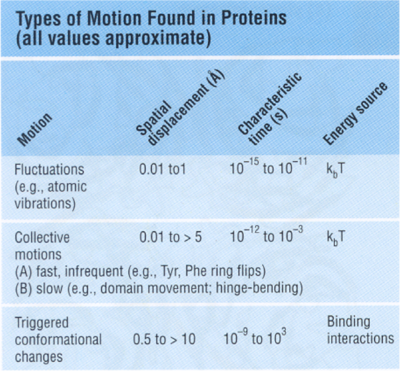
The [blank_start]flexibility[blank_end] of proteins is seen in many different forms of motion. The [blank_start]timescales[blank_end] of these movements dictate the type of events that the motion is associated with. Very fast and small scale motions tend to be associated [blank_start]with catalysis[blank_end], whereas collective mid range spatial and temporal motions are associated with conformational changes [blank_start]upon binding or signalling[blank_end]. Slow and large scale motions in proteins are often associated with [blank_start]binding events[blank_end]. Many of these movements involve the release of bound [blank_start]water molecules[blank_end] and the making/breaking of [blank_start]non-covalent[blank_end] interactions as the protein moves or subunits move relative to one another.
Answer
-
flexibility
-
complementarity
-
timescales
-
energy sources
-
with catalysis
-
with binding
-
with signalling
-
upon binding or signalling
-
upon binding or catalysis
-
upon catalysis or signalling
-
binding events
-
catalytic events
-
signalling events
-
water molecules
-
amino acid residues
-
non-covalent
-
covalent
Question 39
Question
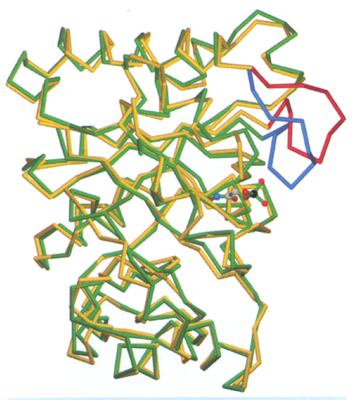
Give an example of a substrate induced conformational change in a protein
Answer
-
Triosephospahte isomerase
-
Alanine amino transferase
-
Polyamine oxidase
-
Myoglobin
Question 40
Question
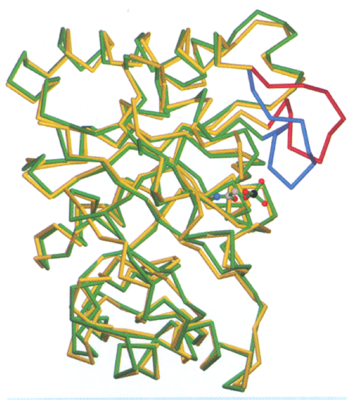
Triosephospahte isomerase shows specific localised large movements on [blank_start]binding[blank_end] substrate. An [blank_start]eight[blank_end] residue loop (red) is in the open configuration prior to substrate binding and closed down over the bound substrate to exclude [blank_start]solvent[blank_end] (blue) upon [blank_start]binding[blank_end]. You will note that this is a localised [blank_start]shape[blank_end] change and that the main body of the protein does not really change shape. Such triggered conformational changes can be quite [blank_start]large[blank_end] in proteins and it is the unique structure of proteins and the inherant flexibility/instability of the molecules that allows this to happen.
Answer
-
binding
-
active
-
eight
-
seven
-
six
-
solvent
-
solute
-
binding
-
inhibition
-
shape
-
bond
-
charge
-
large
-
small
Want to create your own Quizzes for free with GoConqr? Learn more.