
Quiz
Protein section 5
This quiz has question types that open in the usual player.
Questions in this quiz (26)
1The study of the rates of enzyme catalysed reactions is called..
- Aenzyme kinetics
- Benzyme thermodynamics
- Cenzyme Vmax
- Denzymatics
2The simplest way to investigate reaction rate is to monitor [blank_start]increase[blank_end] in reaction product against time. This can be done at a variety of [blank_start]substrate[blank_end] concentrations and the initial velocity of the reaction determined. Eventually the reaction will reach a plateau when the reaction equilibrium has been attained.
In reality enzyme kinetics is more readily understood if we only consider the [blank_start]forward[blank_end] reaction and we define V0 as the number of [blank_start]moles[blank_end] of product formed per second when the reaction is just beginning at t ~0- Aincrease
- Bdecrease
- Csubstrate
- Denzyme
- Eforward
- Fbackwards
- Gmoles
- Hgrams
- Ilitres
3add labels to the enzyme kinetics equation

- Aenzyme
- Bsubstrate
- Cenzyme.substrate complex
- DProduct
- Erate constants
4What are the preconditions of the enzyme kinetics equation
- AInitial velocities (v0), ie [P] = 0
- B[S]>>[E]
- CpKa=pH
- DConstant enzyme concentration
5when is this equation useful?
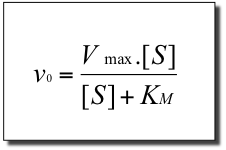
- Awhen looking at enzyme kinetics
- Bwhen calculating Kd
- Cwhen substrate concentration is smallet than the enzyme concentration
- DWhen calculating the colume of the substrate added
6Label the Michaelis-Menten Relationship
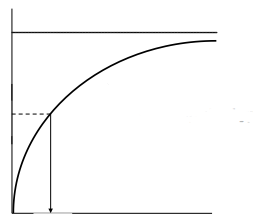
- ARectangular hyperbola
- BKM the Michaelis constant
- C[S]
- DV0
7The Michaelis constant is a measure of the affinity of the enzyme for its substrate
and is expressed as..- AKm
- BKd
- CKcat
- DKw
- EKc
- FVmax
8Kcat is...
- AThe catalytic constant
- BThe Michaelis constant
- CThe catabolic constant
- DThe compressed anabolic temperature constant
9A low KM means a low affinity of enzyme for substrate
- ATrue
- BFalse
10How can you find Kcat?
- Akcat = Vmax/[Eo]
- Bkcat=Vmax*[Eo]
- Ckcat=Vo/[Eo]
- Dkcat=Vo*[Eo]
- Ekcat=(Vmax*[S]) / ([S]+Km)
11kcat is the number of substrate molecules transformed per molecule of enzyme per second (units are s-1) or i.e...
- Aturnover number
- Bequilibrium number
- Ccatalytic number
- Dtransformation number
- Ecritical number
12Label each column
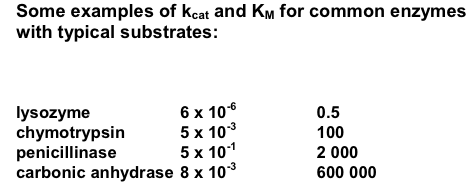
- AEnzymes
- BKm (mol.L-1)
- Ckcat (s-1)
13Enzymes are capable of working on a number of substrates, some better than others. The efficiency of these enzymes depends both on kcat and on KM.
- ATrue
- BFalse
14The specificity constant is defined as..
- Akcat/KM
- Bkcat
- CKM
- DVmax
- EVo
- FKd/kcat
15 The [blank_start]higher[blank_end] the kcat and [blank_start]the lower[blank_end] the KM the bigger the specificity constant.
The best substrate for an enzyme will have the [blank_start]highest[blank_end] specificity constant.
This constant also describe the [blank_start]catalytic[blank_end] efficiency of enzymes.- Ahigher
- Blower
- Cthe lower
- Dthe higher
- Ehighest
- Flowest
- Gcatalytic
- Hcatabolic
16What is the name of this equation?
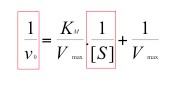
- ALineweaver-Burk plot
- BThe Michaelis-Menten Relationship
- CEnzyme kinetics
17Label the Lineweaver plot
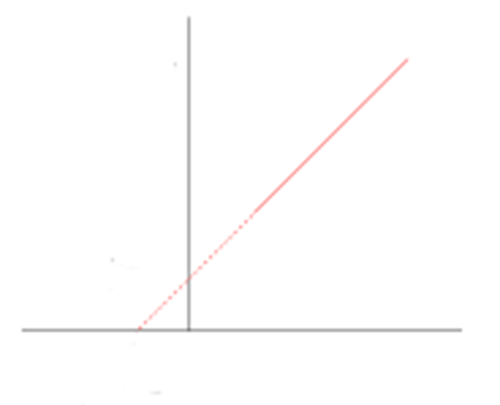
- A1/Vo
- B1/[S]
- C1/Vmax
- D-1/Km
18Inhibitors can also be very useful substances used as pharmaceuticals. Examples would be [blank_start]penicillin[blank_end] which inhibits the enzyme responsible for cell wall biosynthesis in certain bacteria [blank_start]and aspirin (methyl salicylate)[blank_end] which binds to and inhibits cyclooxygenase enzymes.
- Apenicillin
- Baspirin (methyl salicylate)
- Cand aspirin (methyl salicylate)
- Dand penicillin
19There are two types of inhibition, REVERSIBLE and IRREVERSIBLE.
Reversible inhibition is said to be [blank_start]COMPETITIVE[blank_end] whereas irreversible inhibition [blank_start]can be NON-COMPETITIVE or UNCOMPETITIVE.[blank_end]- ACOMPETITIVE
- BNON-COMPETITIVE OR UNCOMPETITIVE
- Ccan be NON-COMPETITIVE OR UNCOMPETITIVE.
- Dcan be COMPETITIVE
20This inhibition is...
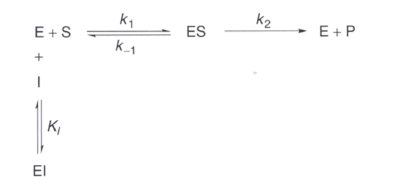
- AReversible Competitive
- BReversible Non-competitive
- CIrreversible Uncompetitive
- DIrreversible Non-competitive
- EIrreversible Competitive
21In competitive inhibition KM is [blank_start]increased[blank_end] but Vmax remains unaltered.
An example of competitive inhibition is inhibition of succinate dehydrogenase by malonate. Malonate competes with succinate for [blank_start]binding[blank_end] at the active site but cannot be converted to fumerate. [blank_start]Increasing[blank_end] the concentration of succinate competes out the inhibitor.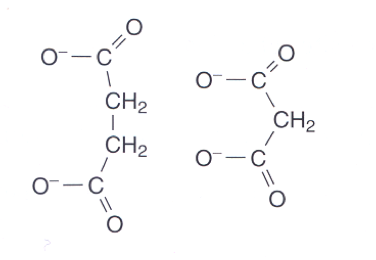
- Aincreased
- Bdecreased
- Cbinding
- Dinhibition
- EIncreasing
- FDecreasing
22This inhibition is...
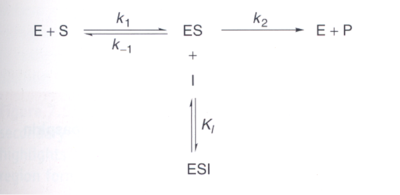
- AReversible competitive
- BIrreversible competitive
- CIrreversible uncompetitive
- DReversible uncompetitive
- EReversible non-competitive
- FIrreversible non-competitive
23In uncompetitive inhibition KM is [blank_start]unaltered or appears reduced[blank_end] and Vmax is [blank_start]dramatically reduced[blank_end]
There is no requirement for the inhibitor to resemble the structure of the [blank_start]substrate[blank_end]. The inhibitor does not bind to free enzyme only to [blank_start]ES complexed[blank_end] enzyme. It is believed that these type of inhibitors distort the active site region [blank_start]preventing[blank_end] further substrate turnover.- Aunaltered or appears reduced
- Bincreased
- Cdramatically reduced
- Dincreased
- Esubstrate
- Fenzyme
- GES complexed
- HS
- Ipreventing
- Jinducing
24This inhibition is..
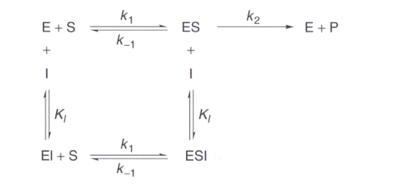
- AReversible Non-competitive
- BReversible competitive
- CIrreversible Non-competitve
- DIrreversible competitive
- EReversible uncompetitive
- FIrreversible uncompetitive
25A non-competitive inhibitor binds to both the free E and the ES complex and the effect of this is to [blank_start]lower[blank_end] the effective number of enzyme molecules. The rsult is [blank_start]a decrease[blank_end] in Vmax as a result of changes in [blank_start]kcat[blank_end].
Vmax is [blank_start]reduced[blank_end] and KM is not normally effected- Alower
- Bincrease
- Ca decrease
- Dan increase
- Ekcat
- FKm
- GVo
- HKd
- Ireduced
- Jincreased
26What are the EXAMPLES OF IRREVERSIBLE ENZYME INHIBITORS
- AAspirin
- BCyanide
- CPenicillin
- DRetinol
- EHaemoglobin
- FParacetamol
Information
- Description
- 1st year Biochemistry and molecular biology Quiz on Protein section 5, created by MrSujg on 27/11/2015.
- Author
- MrSujg
- Language
- English
- Views
- 364
- Tags
- Rating
- 2.0 out of 5 · 1 rating Rate this quiz