
9336936


Question 1
Question
Let R be an equivalence relation defined on a set S and define [a]= {b in S| bRa}. Then _______________
Answer
-
{[a]|a is in S} is a partition of S
-
{[a]|a is in S} is a subset of S
-
{[a]|a is in S} is a subgroup of S
Question 2
Question
True or False, if S is a set closed under a binary operation * , then S contains more than one identity
Answer
- True
- False
Question 3
Question
Let S be a set closed under a binary operation *, with identity e, where * is ([blank_start]Answer 1[blank_end]). Then x (in S) has ([blank_start]Answer 2[blank_end]) Inverses.
Answer
-
Closed
-
Commutative
-
Associative
-
Distributive
-
At most 1
-
More than 1
Question 4
Question
Let S be a set, closed under an associative binary operation *, with identity e. Then, if x^-1 and y^-1 exist then
Answer
-
(x*y)^-1 = y^-1 * x^-1
-
(x*y)^-1 =x^-1 * y^-1
Question 5
Question
Suppose n is a Irrational Number and S a set closed under associative binary operation * then x^n = x * x * x * ... * x (n terms)
Answer
- True
- False
Question 6
Question
A group is a pair (S,*) where S is a non-empty set and * a binary operation on S such that;
S is [blank_start]ANSWER 1[blank_end] under *,
* is [blank_start]ANSWER 2[blank_end] on S,
S has [blank_start]ANSWER 3[blank_end] w.r.t. to * denoted e,
every element in S has an [blank_start]ANSWER 4[blank_end], denoted x^-1 in S
Answer
-
Closed
-
Isometric
-
Equivalent
-
Prime
-
Associative
-
Distributive
-
Non-Zero
-
Non-Empty
-
Field
-
Commutativity
-
Delta
-
Identity
-
Inverse
-
Element
-
Even parity
-
Odd power
Question 7
Question
Tick the properties required for the General Linear Group of degree n
Answer
-
Non-singular (Invertible)
-
Matrix size n x n
-
Symmetric matrix
-
Transposition notation
Question 8
Question
What are the properties of an ISOMETRY
Answer
-
Bijective Mapping
-
Distance Preserved
-
f(xy) = f(x)f(y)
-
Symmetrical
Question 9
Question
If P is the set of points representing a figure in space, and G is the set of all isometries that map P onto itself, then (G, *) is a group called the Symmetry Group Of P
Answer
- True
- False
Question 10
Answer
-
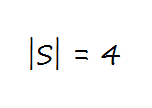
The set S has four elements in it.
Question 11
Question
Let (G, *) be a group with identity element e and consider some element a in G. What does it mean to say that a has period w?
Answer
-
a^w = e
-
a^w = 0
Question 12
Question
Complete the following definition: Let (G,*) be a group and H be a [blank_start]subset[blank_end] of G. Then, H is a [blank_start]subgroup[blank_end] of G [blank_start]if and only if[blank_end] (H,*) is a group.
Answer
-
subset
-
group
-
unit
-
isometry
-
subgroup
-
group
-
set
-
period
-
if and only if
-
if
-
when
-
providing
Question 13
Question
True or False: If (H,*) is a subgroup of (G,*) then;
i) they have the same identity
ii) the inverse of x in H is the inverse of x in G
Answer
- True
- False
Question 14
Question
Complete the definition: If H is a [blank_start]non-empty[blank_end], finite, subset of the [blank_start]elements[blank_end] of a group (G,*), then (H,*) is a subgroup of (G,*) [blank_start]if and only if[blank_end] H is [blank_start]closed[blank_end] under *.
Answer
-
non-empty
-
non-zero
-
ring
-
matrix
-
elements
-
period
-
order
-
parity
-
if and only if
-
if
-
and
-
when
-
closed
-
commutative
-
associative
-
invertible
Question 15
Question
Let (G,*) be a group and x be in G. Then _____________ forms a subgroup of (G,*) called the cyclic subgroup generated by x, denoted <x>
Answer
-
{x^n|n is an integer}
-
{yx|y is in a group H}
-
{x+kn|n,k are integers}
-
fi(n) = |{x is natural| x<_ n and gcd (x,n)=1}| for all naturals n
Question 16
Question
Select the properties for which a binary operation is uniquely defined
Answer
-
Closed
-
Associativity
-
Commutativity
-
Identity
-
Distributivity
-
Relation
-
Inverse
-
Finite
Question 17
Question
True or False, if (G,*) is a cyclic group with generator a, denoted <a>. Then |G| = period of a
Answer
- True
- False
Question 18
Question
Which ONE of the following is used to describe a LEFT COSET?
Answer
-
{x^n|n is an integer}
-
fi(n) = |{x is natural| x<_ n and gcd (x,n)=1}| for all naturals n
-
{x+kn|n,k are integers}
-
{xy|y is in a group H}
Question 19
Question
Which of the following describes that
a) the period of the coset is the period of the set
b) each element can only be in one coset
( G is a finite group and H a subgroup). SELECT TWO
Answer
-
For all g in G, |gH| = |H|
-
For all g1, g2 in G, either g1H = g2H or g1H n g2H = EmptySet
-
|gH| = 0
-
g1H = g2H and g1H n g2H = g1H u g2H
Question 20
Question
[blank_start]LAGRANGE[blank_end]'S THEOREM: Let (H,*) be a subgroup of a [blank_start]finite[blank_end] group (G,*). Then the number of [blank_start]elements[blank_end] in H divides the number of elements in G; that is IHI | IGI
Answer
-
Lagrange
-
Cauchy
-
Silow
-
Wilson
-
finite
-
infinite
-
non-empty
-
abelian
-
elements
-
subgroups
-
sets
-
identities
Question 21
Question
Let (G,*) be a finite group of order n and let g be an element with period k. Then i) k|n (ie. the period of an element divides the order or the group) and ii) g^n = e
Answer
- True
- False
Question 22
Question
Complete the theorem: Let (G,*) be a [blank_start]finite[blank_end] group of order p, where p is [blank_start]prime[blank_end]. Then, (G,*) is [blank_start]cyclic[blank_end]
Answer
-
finite
-
infinite
-
closed
-
associative
-
prime
-
non-empty
-
non-zero
-
irrational
-
cyclic
-
empty
-
a field
-
partitioning
Question 23
Question
Which of the following are properties of a homomorphism?
Answer
-
f(xy)=f(x)of(y)
-
bijective
-
distances preserved
Question 24
Question
Which of the following hold for an Isomorphism of groups f: G1 -> G2
Answer
-
identity in G1 = identity in G2
-
|x| = |f(x)| same period
-
G1 is abelian iff G2 is abelian
Want to create your own Quizzes for free with GoConqr? Learn more.