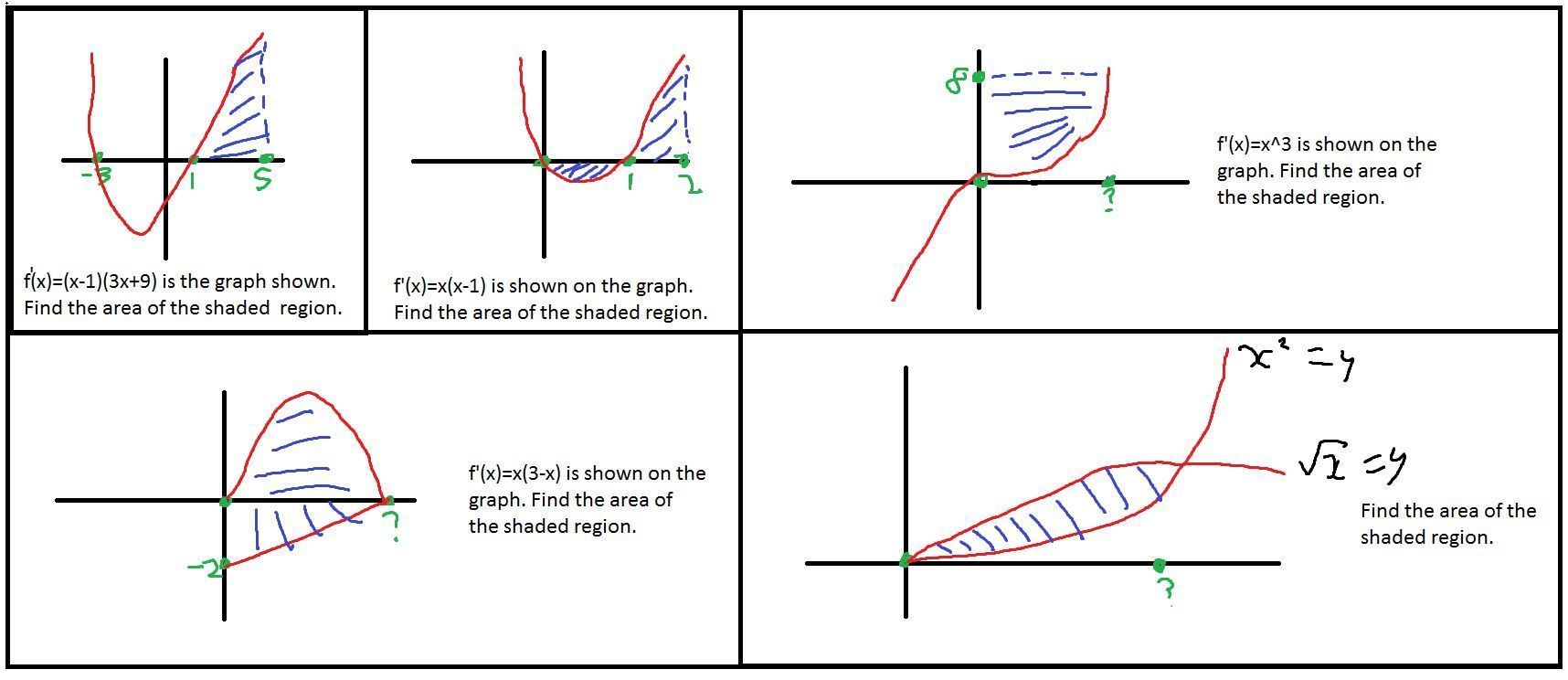
1. y=(x-1)(3x+9) = 3x^2+6x-9 , 5∫1 (3x^2+6x-9) dx ; [3x^3/3 + 6x^2/2 - 9^2/2]^(5 1) , (3(5)^3/3 + 6(5)^2/2 - 9^2/2) - (3(1)^3/3 + 6(1)^2/2 - 9^2/2) = 160 = A
2. 2∫1 (x^2-x)dx = -1/6 , 2∫0 (x^2-x)dx = 2/3 , so 2/3 - (-1/6) = 5/6. 1∫0 (x^2-x)dx = -1/6 , so 5/6 + 1/6 = 1. Area = 1
3. Cube root of 8=2, so 2∫0 (x^3)dx = 4. Now we find the entire area of the rectangle and take this away, so 2 x 8 =16, and 16/4=12, so A=12
4. The missing x-coordinate is 3, as we get this when we factorise the function. Now 3∫0 (-x^2-3x) = 9/2. We add this the the area of the triangle next, so 9/2 + 3x2 / 2 = 7.5 (Area)
5. To find the missing x-coordinate, we could use a simultaneous equation, so root(x)=x^2, x=x^3 so therefore x must equal 1. Now do 1∫0 (root(x))dx - 1∫0 (x^2)dx = 1/3
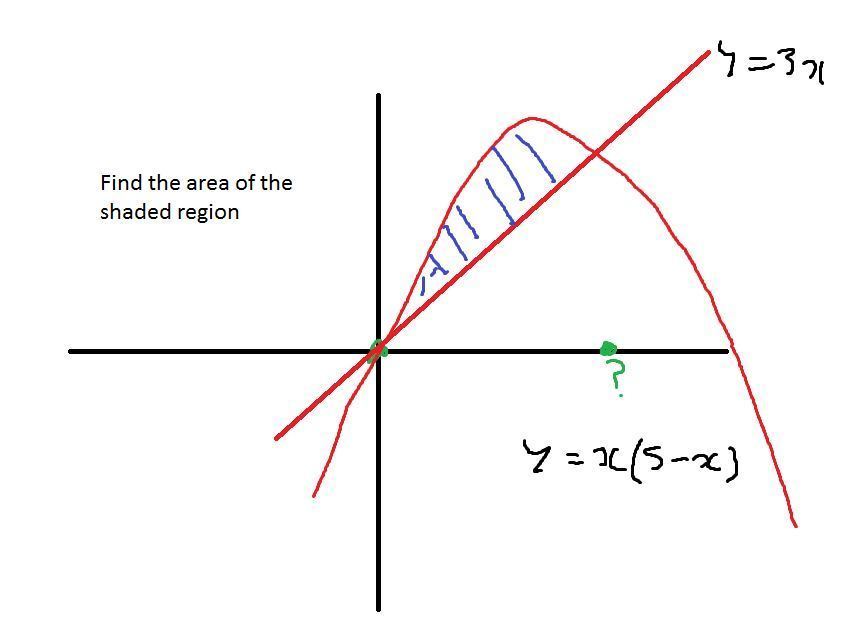
Use simultaneous equation to find x-coordinate of intersection ; 3x=5x-x^2 , x^2-2x=0 , so x=0 or 2.
Now find the area under the curve ; 2∫0 (5x-x^2)dx = 22/3
Area under line ; 2∫0 (3x)dx = 6
Subtract ; 22/3 - 6 = 4/3, so area = 4/3.
Slide 5
1. 5∫4 (2A^2-6x^2)dx = 120A. Find the value of A
2. 4∫1 (A-2root(x))^2 dx = 10-A^2. Find the value of A.