Quantum Physics Part 1 - Photoelectric effect

Description

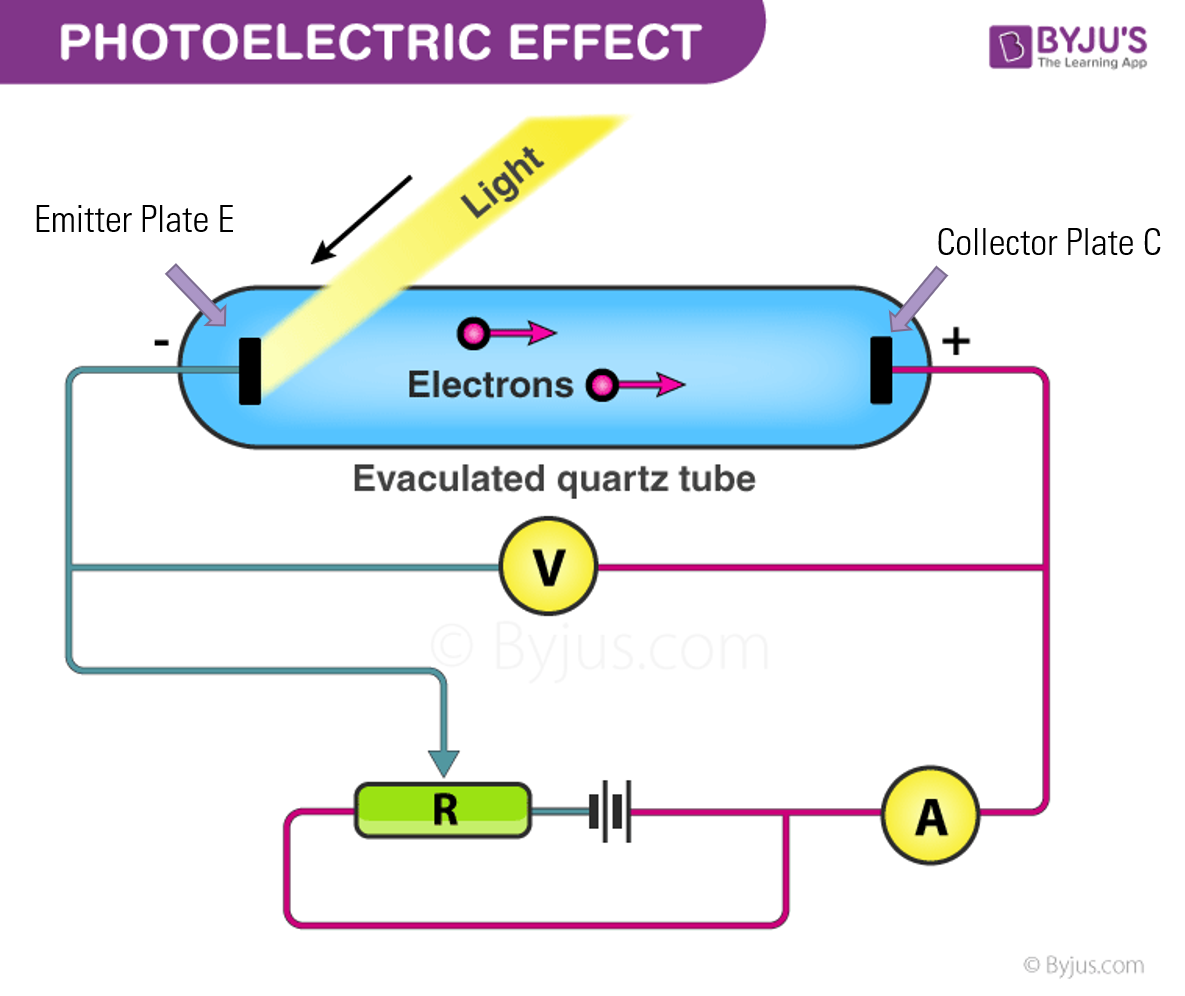
Photoelectric effect. EM radiation (photons) shines at emitter plate, if frequency high enough emit photoelectrons to be absorbed by collector plate Collect all or none Reverse polarity of variable voltage source to find stopping potential
Jia Zhen Yee
Slide Set by Jia Zhen Yee, updated more than 1 year ago
Jia Zhen Yee
Created by Jia Zhen Yee over 4 years ago
1
0

Resource summary

Slide 1

    Photoelectric Effect
    Electrons absorb energy from incident EM radiation. Electrons are emitted when they get enough energy causing current to flow in the circuit. The emitted electrons are called photoelectrons. *Photoelectric effect is the phenomenon where electrons are emitted from a metal surface when electromagnetic radiation of sufficiently high frequency is incident on the surface. *Photoelectric Experiment Setup: When radiation of sufficiently high frequency (greater than threshold frequency) is incident on the emitter plate E, it will emit electrons. The variable voltage source maintains electrodes at different know potentials. The emitted electrons from E (that have sufficient energy) will travel to the collector C and a current (known as photocurrent) will be detected by the ammeter as the electrons complete the loop in the circuit.
    Caption: : Fig 1. The Photoelectric Experiment

Slide 2

    Photon
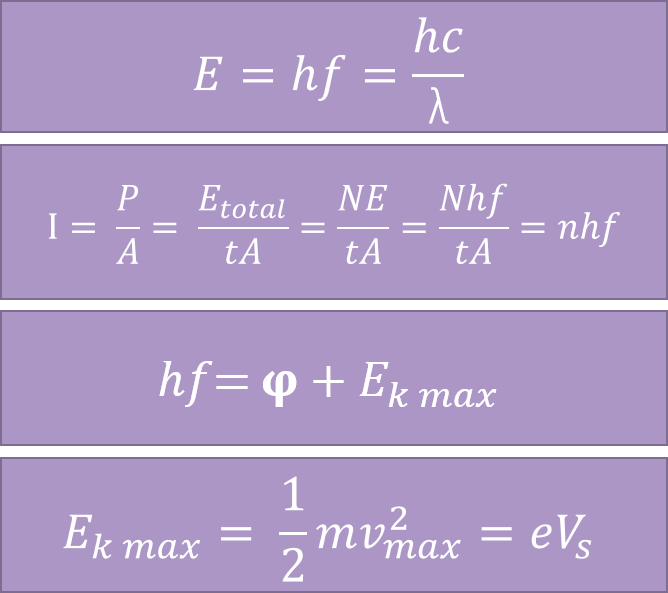
    A photon is a discrete bundle (or quantum) of electromagnetic energy. E: energy of a single photon - dependent on frequency - for a given frequency, a beam of EM radiation of greater intensity simply means more photons per unit time and not greater energy Total E = total energy of all the photons n: no. of photons passing a unit area per unit time Work function energy φ of a material is defined as minimum amount of the energy necessary to remove an electron frm the surface of the material. range of kinetic energies, more energy required to let electrons below the surface to escape By principle of conservation of energy, photo energy absorbed is converted to maximum KE after overcoming work function of metal.  
    Caption: : Fig 2. equations for photoelectric effect

Slide 3

    Quantum Analysis of the Photoelectric Effect
    When an EM radiation is directed at a metal surface, a stream of particles bombards the surface of the metal. Any free electron near the surface could absorb an incoming photon and gain all the energy of the photon.* (a photon must be absorbed as a whole by a single electron. Absorb all or nothing. If the gain in energy is sufficient, the electron can leave the plate. (escape) A photon that is not absorbed will be reflected or transmitted. Electrons are emitted INSTANTANEOUSLY: all the photon energy is delivered immediately to the electron in a single absorption hence no time delay and is independent on the intensity of the incident radiation.  

Slide 4

    Threshold frequency
    MINIMUM frequency of the incident radiation for the electron to escape. i.e. MAXIMUM wavelength of the incident radiation for the electron to escape For photoelectric emission to occur, f > threshold f or λ < threshold λ
Show full summary Hide full summary

Similar

AQA Physics P1 Quiz
Bella Statham
GCSE AQA Physics - Unit 3
James Jolliffe
Using GoConqr to study science
Sarah Egan
GCSE AQA Physics 1 Energy & Efficiency
Lilac Potato
Waves
kate.siena
Forces and their effects
kate.siena
Junior Cert Physics formulas
Sarah Egan
Forces and motion
Catarina Borges
OCR Physics P4 Revision
Dan Allibone
P2 Radioactivity and Stars
dfreeman
Physics 1A - Energy
Zaki Rizvi