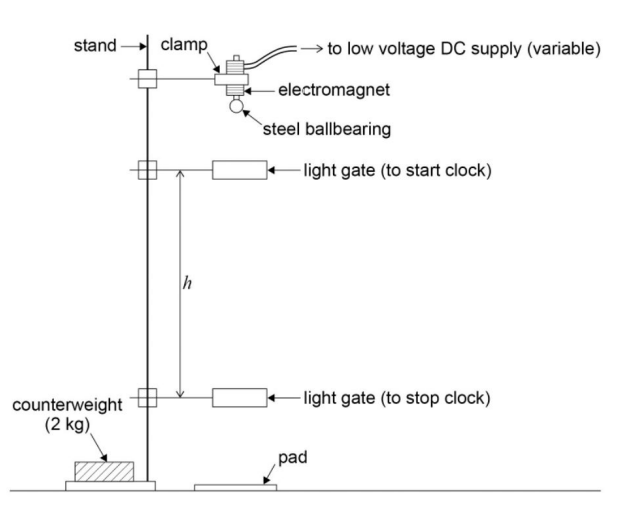
Stand and clamp
Electromagnet
Steel ball bearing
Light gate
Stopwatch
Slide 2
Method
Set up the apparatus as shown in the diagram.
The position of the lower light gate should be adjusted such that the height h is 0.500m, measured using the metre ruler.
Turn on the electromagnet and attach the ball bearing. Reset the stopwatch to zero and switch off the electromagnet. Read and record the time t on the stopwatch.
Reduce h by 0.050m by moving the lower light gate upwards and repeat this, reducing h by 0.050m each time down to 0.250m.
Repeat the experiment twice more and find and record the mean t for each h
Plot a graph of 2h/t against t and draw a line of best fit. The gradient will be g.
h = ut +1/2gt^2 ⇒ 2h/t = 2u+2g
The y intercept is 2u, where u is the speed of the ball bearing when it reaches the
top light gate (which we don’t need).
Slide 4
Safety
Use a counterweight or clamp the stand to the table to avoid it toppling over and causing injury
Slide 5
Improvements and notes
The distance between the upper light gate and the starting position of the ball bearing must be kept constant so that it reaches the upper light gate with the same speed each time.
The ball bearing can be cushioned by a pad which is inside a tray at the bottom of the clamp so it does not fall off dangerously.
The ball bearing should be dense to help mitigate the effects of air resistance.
To reduce parallax error in measuring the height, the ruler can be clamped directly next to the light gates.