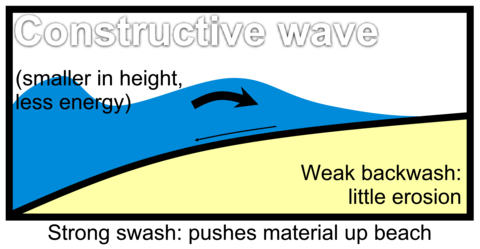
Constructive waves:1) The waves have a low frequency (6-8 waves per minute2) They are low and long3) The swash is powerful and it carries material up the beach4) The backwash is weaker and it doesn't take a lot of material back down the beach. This means material is deposited on the coast.
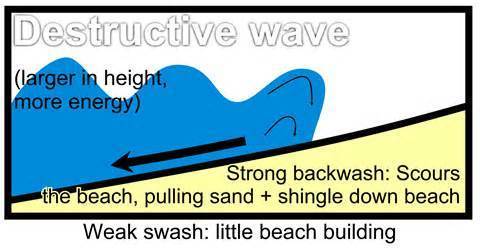
Destructive waves:1) They have a high frequency (10-14 waves per minute)2) They are high and steep3) Their backwash is more powerful than their swash. This means material is removed from the beach
Slide 3
Mechanical Weathering
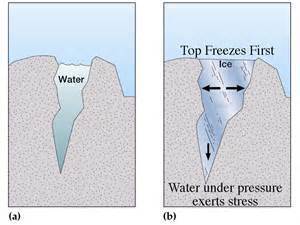
Mechanical Weathering is the breakdown of rock without changing it chemical composition. There's one main type of mechanical weathering that occurs on the coast: freeze-thaw weathering (onion skin)Freeze-thaw Weathering1) It happens when the temperature alternates above and below 0 degrees, (the freezing point of water)2) Water gets into the rock that has cracks e.g. granite3) When the water freezes it expands, which puts pressure on the rock4) When the water thaws it contracts, which releases the pressure5) Repeated freezing and thawing widens the cracks and causes the rocks to break up
Chemical weathering is the breakdown of rock by changing its chemical composition. Carbonation weathering is a type of chemical weathering that happens in warm and wet conditions.1) rainwater has carbon dioxide dissolved in it, which makes it a weak carbonic acid.2) Carbonic acid reacts with rock that contains calcium carbonate e.g. carboniferous limestone, so the rocks are dissolved by rain water.
Slide 5
Mass Movement
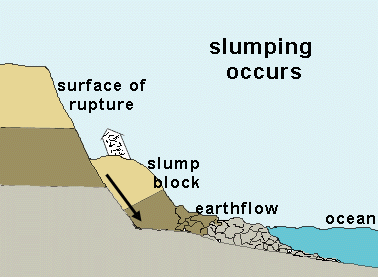
Mass movement is the shifting of rocks and loose material down a slope e.g. a cliff. It only happens when the force of gravity going down the slope is larger than the force holding it up. Mass movement causes coasts to retreat rapidly. It is more likely to happen when the material is full of water (saturated) - it acts as a lubricant and also ways down the material. The tow types of mass movement are:1) Slides: material shifts in a straight line2) slumps: material shifts with a roation