-Five constant acceleration equations:*assumptions - the object is a particle (i.e. very small, not affected by air resistance) - acceleration is constant.1) v=u+at acceleration = change in velocity/change in time.2) s=ut+1/2at^23) s=[(u+v)/2] xt4) v^2=u^2+2as5) s=vt-1/2at^2
M1 - Kinematics
Slide 2
Motion Graphs - Displacement-Time Graph
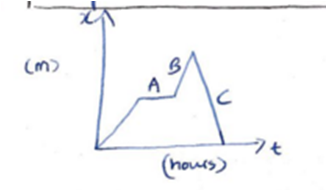
*Velocity and displacement are vector quantities.*Displacement is how far the object is from the origin; whereas distance is how much the object has travelled.*Velocity is the rate the object changes position; while speed is how fast it is moving.*Therefore, displacement and velocity have the ability to be negative. For example, at C, the person is walking at a velocity of 30ms^-1. This means, speed of 30ms^-1 in the opposite direction.
Caption: : A=Horizontal line= zero gradient. No displacement, thus is not moving. B=The steeper the line, the greater the velocity. *Height=distance. *Gradient=velocity.
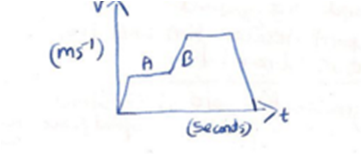
A=Constant velocityB=Accelerating.*Area= distance*Gradient= acceleration*To get the area, split the graph into rectangles, triangles of trapeziums, calculate individuals areas and add.