
The Kalam Causal Argument
Slides in this set (12)
-
- This is an originally Arabic, inductive philosophical argument.
- Kalam refers to Arabic philosophy and theology.
- In modern terms, we could cite William Craig as an exponent of it.
-
- All that begins to exist has a cause for its existence.
- The universe began to exist.
- Therefore, the beginning of the universe had a personal cause.
- Thus...
- God is the cause as there has to be something external to the universe to cause it.
- The argument is remarkably straightforward. However, the assumptions in premises 1 and 2 are quite complex.
- The debate concerning the Kalam argument centres on whether or not all the things that exist do indeed need a cause; and on whether or not the universe did begin to exist, or whether it has always existed.
-
- To understand the Kalam Causal Argument, we must first be familiar with what the word 'infinite' means.
- 'Infinite' refers to something that is "limitless or endless in space, extent, or size; impossible to measure or calculate."


-
Why must the universe have a beginning?
- Actual infinites cannot exist in the world
- A beginning-less, temporal series of events is an actual infinite.
- To say that the universe has no beginning, is to say that there is an actual infinite number of past events in the history of the universe.
- This cannot be the case.
- Craig uses the example of a library. The first library has an infinite number of red books, and the second has an infinite number of black books and an infinite number of red books. The second library has twice as many books as the first, but it can't have. Also, if each book has infinite number of pages, to read one would be like reading every book. This also cannot be the case.
- Therefore, actual infinites are incompatible with the real world.
- The impossibility of traversing an actual infinite
- Even if we do accept that actual infinites are possible in the real world, there is another problem with their existence;
- The actual infinite must occur all at once because you cannot traverse (cross) an actual infinite by successive addition.
- A temporal series of events is formed by successive addition.
- Therefore, the history of the universe cannot be infinite.
- If it isn't infinite, it must be finite. Finite things must have a first term or beginning.
- Thus, the universe must have had a beginning.
- There are two explanations for the impossibility of traversing an actual infinite, which are shown on the next slide.
-
- Explanation 1:
- Cause and effect applies to a contingent world. For an event to occur, it must have a cause.
- The past is a long chain of causes and effects.
- There must have been a first cause in order that the first effect could have come about. "A causal sequence leading up to an event must have had a first member and determinate number of members in the sequence, since the entire event is already actual." An infinite succession of past events wouldn't let this happen.
- Explanation 2:
- It's impossible to count to infinity. A series formed by successive addition is a potential infinite. But at any given moment, it is always finite.
- The past must have been finite, because the present moment is the most recent member of a series of past events formed by successive addition, and one cannot reach infinity one at a time.
-
-
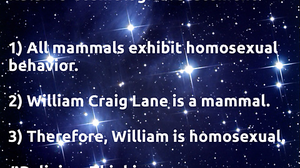
- This is a type of philosophical error that in and of itself. It is an unjustified assumption that a characteristic held by members of the group automatically pertains to the group as a whole. The group may have that characteristic, but is it wrong to just assume that it does.
- Bertrand Russell used the example all men having mothers does not mean that there is a mother of all men in the radio debate.
- David Hume argues that if we have the explanation of each of twenty particles of matter, it would inappropriate to then ask what the cause of the group is, because that is given by the explanation of the cause of particles. Also, just because there is an explanation for each individual particle, does not mean that there is a cause for the group as a whole. The mistake is calling the individual particles a group.
- To say that the universe must be caused because the things in it are caused is therefore falling victim to the quantifier shift fallacy. There is no evidence to suggest that God is the cause of the universe, therefore, the argument is fundamentally flawed.
-
The Challenge of Quantum Physics
- The claim that something can spring from nothing is actually intelligible.
- Recent developments in Quantum physics suggest that electrons can pass out of existence at one point, and come back in another.
- So far, we can't trace their immediate existence or what causes them to come into existence at a given point. Something appears to come from nothing.
- Craig's response is that the vacuum is a place of minimal energy, so electrons do not appear from nothing, but rather are a result of vacuum fluctuations.
- It's hard to know what to make of this theory. Essentially, we need to wait for developments in our scientific knowledge before we can determine how strong the claim is.
-
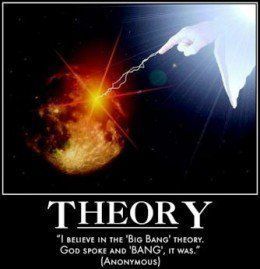
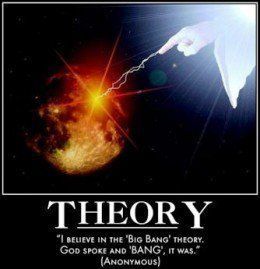
- The conclusion may be false, as the Conservation of Energy law doesn't account for the Big Bang. So at one stage in the history of the universe, its energy increased from zero.
- This explosion released energy from which all matter emerged. So out of nothing, everything came.
- Again, we have to wait for developments in astrophysics to find out if the argument is correct or not. But it's a useful illustration of how a simple argument is in fact, very, very complex.
-
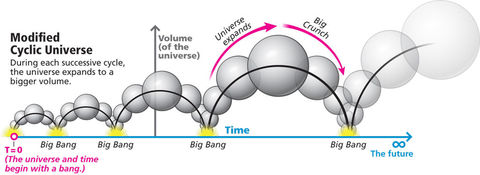
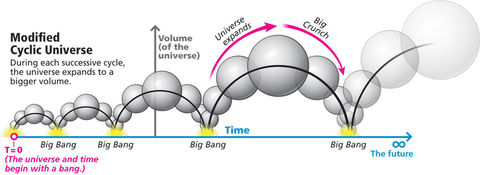
What if the universe is oscillating?
- If the oscillating universe is true, then there was never a beginning to the universe.
- Determining whether the oscillating universe model or the infinitely expanding universe model is correct depends on calculations of the of the total amount of matter in the universe.
- Some argue that the density of matter in the universe is now insufficient to halt the expansion of the universe; it has passed its gravitational threshold and will continue to expand forever.
- Others claim that there is a great quantity of dark matter in the universe, which means that we have not so far passed the critical threshold beyond which the contraction of the universe would be impossible.
- Clearly, this argument also depends on further developments in astrophysics.
-
- While there is no conclusive evidence either way, it might well be said that a considerable amount of doubt surrounds the Kalam Causal Argument, and as such, it might be best to try to find an argument that does not rely on these dubious elements for its success.
- Modern versions of the Cosmological Argument do not fall foul of these criticisms, as they are not based on arguments from temporal regression, but on a need for an explanation/dependence - the idea that there must be something upon which a contingent universe is dependent upon for its existence.
-
Information
- Description
- AS - Level (Year 1) Philosophy (4b) Traditional Arguments for the Existence of God - Cosmo.) Slide Set on The Kalam Causal Argument, created by Summer Pearce on 10/05/2016.
- Created by
- Summer Pearce
- Views
- 6
- Rating