Reflection & Refraction

Description

KS3 Physics Slide Set on Reflection & Refraction, created by Andrew Gilmour on 04/06/2016.
Andrew Gilmour
Slide Set by Andrew Gilmour, updated more than 1 year ago
Andrew Gilmour
Created by Andrew Gilmour over 9 years ago
8
1

Resource summary

Slide 1

    How light travels
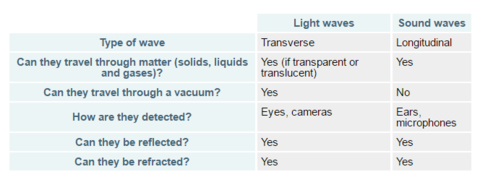
    Light travels as waves. These are transverse waves, like the ripples in a tank of water. The direction of vibration in the waves is at 90° to the direction that the light travels.Light travels in straight lines, so if you have to represent a ray of light in a drawing, always use a ruler.Unlike sound waves, light waves can travel through a vacuum (empty space). They do not need a substance to travel through, but they can travel through transparent and translucent substances. The table summarises some similarities and differences between light waves and sound waves::

Slide 2

    Speed of Light
    Light travels extremely quickly. Its maximum speed is approximately 300,000,000 m/s, when it travels through a vacuum.The very large difference between the speed of light in air (almost 300,000,000 m/s) and the speed of sound in air (343 m/s) explains why you: see lightning before you hear it see a firework explode before you hear it see a distant door slam before you hear it

Slide 3

    Reflection
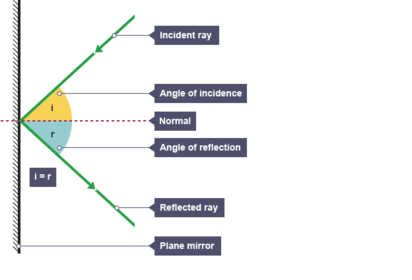
    A ray diagram shows how light travels, including what happens when it reaches a surface. In a ray diagram, you draw each ray as: a straight line with an arrowhead pointing in the direction that the light travels Remember to use a ruler and a sharp pencil. The law of reflectionWhen light reaches a mirror, it reflects off the surface of the mirror: the incident ray is the light going towards the mirror the reflected ray is the light coming away from the mirror
    Caption: : A ray diagram for reflection at a mirror

Slide 4

    In the ray diagram: the hatched vertical line on the right represents the mirror the dashed line is called the normal, drawn at 90° to the surface of the mirror the angle of incidence, i, is the angle between the normal and incident ray the angle of reflection, r, is the angle between the normal and reflected ray The law of reflection states that the angle of incidence equals the angle of reflection, i = r. It works for any angle. For example: the angle of reflection is 30° if the angle of incidence is 30° the angle of reflection is 90° if the angle of incidence is 90° In the second example, if a light ray travelling along the normal hits a mirror, it is reflected straight back the way it came. The reflection of light from a flat surface such as a mirror is called spectacular reflection– light meeting the surface in one direction is all reflected in one direction.
    Ray Diagram

Slide 5

Slide 6

    Scattering
    If light meets a rough surface, each ray obeys the law of reflection. However, the different parts of the rough surface point in different directions, so the light is not all reflected in one direction. Instead, the light is reflected in all directions. This is called diffuse scattering. It explains why you can see a clear image of yourself in a shiny flat mirror, but not in a dull rough wall.

Slide 7

    Imaging Mirrors
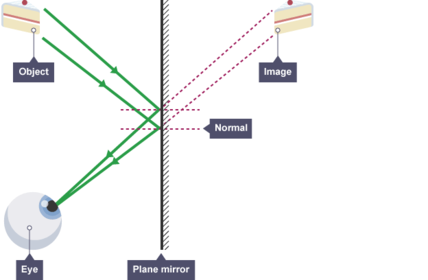
    A plane mirror is a flat mirror. When you look into a plane mirror, you see a reflected image of yourself. This image: appears to be behind the mirror is the right way up is ‘laterally inverted’ (letters and words look as if they have been written backwards) You can use a ray diagram to show how an image in a mirror forms.Notice that the ‘real’ rays, the ones leaving the object and the mirror, are shown as solid lines. The ‘virtual’ rays, the ones that appear to come from the image behind the mirror, are shown as dashed lines. Remember that each incident ray will obey the law of reflection.
    Caption: : A ray diagram to show how an image forms in a mirror

Slide 8

    Refraction
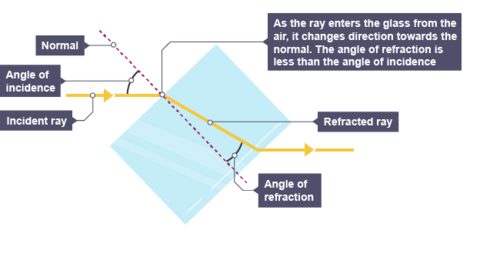
    Light waves change speed when they pass across the boundary between two substances with a different density, such as air and glass. This causes them to change direction, an effect called refraction.At the boundary between two transparent substances: the light slows down going into a denser substance, and the ray bends towards the normal the light speeds up going into a less dense substance, and the ray bends away from the normal The diagram shows how this works for light passing into, and then out of, a glass block. The same would happen for a Perspex block:

Slide 10

Slide 11

    Focusing
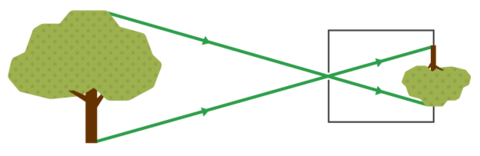
    Light can be focused so that it appears to meet at a single point. Focusing is important for getting clear images in our eye or in photographs. Images that are not focused appear blurred. The pinhole camera A pinhole camera consists of a box or tube with a translucent screen at one end and a tiny hole (the pinhole) made in the other end. Light enters the box through the pinhole and is focused by the pinhole onto the translucent screen. The image is upside down and smaller than the object.
    Caption: : A ray diagram to show focusing in a pinhole camera

Slide 12

    The Convex Lens
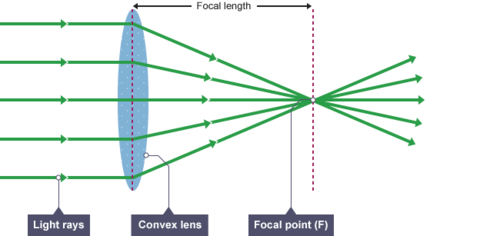
    A convex lens is made from a transparent material that bulges outwards in the middle on both sides. It can focus light so that appears to meet at a single point, called the focal point. Light is refracted as it passes into, then out of, the lens.Convex lenses are found in: magnifying glasses spectacles for people with long-sight (who can see distant objects clearly but not nearby ones) telescopes
    Caption: : A ray diagram to show how a convex lens can focus light

Slide 13

    Colour
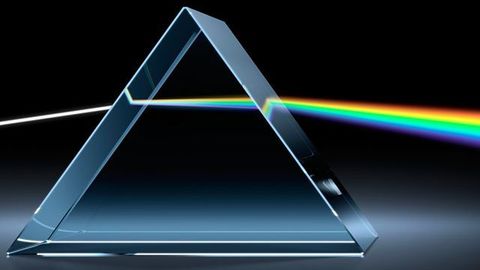
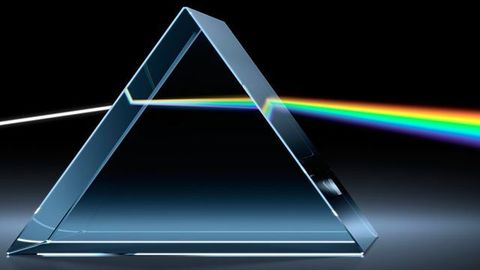
    White light is a mixture of many different colours, each with a different frequency. White light can be split up into a spectrum of these colours using a prism, a triangular block of glass or Perspex.Light is refracted when it enters the prism, and each colour is refracted by a different amount. This means that the light leaving the prism is spread out into its different colours, a process called dispersion.
    Caption: : Dispersion of white light by a prism into a spectrum

Slide 14

    Here are the seven colours of the spectrum listed in order of their frequency, from the lowest frequency (fewest waves per second) to the highest frequency (most waves per second): red orange yellow green blue indigo violet This mnemonic is one way to remember the order: ‘Richard Of York Gave Battle In Vain’.
    The Spectrum

Slide 15

    Coloured Light
    There are three primary colours in light: red, green and blue. Light in these colours can be added together to make the secondary colours magenta, cyan and yellow. All three primary colours add together make white light.The way coloured light mixes is very different from the way that paint does.When light hits a surface, some of it is absorbed and some of it is reflected. The light that is reflected is the colour of the object in that light. For example, a blue object absorbs all the colours of the spectrum except blue: it reflects blue light.
    Caption: : Primary colours of light add together to make white light, or secondary colours
Show full summary Hide full summary

Similar

AQA Physics P1 Quiz
Bella Statham
GCSE AQA Physics - Unit 3
James Jolliffe
Using GoConqr to study science
Sarah Egan
GCSE AQA Physics 1 Energy & Efficiency
Lilac Potato
Waves
kate.siena
Forces and their effects
kate.siena
Forces and motion
Catarina Borges
Junior Cert Physics formulas
Sarah Egan
OCR Physics P4 Revision
Dan Allibone
P2 Radioactivity and Stars
dfreeman
Physics 1A - Energy
Zaki Rizvi