
Notizen
Equations, Group Trends in Periodic Table
Inhalt der Notizen (1)
Seite 1
Reactant + Reactant --> Product
Word equation doesn't tell you anything about the proportions in which they react
St
State symbols
solid (s)
liquid (l)
gas (g)
Substance is dissolved in water - aqueous (aq)
Symbol equation tells us:
- which substances are the reactants
- which substances are the products
- the formula of all the substances involved in the reaction
- numbers of moles of all the substances involved
- states of all the substances
Rules:
1. Write the word equation
2. Convert the words into the correct chemical formulae (gaseous elements except for noble gases are diatomic)
3. Fill in the state symbols
4. Balance the equation
- same number of atoms before and after reaction
- do not change chemical formulae to balance the equation
- only placing whole numbers in front of the formulae can change the proportions of the reactants and products
w
- When an ionic compound OR strong acid dissolves in water it DISSOCIATES into IONS and becomes a conductor of electricity
- When these solutions react, the molecular equation can be simplified by writing an ionic equation
HCl (aq) + NaOH (aq) --> NaCl (aq) + H2O (l)
atoms/molecules that didn't change state didn't react = spectator ions
Spectator Ions: Cl + Na
Net Ionic Equation doesn't include spectator ions
= H (aq) + OH (aq) --> H2O (l)
Elements are ordered by atomic number (represents the number of protons)
Groups: vertical columns where elements have the same number of valence electrons
- have similar chemical and physical properties
Periods: horizontal rows where electrons are filling the same energy level/shell
Metals on the left = metals
metals on the right = non-metals
Metalloid = chemical elements that aren't classified
pH of period 3 oxides
- going across the groups the pH decreases
- metals are basic
- non-metals are acidic or neutral
- acidic = sulphur dioxide (dissolves in water to form acid rain)
- neutral = hydrogen oxide (water) and carbon monoxide
All oxides of metals can act as bases, but some can act as acidic oxides as well = amphoteric oxides
3
4 types of oxides:
- basic:
-- lithium oxide
-- sodium oxide
- acidic
-- sulphur oxide
-- chlorine oxide
- neutral
-- carbon monoxide
-- hydrogen oxide (water)
- amphoteric
-- aluminum oxide
-- zinc oxide
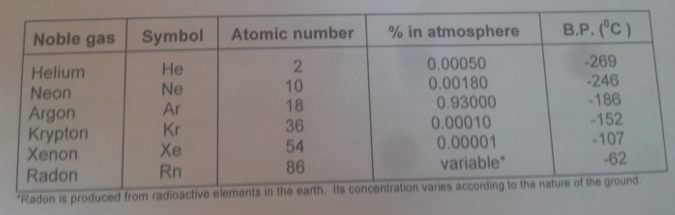
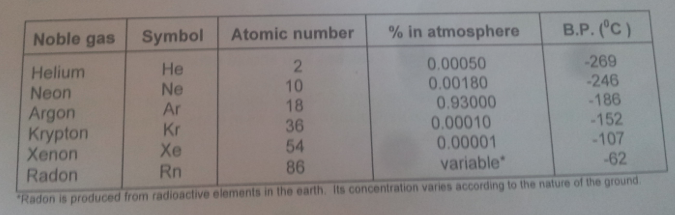
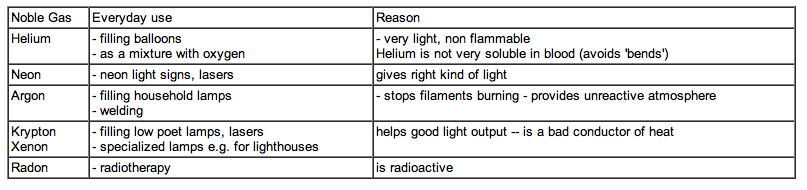
Noble Gases
- unreactive gases (full electron shell)
- 1% of the earth's atmosphere
- non-metals
- colorless gases
Oxides are used to determine whether an element is a metal or a non-metal.
Most non-metals are classed as acidic oxides. While most metals are classed as basicoxides.
Acidic Oxides
Reacts with water to form acids
Neutralises alkaline solution to form salt + water
Basic Oxides
Neutralises acidic solutions to form salt + water
Amphoeteric Oxides
These are non-metals which display both acidic and basic properties
Alkaline Oxides
Reacts with water to form alkaline solutions
Neutral Oxides
Do not display either of the acidic or the basic oxides’ properties.
Lithium:
Bubbles seen
H2 released
Disappears
Sodium:
Melts and forms a ball as the reaction is exothermic. The heat causes the sodium to melt.
Same as Lithium
Potassium:
Lilac flame seen as the hydrogen burns.
Same as sodium
Reacting with water (Mr Rowcliffe ran)
rus
stor
- stored in oil so that they don't react with oxygen
- rusted quickly once exposed to air
- hydrogen is produced when they react with water
- hydroxides are formed (OH)
Potassium > Sodium > Lithium
Reactivity of group 1 metals increase going down the group
all metals rect with water to form strong alkaline solutions
melting point and hardness decreases as you go down the group
Equations
Net Ionic Equations
Periodic Table
More on Oxides
Group 1
Informationen
- Beschreibung
- IGCSE Chemistry (C3 The Periodic Table and Equations) Notiz am Equations, Group Trends in Periodic Table, erstellt von ShreyaDas am 31/03/2014.
- Erstellt von
- ShreyaDas
- Aufrufe
- 692
- Tags
- Bewertung