
Quiz
Russian Revolution 1917 and the USSR
Fragen in diesem Quiz (23)
1How and why did the Russian Revolution start in February 1917?
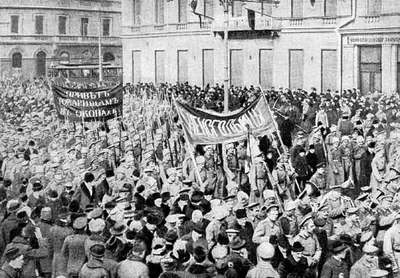
- AWorkers, many of them women who had replaced male workers, went hungry, lacked shoes and clothes. For International Women's Day (March 8th = February 23rd), workers went on strike in virtually every industrial enterprise in Petrograd and demonstrations were organized to demand bread and an end to the war.
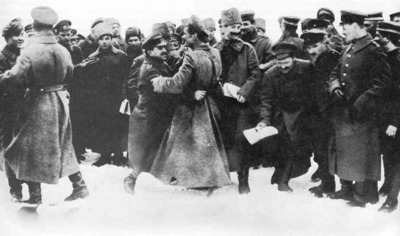
- BBy February 1917, around 2.5 Million Russian soldiers had lost their lives on the battlefield, millions more were injured. Reports of fraternization between Russian and German soldiers circulated.
- CWhen Tsar Nicholas II ordered the army to suppress the demonstrations, troops began to mutiny and soldiers joined the workers' demonstrations.
- DTsar Nicholas did not have to step down, but he had to accept a new provisional government with Ministers from liberal parties.
2What were the "Soviets"?
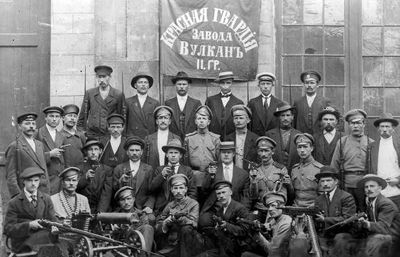
- AMale and female workers and soldiers as well as peasants elected their own workers', soldiers' and peasants' councils, called “Soviets” in Russian.
- BIn February 1917, the Soviets immediately took all the power in Russia and replaced the provisional government.
3What changed during the year 1917?
- AAlthough many soldiers were not willing to continue fighting in the war, sacrificing their lives "for the fatherland", the provisional government chose to continue fighting the war on the side of the Entente.
- BAs a result of the government's policy, over the course of spring and summer 1917, public acceptance of the government and the war grew.
4Who were the Bolsheviks and what were they campaigning for?
- AThe Bolsheviks were a radical, revolutionary faction of the Social Democratic Party.
- BThe Bolsheviks were campaigning for "Peace, Bread and Land".
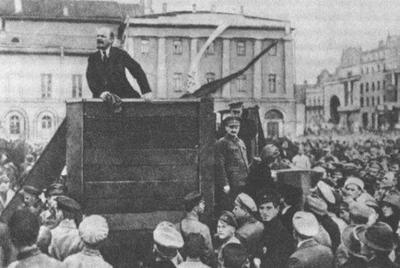
- CWhen the leader of the Bolsheviks, Vladimir Ilyich Lenin, arrived in Russia from his exile in Switzerland in April 1917, he called for supporting the provisional government's efforts to continue the war against Germany and Austria.
- DThe moderate faction of the Social Democrats were opposed to overthrowing the Provisional Government. The moderate Social Democrats had held the majority in most Soviets in the beginning. But the support for the Bolsheviks in the workers' and soldiers' councils increased steadily.
- EBy September 1917, the Bolsheviks were in the majority in the workers' and soldiers' councils in Petrograd and Moscow. Also, a growing number of Social-Revolutionaries - who had the most support from the peasants - joined sides with the Bolsheviks in their call for turning all power over to the Soviets.
5How did the October Revolution take place?
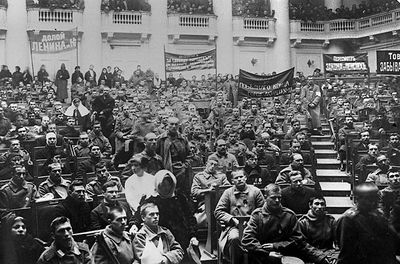
- AOn 7 November 1917 (= 25 October), Red Guard forces led by Leon Trotsky were successful in taking over government buildings and storming the Winter Palace, the seat of the provisional government in Petrograd.
- BThe October Revolution ended the power of the provisional government. Power was taken over by the Congress of Workers', Soldiers', and Peasants' Deputies (= Soviets). The Congress passed a series of revolutionary decrees, starting with the Decree on Land, passed on 26 October 1917.
- CPro-Tsarist forces, supported by the governments of China, Mexico and Brazil, organized into the White Army and went to war against the Soviets' Red Army.
6Please account for - at least - three decrees that were passed after the October Revolution!
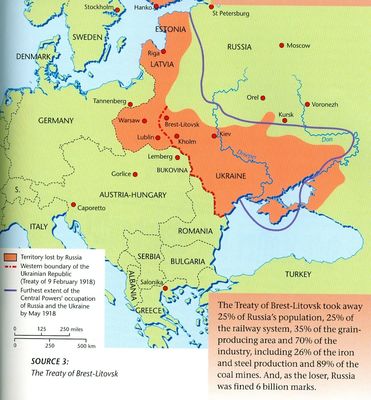
- AThe Decree on Peace declared Russia's immediate withdrawal from the First World War and called for a peaceful settlement without annexations. Nevertheess, the Bolsheviks continued the war against Germany, as the German government demanded control over Belarus, the Ukraine and the Baltic territory. This would have taken away 25% of Russia's population, 35% of the grain producing area and a vast part of its industrial production.
- BThe Decree on Land legalized the dissolution of many wealthy estates by peasants' councils that had already taken place before. More than 1 Mio square kilometers of arable land, formerly controlled by the nobility and the Russian Orthodox Church, was handed over to the peasants' councils.
- CThe Decree on the Rights of the Peoples of Russia allowed for national self determination for the national minorities of the former Russian Empire. Finland declared its independence in December 1917 and became a sovereign state.
- DOther decrees introduced include the eight-hour working day and the nationalization of banks and still another decree established the Red Army, providing for the election of army officers by the soldiers.
7How did the USSR come into existence?
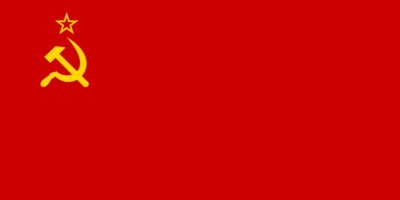
- AThe Red Army was ultimately victorious in the Civil War against the anti-Bolshevik White Army. This paved the way for the creation of the "Union of Soviet Socialist Republics" (= USSR) in 1922,
- BThe USSR was a union of the Russian, Ukrainian, Belarusian, and Transcaucasian Soviet republics.
- CThe USSR did not have a national anthem.
8What was the Communist International?
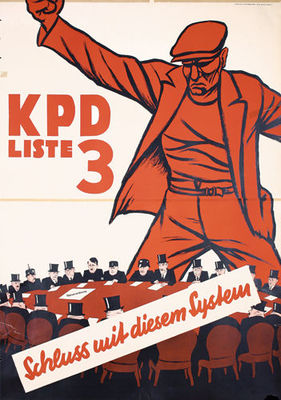
- AFormer Social Democrats, who were in favor of the October Revolution, split from their parties and formed communist parties all over the world. The communist parties formed a new, Communist International with its head-quarters in Moscow.
- BIn the course of the 1920ies and 1930ies, the politics of the communist parties were increasingly controlled by the leadership of the communist party of the Soviet Union.
- CIn the course of the 1920ies and 1930ies, the politics of the the communist party of the Soviet Union was increasingly controlled by the communist international.
9What was Stalinism and how did the USSR develop until World War II?
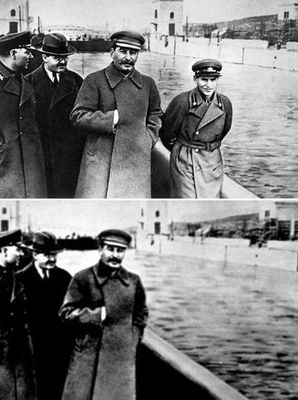
- AIn the early 1920s, the Soviet government permitted some private enterprise to coexist alongside nationalized industry. As Stalin proclaimed the building of "socialism in one country", an intensive program of industrialization was undertaken by the state. In agriculture, Stalin implemented forced collectivization of farms all over the country.
- BStalin's authoritarian bureaucratic rule became known as "Stalinism". Many key accomplishments of the October Revolution were reversed. In the 1930ies, non-Russian nationalities were stripped off many of their minority rights. As Stalin promoted Russian nationalism as a state policy, a new national anthem promoting Russian nationalism was introduced.
- CThr program of forced industrialization in the USSR was not able to raise industrial production significantly. By 1940, the Soviet industry only had the 39th largest output in the world. This was the main reason why the Red Army had no chance to defeat Hitler's Wehrmacht in World War II.
- DIn the 1930ies, Stalin's opponents were put on trial ("show trials") and were executed, if found guilty of "Trotskyism." Millions of people were sentenced to work in forced labor camps, also known as "Gulags". Forced labor was part of the program of forced industrialization of the USSR.
- EThe October Revolution had not abolished the old laws regarding sexual relations. Under Lenin's leadership, gay people were still sentenced to many years in prison as had been the case under the Tsarist government. In the 1930ies, Stalin's government legalized homosexual activity and abortions.
10Die Rote Armee gewann den Bürgerkrieg gegen die Weiße Armee.
- ARichtig
- BFalsch
11Die Rote Armee wurde von den Regierungen der USA und Frankreichs unterstützt.
- ARichtig
- BFalsch
12Sozialdemokraten, die die russischen Revolution unterstützten, gründeten 1919 in Moskau die Kommunistische Internationale.
- ARichtig
- BFalsch
13Die Union der Sozialistischen Sowjetrepubliken (UdSSR) wurde 1922 gegründet.
- ARichtig
- BFalsch
14Finnland war neben den Kaukasusrepubliken, der Ukraine, Russland und Weißrussland eine der Sowjetrepubliken.
- ARichtig
- BFalsch
15Lenin schlug vor seinem Tod im Jahr 1924 vor, Stalin als seinen Nachfolger zu wählen.
- ARichtig
- BFalsch
16Nach Lenins Tod erlangte Stalin immer mehr Macht im Staat und in der Kommunistischen Partei der Sowjetunion.
- ARichtig
- BFalsch
17Nach Lenins Tod ließ Stalin seinen Gegner Trotzki und andere Oppositionelle aus der Kommunistischen Partei ausschließen.
- ARichtig
- BFalsch
18Stalin begann eine massive Industrialisierung und plante den "Aufbau des Sozialismus in einem Land".
- ARichtig
- BFalsch
19In den 1930er Jahren wurden mehrere Millionen Gegner Stalins zu Zwangsarbeit in Arbeitslagern verurteilt.
- ARichtig
- BFalsch
20Die Arbeitslager waren unter der Bezeichnung "GULAG" bekannt.
- ARichtig
- BFalsch
21In den 1930er Jahren wurden nationale Minderheiten in der Sowjetunion (Armenier, Turkmenen, Kasachen, etc.) gegen Diskriminierung geschützt.
- ARichtig
- BFalsch
22Unter Stalin wurde in den 1930er Jahren der Schwangerschaftsabbruch und Homosexualiät unter Strafe gestellt.
- ARichtig
- BFalsch
23Sieben Jahre nach Stalins Tod gewann die Sowjetunion 1960 die Fußball-Europameisterschaft.
- ARichtig
- BFalsch
Informationen
- Beschreibung
- Matura Geschichte Quiz am Russian Revolution 1917 and the USSR, erstellt von Markus Grass am 23/10/2014.
- Autor
- Markus Grass
- Sprache
- Deutsch
- Aufrufe
- 337
- Schlagwörter
- Bewertung
- Noch keine Bewertungen Bewerte dieses Quiz