
Quiz
C5 Quiz
Dieses Quiz enthält Fragetypen, die sich im gewohnten Player öffnen.
Fragen in diesem Quiz (23)
1What is a covalent bond?
- AA pair of electrons that is shared by two atoms
- BA strong force between oppositely charged ions
- CA strong attraction between positive ions and delocalised electrons
2An oxygen molecule contains a covalent bond.
- ARichtig
- BFalsch
3After bonding, the [blank_start]chlorine[blank_end] atom is now in contact with eight electrons in its outer shell, so it is [blank_start]stable[blank_end]. The hydrogen atom is now in contact with two [blank_start]electrons[blank_end] in its outer shell, so it is also stable.
Both [blank_start]nuclei[blank_end] are strongly [blank_start]attracted[blank_end] to the shared pair of electrons in the covalent bond, so [blank_start]covalent[blank_end] bonds are very [blank_start]strong[blank_end] and require a lot of energy to break. Substances with covalent bonds often form [blank_start]molecules[blank_end] with low melting and [blank_start]boiling[blank_end] points, however, such as hydrogen and [blank_start]water[blank_end], as the molecules have [blank_start]weak[blank_end] intermolecular forces of attraction.
- Achlorine
- Bstable
- Celectrons
- Dnuclei
- Eattracted
- Fcovalent
- Gstrong
- Hweak
- Imolecules
- Jboiling
- Kwater
4 The number of covalent bonds an element will form is equal to eight minus the group number.
- ARichtig
- BFalsch
5Molecules of elements and compounds have an electrical charge, so pure molecular substances are able to conduct electricity
- ARichtig
- BFalsch
6What sorts of elements are involved in covalent bonding?
- AA metal and a non-metal
- BTwo metals
- CTwo non-metals
7Giant [blank_start]covalent[blank_end] structures contain very many atoms, each joined to [blank_start]adjacent[blank_end] atoms by covalent bonds. The atoms are usually arranged into giant regular [blank_start]lattices[blank_end] - extremely strong structures because of the [blank_start]many[blank_end] bonds involved. They have very high [blank_start]melting[blank_end] points – this is because a lot of strong covalent bonds must be [blank_start]broken[blank_end]. Graphite, for example, has a melting point of more than 3,600°C. They also have [blank_start]variable[blank_end] electrical conductivity - diamond does not [blank_start]conduct[blank_end] electricity, whereas graphite contains [blank_start]free[blank_end] electrons so it does conduct electricity. Silicon is a semi-conductor – it is midway between non-conductive and [blank_start]conductive[blank_end].
- Acovalent
- Badjacent
- Clattices
- Dmany
- Emelting
- Fbroken
- Gvariable
- Hconduct
- Ifree
- Jconductive
8Which allotrope (form) of pure carbon is the hardest?
- ADiamond
- BGraphite
- CBuckminsterfullerene
9The oppositely charged ions in a crystal lattice are held by strong ionic bonds (electrostatic forces of attraction) in a huge three-dimensional structure.
- ARichtig
- BFalsch
10Because of the strong [blank_start]electrostatic[blank_end] forces between them, it takes a great deal of energy to separate the positive and negative ions in a [blank_start]crystal[blank_end] lattice. This means that ionic compounds have [blank_start]high[blank_end] melting points and [blank_start]boiling[blank_end] points.
The [blank_start]greater[blank_end] the charge on the ions, the stronger the forces holding them together. Sodium chloride is made from Na[blank_start]+[blank_end] ions and Cl[blank_start]-[blank_end] ions and has a melting point of 801°C. Magnesium oxide is made from ions with two charges (Mg[blank_start]2+[blank_end] and O[blank_start]2-[blank_end]) and so has a much [blank_start]higher[blank_end] melting point of 2852°C.- Aelectrostatic
- Bcrystal
- C+
- D-
- E2+
- F2-
- Ghigher
- Hboiling
- Ihigh
- Jgreater
11Which of the following will not conduct electricity?
- AMolten sodium chloride
- BDissolved sodium chloride
- CSolid sodium chloride
12Why do molten ionic compounds conduct electricity, but solid forms do not?
- AWhen the salt is in molten state, the ions are free to move from the crystal lattice. These free moving charged particles (ions) conduct electricity.
- BMolten salts can conduct electricity because their electrons are free to move.
- CMolten salts can conduct electricity because their atoms are free to move from the crystal lattice, and these can carry a charge.
13The negative ions in a salt can be identified by testing with:
- Aa dilute acid
- Bdilute silver nitrate
- Cdilute barium chloride
- Ddilute sodium hydroxide
14The positive ions in a salt can be identified by adding dilute sodium hydroxide and looking at the colour of the precipitate formed.
- ARichtig
- BFalsch
15Metals form giant structures in which [blank_start]electrons[blank_end] in the outer shells of the metal atoms are [blank_start]free[blank_end] to move. The metallic bond is the force of [blank_start]attraction[blank_end] between these free electrons and metal [blank_start]ions[blank_end]. Metallic bonds are strong, so metals can maintain a regular [blank_start]structure[blank_end] and usually have [blank_start]high[blank_end] melting and boiling points. Metals are good [blank_start]conductors[blank_end] of electricity and heat. This is because the [blank_start]delocalised[blank_end] electrons can move throughout the metal.
- Aelectrons
- Bfree
- Cattraction
- Dions
- Estructure
- Fhigh
- Gconductors
- Hdelocalised
16The method used to extract a metal from its ore depends upon the stability of its compound in the ore, which in turn depends upon the reactivity of the metal.
- ARichtig
- BFalsch
17Complete the gaps in the reactivity series.
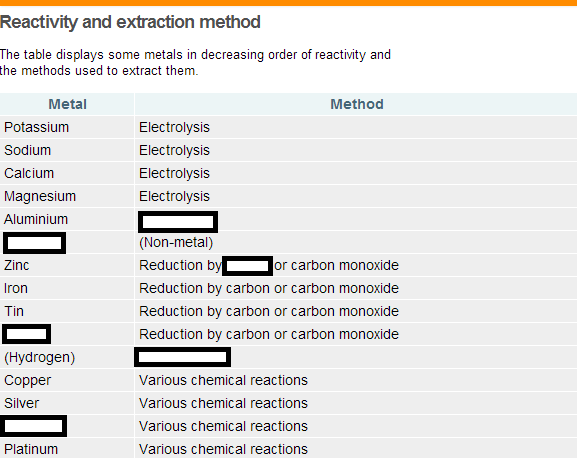
- ACarbon
- BElectrolysis
- Ccarbon
- DLead
- E(Non-metal)
- FGold
18Is it necessary to use two different methods of extracting metals because only those less reactive than carbon can be reduced in a blast furnace.
- ARichtig
- BFalsch
19Aluminium is the most [blank_start]abundant[blank_end] metal on Earth. But it is expensive, largely because of the amount of [blank_start]electricity[blank_end] used in the extraction process.
Aluminium ore is called [blank_start]bauxite[blank_end]. The bauxite is purified to yield a white powder - aluminium oxide - from which aluminium can be extracted.
The extraction is done by [blank_start]electrolysis[blank_end]. But first the aluminium oxide must be melted so that electricity can pass through it. However, aluminium oxide has a very high melting point (over 2000°C) so it would be [blank_start]expensive[blank_end] to melt it.
Instead, it is dissolved in molten [blank_start]cryolite[blank_end] - an aluminium compound with a lower melting point than aluminium oxide., reducing some of the energy costs involved in extracting aluminium. The diagram shows an aluminium oxide electrolysis cell. Both the [blank_start]negative[blank_end] electrode (cathode) and positive electrode ([blank_start]anode[blank_end]) are made of graphite, a form of carbon.
Aluminium ions [blank_start]receive[blank_end] electrons at the negative electrode and are reduced to aluminium atoms:
Al3+ + [blank_start]3[blank_end]e- → Al
The [blank_start]molten[blank_end] aluminium sinks to the bottom of the cell, where it is tapped off.
Oxide ions [blank_start]lose[blank_end] electrons at the positive electrodes and are oxidised to oxygen gas:
2O2- → O2 + 4[blank_start]e-[blank_end]
This oxygen reacts with the [blank_start]carbon[blank_end] of the positive electrodes, forming carbon dioxide, so they gradually burn away. As a result, the positive electrodes have to be [blank_start]replaced[blank_end] frequently. This adds to the [blank_start]cost[blank_end] of the process.
- Aabundant
- Belectricity
- Cbauxite
- Delectrolysis
- Eexpensive
- Fcryolite
- Gnegative
- Hanode
- Ireceive
- J3
- Ke-
- Lmolten
- Mlose
- Ncarbon
- Oreplaced
- Pcost
20The relative atomic mass is a measure of the mass of one atom of the element.
- ARichtig
- BFalsch
21To calculate the relative formula mass:
Write the [blank_start]formula[blank_end] of the compound.
Write the numbers of each [blank_start]atom[blank_end] in the formula.
Insert the relative [blank_start]atomic[blank_end] mass for each [blank_start]type[blank_end] of atom.
Calculate the total mass for each [blank_start]element[blank_end].
Add up the total mass for the [blank_start]compound[blank_end].- Aformula
- Batom
- Ctype
- Datomic
- Eelement
- Fcompound
22Percentage yield = (actual yield/theoretical yield) x 100
- ARichtig
- BFalsch
23In a reaction, the predicted yield was 80 g, but the actual yield was 60 g. What was the percentage yield?
- A75%
- B133%
- C50%
Informationen
- Beschreibung
- GCSE Chemistry Quiz am C5 Quiz, erstellt von Leah Firmstone am 21/11/2015.
- Autor
- Leah Firmstone
- Sprache
- English
- Aufrufe
- 7
- Schlagwörter
- Bewertung
- Noch keine Bewertungen Bewerte dieses Quiz