
Quiz
Halogenalkanes
Dieses Quiz enthält Fragetypen, die sich im gewohnten Player öffnen.
Fragen in diesem Quiz (22)
1Free Radicals are formed from the [blank_start]homolytic[blank_end] fission of a [blank_start]covalent[blank_end] bond, often by UV light which provides enough energy to break the bond [blank_start]equally[blank_end]. This gives each 'half' one electron each. It is these unpaired electrons which make Free Radicals [blank_start]so reactive[blank_end].
- Ahomolytic
- Bheterolytic
- Ccovalent
- Ddative
- Eequally
- Funequally
- Gso reactive
- Hvery unreactive
2Boiling point increases with size and length of a haloalkane because:
- Athere are more Van der Waal's Forces between molecules
- Bthe molecules are heavier
- Cit will have further to go
- Dthe bigger the molecule the less reactive it is
3Look at this equation where methane and chlorine are combined in the presence of UV light to form 1-chloromethane and hydrochloric acid.
Select the correct Propogation reaction(s).
- A
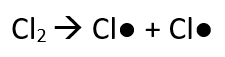
- B
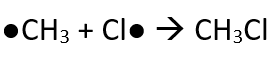
- C

- D

- E
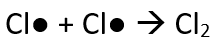
- F

- A
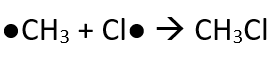
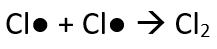
4Look at this equation where methane and chlorine are combined in the presence of UV light to form 1-chloromethane and hydrochloric acid.
Select the correct Termination reaction(s).
- A
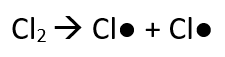
- B
- C

- D

- E
- F

- A
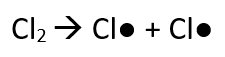
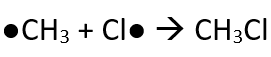
5Look at this reaction in which methane and chlorine are combined in the presence of UV light to form 1-chloromethane and hydrochloric acid.
Select the correct Initiation reaction(s).
- A
- B
- C

- D

- E
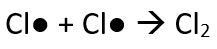
- F

- A
6Look at this reaction in which methane and chlorine are combined in the presence of UV light to form 1-chloromethane and hydrochloric acid.
The bond enthalpy of Cl-Cl is +243 kJ mol-1.
The bond enthalpy of C-H is +413 kJ mol-1.
In the Initiation reaction, the covalent bonds in the [blank_start]chlorine[blank_end] are more likely to be broken by the UV light because the [blank_start]Cl-Cl[blank_end] bond is much weaker than the [blank_start]C-H[blank_end] bond and [blank_start]easier[blank_end] to break.
- Achlorine
- Bmethane
- C1-chloromethane
- Dhydrochloric acid
- ECl-Cl
- FC-H
- GC-H
- HCl-Cl
- Ieasier
- Jmore difficult
7Select all features of a Nucleophile.
- AIt has a lone pair of electrons
- BIt isn't an electron pair donor
- CIt always has a negative charge
- DIt is attracted to electron deficient (slightly positive) Carbon
- EIt has neutrons in its energy shells
8What makes a good nucleophile?
- AIt possesses a charge
- BIncreased electronegativity
- CBeing a bad solvent
- DDecreased steric hindrance
- EBeing able to remove neutrons
9An atom/molecule/ion is only a nucleophile when is donates a pair of electons to an atom other than hydrogen, usually carbon.
- ARichtig
- BFalsch
10Chlorofluorocarbons contain Hydrogen.
- ARichtig
- BFalsch
11The alternatives to Chlorofluorocarbons are:
- AHydrocarbons
- BHydrofluorocarbons
- CBromofluorocarbons
- DFlurocarbons
12Chlorofluorocarbons are:
- Areactive
- Bnon-flammable
- Ctoxic
- Dbad for the ozone layer
13When you react a haloalkane with water, the products are:
- AHydrogen Halide
- Ban Alcohol
- Ca Halogen
- Dan Alkane
14When you react a haloalkane with potassium/sodium cyanide under reflux in an aqueous alcoholic solution, the products are:
- APotassium/Sodium Halide
- Ba Nitrile
- CNitrogen gas
- Da Halogen
15When you react a haloalkane with an excess of ammonia in reflux under pressure, the products are:
- Aan Amine
- BAmmonium Halide
- Ca Halogen
- DNitrogen gas
16When Ammonia reacts in excess with a haloalkane, it acts as a _____ and then a _____:
- Aa Nucleophile with the haloalkane
- Ba Base with the hydrogen halide
- Can Electrophile with the hydrocarbon
- Dan Acid with the hydrogen halide
17In the elimination of haloalkanes with alcoholic potassium/sodium hydroxide, the products are:
- Aan Alkene
- BWater
- CPotassium/Sodium Halide
- Da Halogen
18This question concerns reacting Potassium/Sodium Hydroxide with a Haloalkane.
With Water as a solvent, the Hydroxide Ions act as [blank_start]a Nucleophile[blank_end]. The reaction is therefore is [blank_start]a Substitution[blank_end] and [blank_start]an Alcohol[blank_end] is formed. With Alcohol as a solvent, the Hydroxide Ions act as [blank_start]an Electrophile[blank_end]. The reaction is therefore is [blank_start]an Elimination[blank_end] and [blank_start]an Alkene[blank_end] is formed.
To favour Substitution, the temperature needs to be [blank_start]warm[blank_end] and the Potassium/Sodium Hydroxide needs to be [blank_start]dilute[blank_end] and [blank_start]aqueous[blank_end]. To favour Elimination, the temperature needs to be [blank_start]hot[blank_end] and the Potassium/Sodium Hydroxide needs to be [blank_start]concentrated[blank_end] and [blank_start]alcoholic[blank_end].- Aa Nucleophile
- Ba Substitution
- Can Alcohol
- Dan Electrophile
- Ean Elimination
- Fan Alkene
- Gwarm
- Hdilute
- Iaqueous
- Jhot
- Kconcentrated
- Lalcoholic
19Ozone is [blank_start]an allotrope[blank_end] of Oxygen.
- Aan allotrope
- Ban isomer
- Ca variant
20A Primary Haloalkane is more likely to undergo a Substitution reaction than a Tertiary Haloalkane.
- ARichtig
- BFalsch
21A Primary Haloalkane is more likely to undergo an Elimination reaction than a Tertiary Haloalkane.
- ARichtig
- BFalsch
22Which of these contribute to the creation of the hole in the Ozone Layer?
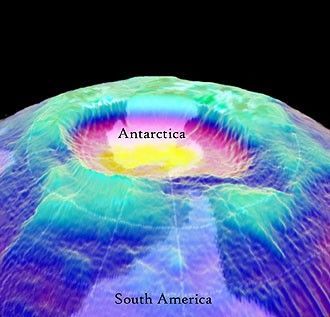
- ANitrogen Monoxide
- BAliens
- CCarbon Dioxide
- DOxygen
- ECFCs
- FUV radiation
Informationen
- Beschreibung
- Test your knowledge of free radical substitution and nucleophilic substitution. I have not included reaction mechanisms, so do make sure that you revise this as well as doing this quiz! Do revise this section too as well as doing this quiz - especially exam questions! This quiz is merely to make sure you know a few key details.
- Autor
- Eleanor H
- Sprache
- English
- Aufrufe
- 168
- Schlagwörter
- Bewertung
- 4,0 von 5 · 4 Bewertungen Bewerte dieses Quiz