
Karteikarten
P7- Section 2
Karten in diesem Stapel (77)
- 1NoteAccidentally deleted cards on pages 144-148 (reflecting telescopes and diffraction) use Blue's
- 2How can we form a spectrum of visible radiation? Why is this possible and what can it tell us?Passing light through a glass prism. As the shorter wavelengths are refracted more than the longer wavelengths the different colours present in light become visible. The colours visible depend on the temperature and chemical composition of the light source. A star's spectrum can tell you how hot it is and what it is made of.
- 3Other than a prism how else can a spectrum be formed? Why is this better?Astronomers use diffraction gratings to produce spectra. It is made by drawing thousands of very closely spaced lines on a reflecting plate. Light then reflects from the plate and the different wavelengths are diffracted different amounts. The result is that specific wavelengths are visible from a certain angle, thus producing a spectrum. They produce a more evenly spread spectrum than a prism does and a reflective grating wastes very little light.
- 4What was the quasar problem?An object was found that caused a shock when its spectrum was examined. It was redshifted to such an extent that it was moving away from us at 40,000 km/s. According to theories of the expanding universe this speed could only be possible if it was 2.5 billion light years away. This led to a problem: how could we see something so far away. It must be giving more more energy than an entire galaxy but only about the size of the solar system. Some scientists refused to accept this and suggested the redshift was due to some other effect.
- 5What was the solution?It wasn't until several years later when more quasars had been discovered that an explanation was accepted. Quasars are now believed to be among the most distant and brightest things in the universe, despite being relatively small. The power is thought to come from matter as it falls into a supermassive black hole at the centre of a galaxy.
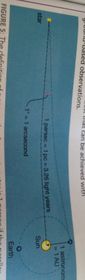
- 6What is parallax on a basic level?Using the apparent motion of the star as the earth moves around the sun to measure distance to do a star. As the earth moves around the Sun, the nearby stars seem to move, compared to the background of distant stars, which is fixed. The close the star the larger the apparent movement.
- 7What do you need to measure distance to a star and how is it measured?You need to know the position of the star compared to a distant star which is measured twice; the readings are taken 6 months apart. The parallax angle is equal to half of the angle formed where the lines from the position of the earth to the star meet (angle p on next card).
Parallax angles are measured in seconds of an arc (''). 1 second is 1/60 of a minute, which is 1/60 of a degree. Angular seconds are often referred to as arcseconds. - 8What is a parsec? What is the limit of parallax?The parsec is unit of length defined using the parallax shift of a star. When the parallax angle is 1 second of an arc, the distance to the star is one parsec.
Distance (parsecs) = 1/parallax (seconds)
Parallax angles don't work well when the angles get too small to measure. This is why the method of parallax can only be used for nearby stars. About 0.02'' is the smallest measurable angle with ground based observations. - 9What is the distance from the Earth to the Sun called?1 astronomical unit
- 10What are light years, parsecs and megaparsecs?1 light year is the distance travelled by light by light in one year. Distance can also be measured in parsecs which= 3.26 light years. The distance between galaxies are measured in megaparsecs which are millions of parsecs.
- 11Use a diagram to show parallax and parsecs.
- 12What is luminosity and what does it depend on?Luminosity is the total energy emitted by the star in one second across all wavelengths and in all directions. This is the total power of the star.
It depends on: radius (larger emitting area/surface area and therefore emit more radiation) and surface temperature (this also affects the colour hotter stars white cooler stars red) - 13What is apparent brightness?How bright something looks from a point. Radiation spreads out equally in all directions as it travels so the further away the star the less bright it appears. As the distance doubles the brightness decreases by 1/4.
AB= 1/ (distance) squared. (inverse square law) - 14What is the period of a star?Some stars vary in brightness much more frequently and dramatically than the Sun. Some variable stars flash like a lighthouse, changing their brightness every few minutes, whilst others take hours, days or months. The time taken to go through a complete cycle is called the period of a star.
- 15What is a binary star and how does this relate to variable stars?A bright star is often orbited by a dimmer partner that passes in front of the star blocking some of the light. This could explain the changing brightness of some stars. Binary star refers to this system.
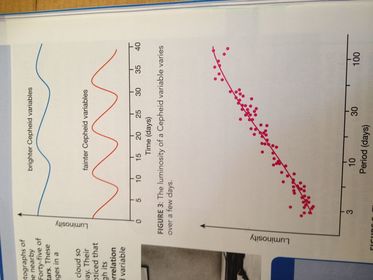
- 16What did Leavitt find out that opened the door to a new way of measuring stars?She studied 1777 variable stars in the Magellanic clouds, which are now known to be nearby galaxies. 45 of these were Cepheid variable stars which are large, pulsating stars with brightness that changes in a predictable way. As all the stars came from the same area she could assume they were the same distance away. Their distance could be compared fairly. Leavitt noticed that the brighter the star, the longer it took to go through its brightness cycle. By plotting a graph, she found a correlation between the brightness and the period of a Cepheid variable star.
Leavitt's discovery led to a new way of measuring distances in space. - 17What are standard candles?If we know how much light an object emits, and how bright it is from Earth it is possible to work out how far away it is. An object of known brightness is called a standard candle. A Cepheid variable star is a standard candle. If we measure its period., we can find its luminosity from Leavitt's graph. Then we measure the light that we receive on Earth. Comparing the two values allow us to calculate how far away the star is.
- 18What graphs can be used to aid our understanding of Leavitt's findings?
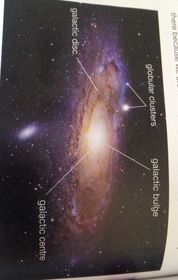
- 19How did Shapely go about working out the shape and size of our galaxy?From inside the galaxy it is hard to determine its shape and size. Astronomers realised our Sun is just one of millions of stars in our galaxy, the milky way. It is a spiral galaxy.
One method of measuring the galaxy was developed by Shapely. He used Cepheid variables to measure the distances to groups of stars called globular clusters. He then made the assumption that all of these were the same brightness and size so he could measure distances further away where no Cepheid stars were visible. After years of painstaking work Shapely suggested that the diameter of the Milky Way might be as large as 300,000 light years. That was much bigger than many astronomers believed, and meant our galaxy would be the biggest, and maybe the only thing in the Universe. - 20What are Nebulae? What did different astronomers think about them?Nebulae are patches of light that are like fuzzy bright clouds rather than points of light. Some of these were known as spiral nebulae because of their shape.
Some astronomers believed that spiral nebulae were new solar systems being formed, each being a spinning cloud of gases that would condense into a star and planets. Others felt that nebulae were actually distant galaxies, each one formed of billions of stars. Their nebulous appearance appearance could be due to their enormous distance from Earth. This was known as the 'island universe' hypothesis.
Many astronomers found this hypothesis hard to believe. There was other evidence that suggested nebulae were quite small. One nebula got much brighter for a time and this couldn't be explained. We couldn't know that this was a supernova within a distant galaxy. At the time this was seen as evidence against such a hypothesis. - 21What was the great debate?In 1920 Heber Curtis and Harlow Shapley argued about the nature of nebulae. Curtis argued for the island universe hypothesis. He said that the spiral nebulae were galaxies like our own and were only 30,000 ly across. Shapely thought our galaxy was 300,000 ly across and formed the whole universe. He believed that the Sun was not at the centre of the galaxy and that the spiral nebulae were clouds of gas, relatively small and nearby. Neither really one the argument and the question was still open to debate.
- 22Draw a diagram of a spiral galaxy.
- 23How did hubble prove the island universe hypothesis?He studied photographs of the Andromeda nebula taken over several years when he noticed a star that varied in brightness. He had discovered a cepheid variable star. Over the next few weeks Hubble measured the brightness of the star, which varied with a period of 31 days. Such a long period meant a very luminous star, yet it appeared very faint here on Earth. Hubble realised that the star was at least one-million light years away. the star and the nebulae were too far away to be in our galaxy. Therefore the nebula had to be a galaxy in its own right.
- 24How do we know that galaxies are moving away from us?If the spectrum of light from a galaxy was compared to that of stars in our own galaxy, there were similar patterns but the galactic spectra were shifted almost always to the red end of the spectrum. This redshift suggested that most of the galaxies were moving away from us.
- 25What was hubble looking for and what did he find?A link between a galaxy's distance and the speed at which it moved away from us. He looked for Cepheid variable stars. The further away the galaxy the fainter the light and the more difficult it was to find a Cepheid star that could be observed. However after several years Hubble had enough results to publish. He found a correlation between a galaxy's distance and its recessive velocity. Hubble had found that the further the galaxy, the faster it was moving away from us.
- 26What is Hubble's law and what does it show?Hubble's results lie close to a straight line through the origin. This means the recessional velocity of galaxy is proportional to its distance from other words.
Speed of recession (km/s) = Hubble constant x distance (Mpc)
The fact that almost all galaxies are moving away from us suggests that either: we are at the centre of the Universe and the galaxies are repelled from us or every galaxy is moving away from every other galaxy. The second explanation seems more likely as the Universe would look similar from every galaxy, therefore space must be expanding. This is evidence for the big band theory. - 27Why do objects change colour as they get hotter? Apply this to stars.All objects emit electromagnetic radiation across a range of wavelengths. The energy emitted at each wavelength depends on the temperature of the object. Hotter objects emit more energy at shorter wavelengths. Stars behave in this way. The colour and luminosity of a star depends on its surface temperature. Hotter stars are more luminous and give off more shorter-wavelength radiation. A star that glows yellow, like the Sun, is hotter than a red star. (order from coolest to hottest red, yellow, white)
- 28Explain energy transport in a star.Stars get energy from nuclear fusion that takes in the core, where the temperature is 16 million degrees. The nuclear reactions release photons of gamma radiation that interact with atoms throughout the radiation zone, losing energy as they go. Further from the core, the star gets cooler. The cooler gas is more efficient at absorbing photons. The main energy transfer process in this section is convection. Regions of hot gas expand and rise towards the surface, where they lose energy, cool, contract and fall inwards again. The surface of the star is called the photosphere. This is the part of the star that we can see. Energy is emitted into space, mainly through electromagnetic radiation, of all wavelengths from radio to gamma rays. Because the surface temperature is about 5300 degrees most radiation emitted is in the visible part of the spectrum.
- 29What is a line spectra? How is it formed? Why is it useful?Bunsen used his burner to investigate the light given out by different elements. They looked at the light from the flaming substance through a prism. They saw the spectrum wasn't continuous but a set of coloured lines we call a line spectrum. They found that each element gave out its own unique emission spectrum and so used it to find new elements.
- 30What is an absorption spectrum?If a bright, white light was shone through the vapour of an element, a spectrum was formed with dark lines on it. This is an absorption spectrum. Atoms of the element have absorbed some of the wavelengths from the white like. The position of the dark line exactly match the position of the bright lines of the emission spectrum.
- 31How can spectrum be used to study stars?Helium was discovered in the emission spectrum of the outer part of the Sun during an eclipse, otherwise the emission spectrum would have been hard to see. The spectra from stars are usually absorption spectra. A spectrum of the Sun's light has hundreds of dark lines which are caused by elements in the Sun's cooler outer atmosphere, which absorb certain wavelengths of light. Every element has its own pattern of absorption lines so, by analysing a star's spectrum we can identify the elements present.
Spectra can also reveal the temperature of a star. When a photon of radiation is absorbed by an atom, the energy may be enough to knock one of the electrons out of orbit. This is called ionisation. An atom that has lost an electron is known as an ion and has a different spectrum to the original atom. Astronomers can tell which atoms have been ionised which gives a measure of temperature. - 32What can spectra tell us about energy levels in atoms? What, in turn, can this tell us about how the spectrums from?Light is emitted from an atom when an electron loses energy. But the spectrum shows that only certain wavelengths of light are emitted. Since the colour of light depends on its energy, this tells us that electrons can only lose energy in certain amounts. Bohr suggested that electrons only exist at certain energy levels. A photon of light is emitted when an electron drops from a higher energy level to a lower one. Atoms of a particular element have their own set of allowed energy jumps, which lead to a unique set of energy jumps by the electrons. Therefore only photons of particular energies are emitted. The higher the energy of the photon, the higher the frequency- and the shorter the wavelength- of the light. This is why every element has its own unique emission spectrum. An absorption spectrum can be explained by the same theory. The dark lines arise because light has been absorbed by electrons in the atom. Only when light of exactly the right energy level hits the atom this can be absorbed and then an electron jumps to a higher energy level. That particular colour of light is removed causing the dark lines on the spectrum.
- 33What is temperature? What cause air pressure? What is absolute zero?It isn't the same thing as energy (for example a burning match has a high temperature but low energy). It is easier to understand if we think about the motion of molecules of gas. Molecules in air move at speed in random directions. As the molecules hit the walls they bounce back, each one exerting a small force on the wall. The total force of the billions of molecules on the whole area of the wall is what causes air pressure.
If you heated the air in a room the molecules would move faster. The kinetic energy of the molecules would increase as would the temperature. The temperature depends on the average kinetic energy of the molecules. If we keep reducing the temperature, the kinetic energy of the molecules would reduce. The molecules would move more and more slowly as the temperature dropped. Eventually the molecules would stop moving and the temperature couldn't get any lower. We call this temperature absolute zero. - 34How are temperature and volume related? Use the example of the piston.If a volume of gas is trapped in a cylinder by a piston the piston is free to move; only air pressure from the atmosphere inside holds it in place. As the gas is heated its molecules will move faster. They will hit piston harder and more often and push it upwards. There is a linear relationship between volume and temperature, although this is not directly proportional as it does not go through the origin.
Suppose we could keep cooling the gas: the volume would reduce further. Extrapolating the graph backwards shows the volume of gas would reach zero at -273 degrees (absolute zero). If we redraw the graph using kelvin instead of cercius the relationship is directly proportional. Therefore V/T = constant. The relationship only holds if the pressure and mass of the gas is kept constant. - 35How do we convert Celsius to Kelvin?Take away 273
- 36Again using the example of the piston, explain how temperature and pressure are related.We could carry out a similar experiment by heating the gas as before, but this time we could keep the piston fixed in place. The pressure of the gas would increase as the molecules move faster, hitting the walls with greater force and colliding with the more often. Again this relationship is directly proportional. P/T = constant. This relationship only holds if the volume of gas is kept constant and the mass of gas stays fixed.
- 37What is the symbol for direct proportionality?

- 38Describe visually an experiment that investigates the link between pressure and volume.
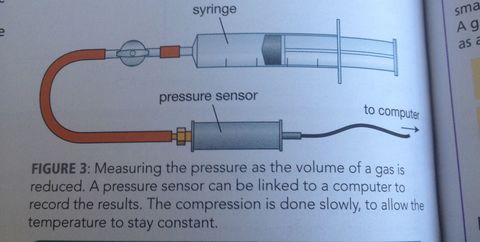
- 39What is the relationship between pressure and volume?High pressure, low volume and vica versa. Boyle's law states that for a fixed mass of gas at a constant temperature the pressure times the volume gave a constant.
- 40What is pressure and volume measured in?Volume in cubic metres pressure in pascals (Pa)
- 41What three qualities is the state of a known mass of gas described by? What do the laws previously described refer to.Pressure, volume and absolute temperature. These quantities are linked by the three gas laws. These laws apply to a fixed mass of an ideal gas. An ideal gas has molecules that take up a very small fraction of the gas's volume and are too far apart to affect each other. A gas that is well above its boiling point and not under high pressure, will behave as an 'ideal gas'
- 42What are giant molecular clouds and what happens inside them?Immense clouds of gas molecules where stars begin their lives. They are mainly formed from hydrogen gas and interstellar dust, although there are small amounts of other particles such as helium, carbon and even water molecules. Gravity is constantly acting to pull the molecules and dust together. As the cloud collapses, gravitational potential energy is transferred to kinetic energy. The particle move faster and the temperature increases. Eventually the pressure of the gas pushing outwards is balanced by the forces of gravity pulling inwards. The cloud is in equilibrium.
- 43How is a protostar formed?The clouds are not uniform there are regions of higher density. These are less stable than the rest of the cloud. It is these clumps that collapse into denser regions that will eventually become stars. The dense regions of gas and dust are only stable while the gas pressure balances the gravitational force. A nearby supernova, or a collision with another gas cloud can trigger a gravitational collapse. Once again the gas becomes denser and hotter. The volume decreases and its temperature increases, causing the outward pressure to increase until it balances gravity once more. By now the dense region has become so hot, at 2000-3000 K that it glows red. It is known as a protostar. The protostar's gravity attracts more gas and dust onto its surface. Over the course of a few million years the protostar becomes more massive. Eventually the core of the protostar becomes so hot and dense that nuclear fusion starts and a new star lights up.
- 44How are stars powered? What were previous explanations and what is the current one?In the 18th century it was thought that the Sun was powered by chemical reactions, burning like a fire. Knowing the mass of the sun they calculated it might burn for 50,000 years. But geologists believed the earth was at least 400 million years old.
Another explanation was that the Sun was powered by gravitational collapse like protostars. That gave the Sun's age as 25 million years- but that was still too short.
In the early 20th century the correct explanation was developed. It was based on the discovery of radioactivity, the atomic nucleus and Einstein's theory of relativity that showed mass could be converted to energy. In 1920 it was suggested that the Sun's energy came from nuclear fusion. In the core of the Sun, hydrogen nuclei are pushed together to make helium. The reaction releases large amounts of energy, much more than any chemical reaction. This gave the Sun's age at 4.5 billion years with enough fuel for another 5 billion years. - 45Explain the core.The innermost 10% of the Sun is called the core. Conditions are extreme because of the enormous gravitational force. The density of the material is 20 times greater than iron, yet it is still a gas due to the temperature being 15 million kelvin. At this temperature there are no atoms just a plasma of electrons and nuclei. The Sun is 78% hydrogen so most of the nuclei are just protons.
- 46Explain fusion in more detail.When two protons collide at such high speed they can fuse together. They undergo a nuclear reaction to form a deuterium nucleus. This is a heavy type of hydrogen. The high speed is important. Every proton carries a positive charge so two protons will repel each other. It is only when they collide at high speed that they get close enough for the attractive strong nuclear force to overcome the electromagnetic repulsion.
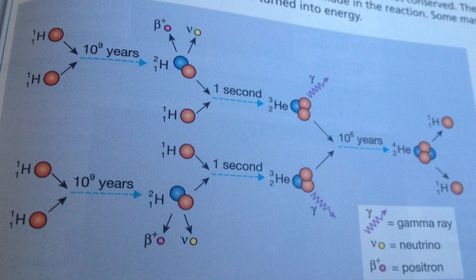
- 47What is the p-p cycle?The Sun is powered by the fusion of hydrogen into helium. This happens in a series of reactions which start with the fusion of two protons to make deuterium.
- 48How can nucleuses be represented and what are the three naturally occurring isotopes of hydrogen?
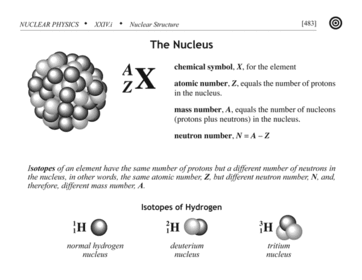
- 49Write the reaction that fuses two protons to make deuterium.

- 50Describe the reaction in terms of mass, proton number and charge.The mass numbers and atomic numbers are balanced on either side of the equation. This shows charge is the same before and after the reaction. Charge conservation is ensured by the production of the positively charged positron. The positron is the anti-matter equivalent of the electron. A positron has exactly the same mass as an electron but it carries a positive charge. Perhaps the surprising thing about the reaction is that mass is not conserved. Some mass has been turned into energy.
- 51Describe the p-p cycle in terms of an image.
- 52What is Einstein's equation? Why is it useful?E= m(c squared). E= energy M= mass c= speed of light.This explains how mass is converted to energy and shows that even a tiny amount of mass will be converted to a lot of energy.
- 53What is the main sequence of a star?Nuclear fusion of hydrogen to helium releases huge amounts of energy. this heats the gas in the core to high temperatures. The enormous pressure from this gas, and from the radiation released from the core pushes outwards. This pressure would blast the star apart but the star's mass is so large that gravity holds it together. The star is held in equilibrium- in a stable state- balanced between these huge forces. The star is now said to be in the main sequence, the longest phase of its life.
- 54What happens in massive stars?Some stars are much bigger than our Sun and the gravitational forces at the centre of these stars is immense. The temperature is large enough to fuse larger nuclei together despite the large repulsive forces. Helium nuclei are fused to make heavier nuclei such as carbon and oxygen. If the temperature is high enough, the series of reactions will continue until iron is formed. The fusion of light nuclei releases energy but energy has to be supplied to form nuclei that are heavier than iron. Once the core stops releasing energy, the balance of forces keeping the star in equilibrium is lost and the gravity will start to crush the star.
- 55What is the Hertzsprung-Russell diagram?It shows the differences between stars. The luminosity of a star is plotted on the vertical axis, relative to the luminosity of the Sun, and the surface temperature on the horizontal axis, in Kelvin. Because the surface temperature also determines its colour the temperature axis also indicates the peak wavelength of light emitted by the star.
- 56Show this visually.
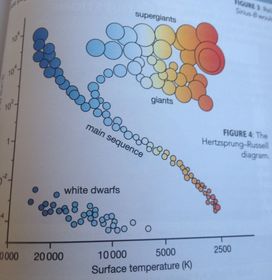
- 57What are the three main groups shown by the HR diagram?Main sequence: diagonal line across the middle of the HR diagram contains stars in the stable part of their lives. All these stars are fusing hydrogen into helium, but they cover a range of temperature and luminosity.
Supergiants and giant stars: These group contain stars that are more massive than the Sun. Some are coming to the end of their lives.
White Dwarfs: These are small hot stars where nuclear fusion has ceased. They will gradually cool and fade. - 58What happens when a star begins to run out of hydrogen?When a star runs short of hydrogen in its core fusion is reduced. Less energy is released and the pressure drops. Gravitational attraction is now larger than the outward pressure so the star contracts.
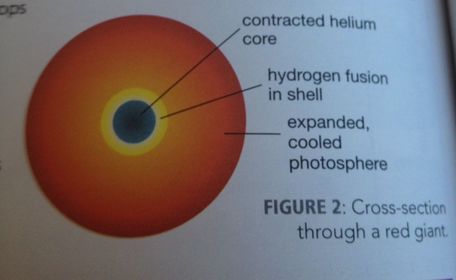
At this stage the core is mainly helium it is surrounded by a shell of hydrogen. The gravitational collapse raises the temperature and hydrogen begins in the shell. The energy released by this causes the outer layer of the star, the photosphere, to expand enormously. As the photosphere expands its temperature drops and it shines red. When the Sun reaches this stage it will expand to a hundred times its current size, becoming a red giant star.
A red giant has a cool photosphere and a hot dense helium core. It is tremendously bright due to its size. This phase is much shorter than the main sequence. The hydrogen in the shell will begin to run out. What happens next depends on the star's mass. - 59Draw a labelled diagram of a red giant
- 60What is the final fate of Sun sized stars?The hydrogen fusion in the shell of the red giant produces more helium. This accumulates in the core making it hotter and denser. When the temperature reaches 100 million K helium fusion begins. First beryllium then carbon is formed. Then further fusion produces larger nuclei such as nitrogen and oxygen.
Stars with masses of up to 8 times that of the Sun cannot create the necessary temperature for further fusion. When the fusion stops the core collapses and the outer layers are ejected into space in a shell of material known as a planetary nebula.
The exposed core is a hot sphere of carbon and oxygen, known as a white dwarf. Its density is enormous, about a million times greater than water. No further nuclear fusion takes place. The star takes billions of years to cool down eventually becoming a black dwarf, the cold remnant of a dead star. - 61What are the fusion reactions to form beryllium and carbon?

- 62Show the path of a star like our Sun on a HR diagram.
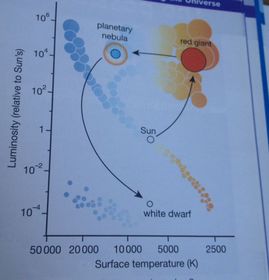
- 63What is the final fate of giant stars?Stars with mass more than 8 times that of the Sun are able to fuse heavier nuclei due to the extra gravitational force. Shells of carbon, oxygen and even heavier elements are formed. Eventually a core of iron and nickel is created. Nuclear fusion of elements heavier than iron absorbs energy rather than releasing it. The star cannot oppose gravity and undergoes a collapse called a supernova. During the supernova heavier elements are created. A massive shock wave rips the star apart spreading the elements across space and leaving behind a dense core.
- 64What happens if the mass of the core is between 1.4 and 4 solar masses?Gravity is so strong that protons and electrons combine to form neutrons. The core has become a neutron star. A neutron star is typically only 20km across. The star is so dense that a teaspoonful would have the mass of a billion tonnes.
- 65What happens if the core is greater than 4 solar masses?Gravity is so strong that no force can resist it. The core collapses further, its density increases and gravity gets even stronger. Eventually gravity is so strong that not even light can escape. A black hole has been formed. At the centre of the black hole density and gravitational strength approach infinity.
- 66What are extrasolar planets?It is difficult to detect planets orbiting a distant star. Planets are too small to be seen directly, don't emit light and the light they reflect gets lost in the glare of the star. They are detected by studying the star. As the planets orbit its gravity makes the star wobble, this is called the Doppler effect. Astronomers look for tiny changes in the star's position or the colour of the star's life. Another way is to look for the small dip in light from a star as the planet moves between us and the star. So far no one has detected an Earth-like planet orbiting a Sun like star.
- 67What is the Goldilocks zone?Many planets discovered would be unsuitable for life. Planets too close to the Sun would be too hot and be bathed in damaging radiation. a planet that is distant is likely to be too cold. The goldilocks zone is a region around a star where the temperature is just right. Here water exists as a liquid.
- 68How can we look for life on distant planets?Look for signs of oxygen by studying the dim light reflected from the planet. This would require a telescope of diameter 4 times that of Hubble and 100 times more precise.
- 69How confident are scientists that there is life on other planets?Very. Even if only 10% of stars have planets and only 0.1% of those are in the habitable zone, there would still be 20 million such planets in the galaxy. Life started quite early on Earth and managed to survive harsh environments so it seems reasonable to assume that some form of life exists in the galaxy.
- 70What evidence is there of life existing away from Earth?No generally accepted evidence. Mars had water in the past and some think they have found evidence of bacterial life in rocks. This is not generally accepted. Europa, one of Jupiter's moons, has a frozen surface but liquid oceans may exist below. Further afield organisations are listening for radio signals from advanced civilisations.
- 71What are the advantages and disadvantages of having a space based telescope?Ad: Earth's atmosphere absorbs some light before it reaches telescopes on the ground. It also causes unwanted refraction effects. Other wavelengths such as X-rays are absorbed strongly by the atmosphere. Telescopes that want to observe the universe at other wavelengths have to go into space. Dis: their mirrors are dwarfed by those on Earth (6.5m v 30m diameter); very expensive to launch and maintenance relies on space-walking astronauts. Now that the space shuttle has been retired, maintenance trips may be difficult to organise.
- 72What things are needed for a ground based telescope to be effective?Remote places to avoid pollution; high above sea level; sites with as many cloudless nights as possible; dry air free from pollution because water vapour and particles will scatter the light.
- 73What are the advantages of computer controlled telescopes?Remote access allows astronomers to book time on telescopes in different time zones and look at northern or southern skies. Thy can have access to the best telescopes without having to travel to remote mountain-tops. This is a cost-effective strategy. In addition remote control allows amateurs to rent time on telescopes which gives them access to better telescopes than they could afford to buy, in better locations and without the time consuming set-up.
- 74What is the ELT?The Extremely Large Telescope will have a mirror that is 42m across. It will cost €1 billion to build and around €50 million to run. It will be operational by 2020. The telescope will be built on a mountaintop in Chile's Atacama desert. This limits social impacts but the workforce to build and run the telescope will need to be brought to the site. The site will also need 10 MW of electrical power.
- 75What are Gamma-ray bursters?Bursts of gamma radiation from space that can last from fractions of a second to several minutes. Following the burst there may be an afterglow of X-rays, ultraviolet and visible light.
- 76How are they detected?A satellite called swift is designed to detect the burst and then quickly spin around to point at the source. Then send coordinates around the world. Some telescopes may be aimed at the right area of the sky to study the afterglow.
- 77How is the web being used?Telescopes produced millions of images per second putting them online makes studying them easier as public can help. One project called the milky way project is looking for bubbles which indicate areas of active star formation. By putting tools and images online the public are encouraged to analyse and help us understand origins of stars.
Informationen
- Beschreibung
- GCSE Physics (P7) Karteikarten am P7- Section 2, erstellt von harry.vinall am 20/06/2014.
- Erstellt von
- harry.vinall · Jun 2014
- Aktualisiert
- 6 Apr 2018
- Aufrufe
- 63
- Bewertung