
Galaxies and the Milky Way
92 resources created by 65 users
This Astronomy page on GoConqr gathers community-made quizzes, mind maps, flashcards and notes on Galaxies and the Milky Way, from galaxy types and rotation curves to HII regions, redshift and the Local Group. It's built for university students and school students revising a topic, and for teachers after ready-made material. There are over 90 resources here, including more than 30 quizzes, 20 mind maps and 30 flashcard decks. Pick a deck, try a quiz to find your gaps, then make your own notes.
Top Galaxies and the Milky Way resources
-
89 cardsGalaxy Formation Useful
-
55 questionsASTR 2020 Quiz 5 The best-known example of a ring galaxy is the Cartwheel galaxy. This was likely formed by:
-
77 cardsP7- Section 2
-
45 questionsSTARS & GALAXIES HD 2539 has spectral type K; Betelgeuse has spectral type M. Betelgeuse is more luminous than HD 25329. Whi...
-
30 cardsAstronomy DSOs Astronomy DSO flashcards
-
15 questionsGalaxies and Mercury Quiz A pinwheel structure made of gas , dust, and YOUNG STARS that winds out from the center of a sprial galaxy.
-
9 questionsGalaxy Identification Practice Images
-
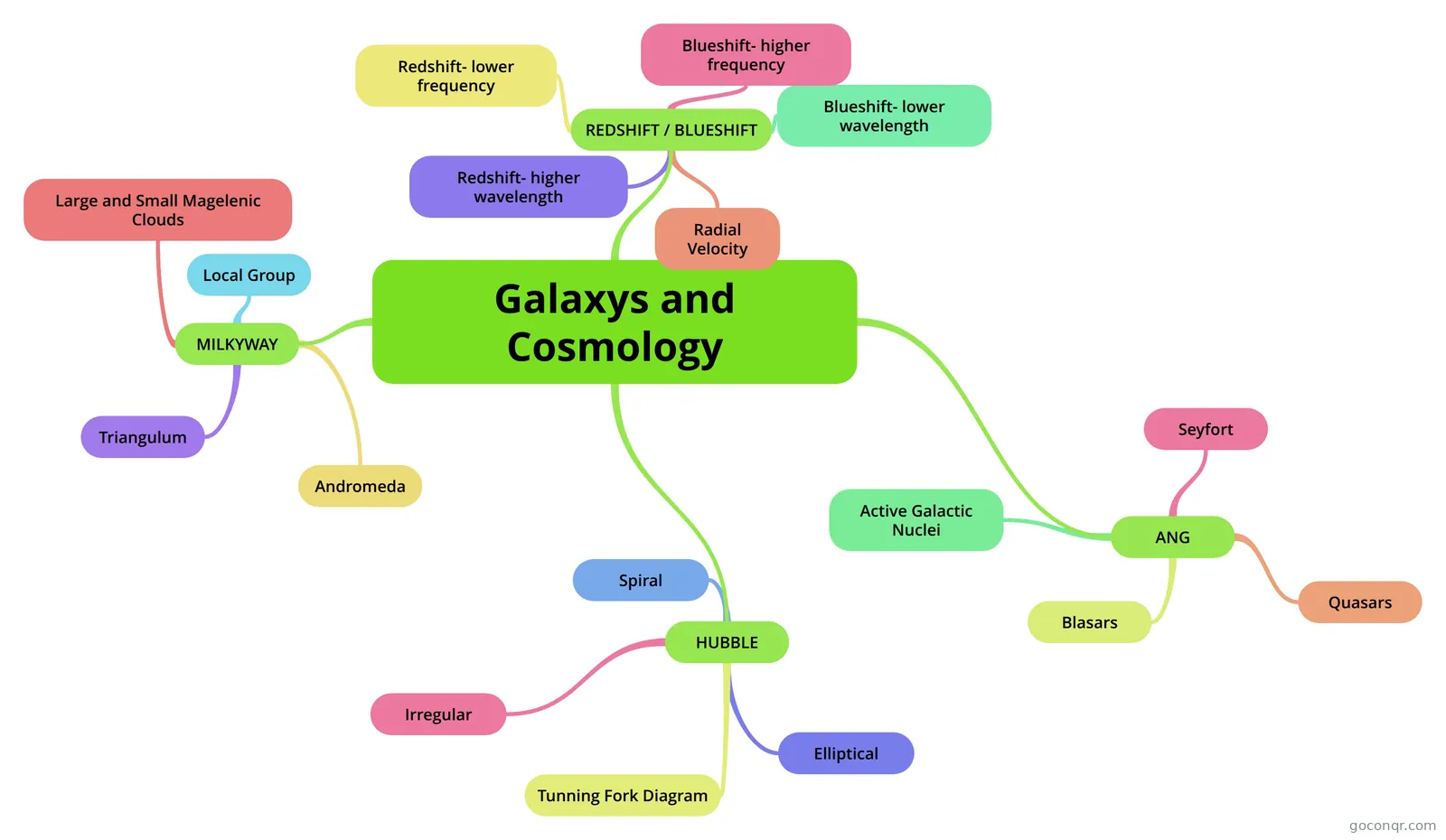 Mind map Galaxys and Cosmology
Quizzes
See all 34 quizzes-
55 questionsASTR 2020 Quiz 5 The best-known example of a ring galaxy is the Cartwheel galaxy. This was likely formed by:
-
45 questionsSTARS & GALAXIES HD 2539 has spectral type K; Betelgeuse has spectral type M. Betelgeuse is more luminous than HD 25329. Whi...
-
15 questionsGalaxies and Mercury Quiz A pinwheel structure made of gas , dust, and YOUNG STARS that winds out from the center of a sprial galaxy.
-
9 questionsGalaxy Identification Practice Images
Mind maps
See all 23 mind mapsFlashcards
See all 30 flashcardsTopics in Galaxies and the Milky Way
More Astronomy topics
About Galaxies and the Milky Way
GoConqr OriginalWhat this unit covers
The unit sits in the Galaxies and the Universe strand of Astronomy. It mixes lecture-style flashcards, short quizzes, mind maps and a few notes, all made by GoConqr users. Most of the material is aimed at university level, with a solid share for school students.
Where to start
If you want the big picture first, open the mind maps called The Milkyway Galaxy and Distance To Galaxies. They give you a quick outline before you meet the detail. The notes called Curtis-Shapley debate and MILKY WAY (SPIRAL GALAXY) add some background on how our view of the galaxy developed. School students may also like the notes on Our galaxy, the Milky Way, from a GCSE astronomy topic on galaxies and cosmology.
Going deeper
The flashcard decks follow a lecture-by-lecture path. Here is a sensible order:
- Galaxies covers apparent magnitude, distance modulus, ellipticity and parallax.
- Galaxy Lecture 8 looks at HII regions, Stromgren spheres and why high-mass stars trace spiral arms.
- Galaxy Lecture 9 asks what the Milky Way rotation curve should look like under different mass distributions.
- Section 4 links rotation curves to evidence for dark matter.
- Galaxy Formation moves into the maths of structure growth, with the continuity, Euler and Poisson equations.
That last deck is the most demanding, so leave it until the earlier ones feel comfortable.
Using quizzes and maps together
Read a mind map, then test yourself. ASTR 2020 Quiz 5 asks about ring galaxies such as the Cartwheel galaxy, and about bulge-dominated spirals. Chapter 13 asks you to pick out correct statements about families of galaxies and how their properties are measured. Quizzes such as Galaxies Quiz and 11. The Milky Way are good for a quick check. Note the questions you miss, then go back to the matching map or deck.
Maps such as Galaxies at High Redshift and The Local Group and Clusters and Superclusters stretch the topic outwards once the Milky Way is clear. When you are ready, pick one deck and one quiz and work through them side by side.
Frequently asked questions
Which resource should I open first?
Start with a mind map such as The Milkyway Galaxy or Distance To Galaxies to see the shape of the topic. Then take a short quiz like Galaxies Quiz to find what you already know, and move on to the lecture flashcards for the detail.
What do the flashcard decks cover?
The decks follow lectures and sections. They include distance and magnitude formulae, HII regions and Stromgren spheres, the Milky Way rotation curve, dark matter evidence and the equations behind galaxy formation. Some decks are midterm or final practice sets.
Are the resources free to use?
Yes. Every resource on this page is free to open, study and take, with no account needed. They were made by GoConqr users, not by GoConqr itself, so wording and depth vary from one resource to another.
Which levels is this unit suited to?
Most resources suit university students, with a good share for school students. Teachers can use the quizzes and maps as ready-made material. The galaxy formation deck is the most advanced, while the general galaxy maps and quizzes are gentler.
Can I save my quiz scores or make my own resources?
A free account saves your quiz scores and lets you make your own quizzes, mind maps, flashcards and notes. It is a handy way to turn the questions you got wrong into a personal revision set.
What if I cannot find a topic I need?
Try nearby titles first. Resources on distance to galaxies, high redshift and the Local Group cover wider ground than the Milky Way alone. If a topic is still missing, you can build your own map or deck with a free account.