
Karteikarten
Week 3
Karten in diesem Stapel (48)
- 1Overall function of the pancreas?-Important in digestion of nutrients, fat and protein
-Provides environment for enzymatic digestion in the small bowel
-Regulates fed/fasted states via. insulin, glucagon - 2Describe the structure of the pancreas-Divided into lobules which drain into intercalated, interlobular and then a main duct
-Drains into lumen to descending part of duodenum (start of midgut)
-Pancreactic duct merges with common bile duct to form the ampulla of Vater
-Muscle wall thickens around it to form the sphincter of Oddi, which regulates/prevents reflux - 3What happens within lobules of the pancreas?-Secretory units reside, composed of an acinus and small intercalated duct
-Acini are clusters of acinar cells (that are polar), synthesising and secreting proteins into the lumen
-Secretions include zymogens, digestive enzymes and an isotonic, plasma-like fluid - 4Function of: acinar cells duct cellsAcinar: polarised for production and export of lots of protein
Duct: transport of electrolytes - 5Function of: centroacinar cells goblet cellsCentroacinar: very first cells of intercalated duct
Goblet: produce mucus for lubrication, hydration, mechanical protection and immunologic role - 6Describe the stimulation and signalling of acinar cells-Stimulated through CCK receptors and muscarinic ACh receptors on the basolateral membrane
-Signals via PKL/Ca 2+ pathway leading to increased enzyme secretion
-VIP and secretin activate adenyl cyclase, increased production of cAMP and activation of PKA - 7What are some CCK triggers? What else do acinar cells secrete other than proteins?-Fat in gut lumen
-Triglycerides
An isotonic NaCl-rich fluid that hydrates the dense, protein-rich material secreted by the acinar - 8How is the NaCl rich fluid made?1) Na-K pump pumps Na+ out and K+ in (Na+ gradient across basolateral membrane)
2) Na/K/Cl cotransporter produces net Cl- uptake, driven by the Na+ gradient
3) Rise in [K+]i is matched by a K+ pump
4) Cl- exits via apical-membrane Cl- channels
5) Movement of Cl- into lumen drives Na+ into lumen via tight junctions - 9Describe the function of pancreatic duct cells-Secrete an HCO3- rich fluid that alkalinises and hydrates the protein-rich primary secretions of the acinar cell
-Fluid is needed to set to a enzymatic optimal pH, for micelle formation and neutralising acid
Formed when:
-Cl-HCO3 exchanger pumps Cl- into the cell and HCO3- into the lumen
-Carbonic anhydrase is generated
-Secretin (trigger: acid)/ACh induces CFTR (cAMP activated Cl- channel) to efflux HCO3-/Cl- and Cl- recycling occurs - 10Describe cystic fibrosis-Mutation in CF gene, alters function of CFTR
-Cl- doesn't flow back out of the cell into the lumen so less HCO3-/water is secreted out
-Results in protein-rich primary secretion leading to ductal obstruction and pancreatic tissue degeneration
-Deficiency in pancreatic enzymes leads to maldigestion of nutrients and diabetes - 11What is the rate of pancreatic secretion dependent on?-Biliary/gastric secretions and intestinal motility
-Fasted state: low level release of pancreatic enzymes
-Fed state: pancreatic secretion increases - 12What is the role of CCK in pancreatic stimulation?-Stimulates acinar cells to increase protein secretion
-Released in response to a fatty meal or indirectly via paraNS
-CCK secretion stimulated by CCK-releasing factors (eg. LCRF)
-Fasting state: LCRF is degraded
-During meal: LCRF stimulate I-cells to release CCK - 13What inhibits pancreatic secretions?Somatostatin
-inhibits release of CCK, secretin, insulin and glucagon
-Analogues used clinically for patients with pancreatitis - 14Describe the cephalic and gastric phase of pancreatic secretionCephalic (sight, taste, smell of food):
-stimulation of ACh receptors
-no CCK or secretin involved
Gastric:
-release of gastrin (weak CCK agonist)
-gastric distention stimulates low levels of secretion via a vagovagal gastropancreatic refles - 15Describe the intestinal phase of pancreatic secretion-Accounts for most of pancreatic secretion
-Acid stimulates secretin release from S cells (stimulates duct cells to secrete HCO3/fluid)
-Lipids stimulate release of CCK
-Lipids activate vagovagal enteropancreatic reflex (stimulates acinar cells) - 16How does the pancreas prevent autodigestion?1) Enzymes stored in secretory granules as zymogens. Only activated when in contact with enterokinase which converts trypsinogen to trypsin (which converts other zymogens)
2) Secretory granule membrane is impermeable
3) Enzyme inhibitors like SPINK1 are in the secretory granule (just in case)
4) Zymogens are condensed and in low pH, ionic conditions - 17Causes of acute pancreatitis?GET SMASHED
Gallstones
Ethanol
Trauma
Steroids
Mumps
Autoimmune
Scorpian sting
Hypercalcaemia, hypothermia, hypertriglyceridaemia
ERCP
Drugs - 18Characteristic features of acute pancreatitis?-Abdominal pain (starts in epigastrium and radiates to the back). Accompanied with nausea and vomiting
-Serum amylase/lipase > 3 times upper limit
-CT scan - 193 phases of acute pancreatitis?1) Premature activation of trypsin within pancreatic acinar which activates other enzymes
2) Intra-pancreatic inflammation
3) Extra-pancreatic inflammation - 20Treatment for acute pancreatitis?-Rest pancreas
-Hourly fluid balance (severe hypovaelamia)
-Pain relef
-Ultrasound scan (gallstones)/CT scan
-ERCP: endoscopy to visualise and treat pancreas eg. remove gallstones. Damage by the scope can cause acute pancreatitis - 21What is chronic pancreatitis? Causes?Inflammation of the pancreas that does not heal or improve. Can lead to permanent damage such as a fibrotic pancreas or diabetes
Causes:
-chronic alcohol abuse
-hereditary disorders
-CF
-Hypercalcemia
-Hyperlipidemia - 22Treatment for chronic pancreatitis-Hospitalisation for pain management, IV hydration and nutritional support
-Creon (synthetic pancreatic enzymes) can be given alongside meals if zymogen is not made
-Plan nutritious diet low in fat with small, frequent meals
-ERCP used to: enlarge duct openings, stent placement, balloon dilation - 23What do the following small intestinal cells do? -goblet cell -enteric endocrine cell -stem/progenitor cell -paneth cellGoblet: mucus secretion
Enteris: hormone secretion
Stem: essential for crypt-villous axis
Paneth: host defence against microbes - 24What do villous/crypt enterocytes do? What cells are present in the colon and what do they do?Villous: nutrient/electrolyte absorption
Crypt: secretion
Surface epithelia absorb electrolytes
Colonic gland cells mediate ion secretion - 25How is the small intestine SA increased?-Macroscopic folds of Kerckring
-Villi and microvilli on apical surfaces of epithelial cells/crypts - 26Describe transcellular and paracellular movementTranscellular: solute must cross the 2 cell membranes in series. Active transport is implied
Paracellular: solute mvoes passively between adjacent epithelial cells via tight junctions - 27What does absorption of water depend on? How does it work?-Depends on absorption of ions: Na+, Cl- (HCO3-)
-NaCl is transported into lateral intercellular spaces (near apical end)
-Apical end becomes hypertonic
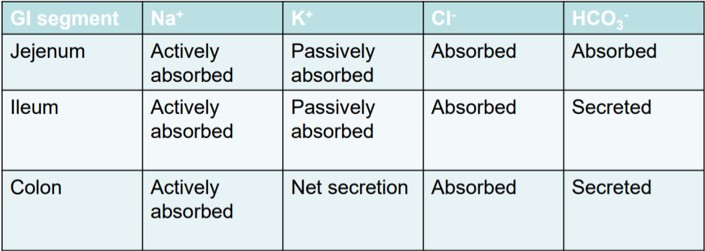
-Osmotic flow of water from the lumen into intercellular spaces via tight junctions - 28Describe whether the following ions are absorbed (actively/passively) in the jejenum, ileum and colon: Na+ K+ Cl- HCO3-
- 29What are the 4 ways sodium is absorbed in the intestine?-Na/Glucose transporters (eg. SGLT1) or Na/aa transporters
-Na-H exchanger
-Parallel Na-H and Cl-HCO3 exchanger
-Epithelial Na+ channels (ie. ENaCs) - 30How does Na/Glucose or Na/aa transport work?1) Na+ is effluxed out via Na+-K+ ATPase in basal membrane
2) Na+ crosses apical surface (enters cell) down an electrochem gradient
3) Energy is provided for moving sugars and neutral aa into epithelial cells against conc gradients
-Net absorption of Na+ is highest in jejunum
-Used in fed state (glucose in lumen) - 31How does the Na-H exchanger work?-Na+ uptake across the apical membrane is coupled to proton extrusion into the intestinal lumen
-Process is enhanced by decreases in intracellular pH and increases in luminal pH (due to luminal HCO3- secretion)
-Occurs usually in jejenum - 32How does the parallel Na-H and Cl-HCO3 exchange (electroneutral transport) work? How does this relate to enterotoxins?-Primary method of Na+ transfer between meals
-Occurs in ileum/large intestine
-Regulated by cAMP, cGMP and intracellular Ca2+ (increases in these, reduce NaCL absorption)
-Enterotoxins induce secretory diarrhoea by elevating cAMP so NaCl absorption is inhibited - 33How do epithelial Na+ channels (ENaCs) work? How do mineralocorticoids like aldosterone work?-Na+ entry occurs across apical membrane via ENaCs
-Na+ absorption occurs in distal colon
Mineralocorticoids increase Na+ absorption by:
1) Increase in opening of ENaCs
2) Insertion of preformed ENaCs
3) Increased synthesis of ENaCs - 34Where does Cl- absorption take place? Ways in which Cl- is absorbed?-Occurs in small/large intestine and is linked closely to Na+ absorption
-Passive Cl- absorption
-Parallel Na-H and Cl-HCO3 exchange
- Cl-HCO3 exchange - 35Describe passive Cl- absorption-Passive process driven by the electrochemical gradient for Cl- by a paracellular or transcellular route
-Drive force is derived from either Na+-Glucose transporter in the small intestine or the ENaCs in the distal colon - 36Describe parallel Na-H and Cl-HCO3 exchangeElectroneutal NaCl absorption mediates Cl- absorption in the ileum and proximal colon
- 37Describe the Cl-HCO3 exchange-Cl is absorbed and HCO3 is effluxed
-Occurs in absence of parallel Na-H exchange
-Occurs in ileum and surface epithelial cells in large intestine - 38Describe congenital chloridorrhea-Congenital absence of apical Cl-HCO3 exchanger
-Autosomal recessive disorder
-Children have diarrhoea with a high stool [Cl-]
-Patients can become alkalotic (increased plasma HCO3-)
-PPI can be used as a treatment - 39What are absorptagogues? Examples? Describe their mechanism of actionSubstances promoting absorption like angiotensin and aldosterone
-Dehydration/drop of plasma volume leads to stimulation of renin-angiotensin-aldosterone axis and Na+ absorption is stimulated
-Angiotensin in the small intestine enhances electroneurtal NaCl absorption by upregulating apical membrane Na-H exchange
-Aldosterone in the colon stimulates Na+ absorption through ENaC - 40What are secretagogues? 4 categories?Substances promoting secretion (ie. diarrhoea)
-bacterial enterotoxins
-hormones and neurotransmitters
-products of cells in immune system
-laxatives - 41Describe cholera-Cholera is caused by bacterium Vibio cholerae which releases cholera toxin (enterotoxin)
-Transmission is via ingesting contaminated water/food
-Most rapidly fatal illnesses - 42How does cholera cause secretory diarrhoea?-Induces [cAMP]i which increases Cl nd k secretion and inhibits electroneutal NaCl absorption
-Nutrient-coupled Na+ absorption is not affected, so oral rehydration solutions containing glucose and Na+ is effective for treating enterotoxin-mediated diarrhoea - 43Describe Verner-Morrison syndromePancreatic tumours that produce VIP which through cAMP induce diarrhoea
- 44Describe immune mediated diarrhoea Treatments?Histamine and proglandins induce diarrhoea through cAMP, IBS
Loperaminde: opioid receptor agonst which acts to myenteric plexus. Smooth muscle motility is decreased so more water is absorpbed
Somatostatin analogues - 45Describe different types of laxatives and their general actionBulk laxatives: increased fibre when taken with water. This swells in water, distending the lumen and increasing motility
Osmotic laxatives: hypertonic increase in stool water which draws water from cells to the lumen
Stimulant laxatives: increases peristalsis via the ENS - 46Describe passive and active transport of calciumPassive:
-occurs in small intestine
-paracellular pathway
-not under control of VDR (vit. D receptor)
Active transport:
-transcellular uptake of Ca2+
-in epithelial cells in duodenum
-under control of VDR - 47Describe how active Ca2+ absorption takes place1) Ca2+ is absorbed across apical membrane via Ca2+ channels
2) Cytosolic Ca2+ binds to calbindin
3) Ca2+ pump and Na-Ca exchanger extrubes Ca2+ across basolateral membrane into institial fluid
* Active form of Vit.D (1,25-OH D3) stimulates all the steps by acting as a transcription factor - 48What is rickets? Treatments?Vitamin D deficiency leading to hypocalcaemia
-increasing dietary calcium, phosphates and Vit. D
-Exposure to sunshine
-Fish oils (source of Vit. D)
Informationen
- Beschreibung
- Functions and secretions of the pancreas Absorption of ions and water
- Erstellt von
- Dolu Falowo
- Aufrufe
- 1
- Bewertung