
Karteikarten
Physics Topic 6 WAVES
Karten in diesem Stapel (136)
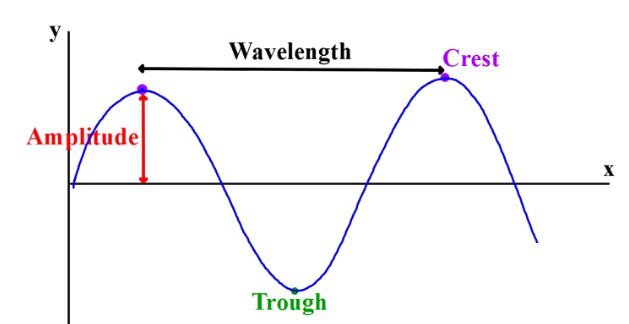
- 1Where are wavelength and amplitude measured?
- 2The wavelength of a wave is ......the distance from a point on one wave
to the equivalent point on the adjacent wave. - 3The amplitude of a wave is ......the maximum displacement of a point on
a wave away from its undisturbed position. - 4The frequency of a wave is ......the number of waves passing a point
each second. - 5period == 1/ frequency
- 6Units for period, T,in seconds, s
- 7units for frequencyhertz, Hz
- 8The wave speed is......the speed at which the energy is transferred (or
the wave moves) through the medium. - 9equation for wave speed =wave speed = frequency × wavelength
- 10Units for... wave speed frequency wavelengthwave speed m/s
frequency Hz
wavelength m - 11describe a method to measure the speed of sound waves in air1)Set up oscilloscope so detected waves at each mic are separate
2) Move both mics slowly away until waves are aligned but have moved 1 wavelength apart
3) Measure distance between mics to find 1 wavelength
4) Calculate speed (freq is whatever you set! eg 1kHz) - 12describe a method to measure the speed of ripples on a water surface.1) Dim light. Use strobe light to see pattern on screen
2) increase frequency until it appears to freeze
3) Measure 10 wavelengths & divide by 10
4) Calculate speed=freq x wavelength - 13When measuring the speed of ripples on a water surface...why use a STROBE?...because it measures a still pattern instead of a constantly moving one
- 14When measuring the speed of ripples on a water surface... What does the distance between each shadow line represent?It is equal to one wavelength
- 15When measuring the speed of ripples on a water surface... When does the pattern appear to freeze?When the frequency of the strobe light is equal to the frequency of the waves
- 16Where can waves be reflected? absorbed ?or transmitted?all happen at the boundary between two different
materials. - 17Draw a reflected ray!
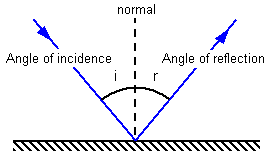
- 18What is the angle of incidence?Angle between incoming wave and the normal
- 19What is the angle of reflection?Angle between reflected wave and the normal
- 20What is the "normal"?an imaginary line that's perpendicular to the surface at the point of incidence
- 21When does "specular reflection" happen?when a wave is reflected in a single direction by a SMOOTH surface (eg light reflected by a mirror)
- 22When does "diffuse reflection" happen?when a wave is reflected in a single direction by a ROUGH surface (eg paper) & rays are scattered in lots of different directions
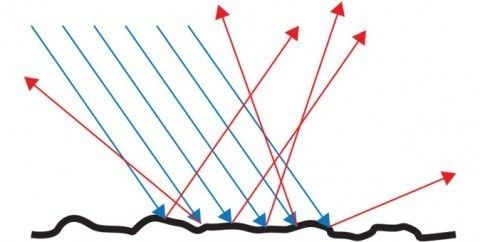
- 23Can sound waves travel through solids?Sound waves can travel through solids causing vibrations in the
solid. - 24Within the ear what do sound waves do?they cause the ear drum and other parts
to vibrate which causes the sensation of sound. - 25The conversion of sound waves to vibrations of solids works over a limited frequency range. What is the effect of this??This restricts the limits of human hearing.
- 26What is the range of normal human hearing?From 20 Hz to 20 kHz
- 27What frequency do ultrasound waves have?A frequency higher than the upper limit of
hearing for humans. - 28When are ultrasound waves partially reflected?when they meet a boundary between two different media
- 29Ultrasound: What can the time taken for the reflections to reach a detector be used to determine?They determine how
far away such a boundary is. - 30Ultrasound: What can the time taken for the reflections to reach a detector can determine how far away a boundary is. WHY IS THIS USEFUL?This allows ultrasound waves to be
used for both medical and industrial imaging. - 31What are seismic waves produced by?Seismic waves are produced by earthquakes.
- 32What type of waves are P-waves?LONGITUDINAL, seismic waves.
- 33Do P waves travel at different speeds through solids and liquids?P-waves travel at different speeds
through solids and liquids. - 34What type of waves are S-waves?Transverse, seismic waves.
- 35Can S-waves travel through a liquid?Nope
- 36What do P-waves and S-waves provide evidence for ?The structure & size of the Earth’s core.
- 37What is echo sounding? What can it be used for?Uses high frequency sound waves to
1) detect objects in deep water and
2) measure water depth. - 38Which are faster? P waves or S wavesP
- 39Which are more direct, P waves or S waves?P
- 40What are seismic waves?Surface waves that travel along the earths surface
AND
body waves that travel through the earth - 41What causes seismic waves?earthquakes and explosions
- 42What do we use to detect the seismic waves?Seisometers
- 43What do Seismologists do?Work out the time for shock waves to reach each seisometer and where it doesn't reach
- 44Are electromagnetic waves transverse or longitudinal waves?Transverse
- 45All types of electromagnetic wave travel at the same velocity through ________ ?A vacuum
(space) or air. - 46Put the electromagnetic waves in order from longest wavelength to shortestRadio
Microwave
Infrared
Visible
UV
X ray
Gamma - 47Which electromagnetic waves have the highest frequency (shortest wavelength)?Gamma
- 48Which electromagnetic waves can our eyes detect?Visible light
- 49How can radio waves be produced?...by oscillations in electrical
circuits
(ie using an alternating current in an electrical circuit) - 50When radio waves are absorbed what might they create?An
alternating current with the same frequency as the radio wave itself, - 51What are alternating currents made up of?Made up of oscillating charges. As they oscillate, they produce oscillating electric and magnetic fields ie electromagnetic waves
- 52When transmitted radio waves reach a receiver what happens to them?Absorbed
- 53Radio waves: What happens to the energy transferred by the waves?It is transferred to the electrons in the material of the receiver, & makes them oscillate (& if the receiver is part of a complete circuit it generates an alternating current)
- 54What wavelengths are long wave radio waves and short wave radio waves?long waves= 1-10km
short waves = 10-100m - 55Give the main use of RADIO WAVESCommunication
- 56Uses of microwavesCommunication
microwave ovens - 57How does changes in atoms and the nuclei of atoms affect electromagnetic waves?Changes in atoms and the nuclei of atoms can result in
electromagnetic waves being generated or absorbed over a wide
frequency range. - 58Gamma rays originate from .... what?Gamma rays originate from changes in the nucleus
of an atom. - 59Which of the EM spectrum have hazardous effects on human body tissue?Ultraviolet waves, X-rays and gamma rays can have hazardous
effects on human body tissue. - 60Ultraviolet waves, X-rays and gamma rays can have hazardous effects on human body tissue. WHAT DO THESE EFFECTS DEPEND ON?1) the type of radiation
2) the size of the dose. - 61What is radiation dose (in sieverts) a measure of ?A measure of the risk of harm resulting from an exposure of the body
to the radiation. - 621000 millisieverts (mSv) = ????? sievert (Sv)1000 millisieverts (mSv) = 1 sievert (Sv)
- 63Effects of ultraviolet waves on the body?1) Can cause skin to age prematurely
2) increases risk of skin cancer - 64What type of radiation are X-rays and gamma rays ?Ionising radiation
- 65X-rays and gamma rays are ionising radiation that can cause ________________?1) mutation of genes
2) cancer - 66Uses of radio wavesradio waves – television and radio
- 67Uses of microwavesmicrowaves – satellite communications, cooking food
- 68Uses of infrared• infrared – electrical heaters, cooking food, infrared cameras
- 69Uses of visible light• visible light – fibre optic communications
- 70Uses of ultraviolet1) energy efficient lamps,
2) sun tanning
3) fluorescent lights
4) security pens
5) - 71Uses X-rays and gamma rays• X-rays and gamma rays – medical imaging and treatments.
- 72What type of microwaves do you need to use for communication?Need to use microwaves which can pass easily through Earth's watery atmosphere
- 73Describe how microwave ovens work1) microwaves absorbed by water in food
2) penetrate a few cm into food before being absorbed & transferring energy to the water in the food, causing water to heat up
3) water then transfers energy to the rest of the molecules in food by heating - 74What gives out infrared radiationAll objects.
hotter objects the more IR given out - 75What can detect IR? how?IR cameras.
Turns it into an electrical signal, displayed on screen.
hotter = brighter - 76IR can be used to increase temperature - 2 uses?1) cooking food (eg toaster)
2) electric heaters (contain a long wire that heats up when current flows through it) - 77What are optical fibres?Thin glass/plastic fibres that can carry data from phones or computers over long distances as pulses of visible light
- 78How do optical fibres work?Reflection. Light rays are bounced back and forth until they reach the end of the fibre. (Total internal reflection)
Light isn't easily absorbed or scattered as it travels - 79What is fluorescence?a property of certain chemicals where UV radiation is absorbed and then visible light is emittedo
- 80What do fluorescent lights generate?UV radiation
- 81Describe how fluorescent lights workGenerate UV radiation which is absorbed & re-emitted in visible light by a layer of phosphorus
- 82why are fluorescent lights good to use when light is needed for long periods eg in school classroomsthey are energy efficient
- 83Well done Matthew!Keep going!
- 84Describe how X rays produce an imageX rays do not easily pass through dense materials like bones or metals.
The amount of radiation that's absorbed (or not absorbed!) that gives you an image - 85What are Dan and Phils middle names?James and Michael
- 86Why are some EM waves dangerous?High frequency waves transfer a lot of energy that can cause damage.
eg cells - 87how does a lens form an image?by refracting light.
- 88What happens in a CONVEX lens?Parallel rays of light are brought to a focus at the principal focus.
- 89The distance from the lens to the principal focus is called .... ?the focal length
- 90Is the image produced by a convex lens real or virtual?Can be either!
- 91Is the image produced by a concave lens real or virtual?ALWAYS VIRTUAL
- 92The magnification produced by a lens can be calculated using the equation:magnification = image size/object size
- 93What are the units for magnification?Magnification is a ratio and so has no units.
- 94Image height and object height should both be measured in....which units?Image height and object height should both be measured in either
mm or cm. - 95What are the features of Radio Waves?1. Lowest frequency of Electromagnteic Spectrum and biggest wavelength (1m - 10 to the 4 metres). Made by oscillating charges.
2. Used mainly for communications including TV and FM radio.
3. Little danger to living tissue not absorbed. - 96How are concave and convex lenses represented in ray diagrams?
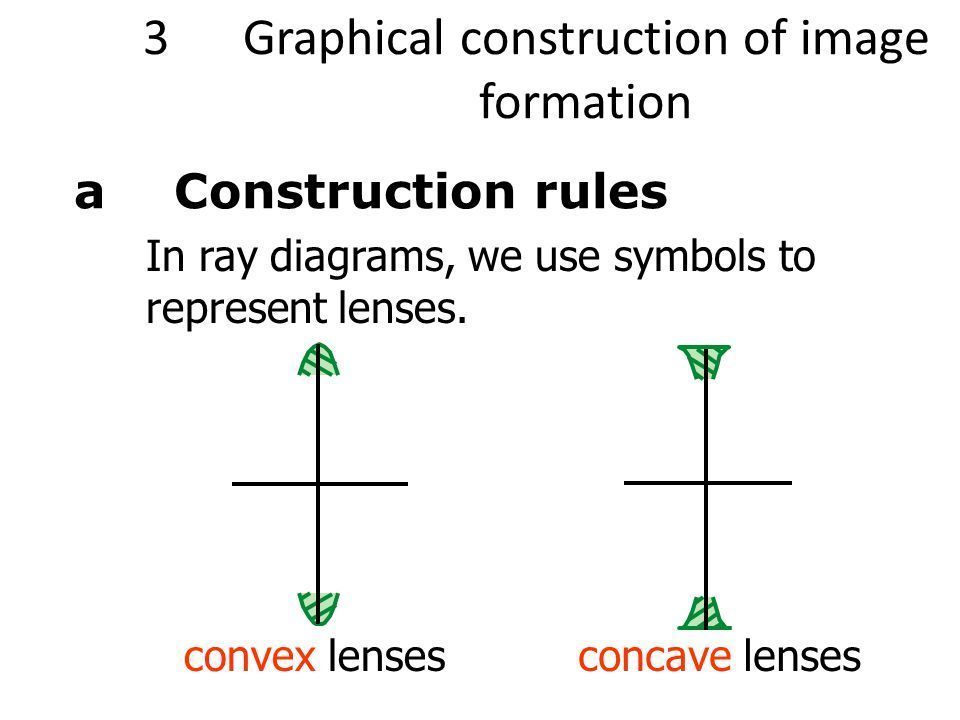
- 971. Used by satellites and microwave ovens (different wavelengths) 2. Little danger to living tissue not absorbed.Microwaves
- 98Draw a ray diagram showing rays from a distant object and a convex lens
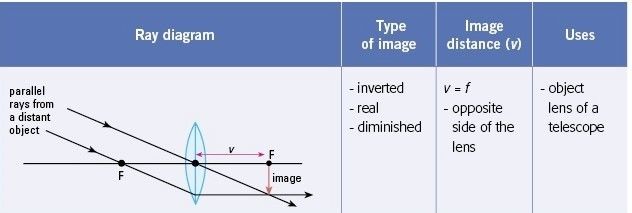
- 99Draw a ray diagram showing rays from an object further than 2F and a convex lens

- 100Draw a ray diagram showing rays closer than F and a convex lens
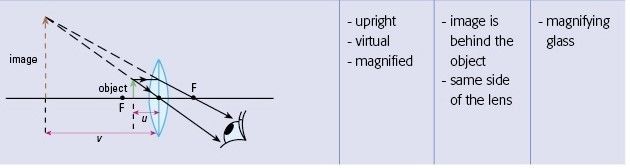
- 101Draw a ray diagram showing rays from an object at F and a convex lens
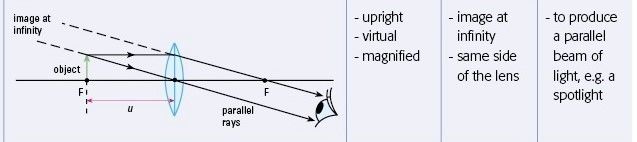
- 102Draw a ray diagram showing rays from an object at 2F and a convex lens

- 103Draw a ray diagram showing rays from an object between F and 2F and a convex lens
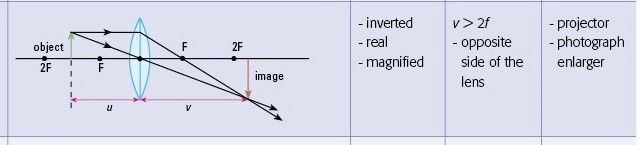
- 104REQUIRED PRACTICAL Describe the Leslie's cube method
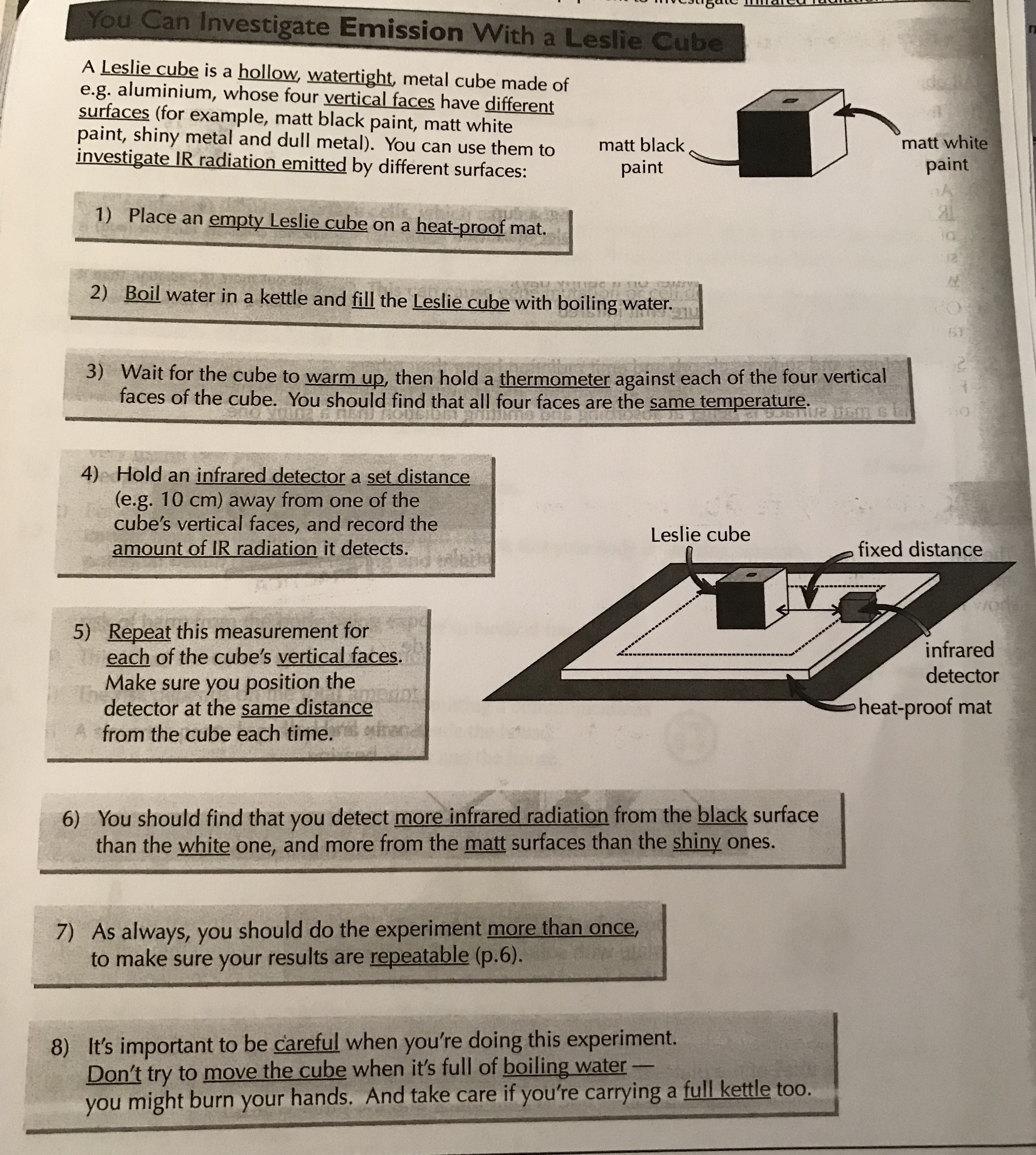
- 105What can the Leslie's cube be used to investigate?Infrared radiation emitted by different surfaces
- 106What are the features of Infrared?1. Used by electric room heaters and toasters etc + to increase and also monitor temperature.
2. Fairly safe but too much will burn you. - 1071) Used in fibre optic cables to transmit data from telephones or computers 2) Safe except at extreme ends of the spectrumVisible light
- 108Uses of ultravioletFluorescent lights.
Security pens. - 109What do ultraviolet rays do to the body?Transfer energy which can cause damage to surface cells of the body - this can lead to sunburn, premature skin aging, blindness & risk of skin cancer.
- 110Used in medicine (eg to detect broken bones and to kill malignant cancer cellsX rays
- 111X rays - are they harmful?Very harmful in LARGE doses.
Can cause gene mutation or cell destruction in cancer - 112how do radiographers protect themselves?Wear lead aprons.
Stand behind a lead screen.
Leave the room. - 113Gamma Rays - uses?Treat cancer.
A medical tracer for diagnostic purposes. - 114Are gamma rays dangerous?Yes, dangerous to the body but medical uses is a careful balance of risk and benefit.
- 115In ray diagrams what units should be used for image height and object height ?Either
mm or cm. - 116How is each colour within the visible light spectrum different?It has its own narrow band
of wavelength and frequency. - 117Reflection from a smooth surface in a single direction is called _______________?Specular reflection
- 118What is "diffuse reflection"?What do we call reflection from a rough surface that causes scattering
- 119How do colour filters work ?By absorbing certain wavelengths (and colour) and transmitting other wavelengths (and colour).
- 120What is the colour of an opaque object determined by?By which wavelengths of light are more strongly reflected.
- 121What happens to wavelengths that are not reflected?They are absorbed.
- 122If all wavelengths are reflected equally, what does the object look like?The object appears white.
- 123If all wavelengths are absorbed the objects appears black.The objects appear black.
- 124Objects that transmit light are either _____________ or ____________Transparent or Translucent
- 125All objects, no matter what temperature, emit and absorb what?infrared radiation
- 126Do things have to be hot to emit IR radiation?No
- 127What happens when the body gets hotter?The hotter the body, the more infrared radiation it radiates in a given time.
- 128What is "a perfect black body"?An object that absorbs all of the radiation
incident on it.
(none is reflected or transmitted!) - 129Does a black body reflect or transmit any radiation?No
- 130Describe what would be the best possible emitter?Since a good absorber is also a good emitter, a perfect black body
would be the best possible emitter. - 131What does the intensity and wavelength distribution of any emission depends on?It depends on the temperature of the body.
- 132Describe the absorption and emission of radiation of a body at constant temperatureAbsorbs radiation at
THE SAME RATE as it is emitting radiation. - 133When does the temperature of a body increase?When the body absorbs radiation faster than it emits radiation.
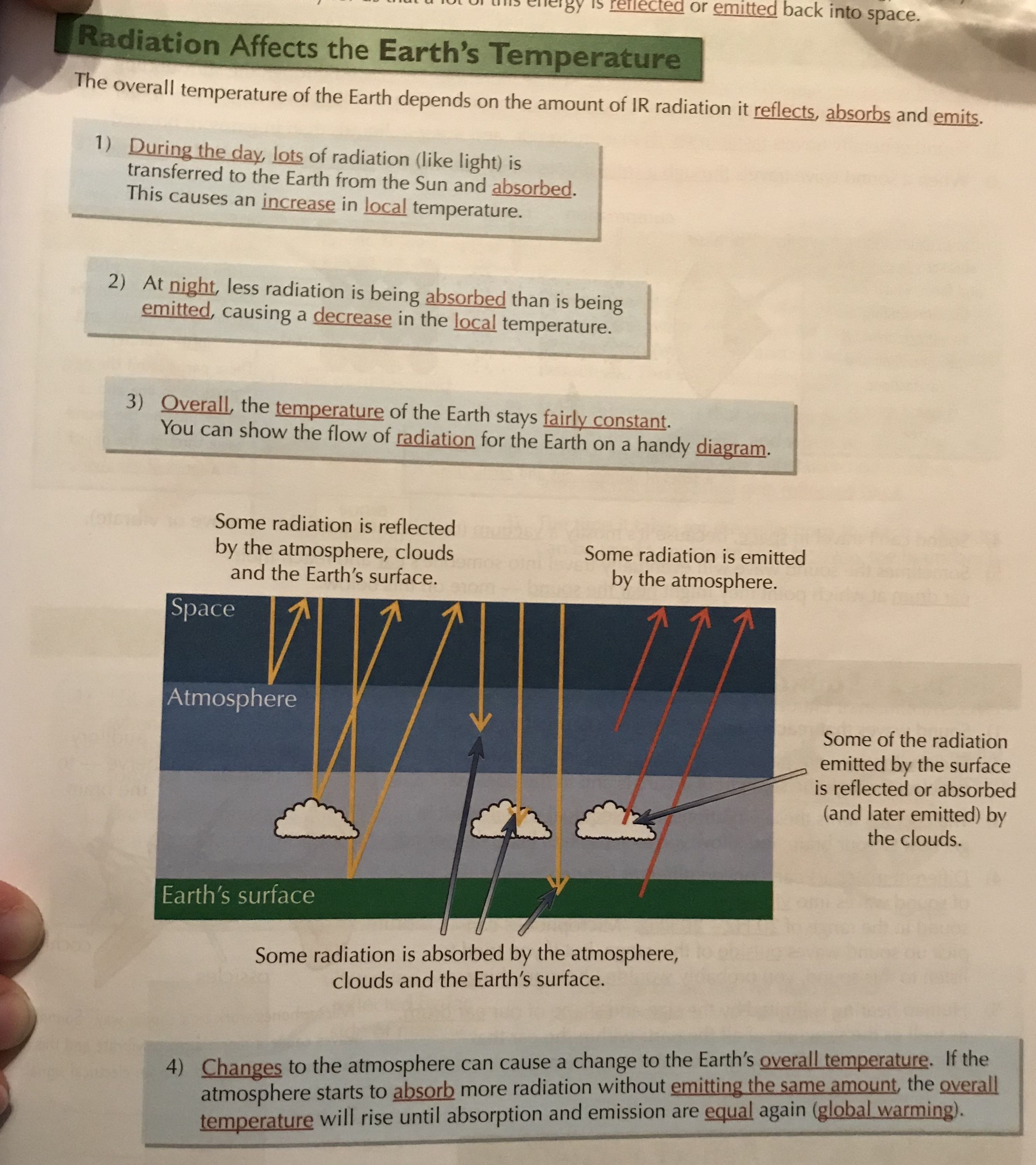
- 134The temperature of the Earth depends on what factors?eg the rates of absorption and emission of radiation, reflection of radiation into space.
- 135Explain how radiation affects the Earth's temperature
- 136—
Informationen
- Beschreibung
- Year 11 Physics Karteikarten am Physics Topic 6 WAVES, erstellt von Matthew Bradley am 23/05/2018.
- Erstellt von
- Matthew Bradley
- Aufrufe
- 0
- Bewertung