
Waves
379 resources created by 287 users
This Waves page on GoConqr gathers community-made quizzes, mind maps, flashcards and notes, from transverse and longitudinal waves to refraction, standing waves, polarisation and the Doppler effect. It's built for school students revising a topic and teachers after ready-made material. There are over 2,300 resources here, including more than 140 quizzes, over 1,200 mind maps and more than 800 flashcards, mostly at secondary level with a small share beyond it. Pick a topic, try a quiz to find your gaps, then build something of your own.
Top Waves resources
-
40 questionsQuiz AS Level Physics Topic 14 Waves A mass attached to the lower end of a spring bounces up and down. At which points in the path of the mass d...
-
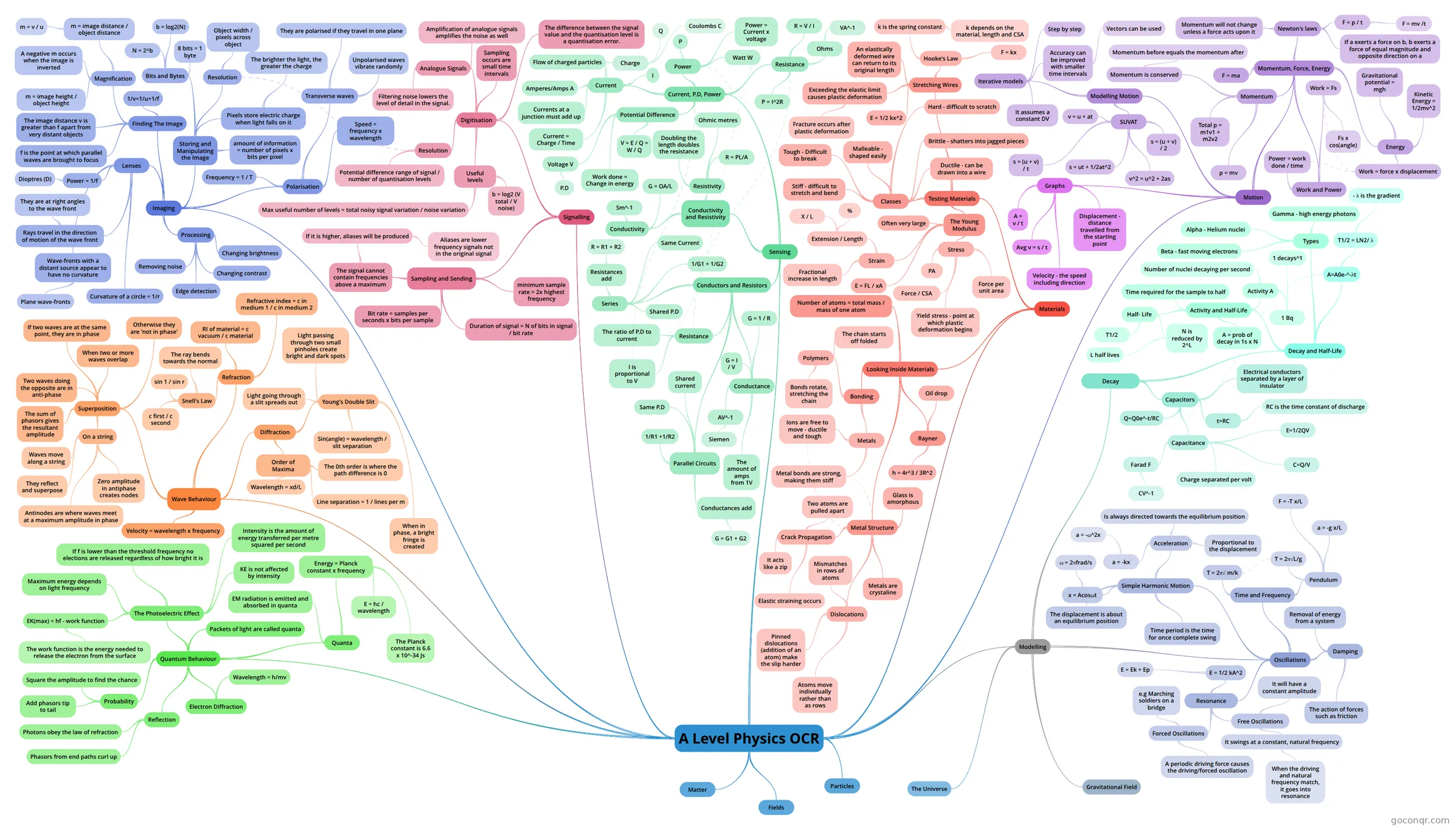 Mind map A Level Physics OCR
-
10 questions9702 AS Level Physics U14 Waves - Waves Basics Quiz A sound wave moves with a speed of 320 m/s through air. The variation with time of the displacement of an a...
-
40 cardsWaves Which is a transverse wave that requires a medium to move? A. ocean wave B. sound wave C. light wave D. mic...
-
37 questionsWaves Covers waves, including categorization, form, and more. For course at UWF.
-
34 cardsTopic 4 - Guideline solutions 4.1.1 Describe examples of oscillations
-
Mind map Physics: Waves, Sound & Light
-
20 questions0654 General Waves Properties Quiz Sound waves of frequency 2.0 kHz travel through a substance at a speed of 800 m/s. What is the wavelength o...
Quizzes
See all 45 quizzes-
40 questionsQuiz AS Level Physics Topic 14 Waves A mass attached to the lower end of a spring bounces up and down. At which points in the path of the mass d...
-
10 questions9702 AS Level Physics U14 Waves - Waves Basics Quiz A sound wave moves with a speed of 320 m/s through air. The variation with time of the displacement of an a...
-
37 questionsWaves Covers waves, including categorization, form, and more. For course at UWF.
-
20 questions0654 General Waves Properties Quiz Sound waves of frequency 2.0 kHz travel through a substance at a speed of 800 m/s. What is the wavelength o...
-
19 questions0654 Sound Waves Quiz Why can ultrasound not be heard by humans?
-
10 questions0654 Electromagnetic Waves Quiz Which row correctly describes light waves and radio waves?
-
10 questionsAS Physics U14 Waves Checkpoint Quiz 1 A longitudinal wave travels through a long spring. The spring is shown at one instant. What is the waveleng...
-
18 questionsLesson 3 Travelling Waves Quiz 2 1. What will this wave look like after it reflects?
Mind maps
See all 119 mind maps-
A Level Physics OCR
-
Physics: Waves, Sound & Light
-
Waves - Chapter 11 Mind map about waves
-
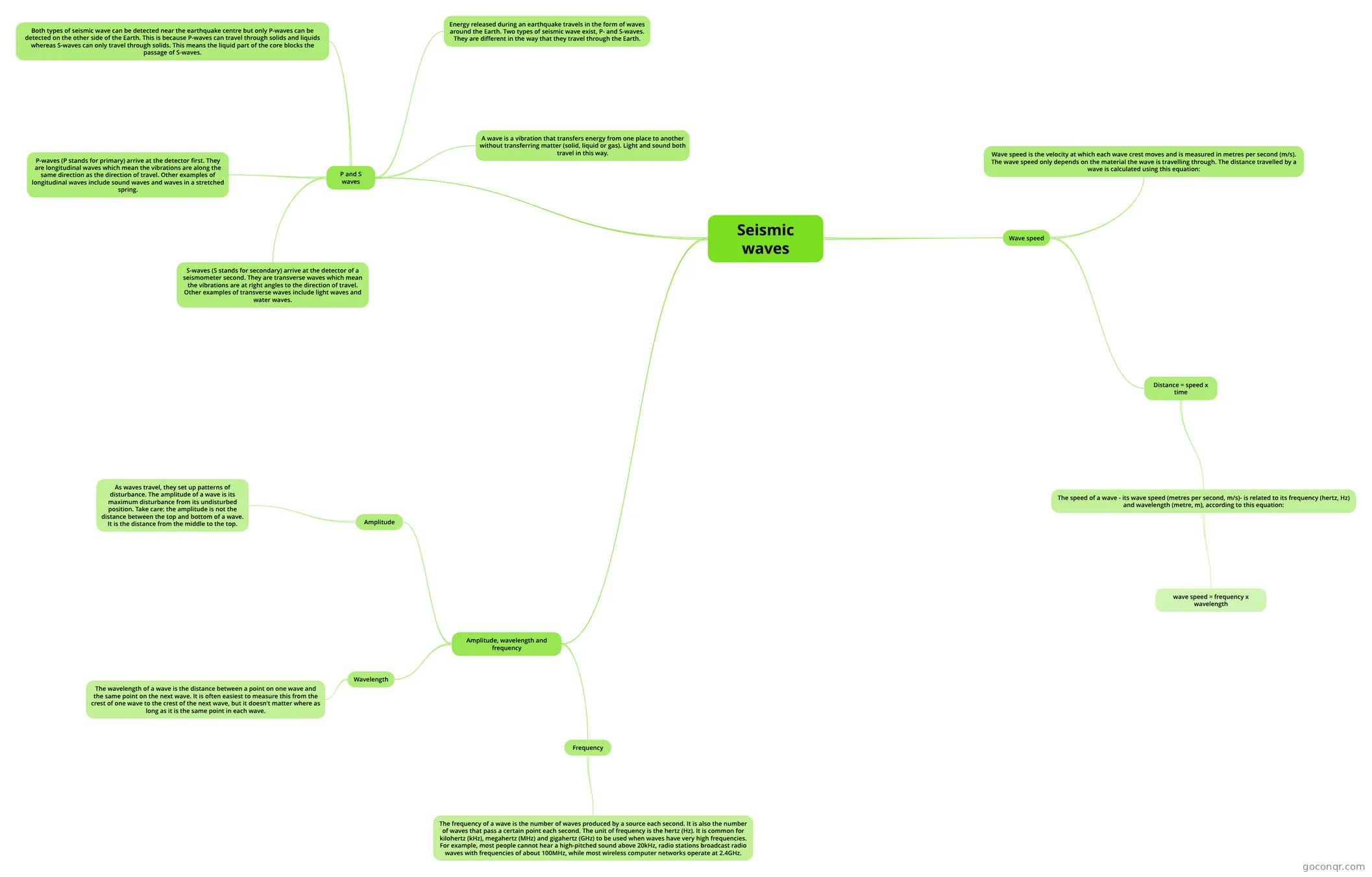 Seismic waves
-
Section 3- Waves (part 2)
-
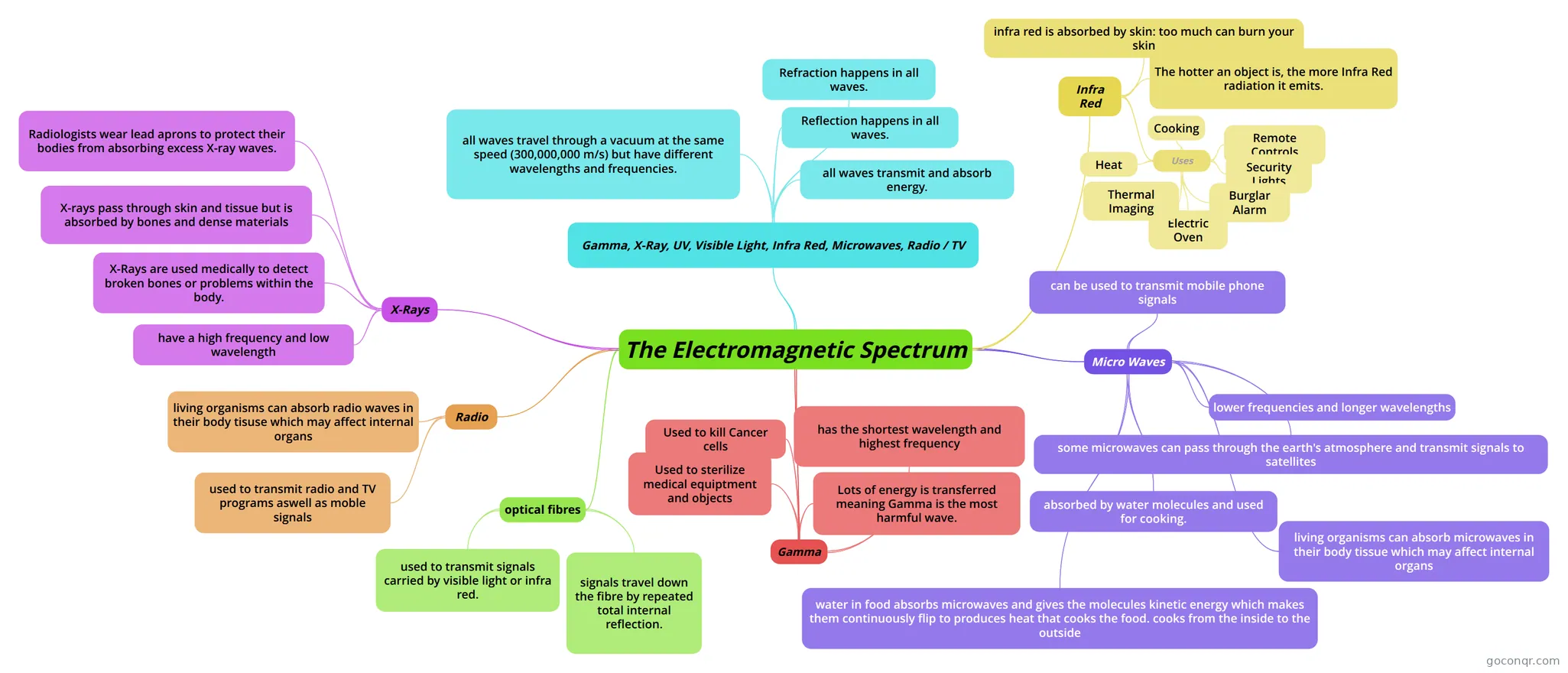 The Electromagnetic Spectrum i made this mindmap to revise for a physics test. Feel free to use it/print it out if it helps.
-
Electromagnetic waves The electromagnetic spectrum descriptions and properties
-
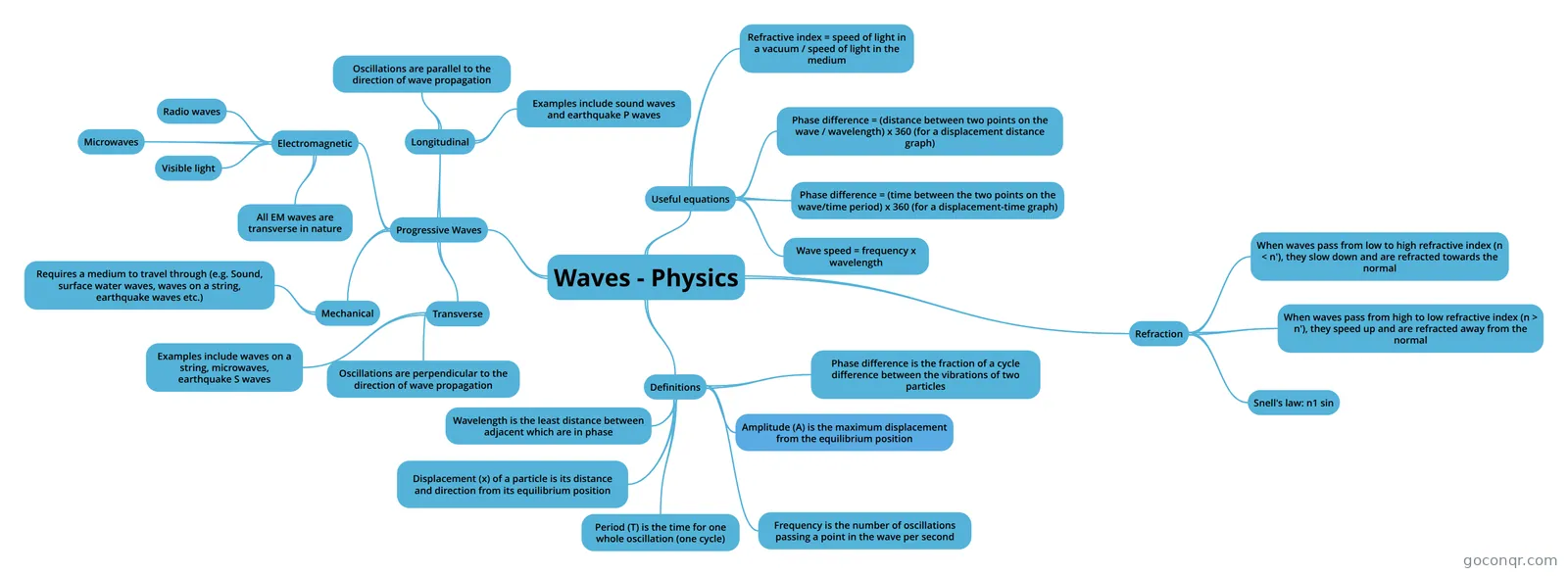 Waves - Physics
Flashcards
See all 167 flashcards-
40 cardsWaves Which is a transverse wave that requires a medium to move? A. ocean wave B. sound wave C. light wave D. mic...
-
34 cardsTopic 4 - Guideline solutions 4.1.1 Describe examples of oscillations
-
13 cardsPhysics: Sound (Speakers) Physics: Mechanical Waves Sound You will need: for the project: * two cups per child * a craft roll (at lea...
-
19 cardsUNIT 3.5 - FEATURES OF WAVES
-
43 cardsWaves Learn all about waves and sound waves.
-
30 cardsWaves Wave Speed Equation
-
37 cardsWaves and Sound - Definitions (Grade 11 Physics)
-
12 cardsPHYSICS 4.1, 4.2 & 4.3 What are the two types of waves and the key properties of each?
Notes
See all 39 notes-
IB Physics Sub-Topic 4.4 Wave Behaviour Lesson 2 Refraction & Snell's Law Lesson 2 - Refraction of Light & Snell's Law Textbook References: Hamper IB HL Physics 2nd Edition - pp 186 - 189; Oxford Text pp 146 - 150. Syllabus Outcomes Covered in This Lesson: Understandings: Refraction Snell’s...
-
IB AHL Topic 9 Interference Lessons AHL Topic 9 - Lessons 4 & 5: Interference Textbook References: Hamper IB HL Physics 2nd Edition p ; Oxford Text pp Understandings: Young’s double-slit experiment Modulation of two-slit interference pattern by one-slit...
-
IB Physics Topic 4 Lesson 6 Polarisation (Part 2) IB Physics Topic 4.3 Polarisation - Lesson 2 Textbook References: Hamper IB HL Physics 2nd Edition p 200; Oxford Text pp142-144 Syllabus Outcomes Covered in This Lesson: Understandings Polarization Applications and Sk...
-
IB Physics Sub-Topic 4.5 Standing Waves Lesson 1 Lesson 1 - Standing Waves Textbook References: Hamper IB HL Physics pp 179 - 181; Oxford Text pp 158 - 163. Syllabus Outcomes Covered in This Lesson: Understandings: The nature of standing waves Boundary conditions No...
-
Physics P8 H - Observing waves on water (Ripple tank) What is a ripple tank? A shallow tank of water with a transparent bottom. Waves are generated using a motor attached to a narrow bar. A light placed above the tank will cast shadows of the waves on the floor &nb...
-
IB Physic Sub-Topic 4.4 Wave Behaviour - Lesson 2 Refraction IB Physics Sub-Topic 4.4 Wave Behaviour Lesson 2 Refraction Syllabus Outcomes Covered in This Lesson: Understandings Applications and Skills: Main Activities: Task #1: Task #2: Task #3:
-
IB Physics Topic 4 Lesson 5 - Polarisation IB Physics Topic 4 Lesson 5 - EM Spectrum & Polarisation (Part 1) Textbook References: Hamper HL IBPhysics 2nd Edition p 200; Oxford Text pp142-144 Syllabus Outcomes Covered in This LessonUnderstandings Polarisation A...
-
Waves and Diffraction What is a wave? It is a collective bulk disturbance that can be created by a vibrating object, that travels through a medium (involving particle interactions: one particle applies a push or pull on its adjacent n...
Slides
More Physics topics
About Waves
GoConqr OriginalWhat the Waves unit covers
This unit sits in the Waves, Sound and Light strand of Physics. The resources start with the basics: the mind map called Waves separates transverse waves, where the oscillation is perpendicular to the energy transfer, from longitudinal waves, where it is parallel. From there the page moves into electromagnetic waves, light, sound, seismic waves and ultrasound.
Where to start
- Open the Waves mind map for the main vocabulary and wave types.
- Read the flashcard deck on the features of waves, which asks you to fill in missing key terms.
- Move on to Electromagnetic waves and Light, which cover properties, reflection and refraction.
- Try 0654 Sound Waves Quiz if you are working on sound, including why humans cannot hear ultrasound.
Using quizzes and maps together
Read a mind map first, then take a quiz on the same idea. The quiz on period and phase difference, for example, asks you to read two sinusoidal waveforms, which is easier once the definitions are fresh. If a question catches you out, go back to the map and check the branch it belongs to. The standing waves quiz and the mind map called Standing WAVES work well as a pair.
Going further
Several resources follow named courses. You will find IB Physics lesson notes on refraction and Snell's law, polarisation and standing waves. There is also a mind map for A Level Physics OCR, and a set of quizzes for the 9702 AS Level waves topic. For GCSE and IGCSE, look for the AQA refractive index map and the 0654 quizzes on sound, electromagnetic waves and general wave properties.
Make it your own
Once you have worked through a few resources, pick a topic you find hardest and build your own mind map or flashcards from it. Teachers can also use the slide sets and notes as ready-made starting points.
Frequently asked questions
Which resource should I open first?
Begin with the mind map called Waves. It sets out transverse and longitudinal waves and the ideas that the rest of the unit builds on. After that, try a short quiz such as the Waves Quiz or Intro Waves to see which parts need more work.
Which exams do these resources suit?
The listed resources mention GCSE Physics, AQA GCSE Physics, Edexcel IGCSE Physics, IGCSE 0654, A-level Physics and IB Physics. Most are at secondary level, so they suit school students revising for those courses, and teachers can use them as ready-made material.
What do the mind maps cover?
The mind maps cover wave types, electromagnetic waves, light, reflection, refraction, total internal reflection, diffraction, standing waves, polarisation, sound and seismic waves. There is also a broad A Level Physics OCR map that links wave behaviour to other topics.
Are the resources free to use?
Yes. Every resource on this page is free to open, study and take, with no account needed. They were made by GoConqr users rather than by GoConqr itself, so styles and depth vary from one resource to the next.
Can I save my quiz scores or make my own resources?
A free account saves your quiz scores and lets you make your own quizzes, mind maps, flashcards and notes. That is handy if you want to turn a weak topic, such as refraction or phase difference, into your own revision set.
What if I can't find the topic I need?
Look through the related titles on the page, since many topics appear under several names, such as Sound, Light or Refractive Index. Because the resources are community-made, you can also build your own map or flashcards for the gap.