
Karteikarten
Physics p1 revision
Karten in diesem Stapel (68)
- 1Physics. P1 revision. Science gcse.Let's get started.........
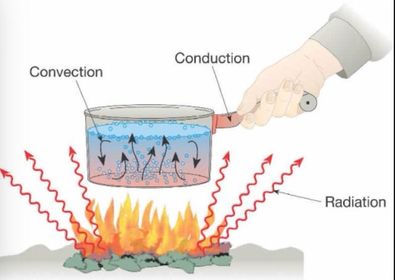
- 2Infrared Radiation.-heat is transferred in 3 diff ways:
Conduction, convection & radiation
-heat radiation is the transfer of heat energy by IR
-Everything gives off infrared radiation
-a vacuum is a space with no particles, radiation travels through it - 3Infrared Radiation Continued-the bigger the temp diff between a body and it's surroundings, the faster energy is transferred by heating
- 4Surfaces&radiation.-dark, matt surfaces absorb and emit infrared radiation the best
-light, shiny surfaces are poor absorbers & emitters but good reflectors of infrared radiation - 5conduction&convection-conduction occurs mainly In solids
-conduction of heat energy is the process where vibrating particles pass on their extra kinetic energy to neighbouring particles.
-metals are good conductors because of their free electrons
-heat is carried in metals by colliding free electrons - 6Convection.-convection occurs in only liquids&gases
-convection occurs when the more energetic particles move from the hotter region to the colder region and take their heat energy with them.
-an example of convection would be an immersion heater - 7Convection continued-water heats up~~>hot water becomes less dense~~>less dense water rises~~>water cools & becomes more dense~~> denser water sinks again
-eventually you end up w convection currents curculating the heat energy through the water - 8Conduction continued-at the hot end, the electrons move faster&collide w the other free electrons, transferring energy. These other electrons then pass on their extra electrons to other electrons etc.
- 9Why do fluids become less dense when they are heated?-A fluid becomes less dense when they are heated because:
-the particles nearest the heat get more energy so they start moving faster so that there is more distance between them and the water expands & becomes less dense - 10Convection, Conduction&. Radiation.
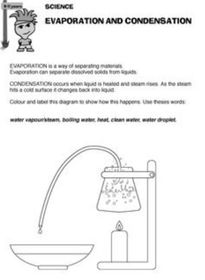
- 11Evaporation&. Condensation.-the rate of evaporation is faster if:
-the temp is higher, density is higher & surface area is larger
-the rate of condensation will be faster if:
-the temp of the gas is lower, density is higher & temp of the surface that the gas touches is lower - 12Evaporation&. Condensation.
- 13States of matter.
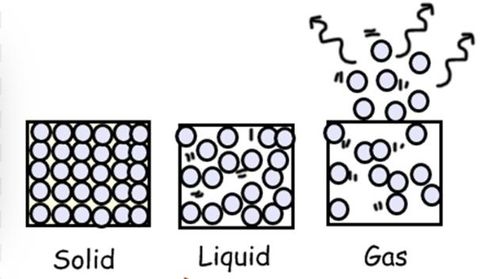
- 14Solids.-have strong forces of attraction hold particles together in a fixed, regular position.
- the particles don't have much energy so they can only vibrate in fixed positions
-has a definite mass, a definite shape & a definite volume too, on heating, it expands real low, and has no compressibility. - 15Liquid-has weaker forces of attraction
-particles are code together but can move around eapch other & form irregular arrangements
-has a definite mass, indefinite shape and a definite volume too, on heating it expands slightly & and has a low compressibility. - 16Gas.-almost no forces of attraction
- more energy than liquids&solids
-they are free to move so they travel in random directions at high speeds
-has a definite mass, indefinite shape and indefinite volume too, on heating, it expands real large & is easily compressible. - 17Heat transferThe rate of heat transfer depends on:
-surface area & volume, the bigger the SA the quicker the heat transfer
- the type of material, conductors transfer heat faster than insulators
-the temp diff between an object & it's surroundings - 18How can we maximise the rate of energy transfer to keep things cool?-by using materials that are matt black, and good conductors
-the airflow around the object is maximised. - 19Vacuum flask.-the double walled glass stops all conduction & convection through the sides
- the walls at the side of the vacuum are silver, this reflects radiation and keep heat loss by radiation to a minimum
-the stopper is made from rubber/cork, which are insulators to reduce any heat loss by conduction
-insulating foam minimises heat conduction to or from the outer glass bottle
-the vacuum stops conduction & convection bc only infrared radiation can travel through a vacuum. - 20Specific heat capacity.-shc stands for specific heat capacity
-shc is the amount of energy needed to change the temp of 1kg substance by 1 degrees Celsius.
-the greater the shc, the more energy is required for each degree of temp change.
-the greater the mass of the substance being heated, the more energy is required for each degree of temp change - 21Specific heat capacity. Continued.-the equation for specific heat capacity is:
e=mxѲ
The letters stand for:
Energy= mass x shc x temp change - 22Using the formula-the shc of water is 4200j/kg°C
-how much energy is needed to raise the temp of 2kg of water by 1°C
-the way to work this out is by using the formula:
E=m x c x Ѳ or
energy needed= mass x shc x temp change
- energy= 2 x 4200 x 1 = 8,400
The amount of energy needed is 8,400J - 23Chapter 2- using energy Conservation of energy-conservation of energy means that energy can be transferred usefully from one form to another, stored or dissipated but it cannot be created or destroyed
-energy is only useful when it can be converted from one form to another.
-the useful energy of a light bulb is light energy.
-the wasted energy of a light bulb is heat energy. - 24Efficiency of a machineEfficiency= useful energy transferred
÷
Total energy supplied to the appliance
Then times by 100 to get a percentage - 25Efficiency of a machine.In a light bulb, for 25 joules of energy that is supplied to the bulb, only 5 joules are transferred into light energy, what is the efficiency of the light bulb?
E= 5 ÷ 25 x 100 = 0.2 x 100
= 20%
-the light bulb is 20% efficient - 26Forms of energy.Electrical energy- wherever a current flows
Light energy- from the sun or light e.g bulbs
Sound energy- from loudspeakers or anything noisy
Kinetic energy- anything that's moving has it
Thermal/heat energy- flows from hot objects to cold ones
Gravitational potential energy- possessed by anything that can fall
Elastic potential energy- stretched springs, elastic, rubber bands etc.
Chemical energy- possessed by foods, fuels, batteries etc. - 27Forms of energyGravitational potential energy- possessed by anything that can fall
Elastic potential energy- stretched springs, elastic, rubber bands etc.
chemical energy- possessed by foods, fuels, batteries etc.
-these three are forms of stored energy bc the energy is not doing anything, it's waiting to be turned into one of the other forms. - 28Chapter 3- electrical energy. .Lamp- creates light energy
Heater- creates heat energy
Speakers- create sound energy
Simple motor- creates kinetic energy - 29Payback time.Payback time is the time it takes for the money you've saved on bills to equal the initial cost of buying the improvement.
-payback time = initial cost
Annual saving
-cost effective methods are the cheapest
-they are cost effective bc they have a short payback time. - 30Payback time.-lost insulation costs £600, it saves £80 per year, how long is the payback time?
Payback time= 600
80
= 7.5 - 31Equation for power.Equation for power:
Power = energy transformed(j)
Time (s)
-an electric motor transfers 48j of electric energy into kinetic energy in 2 mins what is the useful power output of the motor?
Power= 48j/120s =0.4j
The useful power output is 0.4 j - 32Kilowatt hours.-one kilowatt hour is defined as the energy consumed by power consumption of 1kw during 1 hour
1kwh= 3.6x10j to the power of 6 - 33e=p x tp=e/t
p is power
e is energy in joules (j)
t is time in seconds (s)
total cost = num of kwh x cost per kwh - 34kilowatt hoursthe price of 1kwh of electrical energy is 9p. how much does it cost to use a 60w electric light for four hours?
e=p x t
energy= 60W x 4h = 240kwh
total cost= 240x9= £21.60 - 35chapter 4- generating electricity nuclear-nuclear power stations use uranium as a fuel.
-in a power station, fuels such as coal, oil or gas is used to produce electricity. - 36generating electricity- the fossil fuel is burned to convert its stored chemical energy into thermal energy.
-the heat energy is then used to heat water to prodce steam.
-the steam turns a turbine converting heat energy into kinetic energy
-the turbine is connected to a generator which transfers kinetic energy into electrical energy. - 37the national grid-in the national grid- there must be two transformers at the end next to the power plant, where it steps up the voltage for efficient transmission, and one at the other end near the houses where the transformer steps down the voltage to safe, useable levels.
- 38fossil fuelsadvantages
-they are easy to extract
-they are efficient
-cheap & reliable
disadvantages
- they are non-renewable
-they release c02 which adds to the greenhouse effect
-they release sulphur dioxide which makes acid rain. - 39biofuelsadvantages
-cheap & can be grown at home
-they are clean and produce few harmful gases
-they are a renewable energy source
disadvantages
-shortage of food
-forests are burnt down to make room for growing bio-fuels
-biofuels create methane - 40water (hep & tidal)advantages
-renewable energy source
-no fuel costs
-reliable & no harmful gases produced
disadvantages
-destroys habitats
-can release methane
-noise & visual pollution - 41solar poweradvantages
-its a renewable energy source
-no fuel costs
-no harmful gases produced
disadvantages
-expensive & inefficient
-they only work on warm, sunny days
-they don't work at night
-they wouldn't work well in winter - 42wind turbinesadvantages
-its a renewable energy source
-no fuel costs
-no harmful gases produced
disadvantages
-noise & visual pollution
-not reliable
-if theres no wind, theres no electricity - 43chapter 5a- waves-waves transfer energy from one place to another without transferring any matter
- 44transverse waves-transverse waves have sideways vibrations
-in transverse waves the oscillations are perpendicular to the direction of energy transfer of the waves
-the waves are long and wiggly like a snake
-most waves are transverse
-light waves & all other em waves - 45longitudinal waves-longitudinal waves have vibrations along the same line.
-in longitudinal waves, the vibrations are parallel to the direction of energy transfer of the wave.
-the waves are small, tight & straight
-sound waves and ultrasound & shock waves are longitudinal. - 46electromagnetic waves-examples of electromagnetic waves are:
light waves, radio waves & microwaves
- em waves are transverse waves
-they can travel through a vacuum - 47mechanical wavesexamples of mechanical waves:
-sound waves
- water waves
-they are transverse & longitudinal waves
-standing waves can be produced on a stretched string. - 48measuring waves-peak/crest is the top of the wave
-wavelength is the distance between the two peaks
-trough is the dip in the wave
-amplitude is the distance between the straight line and the crest
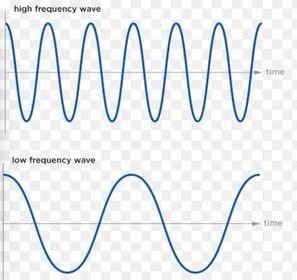
-frequency is the number of complete waves passing a certain point each second or the number of waves produced by a source each second
-frequency is measured in hertz (hz) - 49speed = frequency x wavelength s=f x wavelength _______v_______ f x wavelegnthwhat is the speed of waves with a frequency of 5hz and a wavelength of 2m?
s= 5 x 2 = 10
the speed is 10m/s - 50chapter 5b- wave properties reflection-angle of incidence = angle of reflection
-the normal is an imaginary line that's perpendicular to the surface at point of incidence (where light hits the surface)
-the angles are always measured between the ray and the normal line.
-the law of reflection states that when a ray of light reflects off a surface, the angle of incidence is equal to the angle of reflection - 51reflection- a real image is the image formed where the light rays are focused
-a virtual image is one from which the light rays appear to come but don't actually come from that image like in a mirror. - 52refraction-refraction of light is the change of direction of a light ray when it crosses a boundary between two transparent substances.
-light can be split up to form a spectrum using a prism, this is a block of glass with a triangular cross section. the light waves are refracted as they enter and leave the prism. the shorter the wavelength, the more its refracted. - 53Diffraction.-diffraction is the spreading out of waves when they pass through a gap or round the edge of an obstacle.
- a gap larger than the wavelength causes little spreading and sharp shadow e.g light through a Doorway
-a gap similar to the wavelength causes a lot of spreading with no sharp shadow e.g sound through a doorway - 54Diffraction.-TV and VHF radio signals have wavelengths of around a few metres. This means they cannot diffract over hills or large buildings. The receiver must be in direct line-of-sight with the transmitter. Repeater stations are often positioned at the top of hills to reach all the houses in the valley that would otherwise be in the 'shadow' of the hill.
- 55Sound.-the frequency range for a normal human ear is 20Hz to 20kHz
-sound waves are longitudinal waves
-reflections of sound are echo's
-Sound is mechanical energy, and the energy of the sound is transferred into the medium through which it is travelling. As the energy of sound is carried by the medium, the vacuum of space will not support a sound wave. - 56Musical sounds.-The pitch of a note depends on the frequency of the source of the sound.
-Loudness depends on the amplitude of the sound wave.
The larger the amplitude the more energy the sound wave contains therefore the louder the sound. - 57Waveforms.
- 58Visible light.-White light is the complete mixture of all of the wavelengths of the visible spectrum. Aka colourless light
-white light is made up of all the colours of the rainbow there's red, orange, yellow, green, blue, and violet.
-Radio waves, microwaves, visible light and infrared can all be used for communication. - 59Communication.-Radio waves are made by various types of transmitter, depending on the wavelength. They are also given off by stars, sparks and lightning, which is why you hear interference on your radio in a thunderstorm.
- an optic fibre is a thin glass fibre through which light can be transmitted. - 60Electromagnetic spectrum.
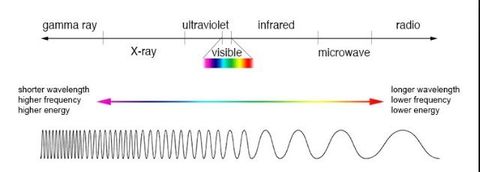
- 61Waves.Remember
-electromagnetic waves transfer energy not matter
-v=f x wavelength can be used to calculate the frequency or wavelength of electromagnetic waves
-radio waves of different frequencies are used for diff purposes
-all electromagnetic waves can travel through space at the same speed by they have diff wavelengths & frequencies - 62Chapter 6b. Universe.Doppler effect
-when the source moves away from the observer the observed wavelength increases & the frequency decreases
-when the source moves towards the observer, the observed wavelength decreases & the frequency increases
-for example a fire engine siren will sound different depending on whether it's moving towards (pitch is higher) or away from you (pitch is lower) - 63Red-shift.Light observed from distant galaxies has been shifted towards the red end of the spectrum. Aka red-shift and this means that the frequency has decreased and the wavelength has increased
-distant galaxies are moving fastest - 64Redshift.The further away a star is,the more light is red-shifted, This tells us that distant galaxies are moving away from us, and that the further away a galaxy is, the faster it's moving away, if it's all moving apart, there's got to be somewhere for it to go, therefore the universe is expanding
- 65Blueshift.Blue shift is when wavelengths decrease & frequency increases. This happens when a star is moving towards you , it appears slightly blue because blue colour has shorter wavelengths and red colour has longer wavelengths
- 66The Big Bang theory.- the Big Bang theory is:
-Scientists believe the Universe began in a hot ‘big bang’ about 13,600 million years ago. The Universe continues to expand today. The evidence for the Big Bang theory includes the existence of a microwave background radiation, and red-shift. Stars do not remain the same, but change as they age. - 67The Big Bang theory.-the universe has been expanding since the Big Bang
-The Cosmic Microwave Background radiation, or CMB for short, is a faint glow of light that fills the universe, falling on Earth from every direction with nearly uniform intensity.
-The CMB is well explained as radiation left over from an early stage in the development of the universe, a - 68The endHope you learnt everything you needed to know....
Informationen
- Beschreibung
- Gcse All subjects (p1) Karteikarten am Physics p1 revision, erstellt von Bethany Townend am 25/10/2014.
- Erstellt von
- Bethany Townend
- Aufrufe
- 678
- Bewertung