
Karteikarten
Ohne Titel
Karten in diesem Stapel (60)
- 1Casting TechniquesPost cast forging- ingot casting, continuous casting.
Cast direct to final shape- sand, investment, die. - 2Ingot castingUp-hill teeming-fills from bottom
Down hill teeming - fill from top
chill zone-small grains at wall
larger columnar grains grow in
pipe at top-shrinkage
alloy segregation-inconsistent solute concentration - 3Continuous castingsteel, water cooled mould-tundish, surface steel=rapid cool, solidify=thin shell, then goes to a rolling mill.
Advantage-less segregation, fewer inclusions
Less waste-ingot top/bottom = waste
High productivity-straight into rolling mill. - 4Sand castingDrag-bottom, cope-top, green sand in mould around pattern- drag invert, cope on top, second half of pattern put in, sand around, runners/risers in-pour in molten metal
- 5Investment castingWax pattern-injection molding-stuck onto tree. Tree-ceramic slurry-refractory sand. 5-10 mm shell. Melt out wax
Pre heat pour alloy/solidify. Shell-finish
Complex shapes, small features-good finish, cast to 100kg, economic small/large batch, melt below 2500.steels, alloys, titanium alloys - 6Gravity die castingBasically sand casting- steel/graphite die coated 1mm ceramic. All alloys castable -even steel with graphite of coated die.
- 7Low pressure die catingAL-alloys-not exposed to air
gas-force melt up through tube-die - 8High pressureAl, Zn, Mg alloys
melt injected with plunger-injection molding
good=thin walls/fine detail replication
fast cycle time - 9Die generallyrepeated use steel die.rapid cool/solidification-thermal conduction of steel. small equi-axed grains-high production rate
The die- high temp stability/thermal conductivity, low adhesion, release quickly-long lead time - 10choose casting techniquedependent on, fluidity, melt temp, component tolerances, micro structure.
Cast to final shape-complicated shape, ductility of alloy to low for hot/cold working + it is cheaper - 11Shrinkagecontraction of liquid
transform liquid to solid
solid state contraction
-causes hot tears/shrinkage cavities
Reduce=correct gating/feeding-7% al. 3% Fe - 12Gas porosityAl solidifies-95% Hydrogen=reject=gas pores=crack initiation.
Even if not evaporate-embrittlement - 13Segregationvariation freezing point=separation in cooling-variation structure properties-reduce-high temp soaking.
- 14HIPINGComponent+chamber+heat+inert gas=removes porosity+increase density.
- 15Mould designgate-entry
runner-flow path
sprue- tapered=constant flow-pour metal in here. - 16TurbulenceTurbulence=air bubble-gas porosity-oxides
melt=impurities/slag-turbulence-distribute through casting.
Prevent-design feed system=steady filling - 17incomplete castingre-arrange gating system-optimise fill rate
- 18Shrinkage cavitiessolidification shrinkage=cavities- use gate riser
- 19RollingHot rolling-destroy cast micro-structure, casting defects-rough surface-poor tolerance
Cold rolling-thin sheet-better surface& tolerance - 20Rolling pressure/frictionMetal sheet=enters slower than roller speed-friction = accelerates sheet through roller.
Minimize pressure by minimizing:
-roll diamter
-rolling reduction
-friction - 21Rolling defectRoll bending
Extra elongation sheet edges-edge buckling
sheet center= tensile stress+edge compression-center cracking
Lateral expansion- no RB-edge cracking, center splitting - 22grain/inclusionplastic deform-forming texture-in roll direction
inclusions are flattened when rolling
cold work- <0.3 tmelt. recrystallize-0.5 tmelt
hot work>0.5 tmelt
flattened inclusions do not recover - 23forgingclosed die forging
open die forging-turbine shaft
upset forging-nuts bolts - 24forging texture 1,2-increase toughness/ductility fiber alignment 3-strength/ductility different parallel/perpforging=control fiber orientation-texture-optimise anistropic properties.
1-elongation/alignment grains-direction cold forming
2-alignment inclusions-no recrystallize
3-alignment grain crystallography (atomic level) after crystallization during hot forming - 25Extrusiondirect extrusion-ram push billet through die-friction die, container wall-higher pressure than indirect extrusion
indirect extrusion-die moves billet supported by closure plate- friction - 26extrusion die materialshigh alloy tool steel or ceramics
heat treatments-nitiriding-increase hardness-improve die life - 27Extrusion defectdirect extrusion-dead zone-2/3 billet outer surface move in, oxide skin-internal oxides=bad-discard 30% left of billet or use follower block/ram-scalp billet.
hot shortness-temp rise-prevent temp rise. - 28tubescentrifugal casting-spin mold pour in melt
butt welding-bend sheet into tube-weld
hot extrusion- fixed/piercing/spider mandrel - 29wire drawingtensile failure-prevent-drawing stress
- 30Deep drawingblank-held-punch into mold
defects-buckling, tensile failure-earing.
drawn-redrawn=increase height- side wall thickness constant. Drawn-wall iron-diameter same wall thickness thinner/wall higher
isentropic-raverage=1
little earing-grad r=close to zero - 31strain ageing rolled sheet steelC.N-diffuse in iron low temp. C,N stick to dislocation-pinning them-harden steel-extra stress to deform- dislocation move = distinct yield point-this causes luders band=strain aged
- 32Types of wearabrasive-cutting action
adhesive wear- surfaces rub
erosion-impact liquid/gas on surface
fatigue-loss of material cracks join - 33Case hardened steelquench/temper-layer of martenisitic steel on pearlitic(mod strength less brittle)
quench 0.3-0.6 wt% C steel -1000 C
Temper 300-600 C
surface=compression stress= improve fatigue resistance - 34electromagnetic inductionpartially martensitic layer on pearlite
- 35Carburisingpack, gas, liquid, plasma - carburising
diffuse C into near surface region-900 C - quench/temper-martensitic layer-only need moderate quench rate-high carbon - 36Carbon nitiridingAddition N as well as C enhances C diffusion+increase harden ability
Careful- not de-carburise heat tre ating - 37NitridingNitride forming elements to steel-then diffuse N into surface-fine dispersion precipitates= hard near surface region=NO QUENCH
Nitride steel=expensive - 38Shot peeningfire small shots at surface- puts it under compression stress, prevents cracks and cold works the surface increasing hardness.
- 39Galvanized steelhot dip- zinc bath- dip component=prevent corrosion 100% zinc coating on steel
Hot dip galvaneal-hot dip but then anneal after-ZN reacts with steel- gives ZN-FE coating
Electro galvanise-electrolytically depost pure ZN or ZN-Fe on steel. - 40Plating, roll bondingTin-outstanding corrosion resistance
chrome- attractive shiny surface corrosion resistance. Hard, low friction
roll bond- two plates-heat-rolled together - 41CVDcomponent-heat-1000c-chamber-flow gas-gas=react deposit on surface=uniform coating, good adhesion of coating as diffusion of coating into substrate. different thermal expansion=cracking if coating above 0.01mm. Thermal distortion=problem. use, TiC, TiN layer
- 42PVDcoating=evaporated or sputtered on to surface-need vacuum. slow coat rate therefore thin coats. substrate not always heated. good adhesion=need clean surface.
expensive - 43thermal spray coatingheat coat material - molten/plastic-spray particle into gas steam onto cold substrate- porous coating. coatings=thick not adherent, process-flexible
- 44Powder processmix elemental, alloy or ceramic/refractory powders then compact-die-sinter-bond metallurgically.
Advantages-form materials- high Tmelt, blend mats not easily alloyed. Low waste, high tolerance, complex shapes, no segregation-constant properties. - 45PM Atomizationwater/air-irregular shaped particles-surface oxide film, cheap, oxide must be reduced in sintering.
Inert gas-oxide free, spherical powders-non structural applications-brazing powder - 46BLEND COMPACT SINTERmix-binders, lube-homogeneous mixture, reduce friction
press-green state=can be handled
sinter-densify-develop desired properties.
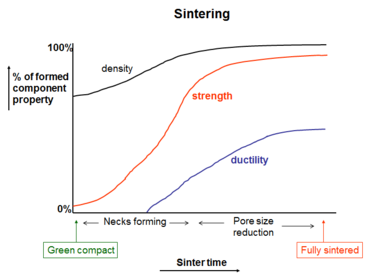
Temp sinter=70-90% melt. improve strength, ductility, density(remove pores). - 47Sinter graph
- 48post sinter operationsReduce porosity, increase strength:
-repressing
-forging
-infiltration by liquid metal
-impregnation with organic material
-heat treatment - 49HIP/CIP PMCIP-powder compaction all directions- no lube needed-high density
HIP-simultaneous sintering as well as removing porosity. - 50Other powder processes-Direct metal laser sintering
-powder forging
-powder rolling
-metal injection moulding - 51Machine surfaces-improve tolerances
improves surface finish
produces features- not easily cast
does produce waste
-labor expensive
tooling often inflexible
machine when, low No, mat cost low. - 52cutting speedhigher speed-better surface finsih
faster cutting=higher temps, increase tool wear, shorter tool life.
Aim for high cutting speed(highest operating temp)+longest tool life - 53Cutting tool materials1-Plain carbon steel/low alloy steel
2-HSS/powder processed HSS
3-Stellite-superseded by cemented carbide
4-cemented carbides-cermets/hard metal can PM cemented carbides
5-coated cemented carbide machine tools. - 54Plain carbon steel/low alloyplain carbon- water quench and temper-martensitic layer, Fe3C carbide precipitates=strength+hardness/
Low alloy-air quench-temper-martensite, Fe3C but without cracking= lower quench rate.
Fe3C carbides-coarsen-hardness only to 350C - 55HSS-most commoncasting, forming, HT get abrasive metal carbide precipitates in steel. Carbides= harder but less tought than Fe3c-stable to 650 C. machine 4Xfaster. cost more
- 56Powder HSShomogenous distribution of carbides-improve strength, toughness + tool life.
Pm- water atomisation, magnetic separation, HIPING - 57Stellitename for any alloy containing Co-50%, superseded by cemented carbides
- 58Cemented carbides"cermets-hardmetal"
Wc-tungsten carbide particle-hard
Co-Cobolt-matrix-toughness
no use Fe as binder- react with C from carbides-brittle Wc-V hard, good thermal shock resistance, disolves into work piece- Tac- lower dissolution rate - 59PM cemented carbidesPress Wc and Co- sinter 1600c-99.9% dense.
Very expensive- only make tip from PM carbide
can use up to 900C!! - 60Coated cemented carbide machine toolscoatings:
-hard at high temp
-tough impact resistant
-low friction
TiN-hard, low friction
AlsO3-wear resistant
TiC- binds with substrate-abrasive wear
Wc/Co- substrate-HSS coat normally only TiN
Informationen
- Beschreibung
- Karteikarten am Ohne Titel, erstellt von Tom Piggott am 17/01/2015.
- Erstellt von
- Tom Piggott
- Aufrufe
- 6
- Bewertung